Also known as
WOLFHOUND
User Contributed Collection
Documents and descriptions supplied by archive contributors. All submissions are reviewed in accordance with our Terms and Conditions.
No user-contributed documents have been approved for this vessel yet. Use the forms below to contribute images or documents relating to this vessel.

Help complete the archive
Do you have a photo of this vessel you can share?
Contribute photographs of WOLFHOUND to the archive for editorial review. Submissions remain private and will only be published following approval by an administrator.
How your photograph will be credited
Exterior · 1940 · Copyright © Example Contributor
Source: Copyright ownership confirmed at submission by Example Contributor.
This example uses the photograph group, year and copyright-holder name supplied in the form. Your own details will replace the example above when an approved image is published.
Already have an account? Log in before uploading to link new photographs immediately.
Help complete the archive
Contribute a document
Share documents or images relating to WOLFHOUND for editorial review. Upload up to 12 PDF, JPG, PNG or WebP files per submission, with a maximum size of 20 MB each. Your submission remains private and will only be published following approval by an administrator.
How your document will be credited
Example Document Title · Contributed by Example Contributor
Source: Archive reference supplied by Example Contributor.
This example uses the document title, contributor name and source or archive reference supplied in the form. Your own details will replace the example above when an approved document is published.
Wikipedia vessel details
Secondary-source table data; verify against primary records where available.
- Name
- HMS Wolfhound (D56)
- Pennant number
- D56
- Flag
- Royal Navy
- Description
- Destroyer
- Built
- 1918
- Tonnage
- 1,100
- Commanding officer
- Lt. Cdr. John Wentworth McCoy, RN
- Trips to Dunkirk
- 1
- Troops landed
- 142
- Notes
- Damaged by grounding in Dunkirk harbour on 27 May; left Dynamo for repair
Dunkirk-related passages from the linked page
Dunkirk 1940 HMS Wolfhound was one of 21 W-class destroyers built for the Royal Navy during the First World War. Completed in 1918 the ship only played a minor role in the war before its end. The ship was converted into an anti-aircraft escort destroyer during the Second World War and was badly damaged during the Dunkirk evacuation. Wolfhound survived the war and was sold for scrap in 1948. After the Second World War began in September 1939 she was one of the old V and W class ships to be selected to be converted to an anti-aircraft ("Wair") escort destroyer,[12] As the Allied forces retreated, Wolfhound was one of the ships detached to support the evacuation of troops from France, and on 25 May she and her sister HMS Wolsey bombarded advancing German units near Calais. The following day Wolfhound ferried a shore party to Dunkirk to coordinate the evacuation; on her return voyage to Dover she loaded 142 troops.[13] On 29 May she was badly damaged at Dunkirk by German bombers, having her back broken.[14] After lengthy repairs she returned to service. After VE Day she was detached to support the re-occupation of Norway. On 14 May she and Wolsey were deployed with Norwegian corvettes to cover minesweeping operations prior to the re-occupation of Bergen.[15] Winser, John de D. (1999). B.E.F. Ships Before, At and After Dunkirk. Gravesend, Kent: World Ship Society. ISBN 0-905617-91-6.
ORDE Registry
1 record1 potential matching record has been identified.
These records may contain vessel particulars, reported movements, participation assessments, named personnel and source references. A match does not by itself prove that the vessel participated in Operation Dynamo.
“Potential match” means a candidate returned by one or more indexing rules; it is not necessarily an exact identity match. Depending on the source, matching may use a normalised vessel name, a partial text or OCR hit, an alias, or related metadata. Roman-numeral suffixes such as I, II, III, IV and V may be absent, misread or separated from the base name, so records for similarly named vessels can be grouped incorrectly. Multi-word names can also produce candidates where only one significant word matches. Confirm the full name, numeral, vessel type, dimensions, builder, ownership, dates and source context before treating two records as the same vessel.
We are compiling and checking transcriptions, metadata, vessel-name matches, source references and reuse permissions before publishing further detail. This work helps prevent incomplete OCR, historic spelling variations or unverified associations from being presented as established fact.
Account registrations and access to these developing records are temporarily unavailable. Existing account holders may log in, and everyone can join the newsletter for publication updates.
Small Craft Service List
0 records0 potential matching records have currently been identified.
Further indexing may identify service-list entries, vessel metadata, source-page references and protected full-size document images. The absence of a current match does not establish that no relevant source exists.
We are compiling and checking transcriptions, metadata, vessel-name matches, source references and reuse permissions before publishing further detail. This work helps prevent incomplete OCR, historic spelling variations or unverified associations from being presented as established fact.
Account registrations and access to these developing records are temporarily unavailable. Existing account holders may log in, and everyone can join the newsletter for publication updates.
No Small Craft records.
Red List (1939–40) — OCR
0 records0 potential matching records have currently been identified.
Further indexing may identify OCR text matches, source files, page references and digitised page imagery. The absence of a current match does not establish that no relevant source exists.
We are compiling and checking transcriptions, metadata, vessel-name matches, source references and reuse permissions before publishing further detail. This work helps prevent incomplete OCR, historic spelling variations or unverified associations from being presented as established fact.
Account registrations and access to these developing records are temporarily unavailable. Existing account holders may log in, and everyone can join the newsletter for publication updates.
Ship Details
These details have been aggregated from multiple sources and may include contemporary records, later recollections, claims or assertions for which no corroborating evidence has been identified. Inclusion does not establish that any account or assertion is accurate. The information may be incomplete, out of date, disputed or incorrect and should be checked against the underlying source records and independent evidence before being relied upon.
No additional ship details available.
Lloyd’s Yacht Register (1939)
Source: Lloyd’s Register Foundation, Heritage & Education Centre, Lloyd’s Register of Yachts 1939, digitised via Internet Archive. Licensed under CC BY-NC-SA 4.0. Images have been converted, resized and watermarked for web display; machine-generated table OCR has been added.
No Lloyd’s records.
Document Collections — Tagged Pages
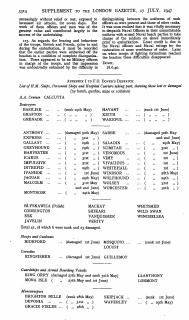
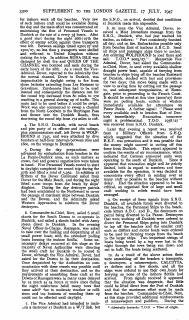
2 pagesImaged document collections containing pages whose OCR text or table data has been tagged with the name WOLFHOUND. Open a collection to view the page images and transcriptions.
Details
33^4          SUPPLEMENT TO THE LONDON GAZETTE, 17 JULY, 1947
unceasingly without relief or rest, exposed to         distinguishing between the uniforms of such
incessant air attacks, for seven days. The             officers as were present and those of other ranks.
work of these officers and men was of the              It was soon realised that it was vitally necessary
greatest value and contributed largely to the          to despatch Naval Officers in their unmistakable
success of the undertaking.                            uniform with armed Naval beach parties to take
                                                       charge of the soldiers on shore immediately
   113. As regards the bearing and behaviour           prior to embarkation. Great credit is due to
of the troops, British and French, prior to and        the Naval officers and Naval ratings for the
during the embarkation, it must be recorded            restoration of some semblance of order. Later
that the earlier parties were embarked off the         on when troops of fighting formations reached
beaches in a condition of complete disorganisa-        the beaches these difficulties disappeared.
tion. There appeared to be no Military officers
in charge of the troops, and this impression           Dover,
was undoubtedly enhanced by the difficulty in             18.6.40.


                             APPENDIX I TO F.O. DOVER'S DESPATCH
List of H.M. Ships, Personnel Ships and Hospital Carriers taking part, showing those lost or damaged
                               (by bomb, gunfire, mine or collision)
A.A. Cruiser CALCUTTA
Destroyers
  BASILISK                    (sunk 2gth May)          HAVANT                    (sunk ist June)
  GRAFTON                     ( „ „       „ )          KEITH                     ( „ „ „ )
  GRENADE                                              WAKEFUL


  ANTHONY ...                 (damaged soth May) SABRE                           (damaged 30th May
  EXPRESS ...                 (    >?   jISl    ,, )                                    and 2nd June)
  GALLANT ...                 (         29th   „ ) SALADIN ...                   (   „     29th May)
  GREYHOUND                   (    „    29th „ ) SCIMITAR ...                     (   „ 3ist „ )
  HARVESTER                   (         3ist „ ) VENOMOUS                         (   „     ist June)
  ICARUS                      (         3ist „ ) VIMY                             (   „     ist „ )
  IMPULSIVE                   (         3ist „ ) VIVACIOUS ...                    (   „     ist „ )
  INTREPID ...                (         29th „ ) WHITEHALL                        (   „     ist „ )
  IVANHOE ...                 (    „     ist June) WINDSOR ...                    (   „ 28th May)
  JAGUAR                      (    „    2gth May) WOLFHOUND                       (   „ 29th „ )
  MALCOLM ...                 (    „    3ist May WOLSEY     ...
                                    and 2nd June) WORCESTER                                 30th    „
   MONTROSE                    (   ,, 29th May)


   BLYSKAWICA (Polish)                  MACKAY                               WHITSHED
   CODRINGTON                           SHIKARI                              WILD SWAN
   ESK                                  VANQUISHER                           WINCHELSEA
   JAVELIN                               VERITY
 Total 41, of which 6 were sunk and 23 damaged.

 Sloops and Gunboats
   BIDEFORD             ...    (damaged ist June) MOSQUITO ..                     (sunk ist June)
                                                  LOCUST
 Corvettes
   KINGFISHER           ...    (damaged ist June) GUILLEMOT


 Guardships and Armed Boarding Vessels
   KING ORRY (damaged 27th May and sunk 30th May)                            LLANTHONY
   MONA ISLE (        „ 27th May and ist June)                               LORMONT

 Minesweepers
   BRIGHTON BELLE              (sunk 28th May)          SKIPJACK .                (sunk ist June)
  DEVONIA                      ( „ 3Ist „ )             WAVERLEY                  ( „ 29th May)
   GRACIE FIELDS ...           ( „ 28th „ )
Details
3300           SUPPLEMENT TO THE LONDON GAZETTE, 17 JULY, 1947
for inshore work off the beaches. Very few the S.N.O., on arrival, decided that conditions
of such inshore craft could be available during at Dunkirk made this impossible.
the day and the main effort was concentrated on        8. At 2025 -the Vice Admiral, Dover, re-
maintaining the flow of Personnel Vessels to ceived a Most Immediate message from the
Dunkirk at the rate of 2 every 3^ hours. After S.N.O., Dunkirk, who had just reached his
a good start during the night 26th/27th the station, as follows: '' Port consistently 'bombed
effect of enemy action against these transports all day, and on fire. Embarkation possible only
was felt. Between sailings timed 0300/27 and from beaches East of harbour A.B.C.D. Send
 1500/27, no less than 5 transports were shelled all ships and passenger ships there to anchor.
 and returned to United Kingdom without Am ordering WOLFHOUND to load there and
 making the trip. In addition MONA ISLE was sail.             T.O.O.* 2005/27."           Meanwhile Vice
 damaged by shell fire and QUEEN OF THE Admiral, Dover, had asked the Commander-
 CHANNEL was bombed and sank during the in-Chief, Nore, to send every available shallow
 early hours of the 28th. As a result the Vice- draught power 'boat, capable of ferrying from
 Admiral, Dover, reported to the Admiralty that beaches to ships lying off the beaches Eastward
 the normal channel, Dover to Dunkirk, was of Dunkirk, stocked with fuel and provisions
 impracticable in daylight owing to fire from for two days; this move 'being made with a
 shore batteries extending from Les Hemmes to view to saving time by cutting out the passage
 Gravelines. Zuydecoote Pass had to be used to, and subsequent reorganisation, at Rams-
 instead and consequently the distance run for gate, prior to proceeding to the French Coast.
 the round trip increased from 80 miles to 172 It should be noted at this time (2000^/27) there
 resulting in a general slowing up of traffic. This were no pulling boats, cutters or whalers
 route had to be used before it could be swept. immediately available for attendance on
 Work was also commenced to sweep a channel Power Boats. A further signal: " Please send
 from the North Goodwin to the Ruytingen Pass every available craft to beaches East of Dun-
 and thence into the Dunkirk Roads, thus kirk immediately.                       Evacuation tomorrow
 shortening the round trip from 172 miles to 108. night is problematical. T.O.O. 1958/27 "
     4. The S.N.O. Dunkirk, with naval beach was received from S.N.O. Dunkirk.
 and pier party of 12 officers and 160 ratings,         Later that evening a report was received
 plus communication staff, left Dover in WOLF- from 2 Military Officers from G.H.Q.
 HOUND at 1345, and were attacked by dive which suggested that the situation of the
 bombers at half-hour intervals between 1600 and B.E.F. was precarious and it was possible that
 1800, on the voyage to Dunkirk.                    the enemy might succeed in cutting off this
     5. During the day preparations were force from Dunkirk. This report appeared to
 advanced for embarkation from beaches in the confirm the results of air reconnaissance, which
 La Panne-Dunkirk area, as such matters as indicated that German armoured units were
 crews, fuel and general organisation were taken operating to the south of Dunkirk.                  Since it
 in hand. Five Personnel Vessels routed to start appeared that evacuation might well be strictly
 in daylight completed the round trip during the limited, both in regard to numbers and time
,?7th and lifted a total of 3,952. In addition 17 available for the operation, it was decided to
^drifters of the Dover Command sailed from concentrate every effort in sending over as
 Dover for the Malo Beach, and during the night many craft as possible to the beaches without
 lifted 2,000 troops from the beach by ships' delay. Had the situation appeared to be less
  dinghies.     During the day destroyer patrols critical, an organised flow of large and small
  had been established to the Northward to cover craft working in reliefs would have been
  the passage of merchant ships between Dunkirk arranged.
  and the Downs, and the Admiralty asked                9. On receipt of these signals from S.N.O.
  Western Approaches to reinforce the Dover Dunkirk, all available forces were diverted to
  destroyers.                                        the beaches, the Personnel Ships to the beach,
     6. Commander-in-Chief, Nore, sailed 6 small    code    letters A.B.C. and D., the destroyers on
  skoots for the South Downs to co-operate in        patrol   'being diverted to La Panne. Destroyers
  Dunkirk, and sailed 4 skoots loaded with Army      that   were  working off Dunkirk were ordered to
  stores direct to Dunkirk.       In the evening to lay off Personnel
                                                     divert   the
                                                                     the
                                                                                Ships going into Dunkirk
                                                                          beaches   and the smaller craft
  Naval Officer-in-Charge, Ramsgate, was asked such as drifters and motor              boats were ordered
  to take over the fuelling and despatching of all to foe used for ferrying troops         from the beach
  small power boats with the attendant pulling to the larger ships. Two important                  strings of
  boats forming the inshore flotilla. Some un-
                                                     boats    being    towed  by  a  tug
  necessary delays occurred at this stage as the night through the tows 'being run down   were   lost  in the
  majority of Naval Authorities were directing                                                            and
  the small craft for Dunkirk to be routed to         cut  in  half,  the  boats being   scattered.
  Dover, although the Vice Admiral, Dover, had          10. As a result of the above action there
   asked for the Downs to be their destination. were assembling off the beaches 2 transports,
   Once despatched 'by the Authorities no com- 9 destroyers, 4 minesweepers, CALCUTTA,
  munication with these vessels was possible until 17 drifters and a few skoots, and all the
   they arrived at their destination, and so the ships were ordered to use their own .boats for
   requirements of assembling these craft at the ferrying as none of the inshore flotilla had
   Downs or Ramsgate were in many cases delayed arrived.             From signals received it appeared
   by as much as 24 hours or more since during that the situation was desperate, that little
  the night misfortune befell many tows that could be lifted direct from the Port of Dunkirk
   came adrif- ^.ue to moderate weather or colli- and that -the maximum effort must be made
   sions and tne business of rounding them up from the beaches. Commander-in-Chief, Nore,
   could not be effected until daylight.              at this stage provided additional reinforcements
                                                      of minesweepers and paddlers. During the
      7. The Vice Admiral had intended to main-
   «.«m a destroyer at Dunkirk as a W/T link, but       * Admiralty footnote: T.O.O. = Time of origin.
Operation Dynamo Map — Movement Logs
Movements recorded for WOLFHOUND during the evacuation period, as plotted on the Operation Dynamo map.
| Departed | Route | Arrived | Troops | Notes | Source |
|---|---|---|---|---|---|
| — | Dunkirk | — | — |
Stationary
Location recorded; complete dated movement unavailable
|
NMM 940.542.1 1940 Orde vol iii, page 347 |
Log in to suggest an evidence-backed edit or a new movement log.