Also known as
HARVESTER
User Contributed Collection
Documents and descriptions supplied by archive contributors. All submissions are reviewed in accordance with our Terms and Conditions.
No user-contributed documents have been approved for this vessel yet. Use the forms below to contribute images or documents relating to this vessel.

Help complete the archive
Do you have a photo of this vessel you can share?
Contribute photographs of HARVESTER to the archive for editorial review. Submissions remain private and will only be published following approval by an administrator.
How your photograph will be credited
Exterior · 1940 · Copyright © Example Contributor
Source: Copyright ownership confirmed at submission by Example Contributor.
This example uses the photograph group, year and copyright-holder name supplied in the form. Your own details will replace the example above when an approved image is published.
Already have an account? Log in before uploading to link new photographs immediately.

Help complete the archive
Contribute a document
Share documents or images relating to HARVESTER for editorial review. Upload up to 12 PDF, JPG, PNG or WebP files per submission, with a maximum size of 20 MB each. Your submission remains private and will only be published following approval by an administrator.
How your document will be credited
Example Document Title · Contributed by Example Contributor
Source: Archive reference supplied by Example Contributor.
This example uses the document title, contributor name and source or archive reference supplied in the form. Your own details will replace the example above when an approved document is published.
Wikipedia vessel details
Secondary-source table data; verify against primary records where available.
- Name
- HMS Harvester (H19)
- Pennant number
- H19
- Flag
- Royal Navy
- Description
- Destroyer
- Built
- 1940
- Tonnage
- 1,400
- Commanding officer
- Lt. Cdr. Mark Thornton, RN
- Trips to Dunkirk
- 4
- Troops landed
- 2,189
- Notes
- Only commissioned on 23 May, cut short trials to join Dynamo
Dunkirk-related passages from the linked page
HMS Harvester was an H-class destroyer originally ordered by the Brazilian Navy with the name Jurua in the late 1930s, but bought by the Royal Navy after the beginning of World War II in September 1939. Almost immediately after being commissioned, in May 1940, the ship began evacuating Allied troops from Dunkirk and other locations in France. Afterwards she was assigned to the Western Approaches Command for convoy escort duties. Harvester and another destroyer sank a German submarine in October. She was briefly assigned to Force H in May 1941, but her anti-aircraft armament was deemed too weak and she was transferred to the Newfoundland Escort Force in June 1941 for escort duties in the North Atlantic. The ship was returned to the Western Approaches Command in October 1941 and was converted to an escort destroyer in early 1942. Harvester was torpedoed and sunk in March 1943 by a German submarine after having rammed and sunk another submarine the previous day while escorting Convoy HX 228. Harvester had her rear torpedo tubes replaced by a 12-pounder AA gun after the evacuation of Dunkirk in 1940, but it is not known exactly when this modification was made. During her 1942 conversion to an escort destroyer, the ship's short-range AA armament had been augmented by two Oerlikon 20 mm guns on the wings of the ship's bridge. The .50-calibre machine gun mounts were replaced by a pair of Oerlikons later. 'A' gun was replaced by a Hedgehog anti-submarine spigot mortar. The ship's director-control tower and rangefinder above the bridge were removed in exchange for a Type 271 target indication radar. A Type 286 short-range surface search radar was probably also fitted midway through the war. The ship also received a HF/DF radio direction finder mounted on a pole mainmast.[3] Jurua was ordered by Brazil on 6 December 1937 from Vickers-Armstrongs, Barrow-in-Furness. The ship was laid down on 3 June 1938 and she was purchased by the British on 5 September 1939 and renamed HMS Handy. The ship was launched on 29 September 1939 and renamed Harvester in January 1940 as her original name was thought too liable to be confused with Hardy. Harvester was commissioned on 23 May and briefly worked up at Portland Harbour before she was assigned to the 9th Destroyer Flotilla.[6] The ship joined the Dunkirk evacuation on 29 May and returned 272 men to Dover during the day. However, the situation at Dunkirk soon became too dangerous to risk the larger and more modern destroyers, so Harvester made no attempt to evacuate any troops during daylight hours on 30 May. This decision was rescinded during the day on 30 May and the ship sailed for Dunkirk on the night of 30/31 May. En route she was narrowly missed by two torpedoes, but she rescued 1341 men in two trips on 31 May and an additional 576 on 1 June.[7] Harvester was lightly damaged by strafing German aircraft that same day and required repairs that were made at Chatham. On 9 June the ship was ordered to Le Havre, France, to evacuate British troops, but none were to be found. She loaded 78 men at Saint-Valery-en-Caux on 11 June. Later in the month she escorted ships evacuating refugees and troops from Saint-Nazaire and St. Jean de Luz (Operation Aerial).[8] Winser, John de D (1999). B.E.F. Ships Before, At and After Dunkirk. Gravesend: World Ship Society. ISBN 0-905617-91-6.
ORDE Registry
6 records6 potential matching records have been identified.
These records may contain vessel particulars, reported movements, participation assessments, named personnel and source references. A match does not by itself prove that the vessel participated in Operation Dynamo.
“Potential match” means a candidate returned by one or more indexing rules; it is not necessarily an exact identity match. Depending on the source, matching may use a normalised vessel name, a partial text or OCR hit, an alias, or related metadata. Roman-numeral suffixes such as I, II, III, IV and V may be absent, misread or separated from the base name, so records for similarly named vessels can be grouped incorrectly. Multi-word names can also produce candidates where only one significant word matches. Confirm the full name, numeral, vessel type, dimensions, builder, ownership, dates and source context before treating two records as the same vessel.
We are compiling and checking transcriptions, metadata, vessel-name matches, source references and reuse permissions before publishing further detail. This work helps prevent incomplete OCR, historic spelling variations or unverified associations from being presented as established fact.
Account registrations and access to these developing records are temporarily unavailable. Existing account holders may log in, and everyone can join the newsletter for publication updates.
Small Craft Service List
0 records0 potential matching records have currently been identified.
Further indexing may identify service-list entries, vessel metadata, source-page references and protected full-size document images. The absence of a current match does not establish that no relevant source exists.
We are compiling and checking transcriptions, metadata, vessel-name matches, source references and reuse permissions before publishing further detail. This work helps prevent incomplete OCR, historic spelling variations or unverified associations from being presented as established fact.
Account registrations and access to these developing records are temporarily unavailable. Existing account holders may log in, and everyone can join the newsletter for publication updates.
No Small Craft records.
Red List (1939–40) — OCR
0 records0 potential matching records have currently been identified.
Further indexing may identify OCR text matches, source files, page references and digitised page imagery. The absence of a current match does not establish that no relevant source exists.
We are compiling and checking transcriptions, metadata, vessel-name matches, source references and reuse permissions before publishing further detail. This work helps prevent incomplete OCR, historic spelling variations or unverified associations from being presented as established fact.
Account registrations and access to these developing records are temporarily unavailable. Existing account holders may log in, and everyone can join the newsletter for publication updates.
Ship Details
These details have been aggregated from multiple sources and may include contemporary records, later recollections, claims or assertions for which no corroborating evidence has been identified. Inclusion does not establish that any account or assertion is accurate. The information may be incomplete, out of date, disputed or incorrect and should be checked against the underlying source records and independent evidence before being relied upon.
No additional ship details available.
Lloyd’s Yacht Register (1939)
Source: Lloyd’s Register Foundation, Heritage & Education Centre, Lloyd’s Register of Yachts 1939, digitised via Internet Archive. Licensed under CC BY-NC-SA 4.0. Images have been converted, resized and watermarked for web display; machine-generated table OCR has been added.
No Lloyd’s records.
Document Collections — Tagged Pages
4 pagesImaged document collections containing pages whose OCR text or table data has been tagged with the name HARVESTER. Open a collection to view the page images and transcriptions.
Source: Lloyd’s Register Foundation, Heritage & Education Centre, Lloyd’s Register of Yachts 1939, digitised via Internet Archive. Licensed under CC BY-NC-SA 4.0. Images have been converted, resized and watermarked for web display; machine-generated table OCR has been added.

Details
| Pet.Mot. | 8 | 4Cy.150mm.-94mm. International Harvester |
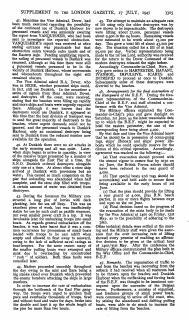
Details
SUPPLEMENT TO THE LONDON GAZETTE, 17 JULY, 1947                                            3305
    41. Meantime the Vice Admiral, Dover, had           45. The attempt to maintain an adequate rate
been much exercised regarding the possibility       of lift using only the older destroyers was by
of the continued use of Dunkirk Harbour for         now shown to be impracticable. The destroyers
personnel vessels and" was anxiously awaiting       were lifting about 17,000, personnel vessels
the report from VANQUISHER, who had been            about 9,500 in the 24 hours. Remaining vessels
sent to investigate the reported obstruction.       were estimated to be worth about 15,000 per
VANQUISHER'S report was received at 0610            day. This gave a total lift of about 43,000 per
stating entrance was practicable but that           day. The situation called for a lift of at least
obstruction exists towards outer inside end of      55,000 per day. Verbal representations being
the Eastern Arpi. Pending amplifying reports,       made to the ist Sea Lord, authority was received
the sailing of personnel vessels to Dunkirk was     for the return to the Dover Command of the
resumed, although at this time there were still     modern destroyers released the night before.
4 personnel vessels presumed to be in the               Accordingly Commander-in-Chief, Nore, at
vicinity of Dunkirk Harbour, whose movements        1531 gave orders to HARVESTER, HAVANT,
and whereabouts throughout the night still          IVANHOE, IMPULSIVE,               ICARUS and
remained obscure.                                   INTREPID to proceed at once to Dunkirk.
    The Vice Admiral asked R.A. Dover, who          Subsequently some of these destroyers were
was in HEBE, whether personnel ships could,         diverted to the beaches.
in fact, still use Dunkirk. In -the meantime a         46. Arrangements for the final evacuation of
series of signals from Rear Admiral, Dover,         the Rearguard of the B.E.F. During the fore-
and destroyers off the coast, were received,        noon representatives of the Commander-in-
stating that the beaches were filling up rapidly    Chief of the B.E.F. and staff attended a con-
and more ships and boats were urgently required     ference with the Vice Admiral.
there. Although it was known that the                  The Military officers explained the Com-
destroyers could use Dunkirk, it appeared at        mander-in-Chief's plan and gave daylight on
this time that the best division of transport was   Saturday, ist June, as the latest reasonable date
to send the great majority of destroyers to the     up to which the B.E.F. might be expected to
beaches, where urgent demands could not be          hold the eastern perimeter, the size of the
ignored, and the personnel vessels to Dunkirk       corresponding force being about 4,000.
Harbour, only an occasional destroyer being            'By that date and time the Vice Admiral knew
sent to Dunkirk from the reduced number now         that he should foe in possession of ocean-going
available for the operation.
                                                    tugs, -ships' lifeboats and ships' power life-
    42. At Dunkirk there were no air attacks in     boats which he could specially reserve for the
the early morning and all was quiet. Later,         climax of this critical operation. Accordingly,
when ships began to arrive in quantity, in view     agreement was reached on the following:—
of the massive target presented by a number of             (a) That evacuation should proceed with
ships alongside the East Pier at a time, the            the utmost vigour to ensure that by 0130 on
S.N.O. Dunkirk ordered destroyers alongside             ist June, the British Forces ashore should
only one at a time. At about 0800 a store ship          (have been reduced to the rear guard of
arrived at Dunkirk with provisions but no               4,000.
water ^ This caused so much congestion on the              (b) That special boats and tugs should be
pier that unloading was abandoned when half             accumulated and held aside to ensure them
complete, and the store ship filled with troops.        being available in the early hours of ist
A certain amount of water was obtained from             June.
destroyers.                                                (c) That the plan should provide for lifting
    43. During the forenoon the Military con-           a rear guard of 4,000, plus R.N. beach
structed a long pier of lorries with deck               (parties, in one or more flights between 0130
planking, into the sea off Bray. This was an            and 0300 on the ist June.
 excellent piece of work, but was insufficiently           (d) Final decision based on the progress of
 stable for use by such craft as paddle steamers,       the evacuation of the main body to be made
 nor even smaller, power craft in a lop. It was         •by the Vice Admiral at 1400 on Friday, 3ist
 invaluable later for embarking troops into small       'May, as to the possibility of adhering to the
 boats. As regards general embarkation off the          plan.
 beaches, it was later learnt that it was a com-    Other technical details were settled at the meet-
 mon occurrence for processions of small boats      ing and the Military staff were given the assur-
 loaded with troops to be cast adrift when           ance that the ever increasing rate of lifting
 empty and allowed to float away to seaward,         showed every promise of enabling an affirma-
 owing to the lack of sufficient naval ratings as    tive decision to foe given at the critical hour
 boat-keepers. For the same reason many of           of i4oo/3fist May. After the conference the
 the smaller pulling boats were swamped and          Military officers communicated the plan both to
 sunk due to overloading by uncontrolled             the War Office and the Commander-in-Chief,
  " rush " of soldiers. Both these faults were       B.E.F.
 remedied later.                                        47. Remarks. The organisation of traffic to
    44. Matters proceeded smoothly throughout        and from the beaches was recovering from the
 the day owing to the mist and there being a         setback it had received when all resources had
 big smoke cloud over Dunkirk which prevented        to be thrown upon the beaches and Dunkirk
  the enemy bombers attacking the ships in large     Harbour when the outflanking and forcing back
 numbers.                                            of the B.E.F. was thought to foe imminent con-
    In order to increase the rate of embarkation     sequent upon the surrender of the Belgian
 through the bottleneck of the East Pier gang-       forces. Furthermore, a number of organised,
 way, the troops were urged to quicken their         and freelance groups of small power boats,
 pace and eventually thousands of troops, tired      were commencing to arrive off the coast, who,
 and without food and water for days, broke into     by seizing the abandoned and drifting pulling
 the double and kept it up the whole length of       boats, were able to do much to increase the
 the pier for more than two hours.                   rate of lifting from the beaches.
Details
33^4          SUPPLEMENT TO THE LONDON GAZETTE, 17 JULY, 1947
unceasingly without relief or rest, exposed to         distinguishing between the uniforms of such
incessant air attacks, for seven days. The             officers as were present and those of other ranks.
work of these officers and men was of the              It was soon realised that it was vitally necessary
greatest value and contributed largely to the          to despatch Naval Officers in their unmistakable
success of the undertaking.                            uniform with armed Naval beach parties to take
                                                       charge of the soldiers on shore immediately
   113. As regards the bearing and behaviour           prior to embarkation. Great credit is due to
of the troops, British and French, prior to and        the Naval officers and Naval ratings for the
during the embarkation, it must be recorded            restoration of some semblance of order. Later
that the earlier parties were embarked off the         on when troops of fighting formations reached
beaches in a condition of complete disorganisa-        the beaches these difficulties disappeared.
tion. There appeared to be no Military officers
in charge of the troops, and this impression           Dover,
was undoubtedly enhanced by the difficulty in             18.6.40.


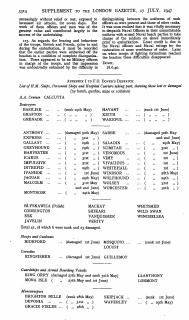
                             APPENDIX I TO F.O. DOVER'S DESPATCH
List of H.M. Ships, Personnel Ships and Hospital Carriers taking part, showing those lost or damaged
                               (by bomb, gunfire, mine or collision)
A.A. Cruiser CALCUTTA
Destroyers
  BASILISK                    (sunk 2gth May)          HAVANT                    (sunk ist June)
  GRAFTON                     ( „ „       „ )          KEITH                     ( „ „ „ )
  GRENADE                                              WAKEFUL


  ANTHONY ...                 (damaged soth May) SABRE                           (damaged 30th May
  EXPRESS ...                 (    >?   jISl    ,, )                                    and 2nd June)
  GALLANT ...                 (         29th   „ ) SALADIN ...                   (   „     29th May)
  GREYHOUND                   (    „    29th „ ) SCIMITAR ...                     (   „ 3ist „ )
  HARVESTER                   (         3ist „ ) VENOMOUS                         (   „     ist June)
  ICARUS                      (         3ist „ ) VIMY                             (   „     ist „ )
  IMPULSIVE                   (         3ist „ ) VIVACIOUS ...                    (   „     ist „ )
  INTREPID ...                (         29th „ ) WHITEHALL                        (   „     ist „ )
  IVANHOE ...                 (    „     ist June) WINDSOR ...                    (   „ 28th May)
  JAGUAR                      (    „    2gth May) WOLFHOUND                       (   „ 29th „ )
  MALCOLM ...                 (    „    3ist May WOLSEY     ...
                                    and 2nd June) WORCESTER                                 30th    „
   MONTROSE                    (   ,, 29th May)


   BLYSKAWICA (Polish)                  MACKAY                               WHITSHED
   CODRINGTON                           SHIKARI                              WILD SWAN
   ESK                                  VANQUISHER                           WINCHELSEA
   JAVELIN                               VERITY
 Total 41, of which 6 were sunk and 23 damaged.

 Sloops and Gunboats
   BIDEFORD             ...    (damaged ist June) MOSQUITO ..                     (sunk ist June)
                                                  LOCUST
 Corvettes
   KINGFISHER           ...    (damaged ist June) GUILLEMOT


 Guardships and Armed Boarding Vessels
   KING ORRY (damaged 27th May and sunk 30th May)                            LLANTHONY
   MONA ISLE (        „ 27th May and ist June)                               LORMONT

 Minesweepers
   BRIGHTON BELLE              (sunk 28th May)          SKIPJACK .                (sunk ist June)
  DEVONIA                      ( „ 3Ist „ )             WAVERLEY                  ( „ 29th May)
   GRACIE FIELDS ...           ( „ 28th „ )
Details
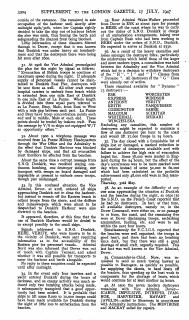
3304          SUPPLEMENT TO THE LONDON GAZETTE, 17 JULY, 1947
outside of the entrance. She remained in sole          35. Rear Admiral Wake-Walker proceeded
occupation of the harbour until shortly after       from Dover in ESK at about 1900 for passage
midnight 2Qth/30th, when her Captain rightly        to HEBE off the coast where he was to carry
decided to take the ship out of harbour before      out the duties of S.N.O. Dunkirk in charge
she also was sunk, thus freeing the berth and       of all embarkation arrangements, taking over
safeguarding the channel from 'being blocked.       from Captain Bush who had been working in
   Little information of these disasters filtered   HEBE under the orders of S.N.O., Dunkirk.
through to Dover, except that it was known          He expected to arrive at Dunkirk at 2330.
that Dunkirk was under heavy air bombard-              36. As a result of the heavy casualties and
ment and that the destroyers there were being       losses amongst the destroyer force, particularly
hit soon after 1600.                                the misfortunes which befell those of the larger
   31. At 1906 the Vice Admiral promulgated         and more modern types, a consultation was held
the plan for 'the night by signal as follows:       between the Admiralty and the Vice Admiral
                                                    which led to a decision to withdraw destroyers
" Evacuation of British troops to continue at       of the " H ", " I " and " J " Classes from
maximum speed during the night. If adequate          " Dynamo ". All destroyers of the " G " Class
supply of personnel vessels cannot be main-         were already out of action.
tained to Dunkirk East Pier, destroyers will
be sent there as well. All other craft except          There remained available for " Dynamo "
hospital carriers to embark from beach which        15 destroyers: —
is extended from one mile East of Dunkirk                 ESK                   WORCESTER
to one mile East of La Panne. Whole length               EXPRESS                WINDSOR
is divided into three equal parts referred to            ANTHONY                 VERITY
as La Panne, Bray, Malo, from East to West                KEITH                 VANQUISHER
with a mile gap between each part. La Panne               CODRINGTON            SABRE
and Bray have troop concentration points each             MALCOLM                SCIMITAR
end and in middle, Malo at each end. These                WHITEHALL              SHIKARI
points should be tended by inshore craft. Pass            WINCHELSEA
the message by V/S to ships not equipped W/T        Excluding any casualties, this number of
as .opportunity offers."                             destroyers might be expected to maintain a
                                                    flow of one destroyer per hour to the coast
   32. About 1900 a telephone message was           and would lift 17,000 troops in 24 hours.
received from La Panne Military Headquarters           37. The day closed with a formidable list of
through the War Office and the Admiralty to         ships lost or damaged, a marked reduction in
the effect that Dunkirk Harbour was blocked         the number of destroyers available and with
by damaged ships, and that all evacuation           failure to achieve the high rate of evacuation
must therefore be effected from the beaches.        hoped for. Some 38,000 were landed in Eng-
   About the same time a corrupt message from       land during the 24 hours, but the effect of the
 S.N.G. Dunkirk;, was receded stating con-          day's occurrences was to be more marked next
tinuous bombing, one destroyer sinking, one         day when instead of some 50,000 to 60,000
transport with troops on board damaged and          which had been calculated as the probable
impossible at present to embark- more troops,       achievement only 48,000 odd were in fac^ trans-
though pier undamaged.                              ported.
                                                    Thursday, ^oth May.
   33. In this confused situation the Vice
Admiral, Dover, at 2128, ordered all ships             38. As an example of the difficulty of any
approaching Dunkirk not to close the harbour,       one man appreciating the situation at Dunkirk
but instead to remain off the Eastern beach to      and the beaches during the night, at 0300/30
collect troops from the shore, and 'the drifters    the S.N.O. on the French Coast reported that
and minesweepers which were about to be             he had no destroyers. In fact, at that time,
despatched to Dunkirk Harbour were also             all available destroyers, namely 10, in the
diverted to the beaches.                            Dover Command, were either on, or on passage
                                                    to or from, the coast, and the remaining five
   It appeared, therefore, at this time that the    were at Dover discharging troops, embarking
use of Dunkirk Harbour would be denied to           ammunition, fuelling, etc. and were to sail
us except possibly to the small ships.              within the next four hours.
   Signals addressed to S.N.O. Dunkirk,                Simultaneously the V.C.I.G.S. reported that
HEBE, VERITY, who were known to be in               the beaches were well organised, the troops in
the vicinity of Dunkirk, „ were sent requiring      good heart, and there had been no bombing
information as to the accessibility of the          since dark, but that there was still a great
Eastern pier for personnel vessels. Admiral         shortage of small craft, urgently required. This
Nord was also informed that Dover was out           last fact was well known to the Vice Admiral,
of touch with Captain Tennant, and asked            Dover.
whether it was still possible for transports to        39. Commander-in-Chief, • Nore, was re-
enter the harbour and berth alongside.               quested to send as much towing hawser as
   No reply to these enquiries could be expected    possible to Ramsgate, as quickly as possible,
until after midnight.                               for supplying the skopts, to haul boats off
   34. In the event only four trawlers and a        the beaches, thus speeding up the boat work to
yacht entered Dunkirk during the hours of           compensate for the shortage of boats, which
darkness, and as enemy activity was much re-        would continue for at least another 24 hours.
duced only two bombing attacks being made,             40. At 0500 the seven modern destroyers
it subsequently transpired that a good oppor-       remaining with Vice Admiral, Dover—
tunity had been missed. It is probable that         ICARUS, IMPULSIVE, INTREPID, IVAN-
ships to lift some 8,000 to 10,000 troops could     HOE,       HARVESTER,          HAVANT       and
have been made available for Dunkirk during         JAVELIN—sailed to Sheerness in accordance
the night at little loss to embarkation from the    with Admiralty instructions. The MONTROSE
beaches.                                            and MACKAY sailed for repairs.
Operation Dynamo Map — Movement Logs
Movements recorded for HARVESTER during the evacuation period, as plotted on the Operation Dynamo map.
| Departed | Route | Arrived | Troops | Notes | Source |
|---|---|---|---|---|---|
| — | Dover | — | — |
Stationary
HMS report explicitly names this location; a complete dated movement is unavailable
|
TNA ADM 116 4649, page 51 |
Log in to suggest an evidence-backed edit or a new movement log.