Also known as
EXPRESS
User Contributed Collection
Documents and descriptions supplied by archive contributors. All submissions are reviewed in accordance with our Terms and Conditions.
No user-contributed documents have been approved for this vessel yet. Use the forms below to contribute images or documents relating to this vessel.

Help complete the archive
Do you have a photo of this vessel you can share?
Contribute photographs of EXPRESS to the archive for editorial review. Submissions remain private and will only be published following approval by an administrator.
How your photograph will be credited
Exterior · 1940 · Copyright © Example Contributor
Source: Copyright ownership confirmed at submission by Example Contributor.
This example uses the photograph group, year and copyright-holder name supplied in the form. Your own details will replace the example above when an approved image is published.
Already have an account? Log in before uploading to link new photographs immediately.

Help complete the archive
Contribute a document
Share documents or images relating to EXPRESS for editorial review. Upload up to 12 PDF, JPG, PNG or WebP files per submission, with a maximum size of 20 MB each. Your submission remains private and will only be published following approval by an administrator.
How your document will be credited
Example Document Title · Contributed by Example Contributor
Source: Archive reference supplied by Example Contributor.
This example uses the document title, contributor name and source or archive reference supplied in the form. Your own details will replace the example above when an approved document is published.
Wikipedia vessel details
Secondary-source table data; verify against primary records where available.
- Name
- HMS Express (H61)
- Pennant number
- H61
- Flag
- Royal Navy
- Description
- Destroyer
- Built
- 1934
- Tonnage
- 1,375
- Commanding officer
- Capt. (D) Jack Grant Bickford, RN
- Trips to Dunkirk
- 6
- Troops landed
- 3,491
- Notes
- Damaged by air attack off Bray on 31 May; repaired after Dynamo
Dunkirk-related passages from the linked page
Express spent most of the first year of World War II laying minefields in British, Dutch and German waters. She participated in the evacuation of Allied soldiers from Dunkirk in May–June 1940, but resumed minelaying afterwards. The ship was one of five British destroyers that inadvertently entered a German minefield off the Dutch coast a few months later, leading to the sinking of two destroyers and Express having her bow blown off, incapacitating her for over a year of repairs. Two months after returning to duty, Express escorted the battleship Prince of Wales and the battlecruiser Repulse (Force Z) to Singapore in late 1941, in an unsuccessful attempt to deter Japanese aggression against British possessions in the Far East. She escorted the capital ships in an attempt to intercept landings in British Malaya in December and rescued their survivors after they were sunk by Japanese bombers. Express was then assigned convoy escort duties in and around Singapore and the Dutch East Indies under the control of American-British-Dutch-Australian Command (ABDACOM) as the Japanese advanced. She escaped from the East Indies and rejoined the main body of the Eastern Fleet in the Indian Ocean. The ship played a minor role in Battle of Madagascar as she screened an aircraft carrier during the late stages of the campaign in 1942. Express, the eighth ship of that name to serve with the Royal Navy,[6] was ordered 1 November 1932, from Swan Hunter & Wigham Richardson at Wallsend under the 1931 Naval Programme, for use as a destroyer that could quickly be converted for use as a minelayer when required. She was laid down 24 March 1932, and launched on 29 May 1934. The ship was commissioned on 2 November 1934, at a total cost of £247,279, excluding government-furnished equipment like the armament.[7] On the night of 9/10 May, Express, Esk and Intrepid laid another minefield in the Heligoland Bight and were diverted on their return voyage to escort Princess Victoria as she mined Dutch waters off Egmond the following night after the Germans invaded the Netherlands on 10 May. This began an intensive series of minelaying sorties in Dutch waters during the rest of the month that saw three German minesweepers sunk on 26 July. The minelaying, however, was interrupted at the end of the month by the need to evacuate the British Expeditionary Force from Dunkirk.[18] On 29 May, Express towed the disabled destroyer Jaguar clear of a wreck in Dunkirk harbour and transferred many of her evacuees aboard before she could repair her engines later that day.[19] The following day, Rear-Admiral Frederic Wake-Walker, commanding the ships involved in the evacuation, briefly hoisted his flag aboard her. She was lightly damaged by bomb splinters on 31 May, but continued to ferry soldiers back to England.[20] The ship and the destroyer Shikari were the last ships to leave Dunkirk with troops on 4 June when the evacuation ended. She brought out 3,419 troops over the course of the operation.[21] The conversion was completed on 2 June; the following day, Express was loaned to the Royal Canadian Navy and commissioned with the name Gatineau. On 15 June, the ship was given to Canada where she was assigned to Escort Group C3 and assigned to the Mid-Ocean Escort Force for convoy duties in the North Atlantic. While protecting Convoy HX 280, she helped to sink the German submarine U-744 on 6 March 1944. Two months later, Gatineau was transferred to the 11th Escort Group, based at Derry, to prepare for the invasion of France (Operation Overlord) by patrolling British waters. She sailed to Halifax in July to begin a lengthy refit that lasted from 3 August to 16 February 1945. The ship spent March working up at the Anti-Submarine Training School at Tobermory before beginning anti-submarine patrols in British waters until the end of the war in May. Gatineau returned to Canada in June and was refitted in Halifax 11–19 July before she was transferred to the West Coast. The ship was paid off into reserve at Esquimalt on 10 January 1946 and struck from the Navy List on 1 April 1947. Gatineau was then sold to Capital Iron & Steel Metals of Victoria, British Columbia;[34] her hulk was used to form a breakwater at Royston, British Columbia (.mw-parser-output .geo-default,.mw-parser-output .geo-dms,.mw-parser-output .geo-dec{display:inline}.mw-parser-output .geo-nondefault,.mw-parser-output .geo-multi-punct,.mw-parser-output .geo-inline-hidden{display:none}.mw-parser-output .longitude,.mw-parser-output .latitude{white-space:nowrap}49°39′14.26″N 124°56′53.74″W / 49.6539611°N 124.9482611°W / 49.6539611; -124.9482611) in 1948. She remained visible for many years, but little remained of her hull by 2004.[35] Admiralty Historical Section (2000). The Evacuation from Dunkirk: Operation Dynamo 26 May–4 June 1940. Naval Staff Histories. London: Frank Cass. ISBN 0-7146-5120-6. Winser, John de D. (1999). B.E.F. Ships Before, At and After Dunkirk. Gravesend, UK: World Ship Society. ISBN 0-905617-91-6.
ORDE Registry
11 records11 potential matching records have been identified.
These records may contain vessel particulars, reported movements, participation assessments, named personnel and source references. A match does not by itself prove that the vessel participated in Operation Dynamo.
“Potential match” means a candidate returned by one or more indexing rules; it is not necessarily an exact identity match. Depending on the source, matching may use a normalised vessel name, a partial text or OCR hit, an alias, or related metadata. Roman-numeral suffixes such as I, II, III, IV and V may be absent, misread or separated from the base name, so records for similarly named vessels can be grouped incorrectly. Multi-word names can also produce candidates where only one significant word matches. Confirm the full name, numeral, vessel type, dimensions, builder, ownership, dates and source context before treating two records as the same vessel.
We are compiling and checking transcriptions, metadata, vessel-name matches, source references and reuse permissions before publishing further detail. This work helps prevent incomplete OCR, historic spelling variations or unverified associations from being presented as established fact.
Account registrations and access to these developing records are temporarily unavailable. Existing account holders may log in, and everyone can join the newsletter for publication updates.
Small Craft Service List
0 records0 potential matching records have currently been identified.
Further indexing may identify service-list entries, vessel metadata, source-page references and protected full-size document images. The absence of a current match does not establish that no relevant source exists.
We are compiling and checking transcriptions, metadata, vessel-name matches, source references and reuse permissions before publishing further detail. This work helps prevent incomplete OCR, historic spelling variations or unverified associations from being presented as established fact.
Account registrations and access to these developing records are temporarily unavailable. Existing account holders may log in, and everyone can join the newsletter for publication updates.
No Small Craft records.
Red List (1939–40) — OCR
13 records13 potential matching records have been identified.
These records may contain OCR text matches, source files, page references and digitised page imagery. A match does not by itself prove that the vessel participated in Operation Dynamo.
“Potential match” means a candidate returned by one or more indexing rules; it is not necessarily an exact identity match. Depending on the source, matching may use a normalised vessel name, a partial text or OCR hit, an alias, or related metadata. Roman-numeral suffixes such as I, II, III, IV and V may be absent, misread or separated from the base name, so records for similarly named vessels can be grouped incorrectly. Multi-word names can also produce candidates where only one significant word matches. Confirm the full name, numeral, vessel type, dimensions, builder, ownership, dates and source context before treating two records as the same vessel.
We are compiling and checking transcriptions, metadata, vessel-name matches, source references and reuse permissions before publishing further detail. This work helps prevent incomplete OCR, historic spelling variations or unverified associations from being presented as established fact.
Account registrations and access to these developing records are temporarily unavailable. Existing account holders may log in, and everyone can join the newsletter for publication updates.
Ship Details
These details have been aggregated from multiple sources and may include contemporary records, later recollections, claims or assertions for which no corroborating evidence has been identified. Inclusion does not establish that any account or assertion is accurate. The information may be incomplete, out of date, disputed or incorrect and should be checked against the underlying source records and independent evidence before being relied upon.
No additional ship details available.
Lloyd’s Yacht Register (1939)
Source: Lloyd’s Register Foundation, Heritage & Education Centre, Lloyd’s Register of Yachts 1939, digitised via Internet Archive. Licensed under CC BY-NC-SA 4.0. Images have been converted, resized and watermarked for web display; machine-generated table OCR has been added.
Details
Document Collections — Tagged Pages
16 pagesImaged document collections containing pages whose OCR text or table data has been tagged with the name EXPRESS. Open a collection to view the page images and transcriptions.
Source: Lloyd’s Register Foundation, Heritage & Education Centre, Lloyd’s Register of Yachts 1939, digitised via Internet Archive. Licensed under CC BY-NC-SA 4.0. Images have been converted, resized and watermarked for web display; machine-generated table OCR has been added.

Details
| 2156 | Express | Wood | AuxSlp | 10:19 | 447 | 97 5.5 | JohnTyrrell | Arklow | Paraffin Motor | F. A. Schulze | Antwerp |

Details
| Pet.Mot. | 11 | 41.8 | 26 | express | 1929 | 6Cy.4}"-5}" |

Details
| Pet.Mot. | 10 | 353 | express | 1937 | 6Cy.4₃ⁿ-5ᵃ" |

Details
| Steelframes Pet.Mot. | 32.7 | express | 1927 | 6Cy. |

Details
| Eliza | 54 | a. Sydalg II. | Shahrazad | Esterel | 93 | S. Marques de | Express | 27 | m. Gaby III. |

Details
| m. Vivacity 21 | a. Juma | 20 | a. Stella | 20 | m. Grateful | 19 | m. Synthonia | 19 | a. Express 18 |

Details
| m. Sans Peur 821 | a. Express 18 | Borga, Finland. | m. Tamahine 43 | a. Barracuta 57 | m. Piet Hein 141 |

Details
| Blandford-Newson, Capt. N. A., R.E. c/o Lloyd's Bank, Ltd., 6, Pall Mall, London, S. W.1. Eng. (R.C.)-Ocn.-Tms. m. Nyata 45 | Blogg, Albert E. J., 56, Abbeville Road, Clapham, London, S.W.4. m. Emily Maud 15 | Blyth, G., Fairwinds, Harland Road, Brid- lington, Yorks.-Scr.-Yrk. Saint 3 | Bohlmann, H. H., c/o The American Express Co., Inc., 158, Kiukiang Road, Shanghai. Shi. Albatross 6 | Bond, E. C., 193, Newmarket Road, Norwich, Norfolk.-N.&S. a. Lazy Bones - |

Details
| Schimmelmann, Count II. C., Lindenborg,pr. Vaarst, Denmark.-Dan. m. Meteor 89 | Schnedler-Sörensen, Ed., Hellerup, Denmark.-Dan. m. Palle 2 24 | Schooley, A. E., 16, Water Lane, Great Tower Street, London, E.C.3. Heron (P.O.) 137 | Schulze, F. A., 7, Antoinette Laan, St. Mariaburg, Antwerp. a. Express 18 | Scoones, W. J., 34, Malford Grove, Snaresbrook, London, E.18.-Nrw. a. Bonita (P.O.) 9 |
Details
SUPPLEMENT TO THE LONDON GAZETTE, 17 OCTOBER, 1941                                   59<>5
as instructors to assist in the training of new         I wish to express my sincere gratitude to the
formations, while an equal number have been          chief of the Mission, General de Division Voruz,
attached to the Force, for instruction, from         and to all his staff for their ever ready help to
units at home.                                       the-British Army on all occasions.
   Despite the almost complete absence of battle        Thanks to their efforts, matters relating to
casualties the supply of officers has caused me      billeting, hire of land, and local purchase of
concern. Over four hundred candidates have           material have been handled without friction.
been sent home for training as officers, while a     To them is due, in large measure, the friendliness
further four hundred have been recommended           of the relations which exist between the French
for immediate commissions.                           population and the troops, and also as between
   These have been drawn to a large extent from      French and British staffs and regiments.
Warrant Officers Class III.                             A British Military Mission under Brigadier
   A large number of War Establishments, par-        J. G. des R. Swayne was established with the
ticularly for the Intelligence Corps and for units   Headquarters of General Georges under whose
on the Lines of Communication, were found to         immediate command the British Expeditionary
need adjustment and steps have been taken to         Force is serving.
this end.
   The existing War Establishment of an infantry      Distinguished Visitors.
battalion, which was not designed for Continental       26. On 4th December His Majesty The King
warfare, has called for modification and I am         visited his troops in France and was received
grateful that my recommendations for an in-          -everywhere with enthusiasm. During the three
crease have been accepted.                            days tour His Majesty was able to make a
   The Royal Corps of Signals has been put to         detailed inspection of forward and rear areas.
great strain in providing communications not          On his return to England, His Majesty was
only for the Army, but for the whole of the Air       graciously pleased to send a message to his
Forces in France. The degree of dispersion            Army which was warmly appreciated by all
required in modern warfare has materially             ranks.
added to their difficulties.                             The President of the French Republic has
   The success with which these demands have          spent a day with the British Expeditionary
been met is due not only to the spirit in which       Force.
the personnel of that Corps have faced and               The Prime Minister and other members of the
overcome difficulties, but to the successful          War Cabinet, the Ministers from the Dominions,
arrangements for co-operation with the French         many members of the Army Council and seven
military and civil organisations, and with the        Field Marshals are amongst those who have
 General Post Office. The Wireless Intelligence       visited my Headquarters at various times.
Staff have done valuable work, and the cipher
duties of the Force have been most efficiently       Honours and Awards.
performed by personnel of the Army Educational          27. I am submitting separately the names
Corps.                                               of officers and other ranks whom I wish to
   The Survey Directorate has been called upon       recommend for reward or to bring to your notice
to carry out a great deal of work under difficult    for gallant or distinguished service.
conditions and has fulfilled all the demands
made upon it.
                                                                   I have the honour to be,
Liaison with the French.                                                      Sir,
  25. On the arrival of the British Expeditionary                      Your obedient Servant,
Force in France a French Military Mission was
established at my headquarters to deal with                                       GORT.
French military and civil authorities and to act
as a link with Grand Quartier General. In
addition, officers and non-commissioned officers                                           General,
of the French Army are attached for liaison                                   Commander-in-Chief,
duties to the headquarters of each formation                          British Expeditionary Force.
and unit as it arrives.
Details
5904          SUPPLEMENT TO THE LONDON GAZETTE, 17 OCTOBER, 1941

    The initial scheme provided for the formation    The Welfare of the Force
 of temporary maintenance dep&ts near the ports         23. The health of the Force has been good
 of Brest and Nantes, but it was soon evident        and the number of troops in the care of medical
that, with so long a line of communication,          units has never exceeded 2-8 per cent, of the
an advanced base was required.                       strength of the Force, despite the unusually
    The use of the port of Havre had at first        severe weather conditions in December and
 been considered undesirable owing to certain        January.
geographical and technical difficulties in the          I wish to express my appreciation of the work
 air defence of the docks. These were, however,      of the Royal Army Medical Corps under my
overcome in mid-November, and an Advanced            Director of Medical Services, Major General
 Base area is now being established near this        J. W. L. Scott.
 port with the co-operation of the French               The arrangements for leave came into force
 authorities, while Field Supply Depdts are being    on i8th December. The numbers permitted
set up further forward. By mid-December,            to be absent on leave at any one time are based
the staff of the Movement Control were working       on the percentage of strength which can be spared
some ninety stations, while fourteen ports were      from the Force. By the end of January ten
in use for landing personnel, animals and stores.   days' leave home had been granted to some sixty
Through these ports, a quarter of a million men,    thousand of all ranks and compassionate leave
forty-five thousand mechanical vehicles and a       had also been granted in deserving cases.
monthly tonnage varying from sixty to one
hundred thousand tons of stores of all kinds            The question of leave was worked out in
were imported and distributed to their various      great detail by the Adjutant General, Lieutenant
areas and reserve dep6ts.                           General Sir Douglas Brownrigg, and the members
                                                    of his staff.
    Works projects of great magnitude have been
in progress from the outset, and the problems           The Expeditionary Force Institutes have now
of accommodation have been many and complex.        established some ninety institutes open on the
An extensive programme of building and hutting      Lines of Communication and bulk stores have
for depdts, hospitals and reinforcement camps       been established in forward areas to enable units
was put in hand, together with installations for    to replenish their own canteens. The same
electric light and power, the bulk storage of       organisation is providing concert parties and
petrol and so on. A vast amount of minor            mobile cinemas, and a proportion of the troops
work in connection with accommodation has           are able to visit each week one of the enter-
been carried out by the Royal Engineers.            tainments provided by the Entertainments
                                                    National Services Association.
    Railway construction at depdts and aero-
dromes has been undertaken by the Trans-                I am likewise grateful to those organisations
portation Services under very adverse weather       which have co-operated so whole-heartedly with
conditions.                                         the Royal Army Chaplains Department in
                                                    attending to the welfare of the troops.
   The complicated nature of modern military
equipment has added greatly to the work of the         Amongst these are the Catholic Women's
Royal Army Ordnance Corps, as regards both          Guild, The Army Scripture Readers' Association,
storeholding and repair. Great difficulty has       The Church Army, The Church of Scotland,
been experienced in finding suitable accommo-       Toe H, The Salvation Army, The Young Men's
dation for depdts and workshops at the bases,       Christian Association, and the Young Women's
more especially since the whole of the resources    Christian Association.
of France are engaged at high pressure on her           The despatch and delivery of mails takes place
own war industries. New installations have          with regularity, and more than nine thousand
therefore been planned and are now under            bags of mail have been handled in one day by
construction.                                       the Postal Service. The necessity for censor-
   The maintenance of mechanical vehicles has       ship is fully realized, but there has been no
received constant attention and the number of       delay in the time taken in the transit of mail
road accidents, and consequently of repairs,        for an ever increasing force.
has been greatly reduced through measures              The great distances between forward troops
taken by the Provost Service to enforce road        and the base made it necessary to depart from
discipline.                                         the old established procedure whereby the 2nd
   The labour problem bids fair to become one       Echelon of the Adjutant General's Branch has
of great magnitude, and its solution may be         always been located in the theatre of war.
difficult. As no adequate labour force was          This office is now established in Margate,
available on mobilisation, the gap was filled       and the move has been fully justified by the
by the temporary use of cavalry and infantry        increased speed with which matters are now
reservists. Later, the Auxiliary Military Pioneer   handled.
Corps absorbed the various labour units already
in France. This Corps has carried out cheer-        Training and Organisation.
fully and efficiently the important, but often         24. The absence of fighting has -afforded
unexciting tasks allotted to its units.             opportunities to continue the training of the
    I am grateful to the Government of India        Force. Weapon training has been possible for
for the high standard of the animal transport       almost every unit, and thanks to the co-opera-
units sent to France, which have proved their       tion of the French Army, artillery practice
usefulness on many occasions.                       camps have been held and other training
   Major General P. de Fonblanque, General          facilities provided. Exercises with troops in-
Officer Commanding, Lines of Communication          volving road movement on a large scale have
Area, has under his command the greatest part       been held and much progress has been made
of the undertakings described above. They           in the technique of co-operation with the Royal
now cover almost one third of France, stretching    Air Force.
from Dunkirk to Brest and from Cherbourg to            About eight hundred and fifty officers and
Marseilles.                                         non-commissioned officers have been sent home
Details
5934         SUPPLEMENT TO THE LONDON GAZETTE, 17 OCTOBER, 1941

of my three Corps. Lieut.-Generals Sir Alan          Honours and Awards.
Brooke, M. G. H. Barker and Sir Ronald Adam,            73. I am submitting separately the names of
Bart. The sudden turn of events on iyth May          officers and other ranks whom I wish to recom-
threw a violent and unexpected strain on the         mend for reward or to bring to your notice for
Commander, Lines of Communication Area (the          gallant or distinguished service.
late Major-General P. de Fonblanque), and I
wish to record my sincere appreciation of his                        I have the honour to be
good and devoted work during the time that he
was serving under my command.                                                       Sir,
   Finally, I desire to express my thanks and                              Your Obedient Servant,
good wishes to all those officers in' the' French                                 GORT,
Army whose duties brought them into contact
with the British Expeditionary Force, and whose                                        General,
goodwill, understanding and personal friendship
 did so much to foster the good relations which                              Commander-in-Chief,
existed between the two armies.                                          British Expeditionary Force.


                  APPENDIX TO SECOND DESPATCH OF C.-IN-C., B.E.F.

OPERATIONS OF IST CORPS FROM 6 P.M.                   artillery fire. It was therefore evident that the
ON 3isT MAY TO MIDNIGHT SND/SED JUNE,                 force could not be evacuated completely on the
                 1940                                 night ist/2nd June. Major-General Alexander
                                                      therefore agreed on a modified plan with Admiral
   Major-General Hon. H. R. L. G. Alexander,          Abrial and General Fagalde at 8 a.m. on ist June.
on taking over command of ist Corps, handed           He arranged to hold his present line till
over command of the ist Division to Brigadier         midnight ist/2nd June; thus he would cover
M. B. Beckwith-Smith. He then proceeded to            Dunkirk and so enable the French to evacuate
Dunkirk to see Admiral Abrial, who informed           as many of their troops as possible. He would
him that he intended to hold the perimeter till       then withdraw to a bridgehead round Dunkirk
all the troops were embarked. A French Corps          with all available anti-aircraft and anti-tank
on the right was to hold the sector from Grave-       guns and such troops as had not yet embarked.
lines to Bergues (Gravelines however had not              During the ist June, heavy enemy attacks
apparently been in French hands for some days)        developed on the British sector, supported by
and a mixed French and British Corps under             bombing and artillery fire. The garrison of
command of Major-General Alexander was to             Bergues (ist Loyals) were forced to withdraw
hold a line from Bergues to Les Moeres, and           to the line of the canal north of the town, and
thence to the sea.                                     to the west, 46th Division, i26tH Infantry
    Major-General Alexander at once • told the         Brigade of 42nd Division and ist Division
Admiral and General Fagalde that in his view           were forced back north of the canal for about
this plan did not take account of the true naval       1,000 yards. 5oth Division had also to meet
and military situation which was serious and           enemy penetration from the east, but by
deteriorating rapidly. The fighting condition of       nightfall on ist June the enemy advance had
the tro'ops was now such that prolonged resist-        been checked on a line Bergues-Uxem-Ghyvelde,
 ance was out of the question and the present          thence due east to the frontier and along the
front could riot in his opinion be maintained          frontier defences to the sea.
 after.the night ist/2nd June : furthermore the
 line to be held was so close to the beach and to         Embarkation was temporarily stopped at
 Dunkirk that the enemy might soon stop all            3 a.m. on 2nd June to prevent casualties in
 further evacuation by short range artillery fire.     daylight; by that time there remained in the
 He gave the same opinion to the Secretary of          Dunkirk area about 3,000 men of various
 State and received a reply that the British force      artillery and infantry units, with seven anti-
 should be withdrawn as rapidly as possible on a       aircraft guns and twelve anti-tank guns. They
 basis of equal numbers of British and French           held the outskirts of Dunkirk throughout
 continuing to be embarked from that time            - 2nd June with little interference save heavy
 onward. This he showed to Admiral Abrial               shelling and bombing of the beaches.
 and General Fagalde informing'them that he                By midnight on 2nd/3rd June, all the remain-
 would hold the sector allotted to him till mid-        ing British troops had been embarked. Major-
 night ist/2nd June and then withdraw under             General Alexander, with the Senior Naval Officer
 cover of darkness. They agreed that in the.            (Captain W. G. Tennant, R.N.) made a tour of
 circumstances no other plan was feasible.              the beaches and harbour in a motor boat and
    The naval situation had by now grown worse,         on being satisfied that no British troops were
 and the Channel from Dunkirk was under direct          left on shore, they themselves left for England.


                                              LONDON
          PRINTED AND PUBLISHED BY HIS MAJESTY'S STATIONERY OFFICE
       To be purchased directly from H.M. STATIONERY OFFICE at the following addresses :
              York House, Kingsway, London, W.C.2; 120, George Street, Edinburgh 2;
                 39-41 King Street, Manchester 2; i, St. Andrew's Crescent, Cardiff;
                                    80, Chichester Street, Belfast;
                                      or through any bookseller.
Details
SUPPLEMENT TO THE LONDON GAZETTE, 17 JULY, 1947                                                 3299
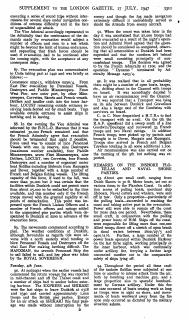
the evacuation. The attributes of this officer        Ministry of Shipping and the Commander-in-
for initiative and resource are well known            Chief, Nore, as to the provision of small craft
throughout the Service, but . I venture to            for the final evacuation, and the provision 01
express the opinion that never in the course of       Naval personnel for manning the small boats
his long and distinguished career have they been      required -for ferrying and skoots and other
put to better use than during the operations for      small vessels taken up for transport purposes.
the evacuation of the Allied Armies from                 7.- A meeting was held at the Admiralty on
Dunkirk.                                              Sunday, the 26th May, to consider the same
   17. RECOMMENDATIONS OF PERSONNEL.                  subject and to examine the number of craft
                                                      available. The notes of this meeting were sub-
   I have already transmitted a brief list of those   sequently supplied to the Vice Admiral, Dover,
recommended for immediate award or decora-            who was not represented at the Admiralty.
tion (which His Majesty has been pleased to              8. Meantime, on the 23rd May, evacuation
accept) and I will forward a further list at a        of Boulogne was started and completed on the
later date when time has permitted a full             24th. The position was more complicated at
examination of all the reports.                       Calais where evacuation was limited to non-
                    (Sgd.) B. H. RAMSAY,              fighting personnel; the fighting personnel having
                                Vice Admiral.         to hold on in order to assist the main B.E.F.
                                                      Further, a supply ship with stores and trans-
                                                      port had to be unloaded at Calais for this
   OPERATION " DYNAMO "—NARRATIVE OF                  Force.
                    EVENTS                               9. It was then apparent from all these events
                INTRODUCTION                          that if the B.E.F. was to be evacuated the
  As far as the Dover Command is concerned,           only port available would be Dunkirk.
the genesis of this operatipn took place at a            10. P.M. Sunday, the 2,6th: The military
War Office meeting on Sunday the igth May,            situation was 'thought to have deteriorated so
1940, at which the Vice Admiral, Dover, was           rapidly that the Vice Admiral was informed
represented. This meeting discussed (i) Tenv          by the Admiralty that it was imperative for
porary maintenance of the B.E.F. through Dun-         " Dynamo " to be implemented with the
kirk, Calais and Boulogne, and (2) Evacuation         greatest vigour, with a view to lifting up to
of personnel through Dunkirk, Calais and              45,000 of the B.E.F. within two days, at the
Boulogne. Under -this last item was included,         end of which it was probable that evacuation
amongst other items, the problem of " the             would be termdnated by enemy action.
hazardous evacuation of very large Forces."
This was considered "to be unlikely." (This
problem ultimately became that of Operation                       OPERATION " DYNAMO ".
" Dynamo ").                                                       NARRATIVE OF EVENTS.
    2. The main decision of this meeting was          Sunday, 2&th May, 1940.
 that the control must be delegated to the Vice          Admiralty ordered Operation " Dynamo " to
Admiral, Dover, and available shipping placed         commence at 1857. Prior to the receipt of this
 at his disposal.                                     order, the despatch of Personnel Vessels* to
    3. Further meetings were held at Dover on         Dunkirk had already commenced at 1500. At
the 20th May, and at the War Office on the 2ist       this time a flow of two vessels every four hours
May, to consider the " emergency evacuation           had been agreed to 'by the B.E.F., the first of
across the Channel of very large Forces."             these reached Dover on the return trip at 2230
These meetings determined the number of per-          and 1,312 personnel were landed.
sonnel vessels and small craft available, and            2. On this day the only Inshore Craft avail-
confirmed that the control of all sea move-           able to Vice-Admiral, Dover, were four Belgian
ments rested with the Vice Admiral, Dover, a          Passenger Launches and the Naval Small Craft
liaison officer from the War Office Movement          of the Dover Command such as Drifters, and
 Control and from the Ministry of Shipping            Motor Boats from the Contraband Control Base
being attached to the Vice Admiral.                   at Ramsgate. The only ones capable of lifting
    4. The need for air protection of sailings,       personnel direct from a beach being the boats
including the period of embarkation and dis-          from Ramsgate. The Admiralty had been asked
embarkation was recognised, and was to be             for the supply of small boats, especially whalers
arranged by the Vice Admiral, Dover, direct           and cutters,* but there was always the difficulty
with the Fighter Command.                             of arranging for the personnel to man them.
                                                      When mattters became urgent, the Admiralty
    5. The reception arrangements at the points       made a signal to the various Home Ports ask-
of disembarkation were -provided for. At the          ing them to report how many cutters and
Dover meeting it was pointed out that in the          whalers could be made available for immediate
event of evacuation it would be necessary to          service under Vice-Admiral, Dover.
make provision for lifting troops from beaches,
and that owing to the very .gradual shoaling of       Monday, 2jth May.
the beaches it would be necessary to have a              3. The Vice-Admiral, Dover, was informed
large number of small boats to carry troops           by the Admiralty of the various steps taken to
from the beaches to the off-shore ships. Fur-         supply coasting vessels, skoots,* motor boats
ther, it was thought extremely doubtful if the        and other small craft including rowing boats
whole of the troops to be evacuated could be
lifted from the beaches, and that, if at all           * Admiralty footnotes:
                                                          (i) The cutters and whalers are rowing boats
possible, the ports must 'be used as well.             carried by H.M. Ships.
   6. Subsequent to the Dover meeting of the              (ii) A skoot is a Dutch type of coasting vessel.
                                                          (iii) The Personnel Vessels were manned iisiost
20th May, continual telephone conversations            wholy by members of the Merchant Navy ana
took place between Dover, the Admiralty,               Fishing Fleets.
Details
SUPPLEMENT TO THE LONDON GAZETTE, 17 JULY, 1947                                          33"
executing a series of round trips without inter-   enemy and though the fog made navigation
mission tor several days under navigation con-     extremely difficult it undoubtedly served to
ditions of extreme difficulty and in the face      shield the Armada from enemy aircraft.
of unparalleled air attack.
   The Vice Admiral accordingly represented to        91. When the count was taken later in the
the Admiralty that the continuance of the de-      day it was ascertained that 27,000 troops had
mands made by evacuation would subject a           been evacuated as a result of the night's opera-
number of officers and men to a test which,        tion and Admiral Nord agreed that the opera-
might be .beyond the limit of human endurance,     tion should be considered as completed, observ-
and requesting that fresh forces should be         ing that all ammunition at Dunkirk had been
used if evacuation had to be continued after       expended and that the numbers left behind
the coming night, with the acceptance of any       were small consisting principally of non-
consequent delay.                                  combatant troops. This decision was agreed
                                                   to by the French Admiralty at uoo, and the
   87. The evacuation plan was communicated        operation " Dynamo " terminated by Ad-
to Units taking part at 1440 and was briefly as    miralty Message 1423/4.
follows: —
Commence 2230/3, withdraw 0230/4. From                92. It was realised that in all probability
East Pder evacuation by Personnel Vessels,         there might be a number of open boats, barges,
Destroyers and Paddle Minesweepers. From           etc., drifting a'bout in the Channel with troops
West Pier, new outer port, by other Milne-         on board.       It was accordingly decided to
sweepers, Corvettes, Skoots and French vessels.    have an air reconnaissance over the Channel.
Drifters and smaller craft into the inner har-        It was reported that a Transport was lying
bour, LOCUST remaining outside entrance re-        on its side between Dunkirk and Gravelines
ceiving loads ferried out 'by small boats. Tugs    and also a barge east of the Goodwins with
available outside entrance to assist ships in      survivors on board.
berthing and in leaving.                              C. in C. Nore despatched 2 M.T.B.s to find
                                                   the transport with no avail. On the 5th the
   88. In the evening the Vice Admiral was         R.A.F. speedboat did a sweep south of a line
informed by the B.N.L.O. Marceau that it was       Goodwin/Boulogne and recovered 33 French
estimated 30,000 French remained and that          troops and two Naval ratings.       In addition
the French Admiralty agree that evacuation         French troops were picked up by patrols and
should be terminated that night if possible.       brought in to Dover, Margate and Ramsgate.
Force -used was to consist of nine Personnel       Troops also arrived in French and Belgian
Vessels with one in reserve, nine Destroyers       Trawlers totalling in ail some additional 1,100.
(maximum, number available), four Paddle              Air reconnaissance was also carried out on
Minesweepers, seven Fleet Minesweepers, nine       the morning of the 5th but nothing was re-
Drifters, LOCUST, two Corvettes, four French.      ported.
Destroyers and a -number of organised motor
boat flotillas including lifeboats from Ramsgate   REMARKS ON THE INSHORE FLO-
and Dover, together with a large number of              TILLAS       AND       NAVAL        SHORE
French and Belgian fishing vessels. The lifting         PARTIES,
capacity of this force, if used to the full, was      93. About 400 small craft, ranging from
more than 30,000 but it was certain that the       Dutch Skoots to 30 ft. Motor boats, set out at
facilities within Dunkirk could not .permit more   various times to the Flanders Coast. In addi-
than a'bout 25,000 to be embarked in the time      tion scores of pulling boats, merchant ship
available, and this number only if the French      lifeboats, Naval cutters and whalers, were sent
troops moved with the greatest rapidity at all     off in tow. Only a proportion—particularly of
points of embarkation. This point was im-          the pulling boats—succeeded in reaching the
pressed upon the French Liaison Officers and a     coast and taking active part in the evacuation.
number of French officers and ratings added        Fewer still were able to remain off the coast
to the augmented pier parties which were de-       for more than one period. Nevertheless, these
spatched to Dunkirk at 2200 in advance of the      small craft, in conjunction with the pulling
evacuation force.                                  and power boats of HjM. Ships off the coast,
                                                   were responsible for lifting more than 100,000
   89. The movements commenced according to        Allied troops direct off a stretch of open beach
plan. The weather conditions at Dunkirk,           in shoal waters between 1600/27/5 ano^
although favourable as regards tide were ad-       0400/2/6.     Further, a large number of the
verse with a north easterly wind tending to        •power boats operated within Dunkirk Harfbour
blow Personnel Vessels and Destroyers off the      on the last three nights, working principally in
vital East Pier making berthing difficult. The     the inner harbour, which was continually
MANXMAN, the seventh Personnel Ship due            under artillery fire, ferrying a further large
to sail failed to sail, and her place was taken    uncounted number out to the comparative
by the ROYAL SOVEREIGN.                            safety of ships lying off.
Tuesday, qkh June.                                    94. Throughout the period all these craft
   90. At midnight when the earlier vessels had    of the inshore flotillas were subjected at one
commenced the return voyage fog was reported       time or another to intense attack from the air,
in mid-channel and off the Thanet coast and        both by bombing and machine gun, and a
a number of ships had to anchor before enter-      large proportion also to sporadic bombard-
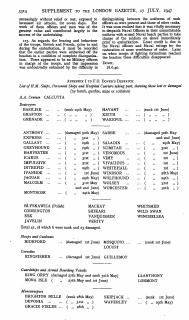
ing harbour. The EXPRESS and SHIKARI               ment by German artillery. Under this fire
were the last ships to leave Dunkirk at 0318       no case occurred of boats ceasing work as long
and 0340 and carried approximately 1,000           as troops w'ere in sight on shore, and move-
troops and the British pier parties. Except        ments of boats westward away from the fire
for an air attack on SHIKARI this final pass-      zone only occurred as dictated by the military
age was made without interruption by the           situation ashore.
Details
33^4          SUPPLEMENT TO THE LONDON GAZETTE, 17 JULY, 1947
unceasingly without relief or rest, exposed to         distinguishing between the uniforms of such
incessant air attacks, for seven days. The             officers as were present and those of other ranks.
work of these officers and men was of the              It was soon realised that it was vitally necessary
greatest value and contributed largely to the          to despatch Naval Officers in their unmistakable
success of the undertaking.                            uniform with armed Naval beach parties to take
                                                       charge of the soldiers on shore immediately
   113. As regards the bearing and behaviour           prior to embarkation. Great credit is due to
of the troops, British and French, prior to and        the Naval officers and Naval ratings for the
during the embarkation, it must be recorded            restoration of some semblance of order. Later
that the earlier parties were embarked off the         on when troops of fighting formations reached
beaches in a condition of complete disorganisa-        the beaches these difficulties disappeared.
tion. There appeared to be no Military officers
in charge of the troops, and this impression           Dover,
was undoubtedly enhanced by the difficulty in             18.6.40.


                             APPENDIX I TO F.O. DOVER'S DESPATCH
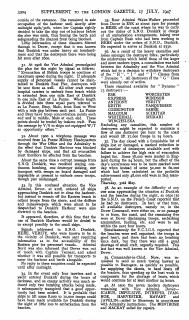
List of H.M. Ships, Personnel Ships and Hospital Carriers taking part, showing those lost or damaged
                               (by bomb, gunfire, mine or collision)
A.A. Cruiser CALCUTTA
Destroyers
  BASILISK                    (sunk 2gth May)          HAVANT                    (sunk ist June)
  GRAFTON                     ( „ „       „ )          KEITH                     ( „ „ „ )
  GRENADE                                              WAKEFUL


  ANTHONY ...                 (damaged soth May) SABRE                           (damaged 30th May
  EXPRESS ...                 (    >?   jISl    ,, )                                    and 2nd June)
  GALLANT ...                 (         29th   „ ) SALADIN ...                   (   „     29th May)
  GREYHOUND                   (    „    29th „ ) SCIMITAR ...                     (   „ 3ist „ )
  HARVESTER                   (         3ist „ ) VENOMOUS                         (   „     ist June)
  ICARUS                      (         3ist „ ) VIMY                             (   „     ist „ )
  IMPULSIVE                   (         3ist „ ) VIVACIOUS ...                    (   „     ist „ )
  INTREPID ...                (         29th „ ) WHITEHALL                        (   „     ist „ )
  IVANHOE ...                 (    „     ist June) WINDSOR ...                    (   „ 28th May)
  JAGUAR                      (    „    2gth May) WOLFHOUND                       (   „ 29th „ )
  MALCOLM ...                 (    „    3ist May WOLSEY     ...
                                    and 2nd June) WORCESTER                                 30th    „
   MONTROSE                    (   ,, 29th May)


   BLYSKAWICA (Polish)                  MACKAY                               WHITSHED
   CODRINGTON                           SHIKARI                              WILD SWAN
   ESK                                  VANQUISHER                           WINCHELSEA
   JAVELIN                               VERITY
 Total 41, of which 6 were sunk and 23 damaged.

 Sloops and Gunboats
   BIDEFORD             ...    (damaged ist June) MOSQUITO ..                     (sunk ist June)
                                                  LOCUST
 Corvettes
   KINGFISHER           ...    (damaged ist June) GUILLEMOT


 Guardships and Armed Boarding Vessels
   KING ORRY (damaged 27th May and sunk 30th May)                            LLANTHONY
   MONA ISLE (        „ 27th May and ist June)                               LORMONT

 Minesweepers
   BRIGHTON BELLE              (sunk 28th May)          SKIPJACK .                (sunk ist June)
  DEVONIA                      ( „ 3Ist „ )             WAVERLEY                  ( „ 29th May)
   GRACIE FIELDS ...           ( „ 28th „ )
Details
3304          SUPPLEMENT TO THE LONDON GAZETTE, 17 JULY, 1947
outside of the entrance. She remained in sole          35. Rear Admiral Wake-Walker proceeded
occupation of the harbour until shortly after       from Dover in ESK at about 1900 for passage
midnight 2Qth/30th, when her Captain rightly        to HEBE off the coast where he was to carry
decided to take the ship out of harbour before      out the duties of S.N.O. Dunkirk in charge
she also was sunk, thus freeing the berth and       of all embarkation arrangements, taking over
safeguarding the channel from 'being blocked.       from Captain Bush who had been working in
   Little information of these disasters filtered   HEBE under the orders of S.N.O., Dunkirk.
through to Dover, except that it was known          He expected to arrive at Dunkirk at 2330.
that Dunkirk was under heavy air bombard-              36. As a result of the heavy casualties and
ment and that the destroyers there were being       losses amongst the destroyer force, particularly
hit soon after 1600.                                the misfortunes which befell those of the larger
   31. At 1906 the Vice Admiral promulgated         and more modern types, a consultation was held
the plan for 'the night by signal as follows:       between the Admiralty and the Vice Admiral
                                                    which led to a decision to withdraw destroyers
" Evacuation of British troops to continue at       of the " H ", " I " and " J " Classes from
maximum speed during the night. If adequate          " Dynamo ". All destroyers of the " G " Class
supply of personnel vessels cannot be main-         were already out of action.
tained to Dunkirk East Pier, destroyers will
be sent there as well. All other craft except          There remained available for " Dynamo "
hospital carriers to embark from beach which        15 destroyers: —
is extended from one mile East of Dunkirk                 ESK                   WORCESTER
to one mile East of La Panne. Whole length               EXPRESS                WINDSOR
is divided into three equal parts referred to            ANTHONY                 VERITY
as La Panne, Bray, Malo, from East to West                KEITH                 VANQUISHER
with a mile gap between each part. La Panne               CODRINGTON            SABRE
and Bray have troop concentration points each             MALCOLM                SCIMITAR
end and in middle, Malo at each end. These                WHITEHALL              SHIKARI
points should be tended by inshore craft. Pass            WINCHELSEA
the message by V/S to ships not equipped W/T        Excluding any casualties, this number of
as .opportunity offers."                             destroyers might be expected to maintain a
                                                    flow of one destroyer per hour to the coast
   32. About 1900 a telephone message was           and would lift 17,000 troops in 24 hours.
received from La Panne Military Headquarters           37. The day closed with a formidable list of
through the War Office and the Admiralty to         ships lost or damaged, a marked reduction in
the effect that Dunkirk Harbour was blocked         the number of destroyers available and with
by damaged ships, and that all evacuation           failure to achieve the high rate of evacuation
must therefore be effected from the beaches.        hoped for. Some 38,000 were landed in Eng-
   About the same time a corrupt message from       land during the 24 hours, but the effect of the
 S.N.G. Dunkirk;, was receded stating con-          day's occurrences was to be more marked next
tinuous bombing, one destroyer sinking, one         day when instead of some 50,000 to 60,000
transport with troops on board damaged and          which had been calculated as the probable
impossible at present to embark- more troops,       achievement only 48,000 odd were in fac^ trans-
though pier undamaged.                              ported.
                                                    Thursday, ^oth May.
   33. In this confused situation the Vice
Admiral, Dover, at 2128, ordered all ships             38. As an example of the difficulty of any
approaching Dunkirk not to close the harbour,       one man appreciating the situation at Dunkirk
but instead to remain off the Eastern beach to      and the beaches during the night, at 0300/30
collect troops from the shore, and 'the drifters    the S.N.O. on the French Coast reported that
and minesweepers which were about to be             he had no destroyers. In fact, at that time,
despatched to Dunkirk Harbour were also             all available destroyers, namely 10, in the
diverted to the beaches.                            Dover Command, were either on, or on passage
                                                    to or from, the coast, and the remaining five
   It appeared, therefore, at this time that the    were at Dover discharging troops, embarking
use of Dunkirk Harbour would be denied to           ammunition, fuelling, etc. and were to sail
us except possibly to the small ships.              within the next four hours.
   Signals addressed to S.N.O. Dunkirk,                Simultaneously the V.C.I.G.S. reported that
HEBE, VERITY, who were known to be in               the beaches were well organised, the troops in
the vicinity of Dunkirk, „ were sent requiring      good heart, and there had been no bombing
information as to the accessibility of the          since dark, but that there was still a great
Eastern pier for personnel vessels. Admiral         shortage of small craft, urgently required. This
Nord was also informed that Dover was out           last fact was well known to the Vice Admiral,
of touch with Captain Tennant, and asked            Dover.
whether it was still possible for transports to        39. Commander-in-Chief, • Nore, was re-
enter the harbour and berth alongside.               quested to send as much towing hawser as
   No reply to these enquiries could be expected    possible to Ramsgate, as quickly as possible,
until after midnight.                               for supplying the skopts, to haul boats off
   34. In the event only four trawlers and a        the beaches, thus speeding up the boat work to
yacht entered Dunkirk during the hours of           compensate for the shortage of boats, which
darkness, and as enemy activity was much re-        would continue for at least another 24 hours.
duced only two bombing attacks being made,             40. At 0500 the seven modern destroyers
it subsequently transpired that a good oppor-       remaining with Vice Admiral, Dover—
tunity had been missed. It is probable that         ICARUS, IMPULSIVE, INTREPID, IVAN-
ships to lift some 8,000 to 10,000 troops could     HOE,       HARVESTER,          HAVANT       and
have been made available for Dunkirk during         JAVELIN—sailed to Sheerness in accordance
the night at little loss to embarkation from the    with Admiralty instructions. The MONTROSE
beaches.                                            and MACKAY sailed for repairs.
Operation Dynamo Map — Movement Logs
Movements recorded for EXPRESS during the evacuation period, as plotted on the Operation Dynamo map.
| Departed | Route | Arrived | Troops | Notes | Source |
|---|---|---|---|---|---|
| — | Dunkirk | — | — |
Stationary
HMS report explicitly names this location; a complete dated movement is unavailable
|
TNA ADM 116 4649, page 46 |
Log in to suggest an evidence-backed edit or a new movement log.