Also known as
WAVERLEY
User Contributed Collection
Documents and descriptions supplied by archive contributors. All submissions are reviewed in accordance with our Terms and Conditions.
No user-contributed documents have been approved for this vessel yet. Use the forms below to contribute images or documents relating to this vessel.

Help complete the archive
Do you have a photo of this vessel you can share?
Contribute photographs of WAVERLEY to the archive for editorial review. Submissions remain private and will only be published following approval by an administrator.
How your photograph will be credited
Exterior · 1940 · Copyright © Example Contributor
Source: Copyright ownership confirmed at submission by Example Contributor.
This example uses the photograph group, year and copyright-holder name supplied in the form. Your own details will replace the example above when an approved image is published.
Already have an account? Log in before uploading to link new photographs immediately.
Help complete the archive
Contribute a document
Share documents or images relating to WAVERLEY for editorial review. Upload up to 12 PDF, JPG, PNG or WebP files per submission, with a maximum size of 20 MB each. Your submission remains private and will only be published following approval by an administrator.
How your document will be credited
Example Document Title · Contributed by Example Contributor
Source: Archive reference supplied by Example Contributor.
This example uses the document title, contributor name and source or archive reference supplied in the form. Your own details will replace the example above when an approved document is published.
Wikipedia vessel details
Secondary-source table data; verify against primary records where available.
- Name
- HMS Waverley (J51)
- Pennant number
- J51
- Flag
- Royal Navy
- Description
- Paddle minesweeper
- Built
- 1899
- Tonnage
- 537
- Commanding officer
- T/Lt. Sydney Frederick Harmer-Elliott, RNVR (A/S.O.)
- Trips to Dunkirk
- 1
- Troops landed
- Not stated
- Notes
- Sunk by E-boat torpedo in the Channel on 29 May
Dunkirk-related passages from the linked page
PS Waverley was a Clyde-built paddle steamer that carried passengers on the Clyde between 1899 and 1939. She was requisitioned by the Admiralty to serve as a minesweeper during World War I and again in World War II, and was sunk while participating in the Dunkirk evacuation in 1940. The current PS Waverley, launched in 1946, was built as a replacement for this vessel.[6] Waverley was built for the North British Steam Packet Co. by A. & J. Inglis at their Pointhouse Shipyard on the Clyde in Glasgow, Scotland.[1][7] The ship was designed to be the flagship of the North British Steam Packet Co. fleet with the intention that it could be used for regular Clyde services but also to help the company expand their initial foray into excursions in areas around Bute, Arran, Kintyre and Loch Fyne.[1] Waverley was equipped with a compound engine, which was a first for ships employed on the Clyde which had up to this point only used single crank engines. But this was combined with a haystack boiler, which at the time was considered an older style of boiler, but being lighter than contemporary modern designs resulted in impressive speeds.[1][8][9] She was launched on 29 May 1899[2] and completed official trials on 8 July during which she achieved 19.73 knots over the measured mile.[5] After her trials she went downriver and around Bute before returning to Craigendoran.[5] She entered service on 10 July 1899.[1] In 1902, North British Steam Packet Co was dissolved and Waverley was transferred to the ownership of its parent company North British Railway operating a smaller range of routes that did not include Kintyre, Loch Fyne and the west of Arran.[1] With the outbreak of World War II she was brought briefly back into service to evacuate children from Glasgow to areas on the Clyde coast, and was then requisitioned by the Royal Navy to serve as the lead ship of the 12th Minesweeping Flotilla.[1][7] The flotilla consisted of five paddle steamers, was based at Harwich on the east coast of England, and tasked with sweeping the shipping lanes.[7] On 28 May 1940, this flotilla was given orders to stock up and sail south to take part in Operation Dynamo, the effort to evacuate Allied soldiers from the beaches of Dunkirk.[7] Having spent several hours attempted to tow off the beached HMS Oriole (PS Eagle), Waverley was intercepted by 12 German Heinkels while returning to England with 600 troops on board.[10] After avoiding their bombs for about 30 minutes, one struck the port side of the ship and opened a 6-foot hole in the bottom of the ship.[10] The ship sank near Kwint Bank Buoy with the loss of two crewmembers and about 150 troops.[7][11][10] 158 survivors were pulled from the water by the Cyclone, 285 by the PS Golden Eagle. A Dutch tugboat Java and two drifters picked up a few more.[12][13] 1 2 "Launches and Trial Trips". Glasgow Herald. 30 May 1899. Yesterday Messrs A. & J. Inglis launched a new passenger steamer for the North British Steam Packet Company named the 'Waverley'. This vessel is of larger dimensions than any other of the company's fleet, and is intended for the daily excursion around Bute, which proved so popular last season, and for the evening run to Kirn, Dunoon, and Rothesay. The Waverley has a spacious dining cabin under the main deck aft, a comfortable tea-room at entrance to deck saloon, and has accommodation for a large number of tourists. She will shortly be placed on the station in connection with fast trains to Craigendoran. 1 2 3 4 5 "Clyde-built heroines of Dunkirk". The Herald. 26 May 1990. Retrieved 13 August 2017. 1 2 3 Alan Newman (10 July 2005). "Dunkirk rescue: My Grandfather's True Survival Story". BBC. Retrieved 13 August 2017. ↑ Gardner, W.J.R. (29 June 2000). The Evacuation from Dunkirk: 'Operation Dynamo', 26 May–June 1940. Taylor & Francis. ISBN 0714681504.
ORDE Registry
4 records4 potential matching records have been identified.
These records may contain vessel particulars, reported movements, participation assessments, named personnel and source references. A match does not by itself prove that the vessel participated in Operation Dynamo.
“Potential match” means a candidate returned by one or more indexing rules; it is not necessarily an exact identity match. Depending on the source, matching may use a normalised vessel name, a partial text or OCR hit, an alias, or related metadata. Roman-numeral suffixes such as I, II, III, IV and V may be absent, misread or separated from the base name, so records for similarly named vessels can be grouped incorrectly. Multi-word names can also produce candidates where only one significant word matches. Confirm the full name, numeral, vessel type, dimensions, builder, ownership, dates and source context before treating two records as the same vessel.
We are compiling and checking transcriptions, metadata, vessel-name matches, source references and reuse permissions before publishing further detail. This work helps prevent incomplete OCR, historic spelling variations or unverified associations from being presented as established fact.
Account registrations and access to these developing records are temporarily unavailable. Existing account holders may log in, and everyone can join the newsletter for publication updates.
Small Craft Service List
0 records0 potential matching records have currently been identified.
Further indexing may identify service-list entries, vessel metadata, source-page references and protected full-size document images. The absence of a current match does not establish that no relevant source exists.
We are compiling and checking transcriptions, metadata, vessel-name matches, source references and reuse permissions before publishing further detail. This work helps prevent incomplete OCR, historic spelling variations or unverified associations from being presented as established fact.
Account registrations and access to these developing records are temporarily unavailable. Existing account holders may log in, and everyone can join the newsletter for publication updates.
No Small Craft records.
Red List (1939–40) — indexed references
These references come from the Red List index. Printed page numbers may differ from digitised image numbers; OCR may not reproduce the vessel name accurately.
- Waverley — ADM 208/3, printed page 3
- Waverley — ADM 208/3, printed page 3
Red List (1939–40) — OCR
7 records7 potential matching records have been identified.
These records may contain OCR text matches, source files, page references and digitised page imagery. A match does not by itself prove that the vessel participated in Operation Dynamo.
“Potential match” means a candidate returned by one or more indexing rules; it is not necessarily an exact identity match. Depending on the source, matching may use a normalised vessel name, a partial text or OCR hit, an alias, or related metadata. Roman-numeral suffixes such as I, II, III, IV and V may be absent, misread or separated from the base name, so records for similarly named vessels can be grouped incorrectly. Multi-word names can also produce candidates where only one significant word matches. Confirm the full name, numeral, vessel type, dimensions, builder, ownership, dates and source context before treating two records as the same vessel.
We are compiling and checking transcriptions, metadata, vessel-name matches, source references and reuse permissions before publishing further detail. This work helps prevent incomplete OCR, historic spelling variations or unverified associations from being presented as established fact.
Account registrations and access to these developing records are temporarily unavailable. Existing account holders may log in, and everyone can join the newsletter for publication updates.
Ship Details
These details have been aggregated from multiple sources and may include contemporary records, later recollections, claims or assertions for which no corroborating evidence has been identified. Inclusion does not establish that any account or assertion is accurate. The information may be incomplete, out of date, disputed or incorrect and should be checked against the underlying source records and independent evidence before being relied upon.
No additional ship details available.
Lloyd’s Yacht Register (1939)
Source: Lloyd’s Register Foundation, Heritage & Education Centre, Lloyd’s Register of Yachts 1939, digitised via Internet Archive. Licensed under CC BY-NC-SA 4.0. Images have been converted, resized and watermarked for web display; machine-generated table OCR has been added.
Details
Document Collections — Tagged Pages
8 pagesImaged document collections containing pages whose OCR text or table data has been tagged with the name WAVERLEY. Open a collection to view the page images and transcriptions.
Source: Lloyd’s Register Foundation, Heritage & Education Centre, Lloyd’s Register of Yachts 1939, digitised via Internet Archive. Licensed under CC BY-NC-SA 4.0. Images have been converted, resized and watermarked for web display; machine-generated table OCR has been added.

Details
| 7680 164516 | Waverley | Steel Pet.Mot. | Sc | 1276 13:29 13 | 35'6 37.2 35.0 | 95 65 | 44 2.5 | Henry Robb, Ld. Builders | Leith 1932 | Petrol Motor 4Cy.3"-4 Gleniffer | W. G. Boyer | London |

Details
| Waverley | Lug | 1425 | 60275 | J. Hilditch | max. |

Details
| a. Maid | 14 | a. Sinbad | 14 | a. Cam | 13 | m. Lady Babs | 13 | m. Quickfirer | 13 | m. Waverley | 13 |

Details
| Boulton, Lieut. L. B., R.N.R., Yacht Nordissa," Littlehampton Sailing and Motor Club, Ltd., Littlehampton, Sussex. m. Nordissa 67 | Boustred, H. W., Caterham, Walton-on-Naze, Essex. Wlt. m. Mowgli - | Bowen, W. G., The Crooked Cottage, Burnham-on- Crouch, Essex.-Cor.-Nav. m. Firefly (P.O.) 6 | Bowmar, W. G., W. G. Bowmar & Co., Ltd., Frog Island, Leicester.-C.A. m. Hamran 14 | Boyer, W. G., Upland, Kings End, Ruislip, Middx. Chi. m. Waverley 13 |

Details
| Briggs, H. J., Waverley, Beverley Road, Kirkella, Hull.-Hbr.Scr. m. Bennan 7 | Brisbane, D. W., The Cliffe, McNeil Street, Peppermint Grove, W. Australia.-Fsh. m. Margaret II (P.O.) 16 | Capt. C.R.,J.P., St. Denis, Bembridge, I.W.-R.Y.S.- Bem.-H.B. m. Maid of Arun 17 | Brodin, C. F., Strandeägen 57, Stockholm.--F M.K. m. Tre Stjärnor 5 | Brooke-Hitching, R. S., Sunnymede Lodge, Maidenhead, Berks.-Tms. m. Nerita |

Details
| Parker-Hutchinson, S. G.J., Castle Lough, Nenagh, Co. Tipperary. L.D. m. Magpie 15 | Parry, William, Glengarth, Oldfield Way, Heswall, Cheshire. a. Faith 37 | Partridge, H. H., G.P.O. Box 268, Auckland, N.Z. N.Z. a. Ngaio 11 | Paterson, Gilbert, 16, Waverley Street, Glasgow, S.1. C.Crz. a. Thistle (P.O.) 4 | Paton, A., 20, Claypote Road, Broughty Ferry, Angus.-Tay. Kittiwake (P.O.) 2 |
Details
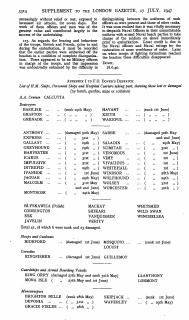
33^4          SUPPLEMENT TO THE LONDON GAZETTE, 17 JULY, 1947
unceasingly without relief or rest, exposed to         distinguishing between the uniforms of such
incessant air attacks, for seven days. The             officers as were present and those of other ranks.
work of these officers and men was of the              It was soon realised that it was vitally necessary
greatest value and contributed largely to the          to despatch Naval Officers in their unmistakable
success of the undertaking.                            uniform with armed Naval beach parties to take
                                                       charge of the soldiers on shore immediately
   113. As regards the bearing and behaviour           prior to embarkation. Great credit is due to
of the troops, British and French, prior to and        the Naval officers and Naval ratings for the
during the embarkation, it must be recorded            restoration of some semblance of order. Later
that the earlier parties were embarked off the         on when troops of fighting formations reached
beaches in a condition of complete disorganisa-        the beaches these difficulties disappeared.
tion. There appeared to be no Military officers
in charge of the troops, and this impression           Dover,
was undoubtedly enhanced by the difficulty in             18.6.40.


                             APPENDIX I TO F.O. DOVER'S DESPATCH
List of H.M. Ships, Personnel Ships and Hospital Carriers taking part, showing those lost or damaged
                               (by bomb, gunfire, mine or collision)
A.A. Cruiser CALCUTTA
Destroyers
  BASILISK                    (sunk 2gth May)          HAVANT                    (sunk ist June)
  GRAFTON                     ( „ „       „ )          KEITH                     ( „ „ „ )
  GRENADE                                              WAKEFUL


  ANTHONY ...                 (damaged soth May) SABRE                           (damaged 30th May
  EXPRESS ...                 (    >?   jISl    ,, )                                    and 2nd June)
  GALLANT ...                 (         29th   „ ) SALADIN ...                   (   „     29th May)
  GREYHOUND                   (    „    29th „ ) SCIMITAR ...                     (   „ 3ist „ )
  HARVESTER                   (         3ist „ ) VENOMOUS                         (   „     ist June)
  ICARUS                      (         3ist „ ) VIMY                             (   „     ist „ )
  IMPULSIVE                   (         3ist „ ) VIVACIOUS ...                    (   „     ist „ )
  INTREPID ...                (         29th „ ) WHITEHALL                        (   „     ist „ )
  IVANHOE ...                 (    „     ist June) WINDSOR ...                    (   „ 28th May)
  JAGUAR                      (    „    2gth May) WOLFHOUND                       (   „ 29th „ )
  MALCOLM ...                 (    „    3ist May WOLSEY     ...
                                    and 2nd June) WORCESTER                                 30th    „
   MONTROSE                    (   ,, 29th May)


   BLYSKAWICA (Polish)                  MACKAY                               WHITSHED
   CODRINGTON                           SHIKARI                              WILD SWAN
   ESK                                  VANQUISHER                           WINCHELSEA
   JAVELIN                               VERITY
 Total 41, of which 6 were sunk and 23 damaged.

 Sloops and Gunboats
   BIDEFORD             ...    (damaged ist June) MOSQUITO ..                     (sunk ist June)
                                                  LOCUST
 Corvettes
   KINGFISHER           ...    (damaged ist June) GUILLEMOT


 Guardships and Armed Boarding Vessels
   KING ORRY (damaged 27th May and sunk 30th May)                            LLANTHONY
   MONA ISLE (        „ 27th May and ist June)                               LORMONT

 Minesweepers
   BRIGHTON BELLE              (sunk 28th May)          SKIPJACK .                (sunk ist June)
  DEVONIA                      ( „ 3Ist „ )             WAVERLEY                  ( „ 29th May)
   GRACIE FIELDS ...           ( „ 28th „ )
Details
3298          SUPPLEMENT TO THE LONDON GAZETTE, 17 JULY, 1947
embarkation staff or organisation a strong naval       14. CO-OPERATION OF THE FRENCH NAVY.
party was required to form up and embark the           French warships and other vessels were
troops. Later, no difficulty was experienced        employed evacuating French troops from
when troops of fighting formations were en-         Dunkirk Harbour, and on the last three nights
countered. Difficulty was experienced in con--      from the beach i£ miles eastward from Dunkirk.
trolling some French 'troops, whilst others were    Details are given in Appendix IV.
so rigidly bound by discipline and tradition that
they would not embark except by complete               15. BASE ORGANISATION.
formation under their own unit officers. In
either case the rate of embarkation was much           An operation of this magnitude involving the
slower than with British troops.                    maintenance and movements of close on 900
                                                    vessels and boats could not have been conducted
   12. INITIATIVE SHOWN BY COMMANDING               without the wholehearted and unceasing efforts
OFFICERS AND SUBORDINATE PERSONNEL.                 of the base establishments at Dover and
   A most satisfactory feature of the operation     Ramsgate, as well as those at Sheerness and
>was the high degree of initiative shown by         Harwich in the Nore Command. At all these
Commanding and Subordinate Officers of units        places officers and men, Naval and civilian,
operating off the coast, ranging from H.M.          laboured unceasingly throughout the Operation.
Destroyers to commandeered motor boats. The            In particular I wish to acknowledge the great
majority of officers and ratings in command         assistance received from the Commander-in-
were in situations requiring independent action     Chief, Nore, Admiral the Hon. Sir Reginald
in extremely difficult conditions. Often the        A. R. Plunkett-Ernle-Erle-Drax, K.C.B.,
easiest course was to be satisfied with work        D.S.O., who in many cases anticipated my re-
already achieved and to return to the United        quests for assistance through his constant watch
Kingdom with a final load of troops. The            on the progress of the Operation.
reverse action was invariably executed, namely,        The prompt and unfailing assistance afforded
continued operation off the coast as long as        by the Chatham Depot in providing personnel
there were both -troops ashore to be evacuated      for .the numerous small craft, working parties
and vessels offshore to receive them. If the        and beach parties, was a feature essential to the
craft in use was damaged or sunk the crew in-       successful outcome of the Operation.
variably seized some other boat to continue            The Naval Officer-in-Charge, Ramsgate,
their efforts.                                      Captain W. R. Phillimore, R.N., by taking
   Unaware of the military situation ashore and     over the servicing and control of the great
often forced to move westward by bombard-           majority of the small craft of the inshore
ment from German artillery or even by rifle         flotillas relieved Dover of an immense volume
fire from advancing German forces, the majority     of work which it would otherwise have been
of these boats, commanded often by stokers or       impossible to handle.
" hostility only " seamen, had only one object         It was also brought to my notice that at
an view, to lit from the beach any, and all         Harwich an exceptional Naval and Military
troops, British or Allied, within sight of the      system was in being for assisting those ships
water's edge.                                       which called there to make a quick turn round,
   On their return to the United Kingdom when       relieving the tired ships' companies of the work
asked to report their proceedings it was only       of cleaning and clearing their vessels.
in answer to direct enquiry that it would trans-       16. SERVICES OF STAFF, INCLUDING OFFICERS
pire that these young men had been subjected        TEMPORARILY APPOINTED.
in many cases, to an unparalleled bombard-             I was fortunate in having the services of
ment from the air. They appeared to consider        Roar Admiral W. F. Wake-Walker, C.B.,
that this was part of the day's work requiring      O.B.E., as Flag Officer afloat off Dunkirk, and
no comment.                                         Captain W. G. Tennant, C.B., M.V.O., as
  13. LOSSES OF TROOPS AFTER EMBARKATION.           Senior Naval Officer, Dunkirk on shore.
   It is a distressing fact -that many ships were   Admiral Wake-Walker was responsible for
sunk or damaged on the return voyage when           supervising the embarkation afloat and Captain
laden with troops. But it is fortunate that in      Tennant for organising embarkation from the
most of such cases the majority of troops were      shore, keeping touch with the French Naval
saved owing to the large volume of traffic that     Authorities and the staff of the British
was coming and going between Dunkirk and            Commander-in-Chief.
the United Kingdom. Exceptions to this were            I cannot conclude this despatch without
due to the rapidity with which certain ships        reference to the splendid work of my staff under
sank after having been bombed or torpedoed.         the guidance of my Chief Staff Officer, Captain
Such cases are as follows: —                        L. V. Morgan, C.B.E., M.V.O., D.S.C.
                                                       Augmented by additional officers, including
      WAKEFUL. Torpedoed. Ship broke in             both Army and Royal Air Force, especially
   half and only those on the upper deck were       appointed for the occasion, their task of
   saved. About 600 troops were below.              organising and operating the large and varied
      CRESTED EAGLE. Was bombed and                 collection of H.M. Ships continued without a
   then beached in a burning condition. Only        pause day and night .throughout the 10 days
   about 300 saved out of 600 on board.             that the Operation lasted, and I can never
      SKIPJACK. 250-300 troops on board,            testify adequately to the excellence of their
   most of whom, unfortunately, went down           work, upon the efficiency of which successful
   with the ship when she sank.                     results depended.
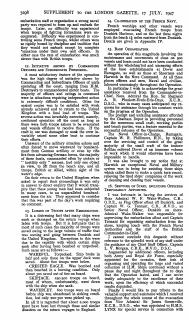
      WAVERLEY. 600 troops were on board               Finally I would like to pay tribute to the
   before ship was abandoned in sinking condi-      valuable support and assistance which I received
   tion, but only 200-300 were picked up.           throughout the whole course of the evacuation
   In all it is regretted that about 2,000 troops   from Vice Admiral Sir James Somerville,
must have been lost through these and similar       K.C.B., D.S.O., who was appointed to H.M.S.
disasters on the return voyages to England.         LYNX for special service in connection with
Operation Dynamo Map — Movement Logs
Movements recorded for WAVERLEY during the evacuation period, as plotted on the Operation Dynamo map.
| Departed | Route | Arrived | Troops | Notes | Source |
|---|---|---|---|---|---|
| — | Dunkirk | — | — |
Stationary
Location recorded; complete dated movement unavailable
|
NMM 940.542.1 1940 Orde vol iii, page 318 |
Log in to suggest an evidence-backed edit or a new movement log.