Also known as
No aliases recorded.
The King
User Contributed Collection
Documents and descriptions supplied by archive contributors. All submissions are reviewed in accordance with our Terms and Conditions.
No user-contributed documents have been approved for this vessel yet. Use the forms below to contribute images or documents relating to this vessel.

Help complete the archive
Do you have a photo of this vessel you can share?
Contribute photographs of The King to the archive for editorial review. Submissions remain private and will only be published following approval by an administrator.
How your photograph will be credited
Exterior · 1940 · Copyright © Example Contributor
Source: Copyright ownership confirmed at submission by Example Contributor.
This example uses the photograph group, year and copyright-holder name supplied in the form. Your own details will replace the example above when an approved image is published.
Already have an account? Log in before uploading to link new photographs immediately.

Help complete the archive
Contribute a document
Share documents or images relating to The King for editorial review. Upload up to 12 PDF, JPG, PNG or WebP files per submission, with a maximum size of 20 MB each. Your submission remains private and will only be published following approval by an administrator.
How your document will be credited
Example Document Title · Contributed by Example Contributor
Source: Archive reference supplied by Example Contributor.
This example uses the document title, contributor name and source or archive reference supplied in the form. Your own details will replace the example above when an approved document is published.
ORDE Registry
0 records0 potential matching records have currently been identified.
Further indexing may identify vessel particulars, reported movements, participation assessments, named personnel and source references. The absence of a current match does not establish that no relevant source exists.
We are compiling and checking transcriptions, metadata, vessel-name matches, source references and reuse permissions before publishing further detail. This work helps prevent incomplete OCR, historic spelling variations or unverified associations from being presented as established fact.
Account registrations and access to these developing records are temporarily unavailable. Existing account holders may log in, and everyone can join the newsletter for publication updates.
Small Craft Service List
0 records0 potential matching records have currently been identified.
Further indexing may identify service-list entries, vessel metadata, source-page references and protected full-size document images. The absence of a current match does not establish that no relevant source exists.
We are compiling and checking transcriptions, metadata, vessel-name matches, source references and reuse permissions before publishing further detail. This work helps prevent incomplete OCR, historic spelling variations or unverified associations from being presented as established fact.
Account registrations and access to these developing records are temporarily unavailable. Existing account holders may log in, and everyone can join the newsletter for publication updates.
No Small Craft records.
Red List (1939–40) — OCR
0 records0 potential matching records have currently been identified.
Further indexing may identify OCR text matches, source files, page references and digitised page imagery. The absence of a current match does not establish that no relevant source exists.
We are compiling and checking transcriptions, metadata, vessel-name matches, source references and reuse permissions before publishing further detail. This work helps prevent incomplete OCR, historic spelling variations or unverified associations from being presented as established fact.
Account registrations and access to these developing records are temporarily unavailable. Existing account holders may log in, and everyone can join the newsletter for publication updates.
Ship Details
These details have been aggregated from multiple sources and may include contemporary records, later recollections, claims or assertions for which no corroborating evidence has been identified. Inclusion does not establish that any account or assertion is accurate. The information may be incomplete, out of date, disputed or incorrect and should be checked against the underlying source records and independent evidence before being relied upon.
- Ship type: Thames Passenger Launch
- Beam: 14ft 6ins
- Length: 81ft
- Engine: Thornycroft 75 Diesel
- Build year: 1902
- Draft: 5ft 5ins
- Builder: H. Tagg, East Molesey
- Construction: Teak on oak
- Displacement: 40.80 tons
Lloyd’s Yacht Register (1939)
Source: Lloyd’s Register Foundation, Heritage & Education Centre, Lloyd’s Register of Yachts 1939, digitised via Internet Archive. Licensed under CC BY-NC-SA 4.0. Images have been converted, resized and watermarked for web display; machine-generated table OCR has been added.
No Lloyd’s records.
Document Collections — Tagged Pages
78 pagesImaged document collections containing pages whose OCR text or table data has been tagged with the name The King. Open a collection to view the page images and transcriptions.
Source: Lloyd’s Register Foundation, Heritage & Education Centre, Lloyd’s Register of Yachts 1939, digitised via Internet Archive. Licensed under CC BY-NC-SA 4.0. Images have been converted, resized and watermarked for web display; machine-generated table OCR has been added.

Details
| 1527 | Dan III | Wood | BmCut | [ ] - | 308 | 60 50 | E.Nord- | Copenhagen | H.M. the King of | Copenhagn | N |

Details
| 5899 | Rita VI | Wood | AuxBm | [ ] | 448 | 10.5 | 67 | E.Nordb- | Copenhagen | Oil Engine | H.M. The King of | Copenhagn |

Details
| ROYAL YACHT SQUADRON. Est. 1815. Entrance Fee, £105 0 0. Annual Subscription £16 0 0. ADM. H.M. The King. | CLUB MARITIMO DEL ABRA. Est. 1902. Entrance Fee, 500 Pesetas. Annual Subscription, 170 Pesetas. PRES. Alvaro Garcia Ogara. | ADEN YACHT CLUB. Revived 1928 Entrance Fee, 5 Rupees. Annual Subscription, 5 Rupees. |

Details
| ADM. H.M. The King of Denmark. | PATRON H.M. King George VI. |

Details
| PRES. H.M. The King of Denmark. | H. BEACH- A. C. Collins. MASTER | COM. Sir Alfred L. Goodson, Bart. |

Details
| COM. Augustus F. Challis. | PATRON H.M. The King of Egypt. | Annual Subscription, £2 2 0. |

Details
| PATRON H.M. The King of Sweden. | V.-C. The Rt. Hon. Lord Inverclyde. | COM. H. E. Warren-Edwards |
| ADM. H.M. The King of the Hellenes. | COM. Comdr. L. T. Peyton Jones, R.N. (ret.). | PRES. Miguel A. Riva. |

Details
| PATRON | H.M. The King of Italy, Emperor of Ethiopia. S.A.R. il Duca d'Aosta. |
| PATRON | H.M. The King of Denmark. |

Details
| ADM. | H.M. The King. |
| PATRON | H.M. The King of Sweden. |

Details
| PATRON | H.M. The King. |

Details
| R.-C. Eric Chamberlin. | PATRON H.M. The King of Norway. H. COM. H.R.H. Crown Prince Olav. | COM. Major R. Workman. |

Details
| KUNGL. SVENSKA SEGEL SÄLLSKAPET. (Royal Swedish.) Est. 1830. Entrance Fee, 20 Kronor. Annual Subscription, 40 Kronor. PATRON H.M. The King of Sweden. H. PRS. H.R.H. The Crown Prince of Sweden. COM. Admiral Otto Lybeck. V.-Cs. Carl Matthiessen and Sven Salén. H. TREAS. L. Gösta Olsson. H. SEC. Harry Nyström. Club Rooms & H. Sec. Birger Jarlsgatan, 4, II, Stockholm. Club Houses Biskopsudden, Sandhamn, Österskär & Nynäshamn. | SWALE YACHT CLUB. Est. 1935. Entrance Fee, £1 1 0. Annual Subscription £0 10 6. COM. H. Sumner Moore. V.-C. G. Stevens. H. TREAS. G. Harvey. H. SEC. M. G. Duff, Conyer," Teynham, Kent. Club House The Ferry House, Harty Ferry, Isle of Sheppey. | SWANAGE SAILING CLUB. Est. 1935. Annual Subscription, £0 5 0. COM. Dr. G. W. S. de Jersey. H. TREAS. H. G. Reddrop. H. SEC. A. G. L. Hardy. "Sunset," Queen's Road W., Swanage. |
| ROYAL TEMPLE YACHT CLUB. Est. 1857. Entrance Fee (In abeyance). Annual Subscription: Members. £4 4 0. Members resident within 10 miles of Club House, £4 14 6. COM. H. J. Davis. V.-C. H. M. Crankshaw. R.-C. A. W. Noott. H. TREAS. G. Faith. SEC. F. C. Newell. Club House: West Cliff Mansions, Ramsgate. | ROYAL THAMES YACHT CLUB. (Late Cumberland Fleet.) Est. 1775. Entrance Fee: Non-Yacht Owners, £15 15 0. Bona fide Yachtsmen, £5 5 0. Annual Subscription: Non-Yacht Owners, £13 13 0. Yacht Owners. £11 11 0. Cadet Members (Bona fide Yachtsmen. Age 18-25 years). Entrance Fee, Nil. Annual Subscription, not exceeding £5 5 0. PATRON H.M. The King. COM. The Lord Queenborough, G.B.E. V.-0. J. S. Highfield. R.-C. Hugh F. Paul. CUP BEARER A. R. Morson. SEC. Richard A. Warry, 60, Knightsbridge, London, S. W.1 | THAMES MOTOR CRUISING CLUB. Est. 1930. Entrance Fee, £2 2 0. Annual Subscription, £2 2 0. COM. S. Owensmith. V.-C. R. M. Miller. R.-C. H. E. Dulcken. H. SEC. & E. G. Baxter, TREAS. 2, Hoodcote Gardens, Winchmore Hill, London, N.21. Club House: Hampton Court Hotel, Hampton Court, Middlesex. |

Details
| PATRON | H.M. The King. |

Details
| 73 DERIA-I-NOUR. V.P. KITABGI KHAN. | 74 E IELA. S.S. H.M. THE KING OF ITALY. | 75 A SEABELL M. CONSUL H. A.JOHNSON. | 76 NONA. CUT. H.E. SADD | 77 SIRIS. SLP. J.F. HENDERSON, B.Sc. | 78 NOUBA. SLP. H. MOYSAN. | 79 ATAIR. SLP R.AMELN | 80 DANAE SCH. F. ROUFF. |

Details
| Gralian | M. | A. W. Munns | 166 | Iela | S.S. | H.M. The King of | Nicholl, R.N. | 889 |

Details
| Denmark, H.M. The King of, | Des Gouttes, Jean, Chandoleine, Vandœuvres, near Geneva. Gen. | Deverell, John D., Pentewan. Cornwall.-Foy. a. Emanuel 7 | Dhome, Marcel, 45, Bud. Gouvion St. Cyr, Paris. | Dickie, Peter S., Bryn Ogwen, Bangor, N. Wales. |

Details
| Edström, Simon, A.-B., P.O. Box 82, Malmö, Sweden. (Mgr. Eug. Eugenides,Spiraki Building, Piraeus.)-G.K.S.S.-Gre. | Edwards, John H., Clovelly, Cambridge Road, Lee-on-the-Solent, Hants. Tons | Egyptian Government (Reserved for H.M. The King), Alexandria, Egypt. Tons | Eldridge, E. E. B., 58, Clifton Court, St. John's Wood, London, N.W.8.-Col.(R.C.)-L.S.- Ssx. Tons | Ellard, Edwin F., The Garlands, Prestwood Road, Wednesfield, Staffs.-Con.-N.W. Tons |

Details
| Inverclyde, Lord, D.L., Castle Wemyss, Wemyss Bay, Renfrew- shire.-R.Y.S.-Bem.-Cly.-Grk.(v.c.) Hgh.-Lgs.-Nor.-S.M.Y.C. | Irvin, Leslie L., Deanrow, Garth Road, Letchworth, Herts.-Lon. Tons | Italy, H.M. the King of, Rome. Adr.-Lro.-R.Y.C.L.(C.)-Sav. Tons | Jackson, The Exors. of the late F. S., One Oak, Ilkley, Yorks. Tons | Jackson, Thos. C., LL.D., Victoria Chambers, Bowlalley Lane, Hull.-Hbr.-Nbl.-Scr.-Y.R.A.- Yrk. (C.) Tons |
Contains public sector information licensed under the Open Government Licence v3.0.
Details
BURTON
Sailing barge DA. Recess
See under Sun III
4d
1615
Left immage with 4 drifters of the
lot M/R flotilla, 7181 the Pidget,
Fisher DOZ. Jooketa and
2300
Entered DURKIPE harbour. MITER
Armitage R.N.V.E. who WAS temporarily
in command of the 1st M/R.P.(1) case
on board.
25300a
Recd. signal that the A.B/V King Oret
use in danger of foundering. Her
0.0., however, stated that he did not
propose to abandon her.
12th seall
003068
The Bystander went alongside the pier
and embarked, in all, 74 troops,
about 30 of whom were French. lisan-
while the King Orty had left her
berth and yes leaving the harbour.
0130
The Bystander was a cable esters of the
King Orry when she foundered.
The Bystander lovered her boat and
menned it with seaman-took Ja Biton
and seamen Iso Boott. Largely due to
the former's efforts, 25 officers
and mon were resoued.
The Bystander sailed.
0830
Arrived Ramagate, Disembarked 74
troops(2) STX ressued GROUP
1715
Chiled for Dunkirk in company with the
2830
Engine broke down. The Bratanier
lat M/R.F.
returned to Ramagate.
Total 74
Minustry - R.O.II, P.158.
R.O.III D.332.
the Pattering number were meder
CASE J.E.H. Bison.
(1) (2) 14, D.B. Cdr. - but A.J. not commanded repart. the let M/R.P.
136
Details
EYSTANDER
E/S Yacht (1st
M/R flotilla)
s/Lt. H.J.B. Barge, R.N.V.R.
29th May
1615
Left Ramsgate with 4 drifters of the
lst M/R flotilla, viz: the Fidget,
2300
Fisher Boy, Jacketa and Silver Dawn.
Entered Dunkirk harbour. Lt. L? N.R.
Armitage R.N.V.R. who was temporarily
in command of the lst M/R.F. (1) came
on board.
2330ca
Recd. signal that the A.B/V King Orry
was in danger of foundering. Her
C.O., however, stated that he did not
propose to abandon her.
30th May
0030ca
The Bystander went alongside the pier
and embarked, in all, 74 troops,
about 30 of whom were French. Mean-
while the King Orry had left her
berth and was leaving the harbour.
0130
The Bystander was a cable astern of the
King Orry when she foundered.
The Bystander lowered her boat and
manned it with seaman-cook J. Elton
and seaman L. Scott. Largely due to
the former's efforts, 25 officers
and men were rescued.
The Bystander sailed.
0830
Arrived Ramsgate. Disembarked 74
troops and 25 of rescued crew.
1715
Sailed for Dunkirk in company with the
1st M/R.F.
1840
Engine broke down. The Bystander
returned to Ramsgate.
Total 74
Authority - R.O.II, p.158.
R.O.III p.332.
The following awards were made:
C.G.M.
Seaman Cook J.H.H. Elton.
(1) Cubison, D.S.C., R.N. commanded report. the 1st M/R.F.
(2) Lt. D.R. Cdr. - but A.J. not mentioned in Ramsgate
Contains public sector information licensed under the Open Government Licence v3.0.
Details
KING ORRY
A.B/V
Cdr. J. Elliott, R.D., R.N.R
26th May
0930
Left the Downs for Dunkirk.
27th May
0200
Off Dunkirk.
0439
Entered harbour.
0730
Embarked 1131 troops.
0803
Sailed for Dover.
0900 -
Between Gravelines and Calais, shelled
0920
by shore batteries. Two or three
shells hit the ship. Air attack at
the same time. Casualties were
caused, and damage to ship.
1100
Arrived Dover. Disembarked 1131 troops.
29th May
p.m.
Sailed for Dunkirk.
1730
Arrived Dunkirk Roads.
Attacked by 1 dive bomber, 1/2 mile
west of the western pier head. Six
bombs shook the ship, but no damage.
Proceeded into Dunkirk harbour. Air
attack which put steering gear out of
action and shattered all instruments.
Ship secured alongside, but damaged
the pier in doing so.
Further air attack and near misses.
30th May
0030ca
Left the berth. When clear of the
harbour entrance, the King Orry
2000ca
foundered.
Several ships including the dr.
Vivacious and the tr. Lord Grey
picked up survivors. 11 were picked
up by D.C/M.B.
[on 2nd June Cdr. Elliott went out in
the tug Sun XV in search of the
disabled H/C Paris]
Total 1131
Authority - - M. 017681/40.
The following awards were made:
D.S.O.
Cdr. J. Elliott, R.D., R.N.R.
122
Details
M.A/S.B.7
89th A/S Group, Portland s/Lt. A. Ecclestone,
R.N.
27th May
1700
Arrived Dover from Felixstowe,
1952
M.A/S.B.6 in company.
Embarked the "Chef de Cabinet" and the
"Secretaire" of the King of Belgium;
also the "Ancien Ministere".
1955
Left Dover for Nieuport, M.T.B.107(1)
in company.
28th May
0300
Disembarked Belgian Ministers at
Nieuport jetty.
0315
Left Nieuport jetty, M.T.B's 107(1)
and 22 in company.
0330
Set course for Dover. The two M.T.B's
set course for Harwich.
0525
Arrived Dover.
30th May
0020
Left Dover for Dunkirk with 13 Military
Officers carrying secret messages.
0240
off Dunkirk. The military officers
were landed at the 3 beaches.
Entered harbour to deliver secret
message to S.N.O. Dunkirk. 38 French
troops embarked.
I
0725
Proceeded.
1035
Arrived Dover.
1100
Disembarked 38 French troops.
1135
Left Dover to rendezvous off Ramsgate
31st May
with M.A/S.B. No.6 to escort convoy
of small craft.
1147
Off Deal, developed a fire in port
1203
Fire engine. extinguished. M.A/S.B.7 taken in
tow by tug Doria.
1517
Arrived Dover for repairs.
1730
Repairs completed.
2nd June
2100
Left Dover.
2117
Joined 3 blockships, in convoy off
South Goodwin L.V.
3rd June
0200
Proceeded to lead the 3 blockships
Westcove, Edvard Nissen and Holland]
0230ca
The rear blockship Holland] was
into Dunkirk Channel.
"rammed and sunk by a troopship
this blockship to take off the C.O. to
leaving Dunkirk". Went alongside
and Vivacious]. Proceeded of
crew, who were transferred
a the
THE the
them
107 to brought off the crew
Left blockship. Dunkirk. 7 miles to lifeboat, the westward,
0400
picked down and on fire [the
up the crew of a Jane
Holland]. broken Abandoned the life boat.
0625
2100
Left Arrived for Dover. Dunkirk ]. escorting an R.A.F.
M/B [
(1) Error for M.T.B.67.
254
Details
SUPPLEMENT TO THE LONDON GAZETTE, 17 OCTOBER, 1941                                   59<>5
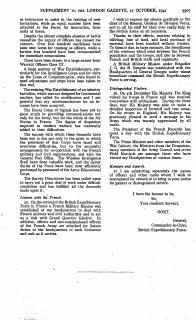
as instructors to assist in the training of new         I wish to express my sincere gratitude to the
formations, while an equal number have been          chief of the Mission, General de Division Voruz,
attached to the Force, for instruction, from         and to all his staff for their ever ready help to
units at home.                                       the-British Army on all occasions.
   Despite the almost complete absence of battle        Thanks to their efforts, matters relating to
casualties the supply of officers has caused me      billeting, hire of land, and local purchase of
concern. Over four hundred candidates have           material have been handled without friction.
been sent home for training as officers, while a     To them is due, in large measure, the friendliness
further four hundred have been recommended           of the relations which exist between the French
for immediate commissions.                           population and the troops, and also as between
   These have been drawn to a large extent from      French and British staffs and regiments.
Warrant Officers Class III.                             A British Military Mission under Brigadier
   A large number of War Establishments, par-        J. G. des R. Swayne was established with the
ticularly for the Intelligence Corps and for units   Headquarters of General Georges under whose
on the Lines of Communication, were found to         immediate command the British Expeditionary
need adjustment and steps have been taken to         Force is serving.
this end.
   The existing War Establishment of an infantry      Distinguished Visitors.
battalion, which was not designed for Continental       26. On 4th December His Majesty The King
warfare, has called for modification and I am         visited his troops in France and was received
grateful that my recommendations for an in-          -everywhere with enthusiasm. During the three
crease have been accepted.                            days tour His Majesty was able to make a
   The Royal Corps of Signals has been put to         detailed inspection of forward and rear areas.
great strain in providing communications not          On his return to England, His Majesty was
only for the Army, but for the whole of the Air       graciously pleased to send a message to his
Forces in France. The degree of dispersion            Army which was warmly appreciated by all
required in modern warfare has materially             ranks.
added to their difficulties.                             The President of the French Republic has
   The success with which these demands have          spent a day with the British Expeditionary
been met is due not only to the spirit in which       Force.
the personnel of that Corps have faced and               The Prime Minister and other members of the
overcome difficulties, but to the successful          War Cabinet, the Ministers from the Dominions,
arrangements for co-operation with the French         many members of the Army Council and seven
military and civil organisations, and with the        Field Marshals are amongst those who have
 General Post Office. The Wireless Intelligence       visited my Headquarters at various times.
Staff have done valuable work, and the cipher
duties of the Force have been most efficiently       Honours and Awards.
performed by personnel of the Army Educational          27. I am submitting separately the names
Corps.                                               of officers and other ranks whom I wish to
   The Survey Directorate has been called upon       recommend for reward or to bring to your notice
to carry out a great deal of work under difficult    for gallant or distinguished service.
conditions and has fulfilled all the demands
made upon it.
                                                                   I have the honour to be,
Liaison with the French.                                                      Sir,
  25. On the arrival of the British Expeditionary                      Your obedient Servant,
Force in France a French Military Mission was
established at my headquarters to deal with                                       GORT.
French military and civil authorities and to act
as a link with Grand Quartier General. In
addition, officers and non-commissioned officers                                           General,
of the French Army are attached for liaison                                   Commander-in-Chief,
duties to the headquarters of each formation                          British Expeditionary Force.
and unit as it arrives.
Details
SUPPLEMENT TO THE LONDON GAZETTE, 17 OCTOBER, 1941                                      5909
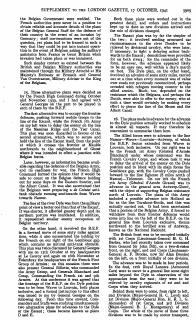
  the Belgian Government were wedded. The                     Both these plans were worked out in the
  French authorities were never in a position to          greatest detail, and orders and instructions
  obtain reliable and accurate details of the plans       kept up to date as new divisions arrived and
  of the Belgian General Staff for the defence of         the role of divisions changed.
  their country in the event of an invasion by                The Escaut plan was by far the simpler of
  Germany; staff conversations were out of the            the two; it involved sending armoured car
  question, yet plans had to be framed in such a          reconnaissances to the river Dendre to be
  way that they could be put into instant opera-          relieved by divisional cavalry, who were later,
  tion in the event of Belgium asking for military        if necessary, to fight a delaying action back-
  assistance from France or Great Britain when             wards to the Escaut; demolitions were provided
  invasion had taken place or was imminent.                for on both rivers; for the remainder of the
     Such slender contact as existed between the           force, however, the advance appeared likely
  British and Belgian Military authorities was             to be an easy one, well within a day's march
  maintained through the Military Attach^ at His           on foot. The Dyle plan, on the other hand,
  Majesty's Embassy at Brussels and General               involved an advance of some sixty miles, carried
  Van Overstraeten, Military Adviser to the King           out at a time when every moment was of value
  of the Belgians.                                         over roads not previously reconnoitred, perhaps
                                                           crowded with refugees moving counter to the
       15. Three alternative plans were decided on         allied armies. Much, too, depended on the
    by the French High Command during October             resistance which the Belgians, and perhaps the
    and November 1939, and I had agreed with              Dutch, were able to offer to the enemy, who at
    General Georges on the part to be played in           such a time would certainly be making every
    each of them by the B.E.F.                            effort to pierce the line of the Meuse and the
                                                          Albert Canal.
       The first alternative was to occupy the frontier
    defences, pushing forward mobile troops to the             16. The plans made in advance for the advance
    line of the Escaut, while the French 7th Army           to the Dyle position actually worked to schedule
    on my left were to delay the enemy on the line          in almost all respects. It may therefore be
    of the Messines Ridge and the Yser Canal.               convenient to summarise them here.
   This plan was soon discarded in favour of the
    second alternative, which was to secure and               The Allied forces were to advance to the line
   hold the line of the Escaut itself, from the point       Namur—Wavre—Louvain—Antwerp, of which
   at which it crosses the frontier at Maulde               the B.E.F. Sector extended from Wavre to
   northwards to the neighbourhood of Ghent                 Louvain, both inclusive. On our right was to
   where it was intended to effect a junction with         be the French ist Army (General d'Armee
   Belgian forces.                                          Blanchard) under whose command was the
                                                            French Cavalry Corps, and whose task it was
       Later, however, as information became avail-        to delay the arrival of the enemy on the Dyle
   able regarding the defences of the Belgian Army,        position and to block with its main forces the
* and its readiness for war, the French High               Gembloux gap, with the Cavalry Corps pushed
   Command formed the opinion that it would be             forward to the line Eghezee (8 miles north of
   safe to count on the Belgian defence holding            Namur)—Tirlemont. On our left the French
   out for some days oh the Eastern frontier, and          7th Army (General d'Armee Giraud) was to
   the Albert Canal. It was also ascertained that          advance to the general area Antwerp-Ghent,
   the Belgians were preparing a de Cointet anti-          with the object of supporting Belgian resistance
   tank obstacle running southwards from Wavre             north of Louvain. The plans of this Army
  towards Namur.                                          included a possible advance into Holland as
      The line of the river Dyle was from the military     far as the line Turnhout-Breda, and this was
  point of view a better one than that of the Escaut.      actually carried out. It had been ascertained
  It was shorter, it afforded greater depth and its        that a portion of the Belgian Army, if forced to
  northern portion was inundated. In addition,            withdraw from their frontier defences would
  it represented smaller enemy occupation of              come into line on the left of the B.E.F. on the
  Belgian territory.                                      general line from Louvain exclusive, thence
                                                          northward to the fortified area of Antwerp,
      On the other hand, it involved the B.E.F.           known as the National Redoubt.
  in a forward move of some sixty miles against
  time, while it also necessitated the holding by             The British front was to be occupied initially
  the French on our right of the Gembloux gap             with ist Corps (Lieutenant-General M. G. H.
  which contains no natural anti-tank obstacle.           Barker, who had recently taken over command
  This plan was twice discussed by General Georges        from General Sir John Dill), on a two-division
  with me on I3th October at my headquarters              front, on the right, and 2nd Corps (Lieutenant-
 at Le Cauroy and again on i6th November at               General A. F. Brooke, now Sir Alan Brooke)
 Folembray the headquarters of the French First           on the left, on a front initially of one division.
 Group of Armies; on this occasion there were                 The advance was to be made in four periods.
 also present General Billotte, who commanded             In the first, i2th Royal Lancers (Armoured
 the Army Group, and Generals Blanchard and               Cars) were to move to a general line some eight
 Corap, Commanding the French ist and gth                 miles beyond the Dyle in observation of the
 Armies. At this conference it was agreed that            approaches from the east; they were to be
 the frontage of the B.E.F. on the Dyle position          relieved by cavalry regiments of ist and 2nd
 was to be from Wavre to Louvain, both places             Corps when they arrived.
 inclusive, and a formal instruction to this effect           Behind them were to come, from right to left,
 was issued to me by General Georges on the               2nd Division (Major-General H. C. Loyd) and
 following day. From this time onward, Com-               ist Division (Major-General Hon. H. R. L. G.
 manders and Staffs were studying simultaneously          Alexander) of ist Corps, and 3rd Division
 two alternative plans for advances to the Dyle           (Maj01-General B. L. Montgomery) of 2nd
 or the Escaut; these became known as plans               Corps. The whole of the move of these three
 DandE.                                                   divisions was to be made by motor transport,
Details
SUPPLEMENT TO THE LONDON GAZETTE, 17 OCTOBER, 1941

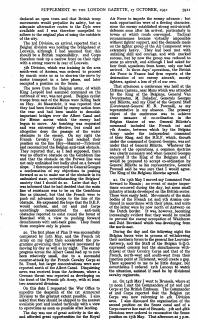
declared an open town and that British troop         Air Force to impede the enemy advance; but
movements would prejudice its safety, but no         such opportunities were of a fleeting character,
adequate alternative routes to the Dyle were         since the enemy established strong anti-aircraft
available and I was therefore compelled to           defences soon after his arrival, particularly in
adhere to the original plan of using the outskirts   towns at which roads converged. Tactical
of the city.                                         reconnaissance became virtually impossible
    The 3rd Division, on arrival, reported that a    without fighter support, and the demands made
 Belgian division was holding the bridgehead at      on the fighter group of the Air Component were
 Louvain, although I had assumed that this           extremely heavy. They had been met with
 should be a British responsibility. 2nd Corps       unfailing skill and courage, and with marked
 therefore took up a narrow front on their right     success, but by now the group was reduced to
 with a strong reserve in rear of Louvain.           some 50 aircraft, and although I had asked for
    5th Division, which was training in the area     four fresh squadrons from home, only one had
 south-west of Amiens, was ordered to proceed        arrived. In three days' operations, the British
 by march route so as to shorten the move by         Air Force in France had firm reports of the
 motor transport in a later phase, and later         destruction of 101 enemy aircraft, mostly
 occupied a position on the Senne.                   fighters, against a loss of 78 of our own.
    The news from the Belgian army, of which            That afternoon a conference was held at the
 King Leopold had assumed command on the             Chateau Casteau, near Mons which was attended
 outbreak of war, was not good. Belgian cyclist      by the King of the Belgians, General Van
 troops from east of the Meuse were falling back     Overstraeten, M. Daladier, Generals Georges
 on Huy. At Maastricht, it was reported that         and Billotte, and my Chief of the General Staff
 they had been forestalled by enemy action from      (Lieutenant-General H. R. Pownall), as my
 the rear and had been unable to demolish            representative in my absence. The primary
 important bridges over the : Albert Canal and       object of the conference was to achieve
 the Meuse across which the enemy had                some measure of co-ordination in the
 begun to move. Air bombing was requested            Belgian theatre of war. General Billotte's
 and was extremely effective, but could not          command included the French ist and
 altogether deny the passage of the water            7th Armies, between which lay the Belgian
 obstacles to the enemy. On my right the             Army under the independent command
 French Cavalry Corps had reached their              of their King, and the B.fe.F. which, though
 position on the line Huy—Hannut—Tirlemont           under the command of General Georges, was not
 and reconnoitred the Belgian anti-tank obstacle.    under that of General Billotte. Whatever the
 They reported that, as I had supposed, there        nature of the operations, a common doctrine
 was no effective obstacle on the Gembloux line      was clearly necessary and when General Georges
 and that the obstacle on the Perwez line was        enquired if the King of the Belgians and I
 not only unfinished but badly sited on a forward    would be prepared to accept co-ordination by
 slope. I thereupon conveyed to General Georges      General Billotte as bis representative, General
 a confirmation of my objections to pushing          Pownall said he was sure that I would agree.
 forward so as to make use of the obstacle in its    The King of the Belgians likewise agreed.
 unfinished state, notwithstanding the Belgians'      . 21. On I3th May I moved my Command Post
 anxiety that I should do so. Later that day I       forward to Renaix; no event of major impor-
 was informed that he had decided that the main      tance occurred during the day, but some small
line of resistance was to be on the Gembloux         infantry attacks developed on the British sector.
 line as planned, but that the French were to        These were easily held. Movements of the main
 push out advanced troops to the line of the         bodies of the French ist and 7th Annies con-
obstacle. He expressed the hope that the B.E.F.      tinued in accordance with their plans, and units
would conform, and ist and 2nd Corps                 of the latter were by now north of Antwerp on
 accordingly      reconnoitred   the     anti-tank   the Dutch border. It was, however, becoming
obstacles reported to exist round the forest of      increasingly evident that they would be unable
Meerdael with a view to pushing forward              to prevent the enemy occupation of Walcheren
detachments with anti-tank guns. They found          and Zuid Beveland which was developing from
them complete only in places.                        the north-east.
    20. The first phase of Plan D was successfully      During the day and the following night the
completed by i2th May, and the French ist            Belgian forces were in process of withdrawing
Army on my right then accelerated the pro-           their northern forces to the general line Louvain-
gramme governing their forward movement by           Antwerp, and the Staff of the Belgian G.Q.G.
moving by day as well as by night. The enemy         expressed concern lest the simultaneous with-
progress across the Albert Canal had up to now       drawal of their Cavalry Corps and that of the
been relatively small, due to a successful           French, north-west and south-west from their
counter-attack by the French Cavalry Corps at        junction point at Tirlemont, would create a gap.
St. Trend, but larger concentrations were now        There appeared to me to be little danger, but
reported north of the Albert Canal. Disquieting      nevertheless I ordered I2th Lancers to watch
news was received from the Ardennes, where a         the situation, assisted if need be by divisional
German thrust was reported as developing on          cavalry regiments.
the front of the French gth Army, with at least         22. On I4th May I went to Brussels, where at
two armoured divisions.                              12 noon I met the Commanders of ist and 2nd
    On this date I requested the War Office to       Corps at the British Embassy. The Commander
expedite the despatch of the ist Armoured            of 2nd Corps reported that the Belgian ist
Division to the greatest extent possible. I also     Corps was now reforming in 4th Division
asked that they should be shipped to the nearest'    area. I also discussed the organisation of the
available port and loaded tactically with a view     second position on the Senne canal and of a
to operations as soon as possible after landing.     Corps reserve line east of Brussels. 5th and 48th
    The day was one of great activity in the air,    Divisions were ordered to reconnoitre the Senne
and afforded great opportunities for the Royal       position on I5th May. That afternoon at 3 p.m.
Details
' SUPPLEMENT TO THE LONDON GAZETTE, 17 OCTOBER, 1941
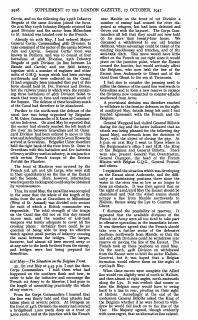
  Carvin, and on the following day isgth Infantry        near Maulde on the front of ist Division a
  Brigade of the same division joined the force.         number of enemy had crossed the river dis-
  On 2ist May I27th Infantry-Brigade rejoined the        guised as refugees, but had been detected and
  42nd Division and the sector from Millonfosse          driven out with the bayonet. The Corps Com-
  to St. Amand was handed over to the French.            manders all felt that they could hot how hold
     Already on 2oth May, I had ordered Major-           on for more than .twenty-four hours. We
  General Curtis, Commanding 46th Division, to           discussed a withdrawal to our old frontier
  take command of the sector of the canals between       defences, where advantage could be taken of the
  Aire and Carvin. General Curtis' force was             existing blockhouses and trenches, and of tha
  known as Polforce, and was to.consist of four          anti-tank ditch. This move would have little
  battalions - of 46th Division, 25th Infantry           effect on the French on our right since it would
  Brigade of 5.oth Division (in line between La          pivot on the junction point, where the Escaut
  Bassee and Carvin) and one field battery,              crossed the frontier, but "would seriously affect
  together with a number of engineer and other          the Belgians, who now held the line of the
  units o'f G.H.Q. troops which had been moving         Escaut from Audenarde to Ghent and of the
  northwards and .were collected on the Canal.          canal from Ghent to the sea at Terneuzen.
  It had originally been intended that part of this         I had also to consider the pressing need to
  force should hold St. Pol, Prevent and Divion,        stiffen the defence of the canal line westwards to
  but the railway trains in which were the remain-      Gravelines and to form a new reserve to replace
 ing three battalions of 46th Division failed to        the divisions now committed to counter-attacks
 reach that town in time and remained south of          southward from Arras.
 the Somme. The defence of these localities south          A provisional decision was therefore reached
 of the Canal had therefore to be abandoned.            to withdraw to the frontier defences on the night
     Further to the north-west the defence of the       of 22nd/23rd May, details being left until I had
 canal line was being organised by Brigadier            reached agreement with the French and the
 C. M. Usher, Commander of X Lines of Communi-          Belgians.
 cation Sub-area. On 22nd May he reported that             General Weygand had visited General Billotte
 the enemy had already reached the left bank of         during the day and the latter indicated that an
 the river Aa between Gravelines and St. Omer.          attack was being planned for the following day
 23rd Division had been ordered to move to this         (22nd May), northwards from the direction of
 area and its leading battalion (6th Green Howards)     Roye, with the object of closing the gap. At
 arrived at Gravelines. Brigadier Usher therefore       8 p.m. on 2ist May I went to Ypres where in
 held the right bank of the river from St. Omer to      the Burgomaster's office I met H.M. the King
 Gravelines with this battalion and five batteries      of the Belgians and General Billotte. There
 of heavy artillery used as infantry, in conjunction   were also present General Van Overstraeten,
 with certain French troops of the Secteur             General Champon, the head of the French
 Fortifie des Flandres.                                Mission with Belgian G.Q.G., General Pownall
    The front of Macforce was covered by the           and others.
 French, 3rd, 4th and 5th Corps, who were still            I explained the situation which was developing
 in their quadrilateral on the line of the Escaut      on the Escaut about Audenarde, and the diffi-
 and the Sensee. Here, however, information            culty of maintaining positions there since the
 was frequently lacking and could only be obtained     water in the river was so low as no longer to
 by reconnaissance.                                    form an obstacle. It was then agreed that on
    Thus, by 22nd May, the canal line was occupied     the night of 22nd/23rd May the Escaut should be
in the sense that the whole of the length of 85        abandoned and that the Allied armies should
miles from the sea at Gravelines to Millonfosse        occupy a line from Maulde northwards to
 (West of St. Amand) was divided into sectors          Halluin, thence along the Lys to Courtrai and
 for each of which a British commander was             Ghent.
responsible. The total strength of the troops              I discussed the possibility of reserves. It
 on the Canal line did not on this day exceed          appeared that the available divisions of the
 10,000 men, and the number of anti-tank               French ist Army were all too tired to take part
 weapons was barely adequate to cover all the          in offensive operations in the immediate future.
 crossing places: certainly there could be no          It was therefore agreed that the French should
 question of being able to keep an effective           take over a further sector of the defensive
 watch against small parties of infantry crossing      positions northwards from Maulde, so that the
the canal between the bridges. The barges,             2nd and 48th Divisions could be withdrawn into
however, had almost all been moved away or             reserve on leaving the line of the Escaut. The ,,
 at any rate to the bank furthest from the enemy,      French took up these positions on 22nd May.
.and bridges were fast being prepared for              On the north, 44th Division on withdrawal
demolition.                                            from the Escaut were to hold the sector Halluin- -
                                                       Courtrai, but it was hoped that a Belgian
2ist May—The Situation on the Belgian Front.           formation would relieve them on the night of
   35. On 2ist May at 4.45 p.m. I met the three        23rd/24th May.
Corps Commanders. I told them what had                     When these moves were complete the Allied
happened on the southern flank and how, in             line would run slightly west of north to Halluin,
-order to take the initiative and encourage the        and then almost at right angles, north-eastwards
French ist Army to do likewise, I had gone to          along the Lys. It was evident that sooner or
the length of committing practically the whole         later the Belgian army would have to swing
of my reserve.                                         back to a line in rear, pivoting on their right
   From the Corps Commanders I learned that            of Halluin. Accordingly at the end of the
the line was thinly held and that attacks had          conference General Billotte asked the King of
taken place at several points. At Petegem on           the Belgians whether if he were forced to with-
the front of 44th Division the enemy had secured       draw he would fall back on to the line of the
a bridgehead 1,000 yards deep on a front of            Yser. His Majesty agreed, though evidently
3,000 yards, and at the junction with the French       with some regret, that no alternative line existed.
Details
SUPPLEMENT TO THE LONDON GAZETTE, 17 OCTOBER, 1941                                    5927
beaches were organised at La Panne, Bray Dunes          While at the Bastion, General Koeltz asked
and Malo-les-Bains, one being allotted to each       me, shortly after n p.m. whether I had yet
Corps ; and military beach parties were impro-       heard that H.M. the King of the Belgians had
vised on each Corps beach. They carried on           asked for an armistice from midnight that
without naval assistance for two days, but were      night. This was. the first intimation I had
hampered by a.shortage of small boats and by a       received of this intention, although I had
lack of experience in their use. The troops were     already formed the opinion that the Belgian
unable to handle boats on a falling tide, and        Army was now iqcapable of offering serious
during daylight on the 27th, when only one           or prolonged resistance to the enemy. I now
destroyer and two whalers were available for         found myself suddenly faced with an open gap
work on the beaches, not more than two hundred       of 20 mile's between Ypres and the sea through
men were embarked.                                   which enemy armoured forces might reach the
    Dunkirk, which for some days had been            •beaches.
heavily bombed, received a particularly severe          Owing to the congestion on the roads, I did
 attack on 27th May; lorry columns had been          not get back to my headquarters at Houtkerque
 set on fire in the town and a pall of black smoke   until about 4.30 a.m. on 28th May. There I
from the burning oil tanks .hung continuously         found that a telegram had been received from
 over the town and docks, impeding the air            the War Office at 1.30 a.m. saying that H.M.
 defence.                                             the King of the Belgians was capitulating at
    Though the outer mole could still be used         midnight.
 the inner harbour was now blocked except to
 small ships.                                         Withdrawal- to' the Sea.
    Dunkirk was therefore cleared of all troops          52. .Next morning (28th May), General
 and they were sent to the dunes east of the          Blanchard arrived at my headquarters at
 town to await embarkation. The port itself           Houtkerque at about n a.m., and I read him
 was kept under the control of G.H.Q. and            .the telegram which I had received the previous
 manned by naval ratings. At one time it              day from the Secretary of State. It was then
 seemed likely to go out of use at any moment,        clear to me that whereas we had both received
 but troops were in fact embarked there till the      similar instructions from our own Government
 end, in numbers which far exceeded expecta-          for the establishment of a bridgehead he had,
 tions.                                               as yet, received no instructions to correspond
    Supplies, water and ammunition were des-          with those I had received to evacuate my troops.
 patched from England to the beaches, and             General Blanchard therefore could not see his
  on 28th May the first convoy arrived. Unfortu-      way to contemplate evacuation.
 nately a high proportion of these stores were            I then expressed the opinion that now the
  destroyed on the way over or sunk when.             Belgian Army had ceased to exist, the only
  anchored off the shore. Nevertheless consider-      alternatives could be evacuation or surrender.
  able quantities were landed at Coxyde and La        The enemy threat to the North-Eastern flank
  Panne and served to create a badly needed           appeared certain to develop during the next
  reserve.                                            forty-eight hours. The long South-Western flank
• During 27th May, the move of 5th and 5oth           was being subjected to constant and increasing
  Divisions was completed and the left flank thus     pressure, especially at Cassel and Wormhoudt,
  extended as far as Ypres. On the front from         and the arrival of the enemy heavy columns
  Bergues to Hazebrouck enemy pressure steadily       could not be long delayed. These considerations
  increased.                                          could not be lightly dismissed. While this dis-
     On the same afternoon, G.H.Q. moved from         cussion was taking place, a liaison officer arrived
  Premesques to Houtkerque (six miles W.N.W.          from General Prioux, now in command of the
  of Poperinghe). Communications were difficult       French ist Army, to say that the latter did not
  throughout. the day since Corps headquarters        consider his troops were fit to make any further
  were all on the move, and it had not yet been       move and that he therefore intended to remain
  possible to re-establish line communications        in the area between Bethune and Lille, protected
  which hitherto had run through Lille.               by the quadrangle of canals.
                                                          I then begged General Blanchard, for the sake
                                                      of France, the French Army and the Allied
 The Belgian Armistice.                               Cause to order General Prioux back. Surely,
    51. During 27th May, I received a further          I said, his troops were not all so tired as to be
 telegram from the Secretary of State which           incapable of moving. The French Government
 read " . . . want to make it quite clear that        would be able to provide ships at least for some
 sole task now-is to evacuate to England maxi-         of his troops, and the chance of saving a part of
 mum of your force possible ". It was therefore        his trained soldiers was preferable to the cer-
 very necessary to discuss further plans with          tainty of losing them all. I could not move
 General Blanchard, for no policy had yet been         him. Finally he asked me formally whether it
 laid down by G.Q.G. or any other French higher        was my intention to withdraw that night to the
 authority for a withdrawal northward of the Lys.      line Cassel-Poperinghe-Ypres.
 I had no idea what plans either he or Admiral            I replied in the affirmative and informed him
 Abrial had in mind.                                   that I now had formal orders from His Majesty's
    In the evening, I left my headquarters at          Government to withdraw the B.E.F. and that
  Houtkerque with the C.G.S. and the French            if I was to have any hope of carrying them out
 liaison officer from .General Blanchard's head-       I must .continue niy move that night. General
  quarters to try and 'get into touch with General     Blanchard's parting was not unfriendly, and
  Blanchard. I failed to find him at La Panne,         when he left I issued my orders for withdrawal
  so I went on to Bastion No. 32 at Dunkirk to         to provide for that change of mind on the part
  visit Admiral Abrial, only to find- that both he     of the French High Command for which I so
  and General Fagalde were equally unaware of          sincerely hoped and which in fact took place
 his whereabouts.                                      later.
Details
SUPPLEMENT TO THE LONDON GAZETTE, 17 OCTOBER, 1941                                     5929
   I communicated the gist of this report to the          The arrival of these troops, though welcome
 C.I.G.S. and I asked that H.M. Government             from-so many points of view, raised the question
 should consider the policy to be followed in the      of embarkation in an acute form. Admiral Abrial
 event of a crisis arising, as well it might.          had apparently received no orders from his
   In reply, I received two telegrams which            Government that the whole of the British troops
.read:—                                                were to be embarked, and he professed great
      ". . . . H.M. Government fully approve           surprise when he heard of my intentions. He
   ypur withdrawal to extricate your force in          had, it seems, imagined that only rearward
   order embark maximum number possible of             elements were to be withdrawn, and that British
   British Expeditionary Force. . . . If you           troops would stay and defend the perimeter to
   are cut from all communication from us and          the last, side by side with the French. I there-
   all evacuation from Dunkirk and beaches had,        fore sent Sir Ronald Adam to see the Admiral.
   in your judgment, been finally prevented            He explained the orders to extricate my Force
   after every attempt to re-open it had failed        which I had received from His Majesty's Govern-
   you would become sole -judge of when it was         ment and which had been confirmed the day
   impossible to inflict further damage to enemy."     before.
    I also received a gracious telegram of en-            Meanwhile, the French troops were expecting,
 couragement and good wishes from His Majesty,         to embark along .with their British comrades,
 the King, which I communicated to all ranks.          notwithstanding that no French ships had so far
    General Weygand telegraphed on this day            been provided: the beaches were becoming
 appealing personally to me to ensure that the         crtiwded with French soldiers, aiid difficulties
 British Army took a vigorous part in any counter-     might have occurred at any time. I urged the
 attacks necessary; the situation, he added,           War Office to obtain a decision as to the French
 made it essential to hit hard. When he sent           policy for embarkation and asked that the French
 this message, he could have had no accurate           should take their full share in providing naval
 information of the real position or of the powers     faculties. However, to permit embarkation of
 of counter-attack remaining to either the French      the French troops to begin at once, I decided to
 or the British. General Koeltz had not, as yet,       allot two British ships to the French that night,
 had time to return to G.Q.G. with a first-hand        and also to give up the beach at Malo-les-Bains
 report on the situation, and in any case the          for their sole use.
 time for such action in the northern theatre
 was long past.
                                                        Medical arrangements.
   French troops arrive : Problems of embarkation.         56. Hospital ships worked continuously till
                                                        3ist May though "continuous bombing made
      55. By 2gth May, the naval arrangements           their berthing difficult and they frequently had
 .were beginning to bear -fruit: however, during       'to put to sea before they were fully loaded.
   the day, the enemy began to shell Dunkirk from       Walking wounded were taken on board personnel
   the' south-west, and the port and the beaches        ships from Dunkirk or the beaches, but to prevent
   were constantly bombed.                              delay in embarking fit men, orders were issued
      Owing to a misunderstanding, the personnel        that the most serious cases should only be
   of certain anti-aircraft units had been embarked     embarked on hospital ships. Casualty Clearing
  instead of being retained for the defence of          Stations had been established at Dunkirk and at
   the port-of Dunkirk. Therefore, I -was the           the beach at La Panne. Some of the wounded
   more dependent on the action of fighter aircraft,    were, however, too ill to move. They had been
   and I made this clear to the War Office. I           collected into two Casualty Clearing Stations,
  realised how heavy was the demand to be made          one at Crombeke and one at Rosendael, where
   on the Royal Air Force for the remainder of the      they were to be cared for till the enemy should
   operation, and how impossible it would be to         arrive.
  expect that they could succeed completely in
  preventing air action on the beaches. Yet they
  did succeed in intercepting a large part of the      The Evacuation of yd and 2nd Corps.
  enemy attacks, and those which'arrived, though          57. The 3rd Corps Sector included the canal
   at times serious, were never able to impede         from Dunkirk to Bergues, with the town of
  our embarkation for long.                            Bergues, and a little more than two miles of
      French troops were now arriving in the peri-     front west of the town. By the evening of .29th,
  meter in large numbers, and, unfortunately,          3rd Corps had withdrawn 44th and 2nd Divisions
  brought with them much transport. The conges-        from their positions and Corps headquarters
  tion created within the perimeter was well-nigh      were now embarked. 44th and 48th Divisions
  unbearable and for two days the main road'           were ordered to be transferred to ist Corps, and
' between La Panne and Dunkirk became totally          2nd, 23rd .and 46th Divisions to proceed to
  blocked with vehicles three deep. The French         Dunkirk for embarkation, ist Corps was also
  were in process of withdrawing all their troops      ordered to embark what remained of 42nd
  behind the defences on the Belgian frontier, and     Division, except for I26th Infantry Brigade.
  for the next two days' their dispositions were       Subsequently a change was made, 44th Division
  superimposed on those of the British troops in       being embarked and 46th Division remaining
  that part of the perimeter between the frontier      with ist Corps.
  and Bergues. The French military forces,
  within the perimeter or now approaching it,             During the 2Qth and 30th May, 5th and 5oth
  consisted of two weak divisions of the i6th          Divisions came into the 2nd Corps, area: the
  Corps (6oth and 68th), General Barthele'my's         former, sadly reduced in numbers, was with-
  regional troops, General de la Laurencie's           drawn from the line, while the latter occupied a
  3rd Corps of two divisions (i2th and 32nd), and      sector between the Belgian frontier and the right
  the Cavalry Corps, together with some artillery.     of the 3rd Division.
Details
5912          SUPPLEMENT TO THE LONDON GAZETTE, 17 OCTOBER, 1941

   I visited H.M. the King of the Belgians and          By the night of i5th May the movements
   General Van Overstraeten and reached agree-        envisaged in Plan D were all running ahead of
  ment that the Belgian ist Corps should be           schedule. 4th Division was moving into Corps
   withdrawn from the area of 2nd Corps and that      reserve behind 3rd Division; 5th Division was
  the left boundary of the B.E.F. should be           moving on to the Senne in place of 5oth Division
  adjusted so as to allow the Belgians the use of     as originally planned, and the latter was now
  the road Vilvorde-Alost for this purpose. I         moving to G.H.Q. reserve along the River
  also stressed the importance of having fresh        Dendre.
  Belgian troops established early in position
  north of Louvain to continue the British line
  covering Brussels.
     Further serious news came from the south                OPERATIONS—SECOND PHASE
  where the enemy had crossed the Meuse between                         (i7th-26th MAY)
  Sedan and Me"zieres, and further north he was
  reported to be surrounding the fortress of St.       Withdrawal to the Escaut decided on; the threat
  Heribert (4 miles S.S.W. of Namur).                    to Arras and to the right flank; formation of
     The French Cavalry Corps on my right had            Macforce and deployment of 2yd Division on
  on the previous day received orders to retire          the Canal du Nord. The enemy reaches the
  to the Perwez position whence they subsequently        Somme and cuts communications with the Base ;
  withdrew, according to plan, to the main position      Calais and Boulogne invested: the admini-
  running through Gembloux.                              strative position. The organisation of the Canal
                                                         line. Alternative lines discussed with French
     At the request of Air Marshal Barratt I             and Belgians, resulting in further withdrawal
  placed at his disposal for use on the French          from the Escaut to the Frontier defences and
 front three squadrons of fighters which I had          fresh plans for attacks southwards in conjunction
 only recently received in response to an urgent         with French main forces. $th and $oth Divisions
  appeal to the Secretary of State for War.             counter-attack on 21st May. A further attack
     23. On 15th May the Dutch Army laid down           in conjunction with French planned for
 its arms; the immediate effect of this on the           26th May: this plan is abandoned owing to
 operations of the B.E.F. was small, for the            penetration of Belgian line on the Lys.
 British forces operating in Holland had at no
 time been under my command. I anticipated,             The beginning of the withdrawal (ifith-T.'jth May)
 however, that this would come as a shock to              24. By i6th May, it became clear that a
 the Belgian Army.                                     prolonged defence of the Dyle position was
     The French 7th Army withdrew' its advanced        impracticable. The French ist Army on my
 formations to the neighbourhood of Antwerp            right were unlikely to make good the ground
 and on this day ordered divisions to move across      lost' on the previous day, notwithstanding the
 my rear to fill the gap created further south.        support I had given them in the air and on the
 This move, however, did not take place till           ground, and a further withdrawal seemed likely
 some three days later when it was accomplished,       to be forced on them by events in the south.
 thanks to efficient traffic control, with little         On the other hand there had been no serious
 delay to our own movements.                           attack on the Belgian positions on my left;
    On this day (i5th May) I established a             nevertheless, any withdrawal from our present
 command post at Lennick St. Quentin, 6 miles          positions would of necessity involve a withdrawal
 west of Brussels. On the British front, the day       by the Belgian Army in the course of which
 passed quietly on the whole, ist Corps was not        Brussels, and probably Antwerp also, would be
 attacked in strength ; 3rd Division of 2nd Corps     abandoned to the enemy.
 was attacked north-west of Louvain and its              Very early on i6th May therefore, I sent a
 forward positions were penetrated, but a counter-    representative to General Billotte who was
 attack successfully restored the original line.      co-ordinating the movements of the British,
 There was considerable enemy bombing of              French and Belgian Forces; I asked that, if
 rearward areas during the day, and the movement      he intended to withdraw, he should let me know
 of refugees became increasingly difficult to         the policy and the timings at once, especially
 control. This was, in part, due to the bombing       as the first bound back to the Senne canals
 of Tournai and other towns on the routes and         involved a march of some fifteen to twenty
to the French decision to close the frontier to       miles.
pedestrian and horsed traffic. Despite my                At about 10 a.m. I received from him orders
requests, made as early as loth May, the Belgian      for a withdrawal to the Escaut, and for the
authorities had done nothing to restrict the use      occupation of the positions along that fiver
of private motor cars or the sale of petrol.          originally planned. The operation was to begin
    During the day I received a request that I        that night (16/17 May), one day being spent on
should take over part of the front held by the        the Senne and one day on the Dendre positions ;
French division on my right. To meet this             thus the Escaut would be reached on the night
request I placed under the orders of this division    of 18/19 May, though the French orders did
a brigade of 48th Division ; this step proved         not rule out the possibility of staying for longer
necessary since at about 6 p.m. the enemy had         than one day on each bound.
penetrated the French front, thus threatening            That evening, I held a co-ordinating con-
the right of 2nd Division. By this tune, how-         ference at ist Corps Headquarters as a result
ever, 48th Division, less one brigade, was in         of which I ordered 5th Division, which was on
position in ist Corps reserve behind 2nd              the way to join 2nd Corps, to the line of the Senne
Division, and I agreed with the commander of          in ist Corps reserve. Two brigades of 46th
ist Corps that the withdrawal of his right            Division* which had been moved up from the
should take place to the River Lasne to join          Lines of Communication for the protection of
up with the French left. This movement was
carried out on the night of the 15/16 May,              * One of the three divisions sent to France for
closely followed by the enemy.                        pioneer duties.
Details
5924         SUPPLEMENT TO .THE LONDON GAZETTE, 17 OCTOBER, 1941
    some sectors were held jointly with the French.      I replied that a plan for withdrawal north-
    The virtual closing of Dunkirk as a port of        westward had been agreed with the French
    entry was making the supply situation ever         tha't morning; I added that the news from the
    more difficult, and the ammunition situation       Belgian front was disquieting,' and concluded
    permitted only of very restricted expenditure.     by saying:—
                                                             . . . " I must not conceal from you that
  The Plan for Withdrawal.                               a great part of the B.E.F. and its equipment
                                                         will'inevitably be lost even in best circum-
.   44. Later, on 26th May, I discussed the plan         stances."
 for withdrawal with the Corps Commanders, and
 issued orders for the operation in accordance            Later in the day, I had a further teiegram
 with the agreement reached with General               from the War Office which read as follows :—
 Blanchard that morning. The plan, as agreed                 " . . . Prime Minister had conversation
 with the French First Group of Armies, envisaged         M. Reynaud this afternoon. Latter fully
 the reservation of certain roads for the exclusive       explained to him the situation and resources
 use of the B.E.F. In fact, however, French               French Army. It is clear that it will not be
 troops and transport continued to use them, and          possible for French to deliver attack on the
 this added very considerably to the difficulties         south in sufficient strength to enable them to
 of the withdrawal of British troops. The roads           effect junction with Northern Armies. In
 were few and for the most part narrow, and for           these circumstances no course open to you
 the next three days they were badly congested            but to fall back upon coast. . . . M. Reynaud
 with marching troops and horsed transport of             communicating General Weygand and latter
 French formations, and with refugees.                    will no doubt issue orders in this sense
    On the night 26th/27th May, ist and 2nd               forthwith. You are now authorised to
 Corps, leaving rearguards in the frontier defences,      operate towards coast forthwith in con-
 were to swing back to the old divisional reserve         junction with French and Belgian Armies."
 position with their right at Fort Samghin
 (5 miles south-east of Lille), while the French        The Situation, of the Belgian Army.
prolonged this line from Thumeries to the canal
at Pont-a-Vendin, linking up there with 2nd                45. The situation on the Belgian front was
Division. The following night (27th/a8th May),          causing me ever increasing anxiety. At the
main bodies were to withdraw behind the Lys,            conference at Ypres on the evening of 2ist May,
leaving rearguards on the Deule canal up to its         His Majesty the King of the Belgians had agreed
junction with the Lys at Deulemont: these               that, if forced to abandon the positions on the
rearguards were to stay there until the next night      Lys, he would withdraw to the Yser, maintaining
 (28th/29th May). The immediate effect of              touch with the left of the B.E.F. Now, however,
these dispositions would be to shorten the total        signs were not wanting that the Belgian Army
perimeter by some 58 miles, but on the other            were being forced to withdraw northwards and
hand I had to face the possibility of having to         away from the Yser canal. If so, the task of
occupy the front from Ypres to the sea, some            defending the whole line as far as the sea
25 miles long, which was still the responsibility       appeared likely to fall on ourselves and the
of the Belgian Army.                                    French, as actually did happen.
                                                           Admiral of the Fleet Sir Roger Keyes, who
    There remained the question of the future.          had been carrying out liaison duties with
I had not so far discussed with General                 H.M. the King of the Belgians since the opera-
Blanchard a further withdrawal to the sea.             tions began, came to G.H.Q. on the morning of
However, the possibility could not have been           26th May, and I e'xpressed to him my earnest
absent from his mind; nor was it absent from           hope that the Belgian Army would fall back
mine, for, although up to now no instructions          towards the Yser. Sir Roger Keyes took this
had been given authorising me to undertake             message back to the Belgian G.Q.G. at Bruges,
such an operation, I had, as I have said, foreseen     where he saw His Maj esty. Later he telegraphed
the possibility of such a move being forced            to me sajdng that the Belgians would do their
upon us.                                               best, but that His Majesty considered that the
   I returned from the conference at General           only method of avoiding immediate and com-
Blanchard's headquarters at about 10.30 a.m.           plete disaster was a strong and immediate
on 26th May to find a telegram from the                counter offensive between the Lys and the
Secretary of State which read:—                        Escaut. Such an operation was, however, quite
      . . . " I have had information all of            out of the question since, now that 5th and
   which goes to show that French offensive            5oth Divisions had been committed, my reserves
   from Somme cannot be made in sufficient             were again reduced to one weak cavalry
   strength to hold any prospect of functioning        regiment.
   with your Allies in the North. Should this             The indication that the Belgian Army would
   prove to be the case you will be faced with a       withdraw northwards and not to the Yser, was
   situation in which the safety of the B.E.F.         confirmed in a note, a copy of which I received,
   will predominate. In such conditions only           sent on 26th May by General Michiels, the
   course open to you may be to fight your way         Chief of the Staff of the Belgian Army, to
   back to West where all beaches and ports            General Neissens, head of the Belgian Mission
   east of Gravelines will be used for embarka-        with G.K.Q.
   tion. Navy will provide fleet of ships and             This note contained the following passage :—
   small boats and R.A.F. would give full support.           . . . ft To-day, 26th May the Belgian Army
   As withdrawal may have to begin very early             is being attacked with extreme violence on
   preliminary plans should be urgently prepared.         the front Menin-Nevele,* and since the
   . . . Prime Minister is seeing M. Reynaud           0 battle is now spreading to the whole of the
   to-morrow afternoon when whole situation               area of Eecloo, the lack of Belgian reserves
   will be clarified including attitude of French
   to the possible move. . . . "                       • * Eight miles west pf Ghent.
Source: The National Archives, Kew, ADM 116 4649. Contains public sector information licensed under the Open Government Licence v3.0.

Details
The Honours and Awards Committee have carefully
considered the claims to recognition of Officers and Men
for good services in Operation DYNAMO, and submit the
following Appointment and Awards as appropriate:-
Distinguished Service Order
Acting Commander Francis Douglas-Watson, R.N.,
17.177
H.M.S. PANGBOURNE.
Distinguished Service Cross
Lieutenant Commander William George Boaks, R.N.
H.M.S. BASILISK.
Lieutenant Eric Lister Jones, R.N., H.M.S. VERITY
Conspicuous Gallantry Medal
Leading Stoker Ronald Kenneth Robb, D/KX. 18359,
H.M.S. PANGBOURNE.
Distinguished Service Medal
Able Seaman Richard Mumford, J.97179, H.M.S. BASILISK
Able Seaman Herbert A. Alderson, J.108085, H.M.S. BASI
Able Seaman Frederick Joseph Chivers, P/J.78575, H.M.S
VERITY
Mention in Despatches
Commander Maxwell Richmond, O.B.E., R.N., H.M.S. BASIL
Able Seaman Horace Rawstron, R.N. 106622, H.M.S. BA
Ordinary Seaman Thomas W.H. Hancock, R.N.V.R., BD/X.17
VXV
H.M.S. BASILI
Lieutenant Commander Arthur Ronald Mawson Black, R.N.,
H.M.S. VERITY
Leading Signalman Martin Robert Dury, P/J64054,
H.M.S. VERITY
Leading Seaman Alfred Reid, D/J. 13129, H.M.S. PANGBOURN
Temporary Lieutenant Sydney Frederick Harmer-Elliott,
Vxv Chief Petty Officer William G. Thompson, C/J.4150,
R.N.V.R., H.M.S. WAVERLE
H.M.S. WAVERLEY.
Posthumous Mention in Despatches
Gunner (T) Ernest George Francis, R.N. (Retd. ), H.M.S.
VX Officer William George Hoare, P/J.80058, R.N., H.M.S. H.M.S.
Petty Warrant Engineer Harold James Tucker, BASILISK. WAKE
PANGBOURNE.
R.Gleadowe
for HEAD OF COMMISSION AND WARRANT BRANCH.
(R. GLEADOWE)
4th October, 1940.
H.M. The king has been Tripor to affore.
leased to approve mayber these awards.
CL:
Navul Societ amara Thealrare of25/10/40. 7/10 all Gazeltids pp 6227/8 otsup 14/10 tolder Gas
forcurs: 29/10/40

Details
30382/40
-
Min Bernett
pleaseputick old Dyrceno
EDMIRALITY
Paper
Additional Awards for Dynamo Operation
Mention in Despatches
A.O. 3/2
Chief Engine Room Artificer Lionel Edwin Miles, P/M.22015,
H.M.S. Icarus.
Chief Petty Officer Telegraphist Frank Harfield, P/J.96718,
H.M.S. Icarus.
Acting Yeoman of Signals William George Giddings, P/JX.136912,
H.M.S. Icarus.
Petty Officer Cook Frederick Albert Day, P/M.38606, H.M.S.
Jevelanel
Icarus.
Fireman John, Connell, T.124, H.M.S. Medway Queen.
H.M. The king has been pleased to approve
these awards.
This paper should be filed in the docket
containing the main list of awards for opention DYNAMO
Naval Jecretary.
Gleadowe.
6.8.40

Details
The Honours and Awards Committee have carefully
considered the claims to recognition of the crew of
H.M.T. tauspx. MONA'S QUEEN, for good services during the
evacuation of Dunkirk, and submit the following Awards
as appropriate:-
Distinguished Service Cross
Mr. Ernest Harry Ambler, Radio Officer.
Distinguished Service Medal
X
Egerton Watterson, Boatswain. Dis. no 546910.
R. elleadowe
(R. GLEADOWE)
for HEAD OF COMMISSION AND WARRANT BRANCH.
29th November, 1940.
Trofox Lo approve.
Check 50/11
approved BY FIRST LORD.and
by H.M. The King.
NAVAL SECRETARY TO
THE FIRST LORD.
Both Gazetter: p262 2nd Sup to Ldn Gaz 14/1/41
11,x11,40,
Witheelwamer,
17/1/ 41

Details
Page 38
Operation "DYNAMO" - Recommendations of Personnel.
H.M.S. WINCHELSEA - Lieutenant Commander William Alan Frank
Hawkins. R.N.
Completed 6 trips to the Beaches and Dunkirk, lifting
in all a total of over 4,300 troops. Whilst off the
beaches embarking troops from her own boats, she was
attacked and dive-bombed by enemy aircraft. In addition,
bombing attacks were made on her whilst in the Dunkirk
Roads and in Dunkirk Harbour.
Recommendations.
OFFICER.
Lieutenant Commander William Alan Frank Hawkins, R.N.
Throughout the operation displayed great zeal,
initiative and great devotion to duty under extremely
trying circumstances. By his able seamanship and
avoiding actions whilst under way, no real damage was
sustained by this ship.
Recommended for decoration.
RATINGS.
Leading Seaman Walter George Harold Last, P/JX.132139.
Whilst in a whaler working off the beach, showed
great gallantry whilst under fire and in a considerable
tideway dived overboard and rescued survivors from the
KING ORRY and thereafter continued showing seamanship
in preventing capsize of whaler on beach and rescuing
survivors.
Recommended for decoration.
E.R.A. 4th Class, Joseph Edwin Whitenstall, P/MX.57728.
Took charge of motor boat after ship had left;
showed great gallantry in continuing to carry out
embarkation of troops whilst under fire.
Recommended for decoration.
Chief Petty Officer Rupert Armstrong, P/J.104917.
For untiring zeal and devotion to duty in
evacuating troops at Dunkirk and also embarking
troops from beaches in a cutter.
Recommended for mention.
Able Seaman Peter Frederick Byford, P/JX.135125.
crew For of skiff succeeded in rescuing troops from the
untiring zeal and devotion to duty as sole
beaches in considerable surf.
Recommended for advancement.

Details
Page 99
Operation "DYNAMO" - Recommendations of Personnel.
Yacht BYSTANDER (Echo John Sounding Yacht) - Sub. Lieutenant Henry
Beresford Barge, R.N.V.R. V.
Recommendations.
RATING:
Able Seaman (Cook) J. H. Elton, LT/JX.180250 (R.N. Patrol Service)
off the Dunkirk, KING this ship proceeded to remove 0200/30/5 the
Employed as Cook in this yacht. At when
dinghy, with ORRY, then sinking in the fairway. The crew of ft.
effect Elton and one other as crew, launched 8 to
attempted a weak to swim to the yacht, but they were personnel in
a rescue. Most of the KING ORRY's
dived was obvious many would drown. Elton done
that it state owing to the arduous service they had such
of the into the water and assisted and supported thereupon
hour swimmers as he could find for more than half as many
loads whilst the dinghy, rowed by the other rating, an
water Elton put many men on to life-rafts and towed the
of men, returned to the BYSTANDER. Whilst in with
by on swimming. The last men he brought back to the yacht them
a life-raft, were towed by Elton in the water
as a tow-rope with one hand on the raft and one hand acting on
the dinghy - a remarkable feat of endurance. He was
responsible for rescuing about 25 Officers and men. In
supplied hot tea and food to all the 97 men on board
addition to the above, Elton, in his capacity as Cook,
within half an hour of leaving the scene of the wreck,
the cooking utensils, etc, normally sufficing for 7.
He provided dry clothes and blankets and generally
tended the rescued, many of whom were suffering from
shock. This rating was unsparing in his efforts and
acted with great gallantry without regard to his own
safety.
Recommended for decoration.
Motor Boat CONSTANT NYMPH: - Chargehand B.A. Smith, Little Ship Club,
(Owner of Motor Boat).
Recommendation.
Chargehand B. A. Smith, Little Ship Club.
Chargehand Smith proceeded with a crew of 2 Naval
Stokers who had never been to sea, in tow p.m. 30th May
for the beaches. Took in a whaler and cutter, and
during the night ferried off about 800 men to 2 skoots
the JUTLAND and LAUDANIA, who were thus filled up.
CONSTANT NYMPH then collected a number of odd boats
trying to row off to ships filled with soldiers, and
collected them and towed them to offshore vessels.
During thiss time fairly continuous bombing and shelling
were encountered. Chargehand Smith remarks that being
deaf and with a lot to do prevented him noticing these
annoyances. Continued work until all fuel was
exhausted, and the boat was sent to a supply drifter
for repair and refuelling, Chargehand Smith being
ordered back to Margate This civilian showed great

Details
APPROVED BY FIRST LORD.
hisper
NAVAL SECRETARY TO
THE FIRST LORD.
H.M. H. The king has been pleased to appore the
awards Phone in the foreforms lists, with the exception
of the propreed DSM for Provate Crowther, 6 R Field
Ambalance, s. Coy., which has not been submitted
Crowther for the M.M.
A letter should be written to the War other recommending
huspet
Naval Secretany
5.8.40.
Vellum Letter sent to M3 Lambar.
M: Olivias act sent to D.N.A
for payment C/5. 5.01.
R.Sleadave
26.9.40

Details
APPROVED BY FIRST LORD.
Thoyper
NAVAL SECRETARY TO
THE FIRST LORD,
H.M. The king has been pleased to appora the
awards Phone in the foreforms lists, with the exception
of the propreed DSM for Provate Crowther, 6 R Field
Ambalance, s. Coy., which has not been submitted
A l.d. In Lhe tn the Was on.. -
Crown
3
abress 4 вчсопов) .W.O
thught user
tusyper
Name Secreture ,118
9d3 20 about VM yd behnemmos me I
odd To moltensonal end 702 DOV, Intaupos 03
nt tedd Itence0 VISTA
A:
to onea one
matting egrooD steving
40.8 Moll AND
@ 4d 08AD88Y
tuta 20 702 edd 03 Bllv
.labom 180 tvees Dodu signitate
Brid us элічшоное oflaw abrod VM
9108 ed bluow Laboli odd to brown edd Ies
bluew Itensed DATA exis 21 Daig sd bloow Drus stategory
.colton edd of
,THE THE I
Insured $ nethed0 200Y
100.00 20 NEW
$80 1710
.1.0.8

Details
Such a necessity since has the now first arisen. day of Though the the Royal
FROM
meet many and till May this year that the endurance and had
has been very various active calls on its courage, War, and has Navy
it seemed likely invasion of the Low scale would besource,
sea has greatly quickened been unexpectedly intensified, and His Majesty' at
enough. But since the and Countries, the War
MAR
in home waters enterprises have along an engaged coast in a number of Ships
and for hazardous some 2,000 miles. enemy which now stretches vital
In particular the withdrawals in so short a time of the
Armies from Norway, Belgium and France were operations of a kind
which could hardly have been foreseen. They were such as to
great losses and to demand a high degree of gallantry and devotion cause
to duty.
The withdrawal from Dunkirk took nine days. 222 of His
FOR
Majesty's Ships took part in it; some of these were sunk, and many
others damaged. The total number of vessels that went across was
nearly a thousand. A large number of the proposed decorations
would go to Officers and Men of the Royal Navy, taken for the
occasion from service ashore, who are not part of the 150, for
whom the scale allowance provides, and to Seamen not in the Royal
Navy. As these latter were for the time being under Naval
discipline they would be given Naval decorations.
It may be relevant to mention that the total number of
decorations awarded for the short action at Zeebrugge in the last
War was 222, or more than two months scale allowance for the whole
seagoing Fleet today. The force employed was 82 Officers and
1698 Men, less than one tenth of that which saved the Armies from
Dunkirk.
I need not say that the Admiralty have no intention of
lowering the standard for decorations in this war. It is in fact
steadily rising. Should the calls on the Royal Navy fortunately the
lessen, that scale the allowance we Committee will, to as provide we have for in unforeseen the past, save Operations; what we but can and we of hope
hazards of Naval warfare will accept have the view that the relentless rigours through-
Majesty's Ships afloat that would the have thousand decorations earned in this period
out these ten months been so heavy and allowed to His
for be ready to invite the King to sanction from Dunkirk; a further 350 decorations
if there had been no withdrawal been fully and that will
this unique and arduous enterprise.
Treasury Chambers,
Whitehall,
S.W.1.
16th July, 1940.
2.

Details
M. 12538 (M. of S.)
which made recommendations:-
Considered the following by the Honours and Awards Committee
Road
Hower Primrose Cooper
Distinguished Service Medal
Ramarat
Mr. H. E. Knight, Coxswain of the Ramsgate Life Boat.
ancharge
Mr. Parker, Coxswain of the Margate Life Boat.
Submitted for approval.
just
Mangale
(J.P. DROOP)
for HEAD OF 8th COMMISSION AND WARRANT BRANCH.
August, 1940.
Propose L- appron
HRM 10/8
APPROVED BY FIRST LORD.
hispit
NAVAL SECRETARY TO
THE FIRST LORD.
A.M. The king has been pleased to approve there
awards.
Naval Secretary
21.8.40. 21. 8.40.
Both these Coxsurine were genzetted 'DSM' - see p5711
of 2nd Sup to Ldn Gog of 26/9/40. Wheelower.
for C.W.B.
28/9/1940

Details
The Honours and Awards Committee have
carefully considered the claims to recognition of
George Wingfield
Tenpey Skipper G.W. Smith, R.N.R., of H.M.D., THREE KINGS, for
good services at DUNKIRK, and submit t the following
Award as appropriate:-
Mention in Despatches
A letter anther of Victor explanation will also be sent to
Tempy Skipper A.V. Long, R.N.R. who was recommended in error.
R. Gleadowe
(R. GLEADOWE)
for HEAD OF COMMISSION AND WARRANT BRANCH.
24th January, 1941.
The 5 affrom.
Ch: 20
APPROVED BY FIRST LORD. THM
The King.
MAyfet
NAVAL SECRETARY TO
THE FIRST LORD
-4 - 4 FEB 1941
Letter to Skipper Long
necessary Ty: Skipper George wingpies Smith w.s. 2999 RNR 11/2/41 : Gagetter p810 2nd Sup L.Es: 11/2/4 cur
Correction, deleting name of Skipper Long: Gagetted b 968 2nd
for
Sup london Gazetta 18/2/41
Service Card notid
Abelui
for
10/3/11

Details
CW. 7896/41
Dunkirk considered and the report of the Withdrawal carefully
The a Honours further and Awards on Committee have
appropriate:-
submits the following additional Award from as
He
Mention in Despatches
Mr. Le Huguet, Chief Officer, Isle of Guernsey.
J.P. Droop
FOR HEAD OF COMMISSION GLEADOWE AND WARRANT BRANCH
for R.
9th April, 1941
Proform Eaptrone.
APPROVED and BY FIRST LORD.
by H.M. The king
husyful
Ch. Chilly
NAVAL SECRETARY TO
THE FIRST LORD.
award published in Lond on gayette 18.4.41. Supplement 15147 of 29ᵗʰ april,
B. fabes adam.
for Hd of C.wf.
301441

Details
2nd May
1.
C.W. 7869/41.
officer
Sir,
With reference to your letter
of the 25th March S.Ped.86/75
I am commanded by My Lords
Commissioners of the Admiralty to
inform you that the King has
approved the award of a "Mention
in Despatches" to Mr. Le Huquet,
additional to that approved for
Mr. Pembry. This award was
published in the supplement to
the London Gazette latest 29th
April, 1941.
dated
I am Sir,
Your obedient Servant
(Signed) R. GLEADOWE.
'he General Manager,
outhern Railway,
eepdene Hotel,
orking, Surrey.

Details
C.W.26612/41,
M.N.2.9.41, Item 74.
The Honours and Awards Committee have carefully
considered the claims to recognition of M. Georges Ragaert,
(Belgian) for his services in M.V. Z.50 LYDIE ZUZANNE
during Operation DYNAMO, and submit that the following Award
is appropriate:-
British Empire Medal (Civil)
J.P.Droop
for SECRETARY, HONOURS AND AWARDS COMMITTEE
6th September, 1941.
Propre 6 aprom
10Pm of
APPROVED BY FIRST LORD.
amPila
NAVAL SECRETARY TO
THE FIRST LORD.
11.9.41
the
In view of the fact that M. Georges Ragaert was at
for operation, to time these Master services, he is of qualified his and own the for ship paper the and is Distinguished taking part in Service a Naval view Cross
Medal, that award being approved instead resubmitted of the British with Empire a
which is not quite (appropriate.
APPROVED BY HCH
R. Gleadowe
H.M. THE KING
SECRETARY, HONOURS AND AWARDS COMMITTEE.
19
8th October, 1941.
APPROVED BY FIRST LORD. Propose to ppm
am Paten.
ittem
NAVAL SECRETARY TO
THE FIRST LORD.
Letter to FO Rugard

Details
ADMIRAITY, S.W.I.
CW. 26612/41.
25th October,1941.
Dear Mr. Van Campenhout,
On the First Lord's recomendation, and subject to the
agreement of the Belgian Government, the King has approved the
Immediate Award of the Distinguished Service Cross to Acting
Leading Seaman Georges François Ragaert.,LE/SB/JX.62 for his good
services, of which we have only just learned, in the withdrawal
from Dunkirk. As Master of M.V.2.50, LYDIE ZUZANNA, he carried
several shiploads of English soldiers.
I hope that your Government will agree to the acceptance
of this well-deserved Award.
Believe me,
Yours very truly,
(Sga.) in V.MARKAM
M. A. van Campenhout, Ministre des
Affaires Chef de Economiques et des Communications.

Details
H&A
HOYAUME DE BELGIQUE
Ministeres des Affaires Economiques
37, EATON PLACE,
et des Communications
LONDON, S.W.I.
Cabinet du Ministre
Tel.: Sloane 9211.
Réf. No.: AVC/NE 16103.
13th November 1941.
Dear Sir Henry,
I beg to acknowledge receipt of your letter of
the 25th October, 1941, informing us that the King has
approved the immediate award of the Distinguished Service
Cross to Acting Leading Seaman Georges François RAGAERT,
LT/SB/JX.62, for his good services in the withdrawal
from Dunkirk.
I am directed by the Minister of Communications
to inform you that the Belgian Government fully agrees to
the acceptance of this award and is most gratified at
the honour conferred on one our brave sailors.
sincerely,
A. van Campenhout,
Chef de Cabinet.
Sir Henry Markham, K.C.B., M.C.,
The Admiralty,
S.W.1.

Details
H.& A.
18th November,1941.
Dear Light,
On the First Lord's recommendation the
King has approved the Immediate Award of the
Distinguished Service Cross to a Belgian,
Acting Leading Seaman Georges François Ragaert,
LT/SB/JX.62, for his good services in the
withdrawal from Dunkirk, when, as Master of
M.V.2.50,LYDIE SUZANNA, he carried several
shiploads of English soldiers.
It has been ascertained through Naval
channels that the Belgian Government is
you will inform them officially in the usual
prepared to accept the Award. I presume that
way. The Admiralty will arrange for the
presentation of the decoration.
Yours sincerely,
Signed) R. GLEADOVN
E.W.Iight,Esq.,
Foreign Office.

Details
18th November,1941.
CW.26612/41.
Sir,
I am to inform you that They been
commanded by My Lords Commissioners have
learnt of <<<<<<<<<<<<<<<<<<<<<<<<< the with Admiralty that the King the 2. Award has to you
<<<<<<<<<<<<<<<<<<<<<<<<<
good ZUZANNA, in the
The Cross will be presented to you in
due course.
I am, Sir,
Your obedient Servant,
Signed) R. GLEADOWN
Georges Rageert,LT/SB/JX.62.
Leading Sman
c/o G.P.O.

Details
CW.26612/41.
18th November,1941.
Sir,
commanded by My Lords Commissioners have
of the I am Admiralty to inform you that They been
learnt with pleased to approve the Award for your you
pleasure that the King has to
graciously Distinguished Service Cross 2.50,LIDIE
ZUZANNA, good in the withdrawal from
of the services as Master of M. V. 2. Dunkirk.
The Cross will be presented to you in
due course.
I am, Sir,
Your obedient Servant,
signed) R. GLEADOWS
Georges
Source: The National Archives, Kew, ADM 199 790. Contains public sector information licensed under the Open Government Licence v3.0.

Details
3.
541
proceded we struck one of the very
511
522
wreckage, doing so lost the use of
both our rudders. For several anscious
minutes we visualised ourselves fighting 8 little rearguard
action of our own, but after several vain calls on the charity
of France, we were rescued by an MTB, which passed our tow
to a large motor yacht when we reached the outer herbour.
Yug Vinain
Except for the fact that a stray enemy aircraft drop-
ped two flares near us, our journey to Dover was uneventful,
to
and after placing the "Malborough" in the charge of the King's
Harbour Master, we returned to Ramsgate by lorry.
I would like to dra your attention to the excellent
coxing and seamanship displayed by Sublicutenant Pool, who
had no previous experience of bosts of the "Malborough's"
512
type, yet who manoevered her under exceedingly difficult and
exiting conditions in confined waters strewn with debris, much
of which, though harmless to the other launches, meant certain
destruction to the vunerable underwater fittings of the
N1940
hydroplane. His task was made particularly difficult by the
fact that these boats have a minimum speed of eight knots
under power.
-o0o-
Sublieut. RN.
ief
agret
G. A. Gabbett- Mulhallen.
Sub.Lieutenant Royal Navy.
The Captain's Secretary.
H.M.S. FERVENT.
RAMSGATE.
522
Source: The National Archives, Kew, ADM 199 792. Contains public sector information licensed under the Open Government Licence v3.0.

Details
Personal and Secret.
Admiralty,
Whitehall.
1940
1940.
August, 1940.
B.E.
Dear Admiral Ramsay,
3
nd
;
1
We have been as quick as we can with your Dunkirk
recommendations, and the First Lord's Humble Duty form
or
is now with the King. There are one or two difficult
cases which call for a special letter to you.
The first is that of Vice Admiral Somerville, who
by
is already a Knight Commander of the Bath and a Companion
of the Distinguished Service Order. For his services
in the Dunkirk operation the only possible Honour would
be appointment as a Knight Commander of the British
Cion
Empire. Such an appointment of one who is already a
K.C.B. would be unusual, and perhaps hardly appropriate.
For this reason, feeling sure that he and you will
understand the difficulty, it has been approved that Vice
Admiral Somerville should be awarded a Mention in Despatches.
The second difficult case is that of Captain Llewellyn
Vaughan Morgan, your Chief of Staff. His case is harder
still, especially as some officers have already been
decorated for Dynamo's staff work at Dover. The correct
appointment for his services would be that of Commander of
lyn
the British Empire, which he already has. It is fully
realised by Their Lordships that the ability, energy, tact
and leadership of Captain Morgan were essential to the
success of this operation, and there is no doubt that he
has earned further Decoration. As his services were not
in action he cannot immediately be appointed a Companion
of the Bath or of the Distinguished Service Order. He could,
however, be made a Companion of the Bath in the New Year
Honours List, and the suggestion is that you should be
invited to include his name in your next half-yearly
recommendations, in the hope, that a C.B, at the New Year
may be available for him' In the meantime I am afraid
that he/
Vice Admiral B.H. Ramsay.
HaR acready
received didit know
oncerning the
the difficulties
what He auswer could be
hur
Admiral Somerville
eady received the
when a KeMa was afficable
unless a K.C.M.G.
gan might be
unfortunate that
J thought that Lossibles
I will certainly
List.

Details
C.W./40.
5th October,
40.
Sir,
addressed to the Relatives of Officers Information
In reply to your letter of the 25th September
Bureau, I am commanded by My Lords Commissioners of
the award of a posthumous Mention in Despatches to
the Admiralty to inform you that the King approved
your son, the late Sub. Lieutenant Humphreys, R.N.,
"for good services in the withdrawal of the Allied
Armies from the beaches at Dunkirk". This award was
published in the Second Supplement to the London
Gazette of Friday, 16th August, 1940, Number 34925,
p.5068, of which I enclose a copy.
It is His Majesty's desire that in due course all
officers and men who have been mentioned in despatches
should receive a certificate to that effect, the
design of which is now under consideration. In the
case of deceased officers this certificate will be
sent to their next of kin.
I am, Sir,
Your obedient Servant,
Birkenhead.

Details
CENTRAL CHANCERY OF THE ORDERS OF KNIGHTHOOD.
St. James's Palace, S.W.1.
August, 1940.
The KING has been graciously pleased to give orders for the
following Appeintments to the Most Excellent Order of the British
Empire, for good services in orgainising the withdrawal to England,
under fire and in the face of many and great difficulties, of
335, 335,490 Officers and Men of the Allied Armies, in about one thousand
of His Majesty's Shipa and other craft between the 27th of May and
the 4th of June, 1940:-
said
To be Additional Commanders of the Military Division of the/Most
Excellent Order:
Captain william Raigersfield Phillimore, Royal Navy / (Retired).
Commodore Edward Glyn de Styrap Jukes-Hughes, Royal Navy, (Retired).
To be an Additional Officer of the Military Division of the said
Most Excellent Order:4
0
Commander Robert Gordon Hood Linzee, Royal Navy / (Retired).
To be an Additional Member of the Military Division of the Said
Most Excellent Order:-
ing Inspector of Shipwrights Frederick Hercules Harvey.
The KING has been graciously pleased to approve the following Awards
for good services in the thdrawal of the Allied Armies from the
beaches at Dunkirk:-
The Medal of the Military Division of the Most Excellent Order of
the British Empire, for Meritorious Service:
Acting Master-at-Arms Sidney Welfare, C/M.36212.
Chief 6XXXXXXXX Petty Officer Telegraphist Alexander Arthur
Lee, C/J.96386.
Chief Shipwright Joseph William Heathcote, P/M.23064
Chief Chief Sick Stoker Ingine Hoom Herbert Artificer John Baxter, Reginald C/K.2659. Francis Fox, P/M.5545.
Berth Petty Officer CEcil Ernest Jelley, C/M.39618.

Details
whith
Admiralty,
on.
whitehall.
August, 1940.
Order for good services in the withdrawal of the Allied
for the following Appointments to the Distinguished Service
The KING has been graciously pleased to give orders
Armies from the beaches at Dunkirk:-
To be Companions of the Distinguished Service Order:
Captain Jack Grant Bickford, D.S.C., Royal Navy, H.M.S. Express.
Captain Eric Wheler Bush, D.S.C., Royal Navy.
hanspos
Commander captain Edward Cawdron Cordeaux, M.B., M.R.C.S., L.R.C.P.,
Commander Michael Oliver Dundas Ellwood, Royal Navy, (Retired).
Royal Navy (Retired) H.M.S. Royal Eags.
Shapling
Commander Reginald Wastell English, Royal Navy, (Retired).
Commander Eric Perceval Hinton, M.V.O., Royal Naty.
e
Commander Edward Reginald Lewis, Royal Navy, (Retired).
Commander Hector du Plessis Richardson, Royal Navy.
Commander John Charles Keith Dowding, R.D., R.N.R., H.M.S. Mona's
(RD)
Isle.
Commander Jeffery Elliott R.N.R., H.M.S. King Orry.
Acting Commander Grenville Mathias Temple, Royal Navy, H.M.S.
Sutton.
Lieutenant-Commander Lionel James Spencer Ede, Royal Navy,
H.M.S. Salamander.
Lieutenant-Commander Humphrey Gilbert Boys-Smith, R.N.R.,
H.M.Skoot Twente.
Lieutenant Robert Bill, Royal Navy.
Lieutenant Archibald Gray, Royal Navy, H.M.Skoot Hilda.
Surgeon Lieutenant John Jordan, M.B., B.Ch., Royal Bideford. Navy, H.M.S.
His Majesty has also been graciously pleased to approve
the following Awards for like good services:-
The Distinghished Service Cross.
Acting
Commander Michael Anthony Ormus Biddulph, Royal Glengower. Navy, H.M.S.
0/1
Lieutenant -Commander Colin Henry Corbet-Singleton, Royal Navy,
H.M.S. Albury.
Lieutenant-Commander Ackroyd Norman Palliser Costobadie, Royal
Navy, H.M.S. Locust.
Lieutenant-Commander Richard John Hullis Couch, Royal Esk. Navy, H.M.S.
Lieutenant-Commander Stratford Hercules Dennis, Royal Navy.
Lieutenant-Commander William Alan Frank Hawkins, Royal Navy,
H.M.S. Winchelsea.
Lieutenant-Commander John Hugh Lewes, Royal Navy, H.M.S. Bideford.
Lieutenant-Commander Hugh Nicholas Aubyn Richardson, Royal Navy,
H.M.S. Shikari.
well

Details
7432 50M 10/38 S.E.R. Ltd. Gp. 671.
base'beservi
Register No.
Minute Sheet No.
X
Temporary Skipper Alfred Manning Lovis, R.N.R., W.S.3397,
H.M.Drifter PAXTON.
x
Captain Gordon Dyer Walter, Master, MAID OF ORLEANS.
Captain George Johnson, Master, ROYAL DAFFODIL.
Captain Thomas Aldis, Master, ROYAL SOVEREIGN.
Distinguished Service Medal
Petty Officer Thomas A. Topley, C/J.112800.
Yeoman of Signals Geoffrey Piper, C/JX.132686.
Able Seaman Alexander C. Moore, C/JX.129026.
Able Seaman James G. Owen, R.F.R., B.20977.
Able Seaman Joseph L. Turner, C/SS.X.24037.
Able Seaman Walter F. Cox, R.F.R., B.22716.
Able Seaman Gilbert Rose, C/J.X151776.
Able Seaman Francis H. McLaughlin, C/J. X146012.
Ordinary Seaman Andrew McKay H. Miller, C/JX.174079.
Ordinary Seaman William J. Edward Burrows, C/JX.154411.
Ordinary Seaman Sydney V. Genner, C/JX.150954.
A special note would be put in the Gazette making it
clear that circumstances had made it possible for these
recommendations to be made in advance of the general body
of recommendations and that they have not been in any sense
specially selected.
*
The Distinguished Service Cross may, at the discretion
of the Admiralty, be awarded to Officers of the Merchant
Navy, and the Committee think that the award of the
D.S.C. to these three Masters would be both correct
and unobjectionable.
R.Gleadowe
for HEAD OF COMMISSION AND WARRANT BRANCH
5th June, 1940.
The King has 1 been pleased to apparer

Details
Propose to accept the Awards Committee's
recommendations generally and to concur in a note being added
in the Gazette to the effect that this is a first list.
Obviously there will be some more junior officers and
to decorations will take a little time to
ratings who have distinguished themselves but whosigs entitlement
It is noted that the Awards Committee propose
awarding the "Military" decoration of the D.S.C. to three
Masters of merchant ships, presumably flying the Red Ensign.
This is contrary to the principle which we have followed up to
date, namely, that officers and men of the Merchant Navy should
be considered as civilians and awarded civil decorations of the
of the Order of the British Empire. It is understood that the
three ships in question were carrying troops: therefore, in
order to regularise the position, it is suggested that these
ships be described in the Gazette as Transports, observing that
they were in fact proper targets for the enemy in view of their
particular duty at the moment. Previous papers in regard to awards to
Marcantile personmel are altached
Ch.
5th June, 1940.
I agree with 2.S.L.: Propar &
appone area diagly
69.6
approved
AVA
b/b.
The king has been pleased to appre the awards
shown in Head of low's Mank of 5ᵗʰ June, 1940, including
the award of 2 OBEs (Military) to the Army offies
Shown at X, which whose were named inserted with the incurrence of
the War Office.
included in the Submission to The king but has have pm
The name of Mr J.L. Kaih (Y) was not
forward Separately by the Prine mayfet Ministic
Sagutte June 1940
Naval Secretary.
7.6.40.

Details
CONFIDENTIAL.
WEC.
Charl
S3.
FROM
FLAG OFFICER COMMANDING DOVER.
Macclesfuld.
DATE
4th. JUNE 1940.
No. B23/862/40.
TO
SECRETARY OF THE ADMIRALTY.
Be pleased to inform Their Lordships that in
accordance with their directions I am forwarding, herewith,
an advanced list containing the names of certain officers
whose services in connection with the recent evacuation
of the Allied Armies from Dunkerque I consider to be worthy
of submission to His Majesty The King for immediate
recognition.
2.-
I am unfortunately unable at this stage to forward
the names of those Naval ratings who displayed valour,
gallantry, or exemplary conduct since it has not been
practicable in the time available to obtain particulars from
the many officers under whom they were serving.
It has, however, been possible to obtain the names
of those men who specially distinguished themselves while
serving on shore in Dunkerque or on the beaches since these
men were under one control, and I submit them in Enclosure
No. 5 so that, if desired, the list of immediate awards may
contain names of both officers and men.
3.-
It is intended that the main list of recommendations
for officers and men shall form the subject of a separate
letter.
4.-
I have not referred in any detail to the arduous
and exacting conditions under which the evacuation took
place as this will also form the subject of a separate
report.
VICE ADMIRAL.

Details
With
the
Compliments
of the
29685/40.
Under Secretary Affairs of State admiralty Esq.,
12.
for Foreign FOREIGN OFFICE,
DATE
19
Dec. 23 1940. 21st S.W.1. December,
1940.
- July 1940
7106/6374/372)
(Ref: EO. letter eldey ho: T7106/6374/372
Sir,
of Dec. m
19
The King has informally approved
award of decorations and medals
the of to the the Order officers of and the British men of the Empire
Belgian Merchant Navy, whose names,
HONOURS AND
together with details of their
valuable services in connexion with
the evacuation of Allied troops from
Dunkirk, are given in the annexed
that, without revealing
has been approached
these proposals,
and inform so as
shother the awards
be agreeable to
These Belgian Boats based on Dartmouth and manned
with volunteers, braved every danger in transferring
troops from Dunkirk. The "JULIA" embarked 1007, the
"GUIDO GAZELLE" 403. the "COR JESU" 274. The last named
boat made one trip, the others two.
The "MARECHAL FOCH" went alongside the quay at
Dunkirk but on a falling tide the weight of the soldiers
jumping on board grounded her. The Master and his one
assistant returned to Dover in another trawler and went
back again the next day, embarked 300 men in the
"MARECHAL FOCH" and set out for England. Off the Goodwin
Light the vessel was run down by a Warship, which took on
board these two brave Belgians and some 150 of the troops.
Mr. Gooding of the Torquay Motor Boat "LADY CABLE" -
with two Naval Ratings,- carried some 560 men in seven
trips between Dunkirk beach and two transports. His
seamanship was of a high order and his voluntary service
of great value.
The bravery, seamanship, high enthusiasm and
pertinacity of these volunteer Rescuers effected the
saving of some 2,500 men of the Allied Troops and are
worth of the highest traditions of the sea.
;inued)

Details
with the of Compliments the R.M.Gleadorse,
29685/40.
2.
Under Secretary Affairs of State admiralty Esq.,
for Foreign FOREIGN OFFICE,
1940.
DATE
Dec. 23ʳᵈ, 1940. 21st S.W.1. December,
1940.
- July 1940
7106/6374/372)
Sir, od your odd of Dec. 7)
(Ref: EO. letter ho: T7106/6374/372
i, 1940
The King has informally approved
the of to the the award Order officers of decorations of the and men British of and the Empire medals
Belgian Merchant Navy, whose names,
HONOURS AND
together with details of their
valuable services in connexion with
the evacuation of Allied troops from
Dunkirk, are given in the annexed
statement.
2. I request that, without revealing
get His Majesty has been approached
is connexion with these proposals,
you will ascertain and inform me as
NOTATION ONLY
soon as possible whether the awards
Referred to
contemplated will be agreeable to
Date
the
A.F. Aveling, Esq., C.M.G., C.B.E.
etc., etc., etc.

Details
Page 99.
Operation "DYNAMO" - Recommendations of Personnel.
H.M.Yacht H. BYSTANDER (Echo Sounding Yacht). - Lieutenant Henry
John Beresford Barge, R.N.V.R.
Recommendations.
RATING:
Able Seaman (Cook) J. H. Elton, LT/JX,180250 180250 (R.N. Patrol Service)
off Dunkirk, this ship proceeded to remove the
Employed as Cook in this yacht. At 0200/30/5 when
dinghy, with Elton and one other as crew, launched to
the KING ORRY, then sinking in the fairway. The crew 8 of ft.
effect a rescue. Most of the KING ORRY's personnel
attempted to swim to the yacht, but they were in such
a weak state owing to the arduous service they had done
that it was obvious many would drown. Elton thereupon
dived into the water and assisted and supported as many
of the swimmers as he could find for more than half an
hour whilst the dinghy, rowed by the other rating, with
loads of men, returned to the BYSTANDER. Whilst in the
water Elton put many men on to life-rafts and towed them
by swimming. The last men he brought back to the yacht
on a life-raft, were towed by Elton in the water acting
as a tow-rope with one hand on the raft and one hand on
the dinghy - a remarkable feat of endurance. He was
responsible for rescuing about 25 Officers and men. In
addition to the above, Elton, in his capacity as Cook,
supplied hot tea and food to all the 97 men on board
within half an hour of leaving the scene of the wreck,
the cooking utensils, etc. normally sufficing for 7.
He provided dry clothes and blankets and generally
tended the rescued, many 01° whom were suffering from
shock. This rating was unsparing in his efforts and
CGM
acted with great gallantry without regard to his own
safety.
luring
stered
Recommended for decoration.
ivors
was
whom
Motor Boat CONSTANT NYMPH: - Chargehand B.A. Smith, Little Ship Club,
(Owner of Motor Boat).
Recommendation.
Chargehand B. A. Smith, Little Ship Club.
D.S.M.
Chargehand Smith proceeded with a crew of 2 Naval
Stokers who had never been to sea, in tow p.m. 30th May
for the beaches. Took in a whaler and cutter, and
during the night ferried off about 800 men to 2 skoots
the JUTLAND and LAUDANIA, who were thus filled up.
CONSTANT NYMPH then collected a number of odd boats
trying to row off to ships filled with soldiers, and
collected them and towed them to offshore vessels.
During thiss time fairly continuous bombing and shelling
were encountered. Chargehand Smith remarks that being
deaf and with a lot to do prevented him noticing these
annoyances. Continued work until all fuel was
exhausted, and the boat was sent to a supply drifter
ordered back to Margate This civilian showed great
for repair and refuelling, Chargehand Smith being

Details
Page 39
Operation "DYNAMO" - Recommendations of Personnel.
I.M.S. WINCHELSEA (Continued).
C.E.R.A. Cecil John Rhodes, P/M. 28822.
Page 38
Operation "DYNAMO" - Recommendations of Personnel.
H.M.S. WINCHELSEA - Lieutenant Commander William Alan Frank
Hawkins. R.N.
Completed 6 trips to the Beaches and Dunkirk, lifting
in all a total of over 4,300 troops. Whilst off the
beaches embarking troops from her own boats, she was
attacked and dive-bombed by enemy aircraft. In addition,
Danc
bombing attacks were made on her whilst in the Dunkirk
Roads and in Dunkirk Harbour.
Recommendations.
OFFICER.
Lieutenant Commander William Alan Frank Hawkins. R.N.
Throughout the operation displayed great zeal,
initiative and great devotion to duty under extremely
trying circumstances. By his able seamanship and
avoiding actions whilst under way, no real damage was
sustained by this ship.
Recommended for decoration.
RATINGS.
Leading Seaman Walter George Harold Last, P/JX.132139.
Whilst in a whaler working off the beach, showed
great gallantry whilst under fire and in a considerable
tideway dived overboard and rescued survivors from the
KING ORRY and thereafter continued showing seamanship
Drun
in preventing capsize of whaler on beach and rescuing
survivors.
Recommended for decoration.
E.R.A. 4th Class, Joseph Edwin Whitenstall, P/MX.57728.
Took charge of motor boat after ship had left;
showed great gallantry in continuing to carry out
DSM
embarkation of troops whilst under fire.
Recommended for decoration.
Chief Petty Officer Rupert Armstrong, P/J.104917.
For untiring zeal and devotion to duty in
evacuating troops at Dunkirk and also embarking
troops from beaches in a cutter.
Recommended for mention.

Details
Operation BYSTANDER "DYNAMO" (Echo Sounding - Recommendations of Personnel. Page
99.
Yacht
Recommendations. John Beresford Yacht) Barge, - Sub R.N.V.R. Lieutenant Henry
RATING:
Able Seaman (Cook) Employed J. H. as Elton, Cook LT/JX. 180250 (R.N. Patrol Service)
ed
off the Dunkirk, KING ORRY, this then kind At when
dinghy, effect a with rescue. Elton Most and one other as The 8 of ft.
attempted to swim of the KING crew, launched to
that it was obvious the arduous they were in such
a weak state owing to to the yacht, but ORRY's personnel
dived into the water many and would assisted drown. service
hour of the whilst swimmers the as he could find for and supported thereupony
loads of men, returned dinghy, rowed by the more other an
water Elton put to the BYSTANDER. rating, with
by swimming. The many last men on to life-rafts and Whilst in the
on a tow-rope were towed by Elton in the to the yacht
life-raft, men he brought back towed them
responsible a remarkable feat of endurance. one hand
the as a dinghy - with one hand on the raft and water acting on
supplied hot above, Elton, in his capacity as men.
addition to the for rescuing about 25 Officers and He was In
within tea and food to all the 97 men Cook,
the half an hour of leaving the scene of on the board
He cooking utensils, etc. normally sufficing for wreck, 7.
provided dry clothes and blankets and
shock. This rating was unsparing in his efforts and
tended the rescued, many of whom were suffering generally from
safety. acted with great gallantry without regard to his own
Recommended for decoration.
C&M
Motor Boat CONSTANT NYMPH: - Chargehand B.A. Smith. Little Ship Club,
(Owner of Motor Boat).
Recommendation.
Chargehand B. A. Smith, Little Ship Club.
Stokers who had never been to sea, in tow p.m. 30th and May
Chargehand Smith proceeded with a crew of 2 Naval
during the ferried off about 800 men to 2 skoots
for the beaches. Took in a whaler and cutter,
CONSTANT the JUTLAND NYMPH night and then LAUDANIA, collected who were a number thus of soldiers, filled odd boats up. and
During and continuous bombing that being
collected them towed them to offshore and shelling
trying to row off to ships filled with vessels.
Dsm
were thiss time fairly Smith remarks these
deaf encountered. and with a lot Chargehand to do prevented him fuel noticing was
annoyances. exhausted, and Continued the boat work was until to all a supply drifter
ordered for repair back and to refuelling, Margate.
Source: The National Archives, Kew, ADM 199 795. Contains public sector information licensed under the Open Government Licence v3.0.

Details
The Honours and Awards Committee ttee have carefully
considered the claims to recognition of Officers and Men
of M/V. CAMEO for good services in taking off French and
British troops at St. Valery. Decorations have already
been approved for the Master and the Mate, and the Committee
submit the following further Awards:-
Distinguished Service Medal
Cornelius Harris, Boatswain.
William Patience, Able Seaman.
NLEY
Mention in Despatches
ADJUS
Alfred Barfoot, Able Seaman.
OOKES
MOOR
Edward Wills, Able Seaman.
MOOR
Ronald Martin, Wiper.
ERPOOL
IDIFF
R.Gleadowe
CASTL
(R. GLEADOWE)
for HEAD OF COMMISSION AND WARRANT BRANCH.
31st July, 1940.
NANT. LIVERPOOL,
Propor to appun
Joeh
2/8.
APPROVED BY FIRST LORD.
NAVAL SECRETARY TO
THE FIRST LORD.
H.M. The King has been pleased to approve these awards
Naral Secretary.
6.8.40.
All these have been duly gazetted - su Note *Note 2 an enclosed
sheet.
for CWB. 3/9/40

Details
4122
6.
and a trawler which were loaded with 500 troops and sailed for
home.
I afterwards visited the burning wreck of H.M.S. "GRENADE"
in the Drifter "LORD CAVAN" in which the S.N.O. was flying his
broad pendant. The vessels was a white hot mass and there could
have been no doubt that the confidential matter had been destroved
Thursday 30th May.
No ships had entered the Port of Dunkirk last night.
The Transport "KING ORRY" which had endeavoured to enter the
port yesterday evening despite signals made to her to keep out,
was attacked by bombers when she was attempting to turn in the
Western basin, and was damaged by & near miss. Although her en-
gines remained undamaged, her steering gear was put out of action
and in her attempt to get alongside the 3 stern Mole ,she ranned
and made a breach in the mole itself, thus rendering 8 great length
of the mole inaccessible to troops Ships had accordingly carried to be
berthed to the landward side of this gap, The KING ORRY herself
but
was making water, and it was decided, although she had managed to
get alongside, that it would be undesirable to embark troops in
her. She was, however, advised to sail, making use of her engines
to clear the harbour and to navigate to England. I SAW her sail
at about 2.30 a.m. and she managed to clear the mouth of the
harbour. She was making water, and sunk about 4 cables outside the
harbour entrance. Her crew or the majority of then were resoued.
We were in urgent need of ships but none came, and at
10000 signal was received from PRINCESS MAUD to sar that she
& fired at by shore butteries 5 ailes to the westward of
had been that in consequence of this she had turned back German to
Dunkirkand Dover. This was proved to be erroneous, as there were no
batteries in this position.
advised ще that he was proceeding to G.H.V. of to
The S.N.O. and instructed ne to carry out the duties decision S.N.O.
Dunkirk, see Lord in Gort, his absence. It will be remembered that the
She we hit 3 times bad 3 Kollow
wounded,
Source: The National Archives, Kew, ADM 234 360. Contains public sector information licensed under the Open Government Licence v3.0.

Details
CHAP. II
THE EVACUATION FROM DUNKIRK
21ST MAY
Counter-attack south of Arras
Mechanised He had Division, co-operation but the movements of the Corps and a byLord Cort
was begun the of the French Cavalry Major-General H. by Lord Gort
The counter-attack this day under with 2 the divisions command south of of Arras planned
did not materialise. Furthermore, serious attack
widely divisions to of the French as 5th Corps would also the The hot develop two
the flanks General Franklyn had latter did
through wear¹. were now troubles developed beak troubles developed beak bubles developed break
the British overworked tanks, whose tracks mechanical troubles developed to
that Although the attack the objectives would not of maintain the day its were therefore reached, it became
and supported by the French on its left¹. momentum unless it was reinforced clear
enemy direction.¹ pressure "Thus compelled concluded the Allied force to withdraw - and in an 23rd
During the 22nd May General the Franklyn held his ground, but on the
had valuable defence of Arras," said Lord Gort, easterly
blocked imposed a vital a road centre".¹ delay on a greatly superior force against which it ... had It
Germans approach Boulogne
military situation, for, in the afternoon, an enemy column of all arms the
In the meantime, the 21st May had marked a still more serious change in
approaching the Germans Boulogne.² The military situation was rapidly deteriorating; was
completely Allied severing our line of communications.³ A quarter of
were across the Somme² and had cut the railway at Abbeville,
tons of troops now lay north of the Somme, cut off from the daily flow a of million
decision ammunition and supplies essential to their maintenance. 2,000
"was to maintain the force through the northern ports", said Lord 'The
established at Dunkirk.
finally taken on 21st May and the headquarters of a Base Sub-Area Gort,
A conference of the Allied Commanders was essential, and at 2000 Lord Gort
went He to Ypres where he met the King of the Belgians and General Billotte.4
river explained the situation developing on the Escaut, where the water in the
and decided back As the to was it was a that line line SO evident low the be in withdrawn rear, Escaut that that General it should no sooner to longer Billotte the or be later abandoned formed Belgian the a frontier Belgian tank on the obstacle. Army defences.⁵ night would of It 22nd-23rd was have thereupon to swing May,
if on he to were the forced to withdraw from the asked positions the on King the of the he Belgians would whether, fall back
the line of the Yser SO as to continue to Lys, of
days B.E.F.⁵ later His Majesty agreed that maintain touch with the left five
the Yser the Belgian command decided no that alternative the idea line of the existed, withdrawal but to
must be ruled out".
I 2 Lord Lord Gort's Second Despatch,
3 Lord Gort's Second Despatch, para. 33.
General Gort's Second Despatch, para. 36.
General Lord Blanchard Gort's Billotte Second succeeded was Despatch, fatally him injured in para. para. command in 37 35. a motor of the accident French returning First Group from of this Armies. conference.
6

Details
OPERATION "DYNAMO" IS COMMENCED
CHAP. III
you that a great part of the B.E.F. and its equipment will inevitably be lost
even in best circumstances".
Later in the day Lord Gort received a further telegram from the War Office
which said, inter alia,
not
possible for French
to
effect
junction
with Northern Armies no course open to you but to fall back upon the
coast
you are now authorised to operate towards the coast forthwith in con-
junction with French and Belgian Armies".
It will be remembered that on the evening of the 21st May the King of the
Belgians had agreed that, if forced to abandon the Belgian positions on the
Lys, he would withdraw to the Yser, maintaining touch with the left of the
B.E.F. Now, however, late on the morning of the 26th May, a note was
received from General Michiels, the Chief of the Staff of the Belgian Army,
which said, inter alia the Belgian Army is being attacked with extreme
violence
and
the lack of Belgian reserves makes it impossible to extend
our boundaries
we have no longer any forces available to fill the gap in the
direction of Ypres. As regards the withdrawal to the Yser, the idea must be
ruled out since it would destroy our units more quickly than the battle.
The Belgian collapse was impending, if it had not actually taken place, and
the task of defending the Allied line as far as the sea had fallen on the British
and French troops.2
Dunkirk perimeter organised
Faced with this critical situation Lord Gort, on the evening of the 26th May,
put in hand his plans for withdrawing in to the bridgehead at Dunkirk³. Orders
had already been given for the embarkation of certain key personnel, and now
all units not required for battle were being withdrawn. It was possibly at
this juncture that, " owing to a misunderstanding, the personnel of certain
anti-aircraft units had been embarked instead of being retained for the defence
of the port of Dunkirk".⁴ The task of organising a bridgehead at Dunkirk
was delegated to Lieut.-General Sir Ronald Adam, Bt., Commander of the
3rd Corps.⁵
The Admiralty signals, "Operation 'Dynamo' is to Commence"
Meanwhile, in the morning of 26th May, a meeting had been held at the
Admiralty to give further consideration to the provision of small craft, and
the crews for manning both them and the ex-Dutch skoots. The meeting also
examined the number of craft available for the evacuation. The port of
Dunkirk had already been so damaged by air attacks as to be no longer avail-
able for unloading supplies, which would now have to be landed on the beaches
to the eastward.
Long before the operation was ordered, the Admiralty fully realized that
large numbers of small craft would be required for a beach evacuation; but
such was the secrecy of even the possibility of evacuation, that steps could
not yet be taken to collect craft for the purpose.
During the afternoon of the 26th May, under the pressure of the acute
military : situation, the Admiralty informed the Vice-Admiral, Dover, that
it was imperative for 'Dynamo' to be implemented with the greatest vigour,
I Lord Gort's Second Despatch, para. 44.
2 Lord Gort's Second Despatch, para. 45.
3 Lord Gort's Second Despatch, para. 47.
4 Lord Gort's Second Despatch, para. 55.
5
He handed over command of the 3rd Corps to Maj.-Gen. S. R. Wason.
15

Details
CHAP. III
THE EVACUATION FROM DUNKIRK
with a view to lifting up to 45,000 of the B.E.F. within two days, at the end of
which it was probable that evacuation would be terminated by enemy action".
A further step was taken when, at 1800, Captain W. G. Tennant, M.V.O.,
R.N., was ordered by the Vice-Chief of the Naval Staff, Vice-Admiral T.S. V.
Phillips, C.B., to proceed to Dunkirk to take control of the naval shore em-
barkation parties. Captain Tennant's appointment as S.N.O., Dunkirk, was
promulgated, his duties to commence the following day2, and beach masters
and pier parties were ordered to proceed from the Nore to Dover.
Then, at 1857, there went out from the Admiralty, by teleprinter, the historic
signal, "Operation Dynamo is to commence "3, which was to save our Army
in France, and to have the most momentous results for the Nation, the Empire
and the World.
Mona's Isle makes the first round trip
Except for the destroyer Wolsey, which left Dover at 1930 to act as W/T
link ship, the first ship to sail on this great mission was the armed boarding
vessel Mona's Isle, which left the Downs at 2116. After some delay with a
fouled propeller she berthed at the Quai Félix Faure during an air attack, and
embarked 1420 troops. On the return journey, she was straddled by shore
guns off Gravelines, and shortly after, was heavily machine-gunned from the
air; these attacks caused 83 casualties, including 23 dead. She reached
Dover at noon on the 27th May escorted by the destroyer Windsor, which had
put her doctor on board and landed her troops. Mona's Isle was the first ship
to complete the round trip in Operation "Dynamo".
Mona's Queen first ship back on 27th May
This, however, was not the first passage on 26th May. Even before the
Admiralty signal, the despatch of personnel vessels to Dunkirk had begun, a
flow of 2 vessels every 4 hours having been accepted by the B.E.F.4. The
armed boarding vessel King Orry had sailed at 0930, and the Mona's Queen at
noon. The Maid of Orleans had sailed at 1100 (with 6,000 two-gallon cans of
water), but arriving off Dunkirk during an air attack was unable to effect an
entrance and returned to Dover"; she was sailed again at 1726, escorted by
the destroyer Wild Swan, which had also taken out the Canterbury at 1728,
and escorted her part of the way.
The Mona's Queen (carrying 1200 troops) was the first of these ships to
arrive back from Dunkirk, reaching Dover shortly after midnight on the
26th/27th May ; the Canterbury arrived at 0309/27 (with 1,340 troops), the
store ship Ngaroma at 0500/27 (with a hundred troops), the Maid of Orleans at
0600/27 (with 980 troops), and the King Orry at 1100/27 (with 1,131). As a
result of these sailings on the 26th May 6,083 troops were landed in England
on the 27th May, of which Mona's Isle had contributed 1,420 towards the
two days".
tentative Admiralty target of "lifting up to 45,000 of the B.E.F. within
Hospital carriers
under Hague Convention was ignored, and their conspicuous white hulls
The the work of the hospital carriers was specially hazardous; their immunity
I D.R. page ii.
2 Appendix M. 2.
3 Appendix M. 1.
4
D.R.
16

Details
MONDAY, 27TH MAY
CHAP. IV
task now is to evacuate to England maximum of your force possible."¹ No
policy had yet been laid down by French G.Q.G., or any other French higher
authority, for a withdrawal northward of the Lys, and, says Lord Gort, "I had
no idea what plans either he [General Blanchard] or Admiral Abrial had in
mind".'
Lord Gort failed to contact General Blanchard either at La Panne, or at the
French naval headquarters, situated at Bastion No. 32, Dunkirk. While at the
Bastion, however, at 2300, he was informed in the course of conversation with
General Koeltz (General Weygand's deputy) that the King of the Belgians
had asked for an armistice from midnight that night. The British Commander-
in-Chief thus found himself suddenly faced with an open gap of 20 miles between
Ypres and the sea, through which enemy armoured forces might reach the
beaches².
Owing to congestion on the roads Lord Gort was unable to reach his head-
quarters at Houtkerque until 0430 on 28th May; he then found that a telegram
had been received from the War Office at 0130/28 saying that the King of the
Belgians was capitulating at midnight, 27th/28th May.³
This was the derelict situation facing Lord Gort in the early hours of the
morning.
Dunkirk locks prepared for demolition
On the 27th May, on the orders of Admiral Abrial, the Royal Naval
demolition party which had arrived at Dunkirk on the 23rd May placed
demolition charges at the New, the Trystram and the Guillain locks in Dunkirk
harbour.
Route Z under fire Route Y adopted Route x prepared
Owing to the great lack of inshore craft for beach work the main naval effort
during the day had been confined to maintaining the flow of personnel vessels
to Dunkirk at the rate of 2 every 31/2 hours. Even this limited transport service
had been seriously interrupted by the fire of shore batteries between Les
Hemmes (east of Calais) and Gravelines. At 0623 the Biarritz and Archangel,
en route for Dunkirk escorted by the destroyer Verity, were shelled 6 miles
E.N.E. of Calais. The Biarritz was hit several times and had 1 killed and 2
wounded. The Archangel was also apparently damaged, and neither ship
took any further part in "Dynamo". At 0640, the M/V Sequacity and the
freighter Yewdale were also shelled off Calais. The Sequacity was hit four
times, and at 1020, when north of Dunkirk channel, after the crew had been
transferred to the Yewdale, the Sequacity went down by the head and sank.
At 0750 the armed boarding vessel Mona's Isle, loaded with troops, suffered
severe casualties and damage from shore guns off Gravelines, and also from
an air attack shortly afterwards, and had to go into dock for repairs. At
0800 the H/C Isle of Thanet was shelled off Calais and returned to Dover. At
0900, the A.B/V King Orry, returning from Dunkirk loaded with troops also
suffered casualties and damage from the Calais guns.
As a result of these happenings the Vice-Admiral, Dover, reported to the
Admiralty that the normal or southern route, Dover to Dunkirk (later known
as Route Z), was impracticable in daylight. Another, more northern route
(later known as Route Y), via the Dyck Whistle buoy, Middelkerk buoy, and
Zuydcoote Pass, was accordingly adopted. This, however, increased the
I Lord Gort's Second Despatch, para. 51.
2 Lord Gort's Second Despatch, para. 49.
3 Lord Gort's Second Despatch 50.
19

Details
TUESDAY, 28TH MAY
CHAP. VI
return to Dover at 15 knots, and could take no further part in "Dynamo."
The personnel vessel Lorina was bombed and sunk at about this period, but
no details are forthcoming.
Icarus damaged
The destroyer Icarus, which had been embarking troops off Zuydcoote, and
in addition had embarked about 470 from the skoot Doggersbank, was attacked
by 10 dive bombers at 1830. She received only slight damage from near
misses but had 1 killed and 25 wounded.
King Orry sunk
The armed boarding vessel King Orry arrived at Dunkirk harbour at about
1900, to find it apparently occupied only by burning and sinking ships. She
herself was immediately subjected to a bombing attack which put her steering
gear out of action and shattered all her instruments. Further air attacks,
and damage by near misses ensued. Realising the risk of the ship blocking
the channel, S.N.O. Dunkirk instructed her Captain, shortly after midnight,
to take her out of harbour. She struggled out at 0230/30, but when clear of the
harbour entrance the King Orry foundered. Several ships, including the drifter
Vivacious, the trawler Lord Grey, and a D.C./M.B., picked up survivors.
Isle of Guernsey deliberately bombed
At about the same time that the King Orry was being bombed, the M/S
Halcyon witnessed the deliberate bombing of the hospital carrier Isle of
Guernsey. She was bombed by 10 planes off Dunkirk harbour while attempting
to pick up an airman. The airman was subsequently picked up by the Halcyon.
Although damaged by near misses, the Isle of Guernsey entered the harbour
after dark and embarked 490 wounded in the early hours of 30th May. She
then proceeded to Newhaven, but was not repaired in time to make another
trip to Dunkirk.
Bideford's stern blown off
The air onslaught had not yet, however, come to an end. The sloop Bideford
had arrived off Bray beach at 1730. At 1750 the first boat loads of troops
(mostly French) came alongside. 'The boats," says her Captain, Lt. Cdr.
J. H. Lewes, R.N., were dangerously overcrowded and several swamped on
the way off from the shore. On arrival alongside, the men would all jump on
board and let their boats drift off on the tide. Paddles were lost overboard,
rendering the boats useless. Bideford's M/B was lowered and ordered to
collect and tow inshore any empty boats. The whaler was lowered and 2
officers and a signalman were sent in to endeavour to take charge on the
beach
this was next to impossible. The men rushed the boats and capsized
them in shallow water, and then left the boats without making any attempt
to right them and use them again. There were only 2 motor landing craft in
the vicinity. One [A.L.C.17] had one engine out of action; the other
[A.L.C.16] was blown up subsequently when lying alongside the ship."
Dive-bombing attacks commenced on the Bideford at about 1915. She was
then machine-gunned by low flying aircraft. At 2007 four bombs were
dropped; one landed 30 yards away one hit the quarter deck; and one hit
or near missed the stern, detonating a depth charge. About 40 feet of the
Bideford's stern was blown away completely; a further 40 feet was reduced
to a tangled mass of metal; the mainmast fell in 3 pieces on the searchlight
45

Details
CHAP. IX
THE EVACUATION FROM DUNKIRK
Loadings at Dunkirk during the day
In
the
space
of
a
few
hours
the
supply cerned to shipping at at any the as losses time, during of asked the destroyers, whole the of enemy a the type previous had of vessel caused 7 which days. almost was as much damage Noremase
and services carrying used of ing personnel attack. 6 only through of power; in no vessels positions In less serious the no than short was other where damage. 15 perhaps view, of vessels they them however, Admiralty equally could could had been manoeuvre the compare serious. to effect lost give to with on The orders the thigh speed under bor them. operation, that possessed Up 9 to by date the sinking great loss the
Dunkirk Nevertheless, through and the despite growing the number increasing of difficulty of threading
was throughout day, though not without a series of setbacks. vessels
maintained the wrecks, the supply of personnel a way into
The Côte d'Argent, a French mail boat transferred to the orders of
Admiral Dover, disembarked 1,000 troops from Dunkirk harbour on the Vice-
disembarked 1,250 troops at Dover in the morning and left again about 0930
June, the King George V 700, the French vessel Rouen 800. The St. Helier. 1st
At 1530 she entered Dunkirk harbour to embark wounded and troops, and was
twice hit by shore batteries before sailing for Dover once more at 2230 with
1,334 troops.
The controlling organisation
The organisation which controlled the supply of shipping functioned in a
room below Dover Castle, known as the Dynamo Room from the codeword
of the Dunkirk operation. In charge was Captain M. M. Denny, R.N. With
him there were 20 or more officers, soldiers, naval officers and Board of Trade
and Sea Transport officials, and the work they did was marvellous. They
were controlling, organizing, fuelling and supplying, not only men-of-war, but
a variety of merchant vessels. Sometimes a merchant vessel would need a
crew to take her over to Dunkirk again, but within a few hours the Sea the
new Transport Officer would get one and the ship would sail. At Ramsgate, collected
and various other places besides Dover, ships and boats were where
Nore, and organised, but the head and control of the whole was in this room,
they worked continuously and tirelessly against time day and night.¹
for the numerous small craft, working parties, and beach small parties craft were of
provided by the Chatham serviced and controlled by N.O.I.C. to assist
Crews Depot. The great majority of the Ramsgate. At
Harwich, which exceptional called there to make a quick turn round their by vessels.
the inshore an flotillas were Naval and Military system was organised relieving the
tired those ships' ships companies of the work of cleaning and clearing
NAVAL LOSSES OF THE DAY.
SUNK BY AIR ATTACK.
Destroyers-Basilisk, Havant, Keith, French Foudroyant.
Gunboat Mosquito.
Minesweepers French Minesweeping Brighton Trawlers Queen, Skipjack. Denis Papin, Moussaillon, Vénus.
Personnel vessel Scotia.
Tugs St. Abbs, St. Fagan.
Barges Lady Robinson, Doris.
I Report of R. A. Wake-Walker, M 017978/41, p.27.
94

Details
THE EVACUATION FROM DUNKIRK
CHAP. XI
difficult for ships to get alongside until the tide turned, about 2300. Rear-
Admiral Wake-Walker, who was afloat in M.A/S.B. 10 used the latter to
harbour was now filled with numbers of small French craft of every sort, size
the Venomous in and tried to get other small craft to do likewise. The narrow push
and description. At this moment a defect Venomous developed in the M.A /S.B's clutch,
apparently her from going as the astern result and of down pushing made on turning her the from a most both alongside, directions. hazardous which adventure prevented with
boats of all sorts bearing The
was away again in half an hour, with 1,500
Alexander and his staff who had been taken on
Admiral Wake-Walker and transferred to the
had difficulty in getting alongside but managed to clear the harbour with 1,022
troops, one minute before the next destroyer was due to enter. The stream of
British troops was evidently diminishing in volume now, for the Winchelsea,
which arrived at the pier at 2300, embarked only 152. The gunboat Locust,
however, which sailed two minutes later, carried 800 troops, a proportion of
whom were French.
Eight drifters disembarked 1,004 men in England, the Starlight Rays bringing
319 of these. The yacht Sargasso brought 252. Only two personnel vessels
lifted British troops from the East Pier; the King George V embarked 1,460
in 27 minutes and sailed at 2225 and the St. Helier embarked 2,000 and sailed
at 2330 for England.
This completed the evacuation of the British rearguard.
At 2330 Captain Tennant made the welcome signal "B.E.F. evacuated."
He embarked in M.T.B. 102, together with the demolition party and left for
Dover.
A pause in the embarkation
After the last of the B.E.F. were clear there was a long pause. French
troops should have followed the British rearguard on the East Pier, but they
did not appear. The West Quay, however, was crowded with French in their
distinctive helmets, though there seemed a scarcity of ships on that side of the
harbour. The personnel ship Royal Sovereign, which had been joined that
afternoon by Commander L.P. Skipwith as adviser to the Master, Captain T.
Aldis, went alongside the West Quay at 2130, handled magnificently, turning
and going alongside bows out", as Rear-Admiral Wake-Walker reported. She
embarked 1,500 French troops and sailed at 2205 for Margate. The Rear-
Admiral also sent the personnel ship Rouen, a French cross-channel steamer,
to the West Quay. In getting away she got broadside on to the wind and
grounded just to the westward of the quay, where she lay, on a falling tide,
showing up clearly against an oil fuel fire behind her. A tug was sent to help
her but drew too much water and could not get near. However, the ship
remained unhit throughout the shelling, and she floated off with the next tide
in daylight and reached England safely with 1,286 men.
Rear-Admiral Wake-Walker was unable to discover the reason for the
cessation of the flow of French troops to the East Pier; it was apparently caused
make a counter-attack, for the counter-attack which was to have been made
by the necessity either of repelling a German attack or holding them up to
at 1500 to restore the line east of Bergues was postponed until 2000. With
destroyers waiting to be filled the situation was most exasperating. Five
destroyers had to be sent back to England for lack of to fill them. The
she Vanquisher was ordered to return to Dover to 0230, taking troops only 37 troops which
embarked from a small boat while lying off the harbour. The Codrington
108

Details
THE NIGHT 2ND-3RD JUNE
CHAP. XI
also stopped off the harbour by entered orders at the 0050 harbour and had only 44 troops when
she devoid of troops and was by Whitshed found Wake-Walker to return to
was sailed at 0250. The Express ordered Rear-Admiral at 0200, found the pier
sailed at 0245 with 82 men collected small craft. Finally, the Malcolm
and Dover lay outside with orders to hail from stop other ships from entering. She
with the Codrington. The and no berth on arrival at 0030
was ordered back at 0248, empty. Thus five destroyer trips were wasted.
Only the minesweepers which berthed at the inner end of the East Pier after
the British rearguard had embarked, managed to collect normal quotas from
the trickle of French troops.
Dunkirk was the headquarters of a French Naval Command and there was
always a considerable number of French marines in evidence. But after the
British naval ratings left at 2300 there was difficulty in getting ships berthed,
as the French did not replace them.
The Albury embarked 200 French troops, the Duchess of Fife 300, the Dundalk
399, the Gossamer 490, the Halcyon 416, the Kellett 350 French and 14 British,
the Marmion 198, the Medway Queen 481, and the Speedwell 300. The Niger
slipped at 0120 with 430 French troops. While turning an unknown French
craft crossed her bows and was rammed, though apparently no damage was
done to her. A few minutes later the Frenchman returned and rammed the
Niger.
Personnel ships did well. The Royal Sovereign sailed at 2205 with 1500
troops, the King George V at 2225 with 1460, the St. Helier at 2330 with 2,000.
The Côte Argent took 955 men, the Newhaven 396 French, the Tynwald 1,200,
the Rouen 1,286; but the Lady of Mann was ordered back for lack of troops
and took only 18 French embarked from a small boat.
Amongst the French ships the torpedo-boat Bouclier embarked 340 men and
the La Flore 410. The patrol vessel Reine des Flots embarked 500 troops
during a violent bombardment" and also reported air attacks (from German
strays returning no doubt), en route to England, for which she sailed from
Dunkirk at 2300 on the 2nd. Seventeen French trawlers and motor fishing
vessels brought off 1,662 troops and a Belgian patrol boat 229.
Summary of troops evacuated, night 2nd-3rd June
To Rear-Admiral Wake-Walker, who had worked out a programme by
which 37,000 men could have been lifted, in addition to those that would get
off in small craft, this had been a most disappointing night's work, owing to
the long pause when the flow of men to the East Pier ceased for some hours
after the British rearguard completed its embarkation, and the difficulty of
getting ships berthed owing to the failure of the French to replace the British
naval parties after these left Dunkirk. Between midnight on 2nd-3rd and
0300 on the 3rd a lifting capacity of about 10,000 men was left empty.
There were disembarked in England on 3rd June 26,700 troops. Of these,
British ships lifted 21,671, French ships 3,216 and Belgian ships 1,812. The
great majority of these, namely 24,830, were embarked in Dunkirk harbour,
principally by ships berthed alongside, though a few were ferried to ships
waiting outside the port. Most of the remainder were taken out of small craft
by ships which were likely to reach England with greater expedition and
certainty many of these found in small craft had no doubt come off from
the beaches.
109

Details
THE FINAL NIGHT, 3RD-4TH JUNE
CHAP. XII
The Locust also, after embarking troops ferried out to her from 2300, came
alongside the East Pier at 0225, and when she sailed ten minutes later had on
board 196 troops.
Mining of the Emile Deschamps
The personnel vessel King George V which left the East Pier about 0300 with
817 troops, ran into thick fog off the English coast. About 0615, near the
Elbow Buoy 21/2 miles east of the North Foreland, she passed a "small French
naval vessel." Suddenly there was a heavy explosion astern of her, and
within a minute the vessel had sunk.
The small French ship was the Fleet Auxiliary Emile Deschamps which had
sailed from Dunkirk for England at about 2100 on 3rd June, crowded with
troops and refugees. About 0558 the minesweeper Albury, 5 cables ahead of
her, gave her a course for the North Goodwin Light Vessel, which the French
ship had missed. A quarter of an hour later the Emile Deschamps struck the
magnetic mine which sank her.
Several vessels were near and hastened to rescue the survivors. The fire-
float Massey Shaw, on passage from Ramsgate to London, was only 200 yards
away at the time and picked up 40, reported to be all sailors, which she trans-
ferred to the Albury. The King George V lowered four boats and picked up
67. The minesweeper Kellett, called up by signal from the Albury, rescued
some very badly injured people as did also H.M.S. Nelson's motor boat, whose
log contains the apparently, but no doubt unintentionally, casual entry
' 2400. L/Sea. Eggington lost overboard with candle-lantern." Fog came
down again as the rescue operations were completed. Among the survivors
landed at Margate were 7 French women and a boy.
Blocking Operation repeated night 3rd-4th June
Owing to the failure of the blocking operation of the previous night to close
the port, the Admiralty, during the forenoon of the 3rd June, ordered it to be
repeated on this night with Admiral Abrial's concurrence. Captain E. Danger-
field, R.N. was again in charge. The ships employed were as follows :-
destroyer :
Shikari;
coastal craft: M. A./S. B. 10,
M.T.B. 107
blockships
Gourko, 1975 tons, built 1911,
Moyle, 1761 tons, built 1907,
Pacifico, 687 tons, built 1905.
The force sailed from the Downs at 2030 on the 3rd by Route Z, M.T.B. 107
being in tow of the Shikari, and anchored at 0130 on the 4th between No. 14 W
and 16 W buoys, near the entrance to Dunkirk harbour.
At 0230 Captain Dangerfield, who had transferred to M. A/S. B. 10 ordered
the ships to weigh and the Shikari proceeded to lead them to the entrance.
The Gourko's anchor was barely aweigh when a violent explosion occurred aft,
caused, it is reported, by a magnetic mine, although the ship was degaussed
and had been wiped in Chatham Dockyard as recently as the 31st May. The
Gourko began to sink rapidly and was ordered to be abandoned. She sank
stern first in 3 minutes. M. A/S. B. 10 took off 9 survivors and transferred
them to the Shikari. M.T.B. 107 rescued 7 others, some of them from the
water. One of the crew was missing, and 8 were wounded.
Meanwhile, the other two blockships carried on with the operation. The
119
Source: The National Archives, Kew, MT 40 36. Contains public sector information licensed under the Open Government Licence v3.0.

Details
III
10
The Flag Officer Commanding Dover.
Ref.No.1490/CS(m)1973/40.
6th August, 1940.
*
RECEIVED
The administration, storing, etc., of the
5
vessels referred to was carried out by a special staff
16.
which
appointed for the operation. It was understood at
the time that Lieutenant Commander Braddy11-Johnson,R.N.,
STATE
was assisted by two Sub-Lieutenants, R.N.V.R. in keeping
to
a complete list of store transactions regarding the
boats prepared for service in the Submarine Basin,
H.M. Dockyard, Dover. This was carried out apart from
the King's Harbour Master's Department, who were not
provided with any list of stores. Presumably a list
was forwarded direct to the Director of Sea Transport
through Captain Hallifax, R.N.
The only gear handled by the Dockyard Depart-
ments connected with this operation was some boat's
IN CHARGE,
gear belonging to the "Jane Hannah", Owner - Mr. Bernard
Chase, and this was recently removed from the Dockyard
by the Owner's Agents; and some other boat's gear
belonging to "Ocean Spray" which was returned by H.M.S.
"Clarkia" and which was replaced in "Ocean Spray" before
the latter boat left for Eastbourne on the 14th July,
1940.
VICEADMIRAL
COMMODORE SUPERINTENDENT.
*
*
DOVER
IV.
No.G8/L/4000/40.
DIRECTOR OF SEA TRANSPORT.
Forwarded.
ALL A REGI STATE RECEIVED AUG OFFICIAL
ClewellyuN.Morqan
N18
Dover,
CHIEF STAFF OFFICER
8th August 1940
for VICE ADMIRAL.
P 8VD

Details
III
The Flag Officer Commanding Dover.
Ref.No.1490/CS(m)1973/40.
6th August, 1940.
The administration, storing, etc., of the
vessels referred to was carried out by a special staff
appointed for the operation. It was understood at
the time that Lieutenant Commander Braddy11-Johnson,R.N.,
was assisted by two Sub-Lieutenants, R.N.V.R. in keeping
a complete list of store transactions regarding the
boats prepared for service in the Submarine Basin,
H.M. Dockyard, Dover. This was carried out apart from
the King's Harbour Master's Department, who were not.
provided with any list of stores. Presumably a list
was forwarded direct to the Director of Sea Transport
through Captain Hallifax, R.N.
The only gear handled by the Dockyard Depart-
ments connected with this operation was some boat's
gear belonging to the "Jane Hannah", Owner - Mr. Bernard
Chase, and this was recently removed from the Dockyard
by the Owner's Agents; and some other boat's gear
belonging to "Ocean Spray" which was returned by H.M.S.
"Clarkia" and which was replaced in "Ocean Spray" before
the latter boat left for Eastbourne on the 14th July,
1940.
M. Fraser
VICEADMIRAL
COMMODORE SUPERINTENDENT.
:-
*
DOVER
IV.
No.G8/L/4000/40.
DIRECTOR OF SEA TRANSPORT.
Forwarded.
DEPARTME A RECEIVED Litilizu
ClewellyuN.Morgan
Dover,
CHIEF STAFF OFFICER
8th August 1940
for VICE ADMIRAL.
P PVD

Details
1
TO DOVER LETTER OF 6 ans. 19to
ENCLOSURE No
- 2 -
VI Yachts and Small Craft. (Continued).
Pioneer.
Chelsea.
Two Rivers.
Charlotte.
Unique.
Diana Mary. - DOVER
Eothen.
Cuisisana.
Ramagete 18/6
Princess Lily.
/
The King.
Count Dracula.
Royal Thames.
Gayfly.
Formosa.
Sallyforth.
Margherita.
Kayell.
Maldon Annie.
Anthony.
Canvey Queen.
Imshi.
Miss Ming.
Sinbad II.
Princess Maud.
Curlew.
Empress.
Skylark.
Faversham.
Bream.
Queen Boadicea.
Pike.
Queen Boadicea. II.
Windsor Castle.
Vera.
Omega.
Daphne.
Tinker.
Kingwood.
Black Arrow.
Hurlingham.
Thetis.
The Viscount.
Aljanor.
His Majesty.
Silvery Breeze.
The Marchioness.
Rummy II.
Mutt.
Thark. ih,Dovier 18/6
Jeff.
Thurne.
Beverley.
Fleetwing.
St. Patrick.
Miss Modesty.
Skylark. (whech of may ?)
Gay Venture.
Spinaway.
Westerly.
Mary Rose.
Sylvia.
Advance.
Lorna Doone.
Hanora.
Hazard.
Maid of Honour.
Tigris I.
Cordelia.
Iote.
View Finder.
Shamrock.
Karina.
Queen of England.
Triton.
Wolsey.
Stonehaven.
X
Sceneshifter.
1 name unknown (Thames Conservancy).
1 Seaschool Yacht (Shipping Federation, Cmdr. Cavill).
VII Power Driven Lifeboats.
26 out of 27 have not been returned. It is
understood that 3 are still at Ramsgate.
VIII Ordinary Lifeboats.
34 out of 87 have not been returned.
Source: The National Archives, Kew, MT 40 36 Pt 2. Contains public sector information licensed under the Open Government Licence v3.0.

Details
LIFEBOATS
Patrons
His Majesty The King. Her Majesty The Queen
Her. Majesty Queen Mary
President:- H.R.H.The Duke of Kent. K.G.
Chairman:- Sir Godfrey Baring, Bt.
Founded 1824
Deputy Chairman The Hon. George Goloille
Secretary:- Lieut:-Golonel C.R. Satterthwaite. Satter thwaite. O.B.E.
Royal National life-Boat Institution
solely by Voluntary Contributions
Life-Boat Depôt
76
Telephone number
and
Telegrams
Boreham Wood. Hertfordshire
Elstree 1755
The are Director of Sea Transport,
Any further communication
air
on this subject should be
CRS/H
addressed to The Secretary
24th September, 1940.
0
Ministry of Shipping, H.O.,
Berkeley Square House,
Berkeley Square,
London, W.1.
Your Ref: T.0.9144/S.T.N.6.B.
Sir,
I beg leave to acknowledge the receipt of your letter
of the 19th instant dealing with the services of this Institution'
Life-boats in connexion with the evacuation of Dunkirk, and to
enclose for your information copies of reports made by the
Honorary Secretary and Coxswain of the Margate and Ramsgate
Life-boats. These were the only two Life-boats which operated
in the evacuation with their own crews; the other Life-boats
employed being manned by Naval ratings.
Copies of the reports which I now enclose were forwarde
to Mr. Guttery of the Ministry of Shipping on the 26th July.
to
While my Committee have made suitable monetary rewards
to the crew of the Margate and Ramsgate Life-boats, and have
addressed a letter of warm appreciation to each station, th
felt that as the services were carried out under Ad
Orders it would not be proper for them to make awards of
Institution's medals or any other honorary award.
I am, Sir,
Your obedient servant,
Enclosure
RECEIVED SEPP. M.
18 1887 ALTISTINO
Culaminium
Secreta
activities set ff for Margate. The do
more, impossible the Life-boat on account on une of Dunkirk the draft Sands of full the of Life-boat water, and and other to as vessels any it was
were close to Neiuport (?) and on the Life-boat's homeward journey
ng
me
em,
Source: The National Archives, Kew, MT 40 66. Contains public sector information licensed under the Open Government Licence v3.0.

Details
TELEGRAPHIC ADDRESS,
MACBRAYNE. GLASGOW."
TELEPHONE: CENTRAL
2
(PRIVATE BRANCH EXCHAN
OM
DAVID MACBRAYNE, Ltd.
12th August, 1940.
REFERENCE
44 ROBERTSON STREET,
To
Director of Sea Transport,
GLASGOW, C.2.
WP/JWA.
Ministry of Shipping,
Berkeley Square House,
RECEIVED
Berkeley Square,
LONDON, W.1.
Your Ref: T.M.6213/40/S.T.A.6.
16
210
Dear Sir,
in
Your letter of the 7th August has been received, and we
have read with interest that it is proposed to assemble to the
fullest all possible information regarding the part played by
the Merchant Navy in the evacuation of the B.E.F. from Dunkirk.
Having regard to the purpose we are naturally gratified to
be able to have recorded the fact that two of this Company's
vessels were included in this wonderful display of seamanship.
However, our attention has been drawn to the fact that there is
some reference in the King's Regulations that private records are
not to be kept or given during the period of hostilities. Being
apprehensive on this matter we should be glad of your guidance
that in fulfilling your request we are not transgressing any such
regulation - if such regulation is still in existence.
On hearing from you that we are free to allow such records
to be taken and produced, we shall arrange forthwith with the
masters of the two vessels concerned. Naturally we have every
desire that the exploits of our two vessels should be included
The
with those of others.
Yours faithfully
DAVID MACHRAYNE Asherch LIMITED,
General Manager.
the
Gun, by permission OI une onier Engineer, Will CII eirect on enemy
planes.
The Chief Steward Onions, 2nd Steward J.F.Brown and
Purser D.Momahon we understand aid heroic work in tending to
the woundea, there being no Doctor on board.
ALL the Medical Supplies and other consumable stores
of our Catering Department were usea to give Medical Comfort to
the rescued.
Source: The National Archives, Kew, Unclassified 1. Contains public sector information licensed under the Open Government Licence v3.0.

Details
3.
541
we struck one of the very
511
522
wreckage, doing so lost the use of
both our rudders. For several anscious
minutes we visualised ourselves fighting 8 little rearguerd,
7
action of our own, but after several vain calls on the charity
of France, we were rescued by an MTB, which passed our tow
to a large motor yacht when we reached the outer herbour.
Yug Vincia
Except for the fact that a stray enemy sircraft drop-
ped two flares near us, our journey to Dover was uneventful,
to
and after placing the "Malborough" in the charge of the King's
Harbour Master, we returned to Ramsgate by lorry.
I would like to dra your attention to the excellent
coxing and seamanship displayed by Sublicutenant Pool, who
had no previous experience of bosts of the "Malborough's"
512
type, yet who manoevered her under exceedingly difficult and
exiting conditions in confined waters strewn with debris, much
of which, though harmless to the other launches, meant certain
N1940
destruction to the vunerable underwater fittings of the
hydroplane. His task was made particularly difficult by the
fact that these boats have a minimum speed of eight knote
under power.
-o0o-
Sublieut. RN.
ief
agret
G. A. Gabbett- Mulkallen.
Sub.Lieutenant Royal Navy.
The Captain's Secretary.
H.M.S. FERVENT.
RAMSGATE.
by the
ight knots
SecretEN
Operation Dynamo Map — Movement Logs
Movements recorded for The King during the evacuation period, as plotted on the Operation Dynamo map.
No reviewed movement log is currently published for this vessel.
Log in to suggest an evidence-backed edit or a new movement log.