Also known as
No aliases recorded.
Meuse
User Contributed Collection
Documents and descriptions supplied by archive contributors. All submissions are reviewed in accordance with our Terms and Conditions.
No user-contributed documents have been approved for this vessel yet. Use the forms below to contribute images or documents relating to this vessel.

Help complete the archive
Do you have a photo of this vessel you can share?
Contribute photographs of Meuse to the archive for editorial review. Submissions remain private and will only be published following approval by an administrator.
How your photograph will be credited
Exterior · 1940 · Copyright © Example Contributor
Source: Copyright ownership confirmed at submission by Example Contributor.
This example uses the photograph group, year and copyright-holder name supplied in the form. Your own details will replace the example above when an approved image is published.
Already have an account? Log in before uploading to link new photographs immediately.

Help complete the archive
Contribute a document
Share documents or images relating to Meuse for editorial review. Upload up to 12 PDF, JPG, PNG or WebP files per submission, with a maximum size of 20 MB each. Your submission remains private and will only be published following approval by an administrator.
How your document will be credited
Example Document Title · Contributed by Example Contributor
Source: Archive reference supplied by Example Contributor.
This example uses the document title, contributor name and source or archive reference supplied in the form. Your own details will replace the example above when an approved document is published.
ORDE Registry
0 records0 potential matching records have currently been identified.
Further indexing may identify vessel particulars, reported movements, participation assessments, named personnel and source references. The absence of a current match does not establish that no relevant source exists.
We are compiling and checking transcriptions, metadata, vessel-name matches, source references and reuse permissions before publishing further detail. This work helps prevent incomplete OCR, historic spelling variations or unverified associations from being presented as established fact.
Account registrations and access to these developing records are temporarily unavailable. Existing account holders may log in, and everyone can join the newsletter for publication updates.
Small Craft Service List
0 records0 potential matching records have currently been identified.
Further indexing may identify service-list entries, vessel metadata, source-page references and protected full-size document images. The absence of a current match does not establish that no relevant source exists.
We are compiling and checking transcriptions, metadata, vessel-name matches, source references and reuse permissions before publishing further detail. This work helps prevent incomplete OCR, historic spelling variations or unverified associations from being presented as established fact.
Account registrations and access to these developing records are temporarily unavailable. Existing account holders may log in, and everyone can join the newsletter for publication updates.
No Small Craft records.
Red List (1939–40) — OCR
0 records0 potential matching records have currently been identified.
Further indexing may identify OCR text matches, source files, page references and digitised page imagery. The absence of a current match does not establish that no relevant source exists.
We are compiling and checking transcriptions, metadata, vessel-name matches, source references and reuse permissions before publishing further detail. This work helps prevent incomplete OCR, historic spelling variations or unverified associations from being presented as established fact.
Account registrations and access to these developing records are temporarily unavailable. Existing account holders may log in, and everyone can join the newsletter for publication updates.
Ship Details
These details have been aggregated from multiple sources and may include contemporary records, later recollections, claims or assertions for which no corroborating evidence has been identified. Inclusion does not establish that any account or assertion is accurate. The information may be incomplete, out of date, disputed or incorrect and should be checked against the underlying source records and independent evidence before being relied upon.
- Ship type: Belgian River Launch
Lloyd’s Yacht Register (1939)
Source: Lloyd’s Register Foundation, Heritage & Education Centre, Lloyd’s Register of Yachts 1939, digitised via Internet Archive. Licensed under CC BY-NC-SA 4.0. Images have been converted, resized and watermarked for web display; machine-generated table OCR has been added.
No Lloyd’s records.
Document Collections — Tagged Pages
26 pagesImaged document collections containing pages whose OCR text or table data has been tagged with the name Meuse. Open a collection to view the page images and transcriptions.
Source: Lloyd’s Register Foundation, Heritage & Education Centre, Lloyd’s Register of Yachts 1939, digitised via Internet Archive. Licensed under CC BY-NC-SA 4.0. Images have been converted, resized and watermarked for web display; machine-generated table OCR has been added.

Details
| 569 PLAIN KATE M.SLP E. BURROWS. | 570 PANSY. YWL. LTCOL W BOWRING, M.B.E., V.D. | 571 G ALAI II SLP. JUAN DE GANDARIAS LAU II. SLP. JOSÉ GANDARIAS | $72 G FOLERPA. LUG. G.G. GARRA RASILLA | 573 T QUETZAL CUT. R.C.A. THOMPSON. | 574 J P GIRUNDIA II.SCH. PIERRE DUPUY. | 575 ALMÉE KCH. J.R. MICHEZ DE MEUSE. | 576 ARAS. M.SCH. H.J. CHISHOLM. |

Details
| Ailsa | Cut. | A. C. Lovesy | 943 | de Meuse | 575 | Armyonde | Ywl. | Dr. R. Emperaire | 678 |

Details
| Michez de Meuse, J. R., | m. Mary Rose 5 | Miller, Major Harvey, | m. Estroma 33 | Mtr. m. Aquarine 55 |
Contains public sector information licensed under the Open Government Licence v3.0.
Details
JESUS FLAGELLE (B.1853)
French M.F.V.
4th June
0900
The Jesus Flagelle disembarked at
Ramsgate about 90 French troops
May
1335
and about 8 French sailors. (1)
the
Total 98
Disembarked 12 in England. (2)
(1)
(1) Ramagate report states that the Meuse, B.1853, H.81 and
LHWD disembarked 354 Allied troops and 33 French sailors.
(2)
91
Details
MADELEINE CAMILLE (H.81) Belgian trawler
Reported by D. Geselle, Belgian telegraphist
"We saved 350 soldiers at Dunkirk".
From Ramsgate report:
4th June
0900
354 B.E.F. and 33 French sailors
were landed by the following 4
vessels: B.1853, H.81, L.H.W.D.,
E
and the Meuse.
(Estimated) Total 90
Authority - C.W. 26612/41.
La Madeleine Camille
with 3 french naval
latings on board in
a convoy commanded by
Ensergued various
DuvaR, landed
173 troops in
England
(hate by bat bras of french
Phystomal Dept)
216
Details
| Not say | 1000 X 8,2, address 3003 |
| Brites for Duakies 3500ca S craim) contranced 11 trupps by 132 larger TRANSL Properied 50 the gold, NAMMERS about 200 $torps implesing n Phone were the list to Yes | |
| Discrime WE now 2230am Procered. bested 100% | |
| 3st June | 1030ms W VALUE |
| AMOUNT Repuired engine. Ordered to Portations. |
Details
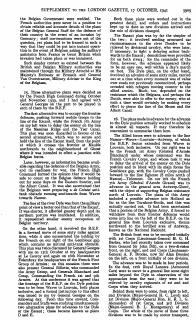
SUPPLEMENT TO THE LONDON GAZETTE, 17 OCTOBER, 1941                                      5909
  the Belgian Government were wedded. The                     Both these plans were worked out in the
  French authorities were never in a position to          greatest detail, and orders and instructions
  obtain reliable and accurate details of the plans       kept up to date as new divisions arrived and
  of the Belgian General Staff for the defence of         the role of divisions changed.
  their country in the event of an invasion by                The Escaut plan was by far the simpler of
  Germany; staff conversations were out of the            the two; it involved sending armoured car
  question, yet plans had to be framed in such a          reconnaissances to the river Dendre to be
  way that they could be put into instant opera-          relieved by divisional cavalry, who were later,
  tion in the event of Belgium asking for military        if necessary, to fight a delaying action back-
  assistance from France or Great Britain when             wards to the Escaut; demolitions were provided
  invasion had taken place or was imminent.                for on both rivers; for the remainder of the
     Such slender contact as existed between the           force, however, the advance appeared likely
  British and Belgian Military authorities was             to be an easy one, well within a day's march
  maintained through the Military Attach^ at His           on foot. The Dyle plan, on the other hand,
  Majesty's Embassy at Brussels and General               involved an advance of some sixty miles, carried
  Van Overstraeten, Military Adviser to the King           out at a time when every moment was of value
  of the Belgians.                                         over roads not previously reconnoitred, perhaps
                                                           crowded with refugees moving counter to the
       15. Three alternative plans were decided on         allied armies. Much, too, depended on the
    by the French High Command during October             resistance which the Belgians, and perhaps the
    and November 1939, and I had agreed with              Dutch, were able to offer to the enemy, who at
    General Georges on the part to be played in           such a time would certainly be making every
    each of them by the B.E.F.                            effort to pierce the line of the Meuse and the
                                                          Albert Canal.
       The first alternative was to occupy the frontier
    defences, pushing forward mobile troops to the             16. The plans made in advance for the advance
    line of the Escaut, while the French 7th Army           to the Dyle position actually worked to schedule
    on my left were to delay the enemy on the line          in almost all respects. It may therefore be
    of the Messines Ridge and the Yser Canal.               convenient to summarise them here.
   This plan was soon discarded in favour of the
    second alternative, which was to secure and               The Allied forces were to advance to the line
   hold the line of the Escaut itself, from the point       Namur—Wavre—Louvain—Antwerp, of which
   at which it crosses the frontier at Maulde               the B.E.F. Sector extended from Wavre to
   northwards to the neighbourhood of Ghent                 Louvain, both inclusive. On our right was to
   where it was intended to effect a junction with         be the French ist Army (General d'Armee
   Belgian forces.                                          Blanchard) under whose command was the
                                                            French Cavalry Corps, and whose task it was
       Later, however, as information became avail-        to delay the arrival of the enemy on the Dyle
   able regarding the defences of the Belgian Army,        position and to block with its main forces the
* and its readiness for war, the French High               Gembloux gap, with the Cavalry Corps pushed
   Command formed the opinion that it would be             forward to the line Eghezee (8 miles north of
   safe to count on the Belgian defence holding            Namur)—Tirlemont. On our left the French
   out for some days oh the Eastern frontier, and          7th Army (General d'Armee Giraud) was to
   the Albert Canal. It was also ascertained that          advance to the general area Antwerp-Ghent,
   the Belgians were preparing a de Cointet anti-          with the object of supporting Belgian resistance
   tank obstacle running southwards from Wavre             north of Louvain. The plans of this Army
  towards Namur.                                          included a possible advance into Holland as
      The line of the river Dyle was from the military     far as the line Turnhout-Breda, and this was
  point of view a better one than that of the Escaut.      actually carried out. It had been ascertained
  It was shorter, it afforded greater depth and its        that a portion of the Belgian Army, if forced to
  northern portion was inundated. In addition,            withdraw from their frontier defences would
  it represented smaller enemy occupation of              come into line on the left of the B.E.F. on the
  Belgian territory.                                      general line from Louvain exclusive, thence
                                                          northward to the fortified area of Antwerp,
      On the other hand, it involved the B.E.F.           known as the National Redoubt.
  in a forward move of some sixty miles against
  time, while it also necessitated the holding by             The British front was to be occupied initially
  the French on our right of the Gembloux gap             with ist Corps (Lieutenant-General M. G. H.
  which contains no natural anti-tank obstacle.           Barker, who had recently taken over command
  This plan was twice discussed by General Georges        from General Sir John Dill), on a two-division
  with me on I3th October at my headquarters              front, on the right, and 2nd Corps (Lieutenant-
 at Le Cauroy and again on i6th November at               General A. F. Brooke, now Sir Alan Brooke)
 Folembray the headquarters of the French First           on the left, on a front initially of one division.
 Group of Armies; on this occasion there were                 The advance was to be made in four periods.
 also present General Billotte, who commanded             In the first, i2th Royal Lancers (Armoured
 the Army Group, and Generals Blanchard and               Cars) were to move to a general line some eight
 Corap, Commanding the French ist and gth                 miles beyond the Dyle in observation of the
 Armies. At this conference it was agreed that            approaches from the east; they were to be
 the frontage of the B.E.F. on the Dyle position          relieved by cavalry regiments of ist and 2nd
 was to be from Wavre to Louvain, both places             Corps when they arrived.
 inclusive, and a formal instruction to this effect           Behind them were to come, from right to left,
 was issued to me by General Georges on the               2nd Division (Major-General H. C. Loyd) and
 following day. From this time onward, Com-               ist Division (Major-General Hon. H. R. L. G.
 manders and Staffs were studying simultaneously          Alexander) of ist Corps, and 3rd Division
 two alternative plans for advances to the Dyle           (Maj01-General B. L. Montgomery) of 2nd
 or the Escaut; these became known as plans               Corps. The whole of the move of these three
 DandE.                                                   divisions was to be made by motor transport,
Details
SUPPLEMENT TO THE LONDON GAZETTE, 17 OCTOBER, 1941

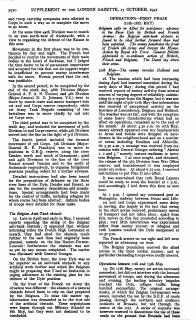
and troop carrying companies were allotted to                OPERATIONS—FIRST PHASE
Corps in such a way as to complete the move                          (ioth-i6th MAY)
in 90 hours.                                          Belgium calls on Allies for assistance: advance
    At the same time 44th Division was to march         to the River Dyle by British and French
to an area north-west of Audenarde, with a              Armies: the Belgian anti-tank obstacle is
view to organising the defence of the Escaut in        found to be sited further forward than had
this area.                                              been expected. The enemy penetrates the front
    Movement in the first phase was to be con-          of French gth Army and crosses the Meuse.
tinuous by day and night. The French had                Action by Royal Air Force. General Billotte
decided to restrict the movements of their main         appointed to co-ordinate action of British,
bodies to the hours of darkness, but I judged           French and Belgians. The Dutch lay down
the time factor to be of paramount importance                arms.
and accepted the risk that our air support might      loth May—The enemy invades Holland and
be insufficient to prevent enemy interference              Belgium.
with the move. Events proved that the risk
was justifiable.                                         18. The tension which had been increasing
                                                      during April had lessened somewhat during the
    In the second period, to be completed by the      early days of May; during this period I had
end of the sixth day, 48th Division (Major-           received reports of enemy activity from several
General A. F. A. N. Thorne) and 4th Division          sources of varying degrees of reliability, culmin-
 (Major-General D. G. Johnson, V.C.) were to          ating in a report from the Hague, but it was not
move by march route and motor transport into          until the night of 9th-ioth May that information
 ist and 2nd Corps reserve respectively, while        was received of exceptional activity on the
 ist Army Tank Brigade consisting of two              frontiers of Luxembourg, Belgium and Holland.
battalions was to move chiefly by rail into           The weather was set fair, and with the exception
 ist Corps area.                                      of some heavy thunderstorms which had no
    The third period was to be completed by the       effect on operations, remained so to the end of
tenth day, and included the movement of soth          the month. At about 4.30 a.m. on loth May,
Division to 2nd Corps reserve, while 4th Division     enemy aircraft appeared over my headquarters
moved into the line on the right of 3rd Division.     at Arras and bombs were dropped on aero-
    The fourth period included the forward            dromes hi the neighbourhood and on a number
movement of 3rd Corps. 5th Division (Major-           of towns including Doullens and Abbeville.
General H. E. Franklyn) was to move to                At 5.30 a.m., a message was received from my
positions in G.H.Q. reserve, along the river          mission with General Georges ordering " Alertes
Dendre, north and south of Grammont; 42nd             i, 2 and 3," namely, instant readiness to move
and 44th Divisions to the line of the river           into Belgium. I at once sought, and obtained,
Escaut around Tournai and to the south of             the release of the 5th Division from War Office
Audenarde respectively, to organise bridgehead        reserve, and henceforward it was employed
positions pending orders for a further advance.       under my orders. At about 6.15 a.m. I received
                                                      instructions to put Plan D into effect.
    Detailed instructions had also been issued           It was ascertained that I2th Royal Lancers
 for the preparation of defences on the three         could be ready to cross the frontier at i p.m.,
 river lines of the Dyle, Dendre and Escaut, as       and accordingly I laid down this time as zero
 also for the necessary demolitions and inunda-       hour.
 tions. Special arrangements had been made
 for the control of traffic, including refugees for      At i p.m. I opened my command post at
 whom routes had been allotted; definite bodies       Wahagnies, midway between Douai and Lille.
 of troops were detailed for these tasks.                ist and 2nd Corps experienced some delay
                                                      in moving, due largely to the fact that owing
                                                      to the short notice received, preliminary moves
The Belgian Anti-Tank obstacle                        of transport had not taken place; apart from
    17. Late in April and early in May, I received    this, moves on this day proceeded according to
reports regarding the siting of the Belgian           plan; very little interference was experienced
anti-tank obstacle; it appeared that, without         either from enemy aircrait or refugees and
informing either the French High Command or            i2th Lancers reached the Dyle unopposed at
myself, they had sited the obstacle much               10.30 p.m.
further to the east than had originally been             The French armies on our light and left were
planned, namely on the line Namur-Perwez-             reported as advancing on time.
Louvain: furthermore the obstacle was not                The Belgian population received the allied
as yet by any means completed. The matter             armies in the most cordial manner, and in
was discussed with General Georges.                   particular the leading troops were loudly cheered.
    On the British front, the river Dyle was so
far superior as an anti-tank obstacle to any           Operations between nth and i$th May.
artificial work further east which the Belgians           19. On nth May, enemy air action increased
might be preparing that I had no hesitation in         somewhat, but did not interfere with the forward
urging adherence to the existing plan for the          movement of troops, and during the afternoon
defence of the Dyle position.                          and evening, the leading infantry brigades
    On the front of the French ist Army the            reached the Dyle, refugee traffic being
 situation was different: the absence of a natural     handled successfully. The original arrange-
 obstacle forced them to rely on.that prepared         ments, of which the Belgian Government were
 by the Belgians. To clear the matter up,              aware, included the use by the B.E.F. of roads
information was demanded as to the true site          'passing through the northern and southern
 of the artificial obstacle. These negotiations        outskirts of Brussels, but not through the
 were begun through our Military Attache1 on           centre of the city. A series of requests was
 8th May, but they were not destined to be             however received to discontinue the use of these
 concluded.                                             roads on the ground that Brussels had been
Details
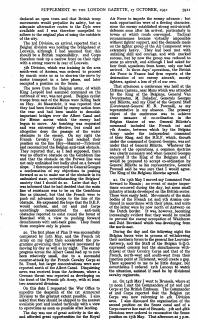
SUPPLEMENT TO THE LONDON GAZETTE, 17 OCTOBER, 1941

declared an open town and that British troop         Air Force to impede the enemy advance; but
movements would prejudice its safety, but no         such opportunities were of a fleeting character,
adequate alternative routes to the Dyle were         since the enemy established strong anti-aircraft
available and I was therefore compelled to           defences soon after his arrival, particularly in
adhere to the original plan of using the outskirts   towns at which roads converged. Tactical
of the city.                                         reconnaissance became virtually impossible
    The 3rd Division, on arrival, reported that a    without fighter support, and the demands made
 Belgian division was holding the bridgehead at      on the fighter group of the Air Component were
 Louvain, although I had assumed that this           extremely heavy. They had been met with
 should be a British responsibility. 2nd Corps       unfailing skill and courage, and with marked
 therefore took up a narrow front on their right     success, but by now the group was reduced to
 with a strong reserve in rear of Louvain.           some 50 aircraft, and although I had asked for
    5th Division, which was training in the area     four fresh squadrons from home, only one had
 south-west of Amiens, was ordered to proceed        arrived. In three days' operations, the British
 by march route so as to shorten the move by         Air Force in France had firm reports of the
 motor transport in a later phase, and later         destruction of 101 enemy aircraft, mostly
 occupied a position on the Senne.                   fighters, against a loss of 78 of our own.
    The news from the Belgian army, of which            That afternoon a conference was held at the
 King Leopold had assumed command on the             Chateau Casteau, near Mons which was attended
 outbreak of war, was not good. Belgian cyclist      by the King of the Belgians, General Van
 troops from east of the Meuse were falling back     Overstraeten, M. Daladier, Generals Georges
 on Huy. At Maastricht, it was reported that         and Billotte, and my Chief of the General Staff
 they had been forestalled by enemy action from      (Lieutenant-General H. R. Pownall), as my
 the rear and had been unable to demolish            representative in my absence. The primary
 important bridges over the : Albert Canal and       object of the conference was to achieve
 the Meuse across which the enemy had                some measure of co-ordination in the
 begun to move. Air bombing was requested            Belgian theatre of war. General Billotte's
 and was extremely effective, but could not          command included the French ist and
 altogether deny the passage of the water            7th Armies, between which lay the Belgian
 obstacles to the enemy. On my right the             Army under the independent command
 French Cavalry Corps had reached their              of their King, and the B.fe.F. which, though
 position on the line Huy—Hannut—Tirlemont           under the command of General Georges, was not
 and reconnoitred the Belgian anti-tank obstacle.    under that of General Billotte. Whatever the
 They reported that, as I had supposed, there        nature of the operations, a common doctrine
 was no effective obstacle on the Gembloux line      was clearly necessary and when General Georges
 and that the obstacle on the Perwez line was        enquired if the King of the Belgians and I
 not only unfinished but badly sited on a forward    would be prepared to accept co-ordination by
 slope. I thereupon conveyed to General Georges      General Billotte as bis representative, General
 a confirmation of my objections to pushing          Pownall said he was sure that I would agree.
 forward so as to make use of the obstacle in its    The King of the Belgians likewise agreed.
 unfinished state, notwithstanding the Belgians'      . 21. On I3th May I moved my Command Post
 anxiety that I should do so. Later that day I       forward to Renaix; no event of major impor-
 was informed that he had decided that the main      tance occurred during the day, but some small
line of resistance was to be on the Gembloux         infantry attacks developed on the British sector.
 line as planned, but that the French were to        These were easily held. Movements of the main
 push out advanced troops to the line of the         bodies of the French ist and 7th Annies con-
obstacle. He expressed the hope that the B.E.F.      tinued in accordance with their plans, and units
would conform, and ist and 2nd Corps                 of the latter were by now north of Antwerp on
 accordingly      reconnoitred   the     anti-tank   the Dutch border. It was, however, becoming
obstacles reported to exist round the forest of      increasingly evident that they would be unable
Meerdael with a view to pushing forward              to prevent the enemy occupation of Walcheren
detachments with anti-tank guns. They found          and Zuid Beveland which was developing from
them complete only in places.                        the north-east.
    20. The first phase of Plan D was successfully      During the day and the following night the
completed by i2th May, and the French ist            Belgian forces were in process of withdrawing
Army on my right then accelerated the pro-           their northern forces to the general line Louvain-
gramme governing their forward movement by           Antwerp, and the Staff of the Belgian G.Q.G.
moving by day as well as by night. The enemy         expressed concern lest the simultaneous with-
progress across the Albert Canal had up to now       drawal of their Cavalry Corps and that of the
been relatively small, due to a successful           French, north-west and south-west from their
counter-attack by the French Cavalry Corps at        junction point at Tirlemont, would create a gap.
St. Trend, but larger concentrations were now        There appeared to me to be little danger, but
reported north of the Albert Canal. Disquieting      nevertheless I ordered I2th Lancers to watch
news was received from the Ardennes, where a         the situation, assisted if need be by divisional
German thrust was reported as developing on          cavalry regiments.
the front of the French gth Army, with at least         22. On I4th May I went to Brussels, where at
two armoured divisions.                              12 noon I met the Commanders of ist and 2nd
    On this date I requested the War Office to       Corps at the British Embassy. The Commander
expedite the despatch of the ist Armoured            of 2nd Corps reported that the Belgian ist
Division to the greatest extent possible. I also     Corps was now reforming in 4th Division
asked that they should be shipped to the nearest'    area. I also discussed the organisation of the
available port and loaded tactically with a view     second position on the Senne canal and of a
to operations as soon as possible after landing.     Corps reserve line east of Brussels. 5th and 48th
    The day was one of great activity in the air,    Divisions were ordered to reconnoitre the Senne
and afforded great opportunities for the Royal       position on I5th May. That afternoon at 3 p.m.
Details
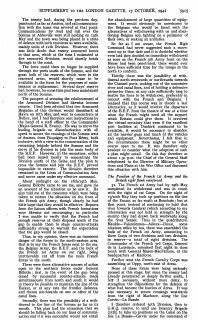
SUPPLEMENT TO THE LONDON GAZETTE, 17. OCTOBER/1941                                  "59*5
    The enemy had, during the previous day,           the abandonment of large quantities of equip-
 penetrated as far as Amiens, and rail communica-     ment. It would obviously be unwelcome to
 tion with the bases was severed' at that'point.      the Belgians who would be faced with the
'Communications by road and rail over the             alternatives of withdrawing with us and aban-
 Sorrime at Abbeville were still holding on igth      doning Belgian soil, fighting on a perimeter of
 May and the town was being placed in a state         their own, or seeking an armistice.
 of defence with such resources as were available,       So far as I am aware, the French High
 mainly, units of I2th Division. However, there       Command had never suggested such a move-
 was little doubt that enemy armoured forces          ment up to that date and it is doubtful whether
 in'that area, which at the time I estimated at       even had they, decided on immediate withdrawal
 five armoured divisions, would shortly break         as soon as the French gth Army front on the
 through to the coast.                                Meuse had been penetrated, there would ever
    The force could then no longer be supplied        have been sufficient time for the troops in the
 through the ports south of the Somme, and the        north to conform.
 great bulk of the reserves, which were in the           Thirdly there was the possibility of with-
 rearward areas, would • shortly cease to be          drawal north-westwards or northwards towards
 available to the force for the purposes of main-     the Channel ports, making use of the successive
tenance or replacement. Several days' reserve         river and canal lines, and of holding a defensive
 had, however, for some time past been maintained     perimeter there, at any rate sufficiently long to
 north of the Somme.                                  enable the force to be withdrawn, preferably in
    The prospect of securing the reinforcement of     concert with the French and Belgians. I
 the Armoured Division had likewise become            realised that this course was in theory a last
 remote/ I had been advised that two Armoured         alternative, as it would involve the departure
 Brigades, of this division would disembark at        of the B.E.F. from the theatre of war at a time
 Havre on i6th May, and were to concentrate at        when the French might need all the support
 Bolbec, and I had therefore sent instructions by     which Britain could give them. It involved
 the hand of a staff officer to the Commander         the virtual certainty that even if the excellent
 (Major-General R. Evans). He was to move the         port facilities at Dunkirk continued to be
leading brigade on disembarkation with all            available, it would be necessary to abandon
 speed to secure, the crossings of the Somme west     all the heavier guns and much of the vehicles
 of Amiens, from Picquigny to Pont Remy, both         and equipment. Nevertheless, I felt that in
inclusive, with a view to .the concentration of the   the circumstances there might be no other
 remaining -brigade behind the Somme and the          course open to me. It was therefore only
 move of his division to join the main body of        prudent to consider what the adoption of such
 the B.E.F. However, in the meantime, orders          a plan might entail. On this day therefore at
 had been issued locally to concentrate the           about 1.30 p.m. the Chief of the General Staff
 Division south of the Seine, and the plan to         telephoned to the Director of Military Opera-
 cross the Somme and join the B.E.F. proved           tions and Plans at the War Office and discussed
 impossible to execute. The division therefore        this situation with him.
 remained in the Lines of Communication Area
 and never came under my effective command.           The Position of the French ist Army and the
    About midnight on the iSth/igth May,                   British right flank reinforced.
 General Billotte came to see me, and gave me            31. The French ist Army had by igth May
 an account of the situation as he saw it. He         completed its withdrawal and was in touch
 also told me of the measures which were being        with the right of ist Corps. On the night of
 taken to restore the situation on the front of       i9/20th May they took up positions on the line
 the French Qth Army, though clearly he had           of the Escaut as far south as Bouchain ; but at
 little hope that they would be effective. Reports    that point, instead of continuing to hold that
 from the liaison officers with French formations     river towards Cambrai (which according to my
.were likewise not encouraging ; in particular        information was not held in strength by the
 I was unable to verify that the French had           enemy) they had drawn back westwards along
 enough reserves at their disposal south of the       the river Sensee. Thus in the quadrilateral
 gap to enable them to stage counter-attacks          Maulde—Va-lenciennes—Arleux—Douai, some
 sufficiently strong to warrant the expectation       nineteen miles by ten, there was assembled the
 that the gap would be closed.                        bulk of the French ist Army, amounting to
    Thus, in my opinion, there was an imminent        three Corps of two divisions and two divisions
 danger of the forces in the north-eastern area,      in reserve—a total of eight divisions. The
 that is to say the French forces next to the sea,    Commander of the French 3rd Corps, General
 the Belgian Army, the B.E.F. and the bulk of         de la Laurencie, remained that night in close
 the French ist Army on our right, being              touch with General Mason-MacFarlane, at the
 irretrievably cut off from the main French           headquarters of Macforce.
 forces in the south.                                    Further west the French Cavalry Corps was
    There were three alternative courses of action    assembling at Oppy, north-east of Arras.
 open to the northern forces under General               None of these forces were being seriously
 Billotte : first, in the event of the gap being      pressed at this stage, but since the enemy had
 closed by successful counter-attacks made            already penetrated, so deeply further south, I
 simultaneously from north and south it would         felt it necessary, without more delay, to
 in theory be possible to maintain the line of the    strengthen the dispositions for the defence of
 Escaut, or at any rate the frontier defences,        what had become the bastion of Arras. It was
 and thence southwards on one or other of the         also necessary to secure crossings westwards
 canal lines.                                         from the right of Macforce, along the line
     Secondly, there was the possibility of a with-   Carvin—La Basse"e.
 drawal to the-line of the Somme as far as its           I therefore ordered soth Division, then in
 mouth. This plan had the attraction that we          G.H.Q. reserve, to send one Infantry Brigade
 should be falling back on our lines of communi-      (25th) to take up positions on the Canal on the
 cation and if it was successful would not entail     line La Bassee—Carvin under the command of
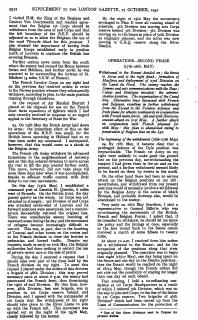
Details
5912          SUPPLEMENT TO THE LONDON GAZETTE, 17 OCTOBER, 1941

   I visited H.M. the King of the Belgians and          By the night of i5th May the movements
   General Van Overstraeten and reached agree-        envisaged in Plan D were all running ahead of
  ment that the Belgian ist Corps should be           schedule. 4th Division was moving into Corps
   withdrawn from the area of 2nd Corps and that      reserve behind 3rd Division; 5th Division was
  the left boundary of the B.E.F. should be           moving on to the Senne in place of 5oth Division
  adjusted so as to allow the Belgians the use of     as originally planned, and the latter was now
  the road Vilvorde-Alost for this purpose. I         moving to G.H.Q. reserve along the River
  also stressed the importance of having fresh        Dendre.
  Belgian troops established early in position
  north of Louvain to continue the British line
  covering Brussels.
     Further serious news came from the south                OPERATIONS—SECOND PHASE
  where the enemy had crossed the Meuse between                         (i7th-26th MAY)
  Sedan and Me"zieres, and further north he was
  reported to be surrounding the fortress of St.       Withdrawal to the Escaut decided on; the threat
  Heribert (4 miles S.S.W. of Namur).                    to Arras and to the right flank; formation of
     The French Cavalry Corps on my right had            Macforce and deployment of 2yd Division on
  on the previous day received orders to retire          the Canal du Nord. The enemy reaches the
  to the Perwez position whence they subsequently        Somme and cuts communications with the Base ;
  withdrew, according to plan, to the main position      Calais and Boulogne invested: the admini-
  running through Gembloux.                              strative position. The organisation of the Canal
                                                         line. Alternative lines discussed with French
     At the request of Air Marshal Barratt I             and Belgians, resulting in further withdrawal
  placed at his disposal for use on the French          from the Escaut to the Frontier defences and
 front three squadrons of fighters which I had          fresh plans for attacks southwards in conjunction
 only recently received in response to an urgent         with French main forces. $th and $oth Divisions
  appeal to the Secretary of State for War.             counter-attack on 21st May. A further attack
     23. On 15th May the Dutch Army laid down           in conjunction with French planned for
 its arms; the immediate effect of this on the           26th May: this plan is abandoned owing to
 operations of the B.E.F. was small, for the            penetration of Belgian line on the Lys.
 British forces operating in Holland had at no
 time been under my command. I anticipated,             The beginning of the withdrawal (ifith-T.'jth May)
 however, that this would come as a shock to              24. By i6th May, it became clear that a
 the Belgian Army.                                     prolonged defence of the Dyle position was
     The French 7th Army withdrew' its advanced        impracticable. The French ist Army on my
 formations to the neighbourhood of Antwerp            right were unlikely to make good the ground
 and on this day ordered divisions to move across      lost' on the previous day, notwithstanding the
 my rear to fill the gap created further south.        support I had given them in the air and on the
 This move, however, did not take place till           ground, and a further withdrawal seemed likely
 some three days later when it was accomplished,       to be forced on them by events in the south.
 thanks to efficient traffic control, with little         On the other hand there had been no serious
 delay to our own movements.                           attack on the Belgian positions on my left;
    On this day (i5th May) I established a             nevertheless, any withdrawal from our present
 command post at Lennick St. Quentin, 6 miles          positions would of necessity involve a withdrawal
 west of Brussels. On the British front, the day       by the Belgian Army in the course of which
 passed quietly on the whole, ist Corps was not        Brussels, and probably Antwerp also, would be
 attacked in strength ; 3rd Division of 2nd Corps     abandoned to the enemy.
 was attacked north-west of Louvain and its              Very early on i6th May therefore, I sent a
 forward positions were penetrated, but a counter-    representative to General Billotte who was
 attack successfully restored the original line.      co-ordinating the movements of the British,
 There was considerable enemy bombing of              French and Belgian Forces; I asked that, if
 rearward areas during the day, and the movement      he intended to withdraw, he should let me know
 of refugees became increasingly difficult to         the policy and the timings at once, especially
 control. This was, in part, due to the bombing       as the first bound back to the Senne canals
 of Tournai and other towns on the routes and         involved a march of some fifteen to twenty
to the French decision to close the frontier to       miles.
pedestrian and horsed traffic. Despite my                At about 10 a.m. I received from him orders
requests, made as early as loth May, the Belgian      for a withdrawal to the Escaut, and for the
authorities had done nothing to restrict the use      occupation of the positions along that fiver
of private motor cars or the sale of petrol.          originally planned. The operation was to begin
    During the day I received a request that I        that night (16/17 May), one day being spent on
should take over part of the front held by the        the Senne and one day on the Dendre positions ;
French division on my right. To meet this             thus the Escaut would be reached on the night
request I placed under the orders of this division    of 18/19 May, though the French orders did
a brigade of 48th Division ; this step proved         not rule out the possibility of staying for longer
necessary since at about 6 p.m. the enemy had         than one day on each bound.
penetrated the French front, thus threatening            That evening, I held a co-ordinating con-
the right of 2nd Division. By this tune, how-         ference at ist Corps Headquarters as a result
ever, 48th Division, less one brigade, was in         of which I ordered 5th Division, which was on
position in ist Corps reserve behind 2nd              the way to join 2nd Corps, to the line of the Senne
Division, and I agreed with the commander of          in ist Corps reserve. Two brigades of 46th
ist Corps that the withdrawal of his right            Division* which had been moved up from the
should take place to the River Lasne to join          Lines of Communication for the protection of
up with the French left. This movement was
carried out on the night of the 15/16 May,              * One of the three divisions sent to France for
closely followed by the enemy.                        pioneer duties.
Source: The National Archives, Kew, ADM 199 788 A. Contains public sector information licensed under the Open Government Licence v3.0.

Details
| 0900 | Meuse |
Source: The National Archives, Kew, ADM 199 792. Contains public sector information licensed under the Open Government Licence v3.0.

Details
Page 3.
OF SHIPS WHICH TOOK PART IN OPERATION "DYNAMO" - 26TH MAY - 4TH JUNE, 1940
PART I - BRITISH SHIPS (continued)
PORTSMOUTH A/P YACHTS
AHOLA
CARYANDA
NONETA
ANLAH
EILA II
SERIOLA
ANKH
LAHLOO
THELE
BOUNTY
MASAYRU
MISCELLANEOUS H.M. SHIPS (small craft)
A.L.C. 5
GREY MIST (Dan-laying
A.L.C. 15
Vessel)
-
A.L.C. 16
# GRIVE (F.A.A. Yacht)
A.L.C. 17
KINDRED STAR (Drifter)
ALOUETTE II
# KING ORRY (Armed Boarding
(Echo Sounding Yacht)
Vessel)
# AMULREE (Harbour Defence
LLANTHONY (Examination
Patrol Craft)
Service Vessel)
ARONIA (Yacht)
LORMONT (Armed Boarding
BEN AND LUCY (Drifter)
Vessel)
BLUEBIRD (M.B.)
MONARDA (Drifter)
BYSTANDER
MONA'S ISLE (Armed Boarding
(Echo Sounding Yacht)
Vessel)
CALETA (Harbour Defence
ST. OLAVES (Rescue Tug)
Patrol Craft)
TARRET (A/S Yacht)
CHRYSTOBEL II (Harbour
THRIFTY (Drifter)
Defence Patrol Craft )
V. 4 ("Vernon' s" pinnace)
"DOLPHIN'S" MOTOR-BOAT
VELIA (Armed Trawler)
EVELYN ROSE Trawler)
VERNON I
"EXCELLENT'S" A/A MOTOR-BOAT
VIVIANA (A/S Trawler)
GAVA (Trawler)
Ambleve.
Escaut.
transferred
GLALA (Harbour Defence Patrol
Meuse.
from
Craft)
Sambre.
Semoise.
page 9.
yser.
DUTCH SKOOTS (Commissioned with Naval Crews)
ABEL TASMAN
DOGGERSBANK
PACIFIC
PASCHOLL
AEGIR
FREDANJA
PATRIA
ALICE
FRISCO
PRINCESS JULIANA
AMAZONE
GORECHT
REIGER
ANTJE
HEBE
RIKA
ATLANTIC
HILDA
RUJA
BART
HONDSRUG
BORNRIF
HORST (Abandoned)
SAN ANTONIO
SURSUM CORDA
BRANDARIS
JAVA
TILLY
CARIBIA
JUTLAND
TINY
DELTA
KAAPFALGA
TUNG
DEMOK I
LENA
TWENTE
DENEB
ORANJE
VREDE
DESPATCH II
ORANGE YREESWIJH
ZEUS
(Continued)
# Sunk

Details
| TIER | X MEUSE (Belgian Launch) | ing |
Source: The National Archives, Kew, ADM 199 795. Contains public sector information licensed under the Open Government Licence v3.0.

Details
- 2 -
11.
A/P 29th Trawlers CARBINEER II, KASTORIA and
paid off on August 1940 on lapse of T 124 agreements NAMUR
(M. 06221/40).
IMMEDIATE.
Serial No. 610.
12.
SECRET.
No Rye in the his title has now been amended to
Club, S.L. Willis and has taken up his Headquarters in (Commander)
The R.N.O. Hastings, Vice Admiral
SPECIAL SECRET BRANCH ACQUAINT.
The following information is circulated for guidance
change area covered by this R.N.O. is R.N.O. involved.
and for such action within each Admiralty Department as may be
(M. 016366/40).
necessary.
62
13.
N.O. i/c Haifa as patrol craft on Palestine Coast:-
The following police launches have been commission
G.Britow
for Head of Military Branch.
MOQITA
SEALION
19th September, 1940.
SEAWOLF
SHARK
HAWK
EAGLE.
1.
Correspondence to Naval authorities in the Shetlands.
All will be borne nominally on books of STAG.
In connection with the distribution of copies of
(M. 017235/40).
Admiralty letters of a General nature regarding anti-invasion that
14.
R/S
61
need be
Messages have recently been addressed by Admiral
ck and
Departments to V.A.A. in error and attention is therefore
Secretary is
to S.S.B.A. No. 583 (28) which states that the appointment
18 SEP 1940
M.r.C. Poole.
Admiral Aircraft Carriers has lapsed.
4th June
(M. 015837/40).
940 19 SEP 1940 rol
to
15.
With reference to S.S.B.A. No. 585 (11), trawler
has been allocated to Brigham and Cowan, S. Shields, for
Head of Military Branch.
h July 1
mof
uties at
to Oropesa Minesweeper. Winch, gallows and fair-leads are
The Secretary to
did
provided if available from those removed from converted trs
Naval Officer-in-Charge,
Poole.
4 C luly,
Approval has been given for trawler LADY LOVE to
19th September, 1940
M.010027/40
(owner
inder
requisitioned, if suitable, for Oropesa M/S in place of tre
been
BAHAMA which has been found unsuitable
Dutch coaster AEGIR paid off at Poole.
is AEGIR
(M. 016433/40).
It is understood from the
The Base accountant organization at Aden is short
Director of Sea Transport that the
0.
ELGICA 8
16.
E GEZUST
centralised ashore. H.M.S. LUCIA will be an independent CO
naval crew did not leave the Dutch
state
up as
with accounts in SHEBA.
Coaster till 4th July, 1940
L by Belg
I 1
THE
all
SHEBA will also carry accounts of base staff,
HUN
Portsmouth that
DERBY, CHANTALA, CHAKDINA, SAGITTA, MOONSTONE, PLANET, Ade
Poole on 28th June, 1940.
enger
LAOMEDON (on commissioning).
Station, KANDAHAR, KIMBERLEY, KINGSTON, AMBER, BURGONET and
It is requested that you will
8
Accounts of FLAMINGO, GRIMSBY and AUCKLAND are
state whather Ansibility tillad an
state lty reaponsibility titud 4th
ach MEUSE
that
carried on board.
it into
a Care and Maintenance
H.M.S. LUCIA will act as repair ship and provide
remained on board after 28th June,
accommodation for personnel waiting passage etc.
1940.
1 over to
The change will take effect as soon as accommodatal
on
ready and necessary personnel arrive.
(Sga.) E w. austin
(M. 015284/40).
17.
With reference to S.S.B.A. No. 550 (1), the follow
for Head of Military Branch.
trawlers are expected to commission on dates shown:-
SILANION
VIKING DEEPS
SABINA
11th September, 1940.
and 3rd
-
STRATHELLA
11th September, 1940.
-
DOROTHY GRAY
4th September, 1940.
-
4th September, 1940.
11.
TRITELIA
-
4th September, 1940.
(M. 013761/40).
'rculation as for Special Secret Branch Acquaint No.

Details
| carried on Accounts board. of FLAMINGO, accommodation for LUCIA | IIIW UOV, tedd ne AID IIIS | the | remained | on board often | 7M | unch MEUSE put into |

Details
- 2 -
paid off on A/P 29th Trawlers August CARBINEER 1940 on lapse II, KASTORIA of T 124 and agreements NAMUR
(M. 06221/40).
IMMEDIATE.
Serial No. 610.
SECRET.
Club, L. Willis Rye and The has R.N.O. his taken title Hastings, up has his Headquarters Vice Admiral in (Commander)
SPECIAL SECRET BRANCH ACQUAINT.
To change in the area covered now by been this amended R.N.O. is to R.N.O., involved.
The following information is circulated for guidance
and for such action within each Admiralty Department as may be
(M. 016366/40).
necessary.
62
.0. i/c Haifa The following as patrol police craft on launches Palestine have been commist
G.Britow
for Head of Military Branch.
MOQITA
SEALION
19th September, 1940.
SEAWOLF
SHARK
HAWK
EAGLE.
1.
Correspondence to Naval authorities in the Shetlands.
All will be borne nominally on books of STAG.
In connection with the distribution of copies of
(M. 017235/40).
Admiralty letters of a General nature regarding anti-invasion
measures, the Secretary to F.O.C. Shetlands has stated that
epartm
such Admiralty circular letters of general application need be
S.S.
sent to F.O.C. Shetlands only and not to N.O. i/c Lerwick and
imiral
R.N.O. Sullom Voe.
(M. 014684/40).
Whale Catcher ORNEN III was commissioned on 24th June
2. 1940 as a tender to MALABAR II for minesweeping and patrol
duties at Trinidad.
(M. 018275/40).
beer
Orope
Catcher THORVARD was commissioned on 9th July 1°
ovided
3. as a tender Whale to MALABAR II for minesweeping and patrol duties at
(M. 018274/40).
Trinidad.
quisit
has been approved to requisition M/B DANDY under (owner
WILL
4. Sergeant J. It Cumming) for Air Rescue work at Herne Bay
supervision of R.N.O. Whitstable. (M. 016623/40).
5. Belgian (H 62: & different vessel from be DE taken DRIE up as
M/F.V's LEOPOLD NERA, ANNA LEOPOED, BELGICA GEZUST a:
acc
DE DRIE GEZUSTERS 540 (8)) manned by Poles) are to manned by
tenders (S.S.B.A. to No. observation minelayers. They will be Belg
(M. 017640/40).
CH
crews.
MEDON
6. Boat LERINA at Appledore for A/P (4. duties. 016300/40).
Approval has been given to take up Motor Passenger
01
S.S.B.A. No. 554 (7) Passenger but Launch put into MEUSE
ommodat
7. commissioned Reference for the Dunkirk Operations,
was service not with civilian crew. (M. 010027/40).
and
Chasseurs 23 and 25 were turned 24 over to
8. Free French Wooden Navy French on 9th September 1940, and Chasseur on
(M. 012992/40).
16th September 1940.
lers
ai
9.
M.L. 119 commissioned on 18th September 1940.
(M. 013007/40).
(3)) and and SILANION 3rd
10. August
equisit
AHAMA
September (S.S.B.A. 1940
W
11.
CH
Source: The National Archives, Kew, ADM 234 360. Contains public sector information licensed under the Open Government Licence v3.0.

Details
CONTENTS
Page
Introduction
xiii
CHAPTER I
Preliminary Events, 10th to 18th May, 1940
Germany invades Holland and Belgium
1
Allies reach River Dyle
1
German thrust on French 9th Army front
1
Occupation of Walcheren and Zuid Beveland imminent
2
Germans cross Meuse
2
Dutch Army surrenders
2
Allies withdraw to River Escaut
2
French 9th Army front broken
3
Allied rail communications severed
3
CHAPTER II
The week before Operation "Dynamo", 19th to 25th May, 1940
Compulsory withdrawal of B.E.F. foreseen
4
...
R.A.F. Component begins return to England
4
...
Vice-Admiral Dover, represented at War Office Conference
4
Channel ports the German objective
4
Gerneral Weygand directing Allied operations
5
R.A.F. Component to set up rear H.Q. at Hawkinge
5
Naval Staff at Dover considers large scale evacuation
5
Provision of small craft considered
5
Counter-attack south of Arras
6
Germans approach Boulogne
6
Organisation of the canal line
7
Emergency evacuation again considered at the War Office
7
Canal line occupied
7
Boulogne cut off, Calais threatened
7
"The Operation will be known as 'Dynamo' "
7
Enemy within 20 miles of Dunkirk
8
Calais cut off
8
i

Details
RESTRICTED
CHAPTER I
PRELIMINARY EVENTS
10TH-18TH MAY 1940 (See Plan 1)
10TH MAY
Germany Invades Holland and Belgium
On the 10th May, following the invasion of Holland and Belgium, the Franco-
British forces under General Georges, commanding the French Front of the
North East, crossed the Belgian frontier and began their advance to the River
Dyle,¹ according to plan.
11TH MAY
Allies reach River Dyle
During the afternoon and evening of the 11th May the leading infantry
brigades reached the Dyle.
The news from the Belgian Army, of which King Leopold had assumed
command on the outbreak of war, was not good. At Maastricht the Belgians
had been unable to demolish important bridges over the Albert Canal and the
river Meuse, and the enemy had begun to move across them; whilst the
Belgian anti-tank obstacle eastward had been reconnoitred by the French
Cavalry Corps and found to be not only badly sited but unfinished.²
12TH MAY
German thrust on French 9th Army Front
The Allied advance to the Dyle was successfully completed by the 12th May.
The B.E.F. was in position between Wavre and Louvain, with the French 7th
Army (General Giraud) on its left and the French 1st Army (General Blanchard)
on its right. On the right of the French 1st Army was the French 9th Army
(General Corap) of the French Southern Command. Disquieting news was,
however, received from the south, where a German thrust with at least two
armoured divisions¹ was reported as developing on the front of the French
9th Army.
This thrust eventually proved to be the beginning of the German break-
through and their sweep westward, which cut off the Allied northern forces
from the main French forces in the south, led to the capture of Boulogne and
Calais, and culminated in the evacuation of Dunkirk.
General Billotte was in command of the French First Group of Armies,
which included the French 1st Army (with the French Cavalry Corps), and
the French 7th Army. Between these two armies lay the Belgian Army
(under the independent command of their King), and the B.E.F., which,
though under the command of General Georges, was not under that of General
Billotte. On this day, however, it was agreed to co-ordinate the action of the
British, French and Belgian forces, and General Billotte was appointed to
perform this task.³
I Lord Gort's Second Despatch, para. 18.
2 Lord Gort's Second Despatch, para. 19.
3 Lord Gort's Second Despatch para. 22.
1

Details
THE EVACUATION FROM DUNKIRK
CHAP. I
13TH MAY
Occupation of Walcheren and Zuid Beveland imminent
in accordance with their plans, and by the May, units of the latter
Movements of the main bodies of the French 13th Ist and 7th Armies continued
north of Antwerp on the Dutch border. It was, however, becoming in-
of Walcheren and Zuid Beveland, which was developing from the north-east.
creasingly evident that they would be unable to prevent the enemy occupation
northern forces to the general line Louvain-Antwerp.
During the day and the following night the Belgians were withdrawing their
14TH MAY
Germans cross Meuse
May the 14th was crucial, for on that day the enemy penetrated the French
9th Army front, and crossed the Meuse between Sedan and Mézières.¹ (See
Plan 1).
15TH MAY
Dutch Army surrenders
On the 15th May the Dutch Army laid down its arms. The immediate effect
of this on the operations of the B.E.F. was small, but "I anticipated says
Lord Gort, "that this would come as a shock to the Belgian Army".2
The French 7th Army withdrew its advanced formations to the neighbour-
hood of Antwerp, and the French divisions on the B.E.F.'s left flank were
ordered to move across the British rear to fill the gap which had been created
on the French 9th Army's front. This move did not, however, actually take
place till some 3 days later,² and it then left the Belgian Army responsible for
the security of the British left flank.
On the British front the day passed quietly on the whole. The 1st Corps
[Lt.-Gen. M. G. H. Barker] was not attacked in strength; 3rd Division [Maj.-
Gen. B. L. Montgomery] of 2nd Corps [Lt.-Gen. A. F. Brooke] was attacked
north-west of Louvain, and its forward positions were penetrated, but a counter-
attack successfully restored the original line.
and, in spite of British support, some ground was lost.
At about 1800, however, the enemy penetrated the French 1st Army's front,
16TH MAY
Allies withdraw to river Escaut
was were impracticable,3 because the French 1st the B.E.F.'s right flank
By the 16th May it became clear that a prolonged defence of the Dyle position
withdrawal unlikely to make good the ground lost on Army the on and a further
It seemed likely to be forced on them by events previous in day the south.³
on night of Senne and one day on the River Escaut, spending on the
the was River therefore decided to withdraw to the River one day
began. 16th-17th May, the 15 to 20 miles withdrawal Dendre. to Accordingly, the Senne positions
2 1 Lord Lord Gort's Second Despatch
2 Lord Gort's Second Despatch, para. 22.
Gort's Second Despatch, para. para. 23. 24.
2

Details
THE EVACUATION FROM DUNKIRK
CHAP. XI
The Admiralty had already continued (2312/2) for the undertaken evacuation that ships would be
night the evacuation 3rd to 4th on June, this and night. they To this the French agreed. complete on the
vided and air protection now urged the French of Admiralty trops pro-
Plan for the night
embarkation, the hours of 2230/3 and with such ships for
For this last and night the maximum it was decided effort to was cut to down be made, by one hour the time
mained available, between to be made by personnel 0230/4. From the as re-
Pier, liftings were to be sent to the entire vessels, destroyers, and East
minesweepers; be ships received, were and it was estimated that length of the pier as paddle
as they could Drifters and fast
thus be provided and for docks 14,000 of men. the inner harbour. small craft were to go would
up to the quays be French ships, for which right
latter pier the remaining would also lift ships (minesweepers the other than paddle, the
beach, the Quai Félix Faure, British Avant Port (West Pier) ; from
numbers could be estimated, were and the to New responsible for evacuation from Malo no
boats. Locust was to remain loads ferried out to her by small
vettes and skoots) outside and troops, receive to number of 5,000. The gunboat cor-
It was intended to employ on the work a force of 9 personnel vessels, 9
destroyers (all that were available), 4 paddle minesweepers, 7 fleet minesweepers,
9 drifters, the Locust, 2 corvettes, 4 French torpedo boats, and a number of
organised motor boats flotillas including lifeboats from Ramsgate and Dover,
together with a large number of French and Belgian fishing vessels. Eleven
small French ships and 3 small tugs left Cherbourg for Dover on the night
2nd-3rd June ; Le Havre was scheduled to send 8 trawlers, 2 minesweepers,
1 tug, and 20 small dinghies ; and Fécamp sent 14 trawlers.
During the afternoon of the 3rd the French authorities transmitted the figure
of French troops still remaining in Dunkirk. This was about 30,000, a pro-
portion of whom belonged to other than combatant units. The total capacity
of the lifting force, if used to the full, was 30,000, but this was about 5,000 more
than the facilities within the port would permit of being embarked in 4 hours,
even if the French troops moved with the greatest rapidity at all points of
embarkation. On previous occasions there had been some instances of difficulty
in persuading French troops to embark otherwise than as complete units.
Vice-Admiral Ramsay consequently impressed on the French liaison officers
the necessity of speed, and he added a number of French officers and ratings
to the augmented pier parties which were despatched to Dunkirk at 2200, in
I The following ships landed troops in England on 4th June (numbers landed in brackets)
British - destroyers Express (611), Malcolm (736), Sabre (592), Shikari (383), Vanquisher
Minesweepers Albury (400), Halcyon (501), Kellett (30), Leda (500), Medway Queen (266),
ferred to trawler off Dunkirk on account of collision damage) Gunboat Locust (196)
(414), Venomous (1200), Whitshed (444); Corvettes Guillemot (460), Kingfisher (200, trans-
Princess Elizabeth (329), Queen of Thanet (150), Speedwell (396) Trawler Saturn (418)
Drifters Forecast (123), "L.H.W.D." (90) Skoots Bornrif (96), Hondsrug (308), Pascholl
(255), Ruja (300) ; Yacht Gulzar (140) ; Personnel vessels Autocarrier (712), Canterbury
Princess (659), Côte d'Argent (1349), King George V (817), Lady of Mann (1244), Newhaven (729),
(1350), Tynwald (3000) ; Tugs Racia (123), Sun XV (37) War Dept. M.Ls.
Maud (1270), Royal Sovereign (took the place of Manxman which refused to sail)
Pigeon (23), Swallow (23) ; Sailing Barge Beatrice Maud (31), Tanga not reach England until 5th
and June) launches (260) ; R.N.L.I. lifeboats Edward Z. Dresden (50), Greater (did London (48) ; Motor boats
Nayland Bonny Heather (210), Diana Mary (28), Elizabeth Green (10), Meuse (50),
Coliath trawlers (355), 3 patrol vessels (836), 13 trawlers and M.F.Vs. (1416), 1104. Belgian Tug
3 M/S (55), Walker II (76). French 5 Torpedo boats 2 S/M chasers (127),
(183), 5 trawlers (554).
114

Details
INDEX
Lord Southborough, 60, 69, 83.
Lorina, sunk, 45.
Louise-Irene, 73n.
Louise Marie, 62n.
Lucian Gougy, 107n.
Lusyne, Capt. P., 116.
Lutteur, 62.
Lydd, 28n, 36-7, 44, 52, 100-1, 103.
Lydie-Susanne, 73.
M.41, 73n.
McClelland, Lt. Cdr. J. W., 59n, 75-7 (work at La Panne).
McCullough, Lt. Cdr., 59n.
Mackay, 20n, 27, 35-6 (put out of action).
MacKewn, Lt. A. R., R.N.R., takes over St. Seriol, 48.
McRea, Lt. H. C. J., 37.
Maid of Orleans, 16-17, 22n, 24, 31n, 54n, 87 (damaged), 127.
Mainwaring, Lt. A. H., killed, 93.
Ma Joie, 60n.
Malabar, 85.
Malcolm, 28n, 54n, 55, 62 (makes two trips on 30th May), 83 (collides with Dunkirk pier),
109 (sent back empty), 112n, 114n, 116, 118.
Malden Annie IV, abandoned, 72.
Malet, Pilote, 73.
Malines, 29n, 37.
Mallard, 34, 99, 104.
Mallow, 88.
Malo, see Beaches.
Manxman, 29n, 54n, 102, 114n.
March, Mr. F. J., 47.
Maréchal Foch, sunk, 116.
Maretta, damaged, 13.
Margaux, 73.
Marie, 74.
Marlborough, 72n.
Marmion, 28n, 54n, 100-1, 107n, 109.
Marrack, Capt. H. R., 74.
Marsayru, adventures of, 72-3.
Mary Rose, sunk, 72.
Mary Scott, 100.
M.A./S.B.6, 52 (sinks Minikoi), 66-7 (takes Lord Gort to Dover), 75.
M.A./S.B.7, 111-112 (in operation CK.).
LA./S.B,10, 101-2, 108, 119.
Massey Shaw, 119.
Maund, Cdr. G. O., speeds up embarkation, 63-64; leads ships into Dunkirk, 101.
Medical Parties, sent across, 49.
Medway Queen, 23n, 27, 31, 100-1, 105, 107n, 109, 114n.
Merchant Navy, see Civilians.
Mermaiden, 72n.
Meuse, 114n.
M.F.H., 72n.
Michael Stevens, 107n.
Midas, 23n, 107n.
Mines and mining, British, 34; German, 38, 93, 110; French, 62-3.
Minikoi, sunk 52.
Ministry of Sea Transport, 21.
Ministry of Shipping, 5.
Minotaur, 72n.
Mirasol, 53.
Mistral, 39, 40n, 41 (damaged), 43.
Monarda, 71n.
Mona's Isle, 16, 19.
Mona's Queen, 16, 28, 31n, 38 (sunk).
Montgomery, Maj.-Gen. B. L., 2, 75, 77 (embarks).
Morrison, P. O., 72.
Montrose, 20n, 27, 32n, 36 (put out of action).
202

Details
PLAN 1
Soate of Miles
10
5
o
10
20
30
40
N
The German
break-through
on 17th.18th
KENT
OSTEND
ANTWERP
DUNKIRK LA PANNE NIEUPORT
BRUGES
18th MAY
may
13th
MAY ON MAPS IN LORD CORTS DESPATCH
R.M.
FURNES
Yser
GAND
MALINES
GRAVELINES
a
BERGUES
CALAIS
SPYKE
RIYS
R.Senna
ALOST
WORMHOUTE
th
F.
LOUVAIN
YPRES
18MAY
Phyle
WATTEN
COURTRAI
MENIN
Escaut
BRUSSELS
13th MAY
CASSEL
COMINES
BOULOGNE
StOMER
R.Dendre
WAVRE
HAZEBROUCK
ARMENTIERES
P.LYS
AIRE
MERVILLE
LILLE
ATH
R.Meuse
EXOLISH
NAMUR
StAMAND
LA BASSEE
R.Sambre
VALE CIENNES
DOUAI
Fscaut
RRA
R.
18th MAY
18thMAY
13th:MAY
CAMBRAI
DOULLENS
ABBEVILLE
R
2.50mm
ALBERT
DIEPPE
PERONNE
AMIENS
st QUENTINE
18th MAY
MEZIERES
SEDAN
R.Oire
Approximiste BritishFrenchead Belgiadine on 13ᵗʰ May:
R.Aisne
"
" " 18th " :
German break break-through shewn in blue
RMass
TSD/HS (655)
C.B.H. 16675- Wt.41534 Dd. -625-6/49

Details
PLAN 2
Scale ofMiles
to
5
o
10
20
30
40
N
The Allied
withdrawal into
18th MAY
the Dunkirk
KENT
GSTEND
.
30ᵗMAY
BRUGES
ANTWERP
PANNE
perimeter on the
+
NIEUPORT
23rd MAY
30th May
May
+
4.
FURNES
MALINES
Yser
GAND
BASED ON MAPS IN LORD GORT'S DESPATCH
LINES
C
GRAVE
STATES
BERGUES
R.Lys
ALOST
R
WORMHOUTE
LOUVAIN
CHANNEL
YPRES
COURTRAI
Escant
R.Dyle
WATTE
MENIN
BRUSSELS
.
R
St. OMER
CASSEL
COMINES
Dandre
WAVRE
BOULDONE
.
ZEBROUCK
INS
ARMENTIERES
R.
R
AIRE
MERVILLE
ATH
LILLE
23rd:MAY
Meuse
23rd MAY
St. AMAND
NAMUR
.
BASSEE
CARVIN
.
18th MAY
R.
Sambre
St.POL
.
VALENCIENNES
DOUAI
BARRAS
Escaut
a
CAMBRAI
OULLENS
BEVILLE
B
ALBERT
R.Somme
PERONNE
him
AMIENS
StQUENTIN
French 10th Arm
MEZIERES
SEDAN
R.Oise
Mause
The Dunkirk Perimeter on 30th May.
Allied line on 18th Щау
French 3rd Army R.Aisne
Approximate British, French and Belgiantine on 23rd May
German progress shewn in blue
TSD/HS (ESG)
C.B.H.16675

Details
PLAN 2
Scale ofMiles
to
5
o
10
20
30
40
&
The Allied
withdrawal into
18th MAY
the Dunkirk
KENT
GSTEND
30thmay
BRUGES
ANTWERP
PANNE
perimeter on the
NIEUPORT
23rd MAY
+ 30th May May +
+
x
FURNES
GAND
MALINES
LINES
Yser
BASED ON MAPS IN LORD GORT'S DESPATCH
C
SAYKER
BERGUES
R.Lys
ALOST
a
WORMHOUTE
LOUVAIN
CHANNEL
YPRES
COURTRAI
R.Dyle
WATTE
MENIN
BRUSSELS
.
R
St. OMER
CASSEL
COMINES
WAVRE
BOULDONE
.
Dandre
ZEBROUCK
IVS
ARMENTIERES
R.
AIRE
LALT
MERVILLE
ATH
LILLE
23rd:MAY
Meuse
23rd MAY
.
St. AMAND
NAMUR
BASSEE
CARVIN
.
18th MAY
R
Sambre
St.POL
VALENCIENNES
DOUAI
ARRAS
R.Escaut
CAMBRAI
DOULLENS
BEVILLE
B
ALBERT
Somme
PERONNE
AMIENS
him
St.QUENTIN
French 10th Army
MEDIERES
SEDAN
R.Oise
RMause
The Dunkirk Perimeter on 30th May
Allied line on 18th Щау
French 3rd Army R.Aisne
Approximate British, French and Belgiantine on 23rd May
German progress shown in blue
TSD/HS (E56)
C.B.H.16675
Source: The National Archives, Kew, MT 40 36. Contains public sector information licensed under the Open Government Licence v3.0.

Details
| CHALUTIER | MEUSE (Belgian Launch) |
Operation Dynamo Map — Movement Logs
Movements recorded for Meuse during the evacuation period, as plotted on the Operation Dynamo map.
No reviewed movement log is currently published for this vessel.
Log in to suggest an evidence-backed edit or a new movement log.