Also known as
No aliases recorded.
Antwerp
User Contributed Collection
Documents and descriptions supplied by archive contributors. All submissions are reviewed in accordance with our Terms and Conditions.
No user-contributed documents have been approved for this vessel yet. Use the forms below to contribute images or documents relating to this vessel.

Help complete the archive
Do you have a photo of this vessel you can share?
Contribute photographs of Antwerp to the archive for editorial review. Submissions remain private and will only be published following approval by an administrator.
How your photograph will be credited
Exterior · 1940 · Copyright © Example Contributor
Source: Copyright ownership confirmed at submission by Example Contributor.
This example uses the photograph group, year and copyright-holder name supplied in the form. Your own details will replace the example above when an approved image is published.
Already have an account? Log in before uploading to link new photographs immediately.

Help complete the archive
Contribute a document
Share documents or images relating to Antwerp for editorial review. Upload up to 12 PDF, JPG, PNG or WebP files per submission, with a maximum size of 20 MB each. Your submission remains private and will only be published following approval by an administrator.
How your document will be credited
Example Document Title · Contributed by Example Contributor
Source: Archive reference supplied by Example Contributor.
This example uses the document title, contributor name and source or archive reference supplied in the form. Your own details will replace the example above when an approved document is published.
ORDE Registry
0 records0 potential matching records have currently been identified.
Further indexing may identify vessel particulars, reported movements, participation assessments, named personnel and source references. The absence of a current match does not establish that no relevant source exists.
We are compiling and checking transcriptions, metadata, vessel-name matches, source references and reuse permissions before publishing further detail. This work helps prevent incomplete OCR, historic spelling variations or unverified associations from being presented as established fact.
Account registrations and access to these developing records are temporarily unavailable. Existing account holders may log in, and everyone can join the newsletter for publication updates.
Small Craft Service List
0 records0 potential matching records have currently been identified.
Further indexing may identify service-list entries, vessel metadata, source-page references and protected full-size document images. The absence of a current match does not establish that no relevant source exists.
We are compiling and checking transcriptions, metadata, vessel-name matches, source references and reuse permissions before publishing further detail. This work helps prevent incomplete OCR, historic spelling variations or unverified associations from being presented as established fact.
Account registrations and access to these developing records are temporarily unavailable. Existing account holders may log in, and everyone can join the newsletter for publication updates.
No Small Craft records.
Red List (1939–40) — OCR
0 records0 potential matching records have currently been identified.
Further indexing may identify OCR text matches, source files, page references and digitised page imagery. The absence of a current match does not establish that no relevant source exists.
We are compiling and checking transcriptions, metadata, vessel-name matches, source references and reuse permissions before publishing further detail. This work helps prevent incomplete OCR, historic spelling variations or unverified associations from being presented as established fact.
Account registrations and access to these developing records are temporarily unavailable. Existing account holders may log in, and everyone can join the newsletter for publication updates.
Ship Details
These details have been aggregated from multiple sources and may include contemporary records, later recollections, claims or assertions for which no corroborating evidence has been identified. Inclusion does not establish that any account or assertion is accurate. The information may be incomplete, out of date, disputed or incorrect and should be checked against the underlying source records and independent evidence before being relied upon.
- Ship type: Passenger Ship
Lloyd’s Yacht Register (1939)
Source: Lloyd’s Register Foundation, Heritage & Education Centre, Lloyd’s Register of Yachts 1939, digitised via Internet Archive. Licensed under CC BY-NC-SA 4.0. Images have been converted, resized and watermarked for web display; machine-generated table OCR has been added.
No Lloyd’s records.
Document Collections — Tagged Pages
69 pagesImaged document collections containing pages whose OCR text or table data has been tagged with the name Antwerp. Open a collection to view the page images and transcriptions.
Source: Lloyd’s Register Foundation, Heritage & Education Centre, Lloyd’s Register of Yachts 1939, digitised via Internet Archive. Licensed under CC BY-NC-SA 4.0. Images have been converted, resized and watermarked for web display; machine-generated table OCR has been added.

Details
| ANTWERP, including all places in Belgium and the Dutch port Terneuzen. | BELGIUM. Mersey House, Quai de Rouen 1, Antwerp. | Register. No. 209.40 & 330.86. |

Details
| Ant | Antwerp | Cff | Cardiff | Hna | Havana | Nap | Naples | Sng | Singapore |

Details
| 130 | Alcyon II | Wood | Aux | 15 | 492 | 15.9 | [ ] — | Arnemuiden, | Petrol Motor | Henri Beyer | Antwerp |

Details
| 233 | Amazone Steel | TwnSc | 141.44 | 117'79 | 21'1 | 92 | J.I.Thorny- | Southmpton | Oil Engines4S.C.SA | Commandant L. | Antwerp | Sou | 100A1 |

Details
| 328 | Annie | Steel | Sc | [ ] - | 39:4 | 9:8 | 4.9 | Antwerp | Oil Engine | E. Ekker | Veere |

Details
| 457 | Askoy Steel | AuxSch | 49.4 | 146 73 | Soc.Anon. | Antwerp | Oil Engine | Hugo van Kuyck | Antwerp |

Details
| 675 | Bestevaer | Wood Pet.Mot. | AuxSlp | - | - 29.0 240 | 8.4 | 3:0 360 | Fr.Lurssen H.W.de Voogt | Vegesack 1922 | Petrol Motor 2Cy. Bergius,Gls.27 | Johan Hauser | Antwerp |

Details
| 708 | Bim Bam (exAlcyon,exRohilla) | Wood Pet.Mot. | AuxSlp Zeilinga,30 | [ ] - 5 | 25.4 28.8 20:3 | 7.5 3:0 | 46 46 430 | A.Böttcher | Hamburg 1912 | Petrol Motor 2Cy.31"-4,5" Hyland,Ld.35 | Lucien G. C. Graux | Antwerp |

Details
| 847 | Boomerang II | ScSch | - | 40.0 | 90 45 | J.DeWaech- | Boom | Oil Engine | Ch. Kohler | Antwerp |

Details
| 872 | Brandeman Steel Pet.Mot | Aux Boeir | - | - 49.2 45.5 | 17.0 60 62 36 1100 | Antwerp Engineering Co. Builders | Antwerp 1920 | Petrol Motor 4Cy.33-4 Ford,38 | G. de Vries Lentsch jun. | Amsterdam |

Details
| 878 | Breehorn | Wood | AuxBm | — | 34.9 | 9:35 | 4.2 | G.deVries | Amsterdam | Petrol Motor | C. Dupont | Antwerp |

Details
| 1033 | Cara Wood OilEng. | Sc | - 12 | 45.9 470 | 7.8 4.9 | Kaufmann & Deurer | Hamburg 1920 | Oil Engine 4Cy. Bolinders,Skm.30 | F. Caers | Antwerp |

Details
| 1072 | Caro | Wood | Aux | - | 532 | 18.5 73 | Duivendyk | Tholen | Petrol Motor | Is. Opsomer | Antwerp |

Details
| 1406 | Courlis Steel | Sc | 320 | 810 | 16.5 87 | Gebr.van | Ysselmonde | Oil Engine 2S.C.SA | Oscar Carlier | Antwerp | Ant | ... |

Details
| 1596 | De Bries Wood | AuxBm | 295 | 98 66 | G.deVries | Nieuwen- | Petrol Motor | Marcel Claeys | Antwerp | |||
| 1603 | Defender Wood | AuxKch | 26.00 | 680 | 160 61 | G &T.Smith | Rye | Oil Engine | Chev.A. M. Gevers.St.S. | Antwerp |

Details
| 1782 | Dreamer | Wood | Sc | - | 504 | 11.0 70 | Ghent | Paraffin Motor | J. J. McKay | Antwerp |

Details
| 2156 | Express | Wood | AuxSlp | 10:19 | 447 | 97 5.5 | JohnTyrrell | Arklow | Paraffin Motor | F. A. Schulze | Antwerp |

Details
| 2449 | Gaby III (erExpress) | Steel OilEng. | ScSch | 10.5 27 | 65'6 | 96 9:0 50 | W.White& Sons | W.Cowes 1883 | Oil Engine 2Cy. Deutz | A. Lefever alt.fromStm.28 | Antwerp |

Details
| 2538 | Georgette Steel (erWulp,exPrimrose) LeeBoards | Lemster Aak Schouten | [ ] - | 492 45.6 | [ ] [ ] 1270 | deBoer deBoer | Lemmer 1912 | W. Van de Walle | Antwerp |

Details
| 2876 | Heliopolis Steel | ScSch | 260.86 | 205.2 | 28.55 | 15.58 | AilsaS.B.Co. | Troon | T.4Cy.18",29"&(2)32" | Baron Empain | Antwerp | 100A1 6,38 |

Details
| 5091 | Njord | Steel Pet.Mot. | AuxCut 38 | — | I 262 23:3 | 8.9 42 42 495 | G.deVries Lentsch,jun. Builder | Amsterdam 1935 | Petrol Motor 2Cy.24"-24" StuartTurner,38 | A. Van Hees | Antwerp |

Details
| 5238 | Olga | Wood | Sc | - | 38:0 | 127 - | VanKerk- | Niel s/Rupel | Petrol Motor | Christo Nicolaïdis | Antwerp | ||
| 5240 | Olicana | Steel | TwnSc | 17.50 | 603 | 11.8 50 | J.C.Aker- | Boskoop, | 2 Paraffin Motors | Henri Van den Bossche | Antwerp |

Details
| 5408 | Paradysvogel (exBrederode) | Wood Pet.Mot. | Aux Botter | 59 | 547 462 | 17.2 42 | J.Joosten | Niel, Antwerp | Petrol Motor 6Cy. Hercules | Prof. Ir. W. Schermerhorn | Rotterdam |

Details
| 5436 | Pauch Steel (ezM.O.VI,ezliseIII) Pet.Mot. | Sc | - 16 | 45.9 459 45.9 | 91 3:6 6.5 2.9 | C.Engel- brecht Yacht- werft | Copenick 1929 | Petrol Motor Daimler | Capt. P. Rietkerk | Antwerp |

Details
| 6072 | Sainte Marie II (exLaGoutte d'Eau, Wood exVineta) Pet.Mot. | AuxBm Cut Mariole | 972 9 | 262 32.8 21:0 | 104 5.7 5.4 570 | Fr.Lürssen | Vegesack a.d. Weser 1920 | Petrol Motor 4Cy. Baudouin | Aimé Meese | Antwerp |

Details
| 6119 | Samsuphy | Steel | AuxKch | 28.99 | 83'6 | 16.4 | 68 | N.J.Van- | Lekkerkerk | Oil Engine | P. Van den Bussche & | Antwerp |

Details
| 7110 | Thistle | III Wood | AuxSlp | [ ] - | 600 | 17.5 | 82 | Mermans | Arne- | Petrol Motor | Eric Sasse | Antwerp |

Details
| 7382 | Vanadis | Steel | TwnSc | 718.97 | 2280 | 348 26'4 | F.Krupp | Kiel | 20ilEngines 4S.C.SA | N.V. Maats. tot Ex- | Antwerp | Msl + | +100A1 |

Details
| 7761 | White Diamond (exLamproie) Steel OilEng. | AuxSch | - 408 | 147.8 | 250 9.9 | Chantiers& AteliersAug. Normand | Havre 1918 | Oil Engine 6Cy.16"-22" Normand,Havre,18 | Dr. Leo Lips | Antwerp |

Details
| 7847 | Windroos Wood | AuxHoo- | 146 2.2 | Declerck | Kruyspolder | Petrol Motor | J. Possemiers | Antwerp |

Details
| 8006 | Zeemeeuw | Wood | Aux | [ ] - | 480 | 140 | I | Van | Tholen | Petrol Motor | C. L. Vingerhoets | Antwerp |

Details
| 8050 | Zonnekind Steel | Aux | — | 45'9 | 141 5.9 | Scheepswerf | Boskoop | Paraffin Motor | Chr. Nielsen | Antwerp |

Details
| 8067 | Calypso | Steel OilEng. | TwnSc | [ ] [ ] [ ] - | [ ] — 85.0 78.5 | 15.8 - 5.8 | Scheepswerf deVlijt N.Kiekin | Aalsmeer 1938 | 2 Oil Engines each6Cy.5"-6" Kermath | Lieut. H. Tournay | Antwerp |

Details
| H SEC & Lt.-Col. B. C. Dwyer-Hampton, D.S.O., TREAS. 6, Green Edge, Beaumaris. Anglesey. | Rue Ruytenburg, 69, Antwerp-Berchem. Club House: Ste. Anne, Antwerp. | Club House: Villa Les Tamaris, 265, Bud. de la Plage, Arcachon, (Gironde). |

Details
| Parson's Mead. Beaulieu, Hants, | H. SEC. M. C. Pauwaert, | H. SEC. GEN. Henri F. Van Riel. 2. Rue Leys, Antwerp. | |
| Club House The Master Builder's House, Bucklers Hard, Beaulieu, Hants. | 83, Rue du Patyntje, Ghent. Club House Langerbrugge, nr. Ghent. | Club Headquarters: 2. Rue Leys, Antwerp. |

Details
| Bertrand y Serra, Euse- bio, Trafalgar 50, Barcelona.-Bcl.-Brc. Linda 6 | Betts, W., Pollards, Four Elms, Kent. | Beyer, Henri, 27, Longue Rue Neuve, Antwerp. Y.C.B. | Billaux, José, Stann Creek, British Honduras. | Birch-Reynardson, Mrs. Wendy, The Deanery, Marlow-on-Thames, Bucks.-Hbl.-Pks. |

Details
| 6, Wardie Road, Edinburgh.-Alm. Aileen (P.O.) 3 Chisholm, S. M., Park Road. London, N. W.3. | Christie, Philip N., Goodall, Nazeing, Essex.-C.A.-Tms. m. Helena Mary 31 | Chupin, Alfred, 37, Rue Emile Zola, Brest.-Y.C.F. Violeta 13 | W.C.2.-L.S.-Ocn. a. Gipsy 10 Claeys, Marcel, 114, Avenue Elisabeth, Antwerp. Y.C.B. | Clark, Charles W., Upalong, E. Portlemouth, Salcombe, S. Devon.-C.A.-Foy. a. Lavinia II 6 |

Details
| 14, Rue Lemmé, Antwerp. Y.C.B.-R.Y.C.I. a. Defender 71 Gherardesca, Conte | Gibbons, Thomas O., 15, Hendon Burn Avenue, Sunderland. Nbl.-Sid. Ierne 8 | Gielow, M., Wendenstrasse 18, Berlin- Schmöckwitz.-Be1.-Wan. Darling VI | Giles, F. Morgan, M.I.N.A., "Cliffside," Shaldon, Teignmouth, Devon.-Cor.-Ee.-Mna.-Ran.-S.W.- | 132, Swan Court, London, S. W.3. C.Crz.-L.S. a. Star Song (P.O.) 7 |

Details
| m. Roshanara 24 Herbosch, Eugène, 66, Avenue l'Italie, Antwerp. | Herring, R. L., 100, Great Russell Street, London, W.C.1.-Bnm.-Cor.-L.S. m. Dorothy May 16 | Hewitt, C. H. W., 16, Cranleigh Gardens, Stoke Bishop, Bristol.-Hmy. | Hibbert, Major Arthur, D.S.O., M.C., The Oaks, The Green, Millom, Cumberland. | Sterlings, Cookham Dean, Berks. & 30, Tufton Court, Westminster, London, S.W.1.-Bxm.-Cor.-Crz.-Foy.-Hbl.- Lon.-Tms.(v.c.)-U.Tms.-Y.R.A. m. Anne 121 |

Details
| m. Desire 6 Husbands, Reginald, F.R.C.S., Forde House, Taunton, Somerset. a. Bunty 6 | Huybrechts, L., 31, Quai St. Michel, Antwerp. Y.C.B.(V.P.) Jetty 36 | Ibbetson, Edwin J., 150, Singlewell Road, Gravesend, Kent. Gvs. m. Karina 10 | Imossi, Joseph G., Arengo's Palace, Gibraltar. Gib.-Y.C.F. a. Peau Brune 143 | stead, Surrey. m. Wayfarer 8 Innes, Mrs. Alexander, Ardlussa, Isle of Jura, Scotland. m. Mayflower 18 |

Details
| Klein, René H., M.I.R.E., 18, Crediton Hill, near Hampstead, London, N.W.6.-Mtr. m. Atlantis 61 | Knight, Eric R., Stoke Lodge, Stoke Fleming, Dartmouth, Devon.-C.A. a. Maysie 5 | Knox, Eng. Lieut.-Comdr. G.F., R.N. (ret.) 55, Hagley Road, Birmingham. Hbl.Y. a. Joyeuse 12 | Kohler, Ch., 12, rue Mercure, Berchem, Antwerp. Y.C.B. m. Boomerang II 13 | Kongensgt. 2, Oslo, Norway.-Nsk. a. Sisi (See page 607) Tamara IX 19 |

Details
| Lawton, G. O., The Manor House, Overseale, Derby- shire.-Lym.-Mtr. m. Centaurus 31 m. Milady 15 | Le Marquand, H. S., 2, Bath Road, Reading, Berks. C.A.-Nav. a. Sylvia 12 | Leather, Group Capt. R. T., A.F.C., Middleton Hall, Belford, Northumberland. C.A.-Cro.-N.Ir.-R.A.F. a. Mairi Bhân 5 | Lee, J. W., Junipers. Dorking Road, Epsom, Surrey. a. Spray 7 | Lefever, A., 22, Avenue Marie, Antwerp. Y.C.B. m. Gaby III 27 |

Details
| McKay, J. J., 23, Rue Van Schoonbeke, Antwerp. Anv. m. Dreamer 25 | Capercailzie 4 m. Riska 2 a. Shona 6 | Mackenzie, Mrs. M. C., Collingwood Grange, Camberley, Surrey. Bem.-Hgh.-Lym.-Sol.-Srn. a. Imatra 45 | Mackley, H. E., 74, Upper St. Giles Street. Norwich, Norfolk.-N.&S.-Nfk. Peter Pan 5 | McLauchlan, S., Royal Liver Building, Liverpool. Con.-Dec.-Mer. a. Myfanwy Bach 6 |

Details
| Moy, Arthur, Tanglewood. Merstham, Surrey. Bum.-Col.-Isl.-Sww.-Tms.-Y.R.A. a. Cariba 37 | Muir, Arthur, J.P., Inverkip House, Inverkip, Renfrew- shire.-Cly.-C.Crz.-Grk. m. Lutha 16 | Munby, Lt.-Col. A. M., D.S.O., Wayside Cottage, Burley, Ringwood, Hants.-Lym. a. Runa 10 | Munro, J. E., The Cresset, Beacon Road West, Crowborough, Sussex. Shearwater 4 | Murdoch, William R., 2, Rue Amsterdam, Antwerp. Y.C.B. a. Wyvern 32 |

Details
| Murnin, L. G., Bettington Road. Dundas, Sydney N.S.W. Tons | Murray, G. W., 41, Burnham Road, Leigh-on-Sea, Essex.-Esx. Tons | Musker, John, 24, Eaton Place, London, S.W.1. R.Y.S.-Tms. Tons | N. V. Maats. tot Exploitatie van Yachten, St. Jacobsmarkt 50, Antwerp. Tons | Naish, Capt. F. C. Prideaux, Hamull, Old Bursledon, Southampton. Cam. |

Details
| Newell, Eric J., Windsor House, 83, Kingsway, London, W.C.2.-Bnm.-Cor.-Tem.-Tms.S. Fortis 53 | Newton, Mrs. F. E., Rahoy, Morvern, Oban, Argyll. m. Faolinn 2 | Nichols, George, 40, Worth Street, New York.-N.Yk. Goose 5 | Nicholson, J. W., Catisfield, Hants.-Alb.-Lon.-On. a. Tammie 10 | Nicolaidis, Christo, 22, Rue Maréchal Gérard, Antwerp. Y.C.B. m. Olga 22 |

Details
| Nielsen, Chr., Royal Yacht Club de Belgique, Antwerp, Belgium.-Bxl.-Y.C.B. a. Zonnekind 34 | Nijman, H. W., Zwarteweg 7, Aerdenhout, Holland. Kag.-Ned.-N1d. | Nissen-Lie, H. S., Sandvika, pr. Oslo, Norway.-Nsk. Thalatta - | Noel, Dr. Carlos M., Caile Suipacha 1422, Buenos Aires. Arg. | Nordenskiöld, Col.B.G., Strandvägen, 39, Stockholm.-K.S.S.S. Ibis |

Details
| Olds, Ransom E., Lansing, Mich., U.S.A.-N.Yk. m. Reomar IV | Olsson, E. H., Vasaplatsen 4, Gothenburg, Sweden.-G.K.S.S.S Robot (P.O.) - | Opsomer, Is., 15, Avenue de France, Antwerp. Y.C.B. a. Caro 63 | Osborn, I. D., Morvah, Druid Stoke Avenue, Bristol. Btl.-Bxm.-C.A.-Drt. a. Robanne 40 | Oswald, Gilbert, 62, Kenilworth Road, Monkseaton, Northumberland.-Nav.-Nbl. a. Macaria 9 |

Details
| Place Guillaume Ogier, 3, Antwerp. Y.C.B. | m. Commodore 15 | Spindrift 5 |

Details
| Porter, A. W., 64, Huntingdon Road, East Finchley, London, N.2.-Cch.-Nrw. a. Gloriana 6 | S. Tiercel 489 Possemiers, J., 33, rue de l'Harmonie, Antwerp. Y.C.B. a. Windroos - | Inworth Hall, Kelvedon, Essex. Msa. a. Sylvia 9 Powell, P. C., Gonrille & Caius College, Cambridge. | Pratt, Edwin J., 115, Cliffords Inn, London, E.C.4. a. Vagus 26 Pratt, Mrs. O., | Preston, D. A. G., 22A, Cleveland Square, Hyde Park, London, W.2.-Bos.-L.S. a. Inverie (P.O.) 8 |

Details
| Regan, R. S., 155, Kings Road, London, S.W.3. L.S.-Med. m. Morn 9 Accademia | Regis, Joseph, 69, Rue de la Palud, Marseilles. Y.C.F.-Msl. a. Elsa 27 | Reid, Mrs. J. D. C., Lonsdale, Drymen Road, Bearsden, Glasgow.-Grk. m. Jastlone (P.O.) 17 | Remmert, J. J., V. Nijenrodestraat 13, The Hague, Holland.-Kaag. m. Joke 11 | 34, Courte Rue Neuve, Antwerp. a. Mavic 23 Rettig, Hans von, Abo, Finland. |

Details
| Rietkerk, Capt. P., 56, Rue Montigny, Antwerp.-Y.C.B. | Riou-Reuzé, H., 13, Rue de la Mannaie, Rennes (Itle et | Fyvie," Giffnock, Renfrewshire. C.Crz.-Grk. a. Aileena 12 | Roberts, L. E. H., Walton House, Biddenham, Bedford. Mtr. | Robertson, Ronald M., Treaslan, Drumchapel, Glasgow. |

Details
| Schimmelmann, Count II. C., Lindenborg,pr. Vaarst, Denmark.-Dan. m. Meteor 89 | Schnedler-Sörensen, Ed., Hellerup, Denmark.-Dan. m. Palle 2 24 | Schooley, A. E., 16, Water Lane, Great Tower Street, London, E.C.3. Heron (P.O.) 137 | Schulze, F. A., 7, Antoinette Laan, St. Mariaburg, Antwerp. a. Express 18 | Scoones, W. J., 34, Malford Grove, Snaresbrook, London, E.18.-Nrw. a. Bonita (P.O.) 9 |

Details
| Ugelstad, Rolf, | a. Alexandra 155 m. Colleen Bawn 3 | Delphis (P.O.) 12 | c/o Rue Haute No. 21, Antwerp. Y.C.B. | |
| Tuss, Dr. Miklos, Szeutkiralyi u. 29, Budapest, Hungary. Mag. Meotis 10 Tuxen, O. A., Heslund, Middelfart, Denmark. Dan. a. Triton III 20 | Stabekk, pr. Oslo, Norway.-Nsk. Jeppe V Ugron, Dr. G., I. Pauler utca 20. I. cT., Budapest. Mag. Rabonbán | Usborne, F. P., The Mill House. Botley, Southampton, Hants.-Cam.-Crz.-Hb. a. Mystery II 10 Vachell, Capt. D. R., M.C., | Valle, Ovidio D., Camacua 227, Buenos Aires.-Arg. Delphis (P.O.) 12 Vamplew, Mrs. Gertrude, Sawley Lock, nr. Long Eaton, Notts. m. Lady Gertrude 9 | a. Samsuphy (P.O.) 96 Van Bussche, P., c/o Rue Haute No. 21, Antwerp. Y.C.B. a. Samsuphy (P.O.) 96 van den Kerckhove, C., |
| Twemlow, Edwin, Stramongate, Sandbach, Cheshire. Con. | Uhlmann, W., Oescherstr. 21, Zollikon, Zurich, Switzerland. Aloha IV | Old White House, Great Horkesley, Colchester, Esser.-Eng.-Msa. a. Souzette 4 | van Bennekum, J. D., Heemraadssingel 46, Rotterdam. Sdm. | 127, Avenue Gitschotel, Antwerp- Berchem.-Anv. a. Karekiet 32 |

Details
| Vanderbilt, Harold S., 230, Park Avenue, New York. N.Yk. | van der Vorm, W. N. H., Westersingel 105, Rotterdam. Maas.-Nid. | Van Halteren, Paul, Boulevard du Souverain, 139, Brussels. Bxl.-Ost.-Y.C.B. | van Kuyck, Hugo, 11, Rue Jan Blockx, Antwerp. Y.C.B. | Varley, Frank, 22, Wilton Place, London, S.W.1.-Vic. m. Ariadne 72 |
| Vanderbilt, W. K., 230, Park Avenue, New York. N.Yk.-Mer. m. Alva 2305 | Van der Zee, H. W., Euxine Shipping Co., Ltd., 88, Leaden- hall Street, London, E.C.3.-Cor. | Van Hees, A., 67, Chaussee de Malines, Antwerp. Y.C.B. | Van Raalte, Noel, Bursledon Lodge, Bursledon, Southampton, Hants. m. Flying Fish 34 | Vaughan, Capt. F. L., 35, Southfield Park, Harrow, Middx. M.B.A.-Mtr. m. Karen II 12 |

Details
| a. Verve of Rhu 17 | m. Kinch 15 Macá 7 | m. Selwood II 11 | 189, Chaussée de Malines, Antwerp. a. Reiger 42 | Young, Dr. Kennedy, Moorhurst, Kersal, Manchester. C.Crz.-Mch. |
Details
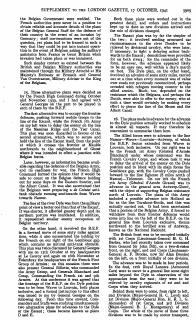
SUPPLEMENT TO THE LONDON GAZETTE, 17 OCTOBER, 1941                                      5909
  the Belgian Government were wedded. The                     Both these plans were worked out in the
  French authorities were never in a position to          greatest detail, and orders and instructions
  obtain reliable and accurate details of the plans       kept up to date as new divisions arrived and
  of the Belgian General Staff for the defence of         the role of divisions changed.
  their country in the event of an invasion by                The Escaut plan was by far the simpler of
  Germany; staff conversations were out of the            the two; it involved sending armoured car
  question, yet plans had to be framed in such a          reconnaissances to the river Dendre to be
  way that they could be put into instant opera-          relieved by divisional cavalry, who were later,
  tion in the event of Belgium asking for military        if necessary, to fight a delaying action back-
  assistance from France or Great Britain when             wards to the Escaut; demolitions were provided
  invasion had taken place or was imminent.                for on both rivers; for the remainder of the
     Such slender contact as existed between the           force, however, the advance appeared likely
  British and Belgian Military authorities was             to be an easy one, well within a day's march
  maintained through the Military Attach^ at His           on foot. The Dyle plan, on the other hand,
  Majesty's Embassy at Brussels and General               involved an advance of some sixty miles, carried
  Van Overstraeten, Military Adviser to the King           out at a time when every moment was of value
  of the Belgians.                                         over roads not previously reconnoitred, perhaps
                                                           crowded with refugees moving counter to the
       15. Three alternative plans were decided on         allied armies. Much, too, depended on the
    by the French High Command during October             resistance which the Belgians, and perhaps the
    and November 1939, and I had agreed with              Dutch, were able to offer to the enemy, who at
    General Georges on the part to be played in           such a time would certainly be making every
    each of them by the B.E.F.                            effort to pierce the line of the Meuse and the
                                                          Albert Canal.
       The first alternative was to occupy the frontier
    defences, pushing forward mobile troops to the             16. The plans made in advance for the advance
    line of the Escaut, while the French 7th Army           to the Dyle position actually worked to schedule
    on my left were to delay the enemy on the line          in almost all respects. It may therefore be
    of the Messines Ridge and the Yser Canal.               convenient to summarise them here.
   This plan was soon discarded in favour of the
    second alternative, which was to secure and               The Allied forces were to advance to the line
   hold the line of the Escaut itself, from the point       Namur—Wavre—Louvain—Antwerp, of which
   at which it crosses the frontier at Maulde               the B.E.F. Sector extended from Wavre to
   northwards to the neighbourhood of Ghent                 Louvain, both inclusive. On our right was to
   where it was intended to effect a junction with         be the French ist Army (General d'Armee
   Belgian forces.                                          Blanchard) under whose command was the
                                                            French Cavalry Corps, and whose task it was
       Later, however, as information became avail-        to delay the arrival of the enemy on the Dyle
   able regarding the defences of the Belgian Army,        position and to block with its main forces the
* and its readiness for war, the French High               Gembloux gap, with the Cavalry Corps pushed
   Command formed the opinion that it would be             forward to the line Eghezee (8 miles north of
   safe to count on the Belgian defence holding            Namur)—Tirlemont. On our left the French
   out for some days oh the Eastern frontier, and          7th Army (General d'Armee Giraud) was to
   the Albert Canal. It was also ascertained that          advance to the general area Antwerp-Ghent,
   the Belgians were preparing a de Cointet anti-          with the object of supporting Belgian resistance
   tank obstacle running southwards from Wavre             north of Louvain. The plans of this Army
  towards Namur.                                          included a possible advance into Holland as
      The line of the river Dyle was from the military     far as the line Turnhout-Breda, and this was
  point of view a better one than that of the Escaut.      actually carried out. It had been ascertained
  It was shorter, it afforded greater depth and its        that a portion of the Belgian Army, if forced to
  northern portion was inundated. In addition,            withdraw from their frontier defences would
  it represented smaller enemy occupation of              come into line on the left of the B.E.F. on the
  Belgian territory.                                      general line from Louvain exclusive, thence
                                                          northward to the fortified area of Antwerp,
      On the other hand, it involved the B.E.F.           known as the National Redoubt.
  in a forward move of some sixty miles against
  time, while it also necessitated the holding by             The British front was to be occupied initially
  the French on our right of the Gembloux gap             with ist Corps (Lieutenant-General M. G. H.
  which contains no natural anti-tank obstacle.           Barker, who had recently taken over command
  This plan was twice discussed by General Georges        from General Sir John Dill), on a two-division
  with me on I3th October at my headquarters              front, on the right, and 2nd Corps (Lieutenant-
 at Le Cauroy and again on i6th November at               General A. F. Brooke, now Sir Alan Brooke)
 Folembray the headquarters of the French First           on the left, on a front initially of one division.
 Group of Armies; on this occasion there were                 The advance was to be made in four periods.
 also present General Billotte, who commanded             In the first, i2th Royal Lancers (Armoured
 the Army Group, and Generals Blanchard and               Cars) were to move to a general line some eight
 Corap, Commanding the French ist and gth                 miles beyond the Dyle in observation of the
 Armies. At this conference it was agreed that            approaches from the east; they were to be
 the frontage of the B.E.F. on the Dyle position          relieved by cavalry regiments of ist and 2nd
 was to be from Wavre to Louvain, both places             Corps when they arrived.
 inclusive, and a formal instruction to this effect           Behind them were to come, from right to left,
 was issued to me by General Georges on the               2nd Division (Major-General H. C. Loyd) and
 following day. From this time onward, Com-               ist Division (Major-General Hon. H. R. L. G.
 manders and Staffs were studying simultaneously          Alexander) of ist Corps, and 3rd Division
 two alternative plans for advances to the Dyle           (Maj01-General B. L. Montgomery) of 2nd
 or the Escaut; these became known as plans               Corps. The whole of the move of these three
 DandE.                                                   divisions was to be made by motor transport,
Details
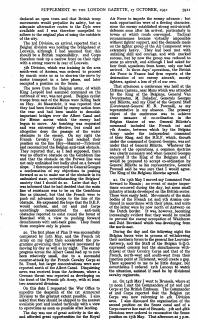
SUPPLEMENT TO THE LONDON GAZETTE, 17 OCTOBER, 1941

declared an open town and that British troop         Air Force to impede the enemy advance; but
movements would prejudice its safety, but no         such opportunities were of a fleeting character,
adequate alternative routes to the Dyle were         since the enemy established strong anti-aircraft
available and I was therefore compelled to           defences soon after his arrival, particularly in
adhere to the original plan of using the outskirts   towns at which roads converged. Tactical
of the city.                                         reconnaissance became virtually impossible
    The 3rd Division, on arrival, reported that a    without fighter support, and the demands made
 Belgian division was holding the bridgehead at      on the fighter group of the Air Component were
 Louvain, although I had assumed that this           extremely heavy. They had been met with
 should be a British responsibility. 2nd Corps       unfailing skill and courage, and with marked
 therefore took up a narrow front on their right     success, but by now the group was reduced to
 with a strong reserve in rear of Louvain.           some 50 aircraft, and although I had asked for
    5th Division, which was training in the area     four fresh squadrons from home, only one had
 south-west of Amiens, was ordered to proceed        arrived. In three days' operations, the British
 by march route so as to shorten the move by         Air Force in France had firm reports of the
 motor transport in a later phase, and later         destruction of 101 enemy aircraft, mostly
 occupied a position on the Senne.                   fighters, against a loss of 78 of our own.
    The news from the Belgian army, of which            That afternoon a conference was held at the
 King Leopold had assumed command on the             Chateau Casteau, near Mons which was attended
 outbreak of war, was not good. Belgian cyclist      by the King of the Belgians, General Van
 troops from east of the Meuse were falling back     Overstraeten, M. Daladier, Generals Georges
 on Huy. At Maastricht, it was reported that         and Billotte, and my Chief of the General Staff
 they had been forestalled by enemy action from      (Lieutenant-General H. R. Pownall), as my
 the rear and had been unable to demolish            representative in my absence. The primary
 important bridges over the : Albert Canal and       object of the conference was to achieve
 the Meuse across which the enemy had                some measure of co-ordination in the
 begun to move. Air bombing was requested            Belgian theatre of war. General Billotte's
 and was extremely effective, but could not          command included the French ist and
 altogether deny the passage of the water            7th Armies, between which lay the Belgian
 obstacles to the enemy. On my right the             Army under the independent command
 French Cavalry Corps had reached their              of their King, and the B.fe.F. which, though
 position on the line Huy—Hannut—Tirlemont           under the command of General Georges, was not
 and reconnoitred the Belgian anti-tank obstacle.    under that of General Billotte. Whatever the
 They reported that, as I had supposed, there        nature of the operations, a common doctrine
 was no effective obstacle on the Gembloux line      was clearly necessary and when General Georges
 and that the obstacle on the Perwez line was        enquired if the King of the Belgians and I
 not only unfinished but badly sited on a forward    would be prepared to accept co-ordination by
 slope. I thereupon conveyed to General Georges      General Billotte as bis representative, General
 a confirmation of my objections to pushing          Pownall said he was sure that I would agree.
 forward so as to make use of the obstacle in its    The King of the Belgians likewise agreed.
 unfinished state, notwithstanding the Belgians'      . 21. On I3th May I moved my Command Post
 anxiety that I should do so. Later that day I       forward to Renaix; no event of major impor-
 was informed that he had decided that the main      tance occurred during the day, but some small
line of resistance was to be on the Gembloux         infantry attacks developed on the British sector.
 line as planned, but that the French were to        These were easily held. Movements of the main
 push out advanced troops to the line of the         bodies of the French ist and 7th Annies con-
obstacle. He expressed the hope that the B.E.F.      tinued in accordance with their plans, and units
would conform, and ist and 2nd Corps                 of the latter were by now north of Antwerp on
 accordingly      reconnoitred   the     anti-tank   the Dutch border. It was, however, becoming
obstacles reported to exist round the forest of      increasingly evident that they would be unable
Meerdael with a view to pushing forward              to prevent the enemy occupation of Walcheren
detachments with anti-tank guns. They found          and Zuid Beveland which was developing from
them complete only in places.                        the north-east.
    20. The first phase of Plan D was successfully      During the day and the following night the
completed by i2th May, and the French ist            Belgian forces were in process of withdrawing
Army on my right then accelerated the pro-           their northern forces to the general line Louvain-
gramme governing their forward movement by           Antwerp, and the Staff of the Belgian G.Q.G.
moving by day as well as by night. The enemy         expressed concern lest the simultaneous with-
progress across the Albert Canal had up to now       drawal of their Cavalry Corps and that of the
been relatively small, due to a successful           French, north-west and south-west from their
counter-attack by the French Cavalry Corps at        junction point at Tirlemont, would create a gap.
St. Trend, but larger concentrations were now        There appeared to me to be little danger, but
reported north of the Albert Canal. Disquieting      nevertheless I ordered I2th Lancers to watch
news was received from the Ardennes, where a         the situation, assisted if need be by divisional
German thrust was reported as developing on          cavalry regiments.
the front of the French gth Army, with at least         22. On I4th May I went to Brussels, where at
two armoured divisions.                              12 noon I met the Commanders of ist and 2nd
    On this date I requested the War Office to       Corps at the British Embassy. The Commander
expedite the despatch of the ist Armoured            of 2nd Corps reported that the Belgian ist
Division to the greatest extent possible. I also     Corps was now reforming in 4th Division
asked that they should be shipped to the nearest'    area. I also discussed the organisation of the
available port and loaded tactically with a view     second position on the Senne canal and of a
to operations as soon as possible after landing.     Corps reserve line east of Brussels. 5th and 48th
    The day was one of great activity in the air,    Divisions were ordered to reconnoitre the Senne
and afforded great opportunities for the Royal       position on I5th May. That afternoon at 3 p.m.
Details
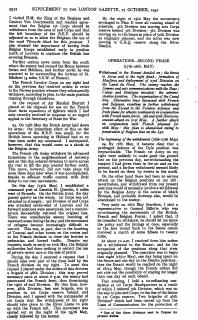
5912          SUPPLEMENT TO THE LONDON GAZETTE, 17 OCTOBER, 1941

   I visited H.M. the King of the Belgians and          By the night of i5th May the movements
   General Van Overstraeten and reached agree-        envisaged in Plan D were all running ahead of
  ment that the Belgian ist Corps should be           schedule. 4th Division was moving into Corps
   withdrawn from the area of 2nd Corps and that      reserve behind 3rd Division; 5th Division was
  the left boundary of the B.E.F. should be           moving on to the Senne in place of 5oth Division
  adjusted so as to allow the Belgians the use of     as originally planned, and the latter was now
  the road Vilvorde-Alost for this purpose. I         moving to G.H.Q. reserve along the River
  also stressed the importance of having fresh        Dendre.
  Belgian troops established early in position
  north of Louvain to continue the British line
  covering Brussels.
     Further serious news came from the south                OPERATIONS—SECOND PHASE
  where the enemy had crossed the Meuse between                         (i7th-26th MAY)
  Sedan and Me"zieres, and further north he was
  reported to be surrounding the fortress of St.       Withdrawal to the Escaut decided on; the threat
  Heribert (4 miles S.S.W. of Namur).                    to Arras and to the right flank; formation of
     The French Cavalry Corps on my right had            Macforce and deployment of 2yd Division on
  on the previous day received orders to retire          the Canal du Nord. The enemy reaches the
  to the Perwez position whence they subsequently        Somme and cuts communications with the Base ;
  withdrew, according to plan, to the main position      Calais and Boulogne invested: the admini-
  running through Gembloux.                              strative position. The organisation of the Canal
                                                         line. Alternative lines discussed with French
     At the request of Air Marshal Barratt I             and Belgians, resulting in further withdrawal
  placed at his disposal for use on the French          from the Escaut to the Frontier defences and
 front three squadrons of fighters which I had          fresh plans for attacks southwards in conjunction
 only recently received in response to an urgent         with French main forces. $th and $oth Divisions
  appeal to the Secretary of State for War.             counter-attack on 21st May. A further attack
     23. On 15th May the Dutch Army laid down           in conjunction with French planned for
 its arms; the immediate effect of this on the           26th May: this plan is abandoned owing to
 operations of the B.E.F. was small, for the            penetration of Belgian line on the Lys.
 British forces operating in Holland had at no
 time been under my command. I anticipated,             The beginning of the withdrawal (ifith-T.'jth May)
 however, that this would come as a shock to              24. By i6th May, it became clear that a
 the Belgian Army.                                     prolonged defence of the Dyle position was
     The French 7th Army withdrew' its advanced        impracticable. The French ist Army on my
 formations to the neighbourhood of Antwerp            right were unlikely to make good the ground
 and on this day ordered divisions to move across      lost' on the previous day, notwithstanding the
 my rear to fill the gap created further south.        support I had given them in the air and on the
 This move, however, did not take place till           ground, and a further withdrawal seemed likely
 some three days later when it was accomplished,       to be forced on them by events in the south.
 thanks to efficient traffic control, with little         On the other hand there had been no serious
 delay to our own movements.                           attack on the Belgian positions on my left;
    On this day (i5th May) I established a             nevertheless, any withdrawal from our present
 command post at Lennick St. Quentin, 6 miles          positions would of necessity involve a withdrawal
 west of Brussels. On the British front, the day       by the Belgian Army in the course of which
 passed quietly on the whole, ist Corps was not        Brussels, and probably Antwerp also, would be
 attacked in strength ; 3rd Division of 2nd Corps     abandoned to the enemy.
 was attacked north-west of Louvain and its              Very early on i6th May therefore, I sent a
 forward positions were penetrated, but a counter-    representative to General Billotte who was
 attack successfully restored the original line.      co-ordinating the movements of the British,
 There was considerable enemy bombing of              French and Belgian Forces; I asked that, if
 rearward areas during the day, and the movement      he intended to withdraw, he should let me know
 of refugees became increasingly difficult to         the policy and the timings at once, especially
 control. This was, in part, due to the bombing       as the first bound back to the Senne canals
 of Tournai and other towns on the routes and         involved a march of some fifteen to twenty
to the French decision to close the frontier to       miles.
pedestrian and horsed traffic. Despite my                At about 10 a.m. I received from him orders
requests, made as early as loth May, the Belgian      for a withdrawal to the Escaut, and for the
authorities had done nothing to restrict the use      occupation of the positions along that fiver
of private motor cars or the sale of petrol.          originally planned. The operation was to begin
    During the day I received a request that I        that night (16/17 May), one day being spent on
should take over part of the front held by the        the Senne and one day on the Dendre positions ;
French division on my right. To meet this             thus the Escaut would be reached on the night
request I placed under the orders of this division    of 18/19 May, though the French orders did
a brigade of 48th Division ; this step proved         not rule out the possibility of staying for longer
necessary since at about 6 p.m. the enemy had         than one day on each bound.
penetrated the French front, thus threatening            That evening, I held a co-ordinating con-
the right of 2nd Division. By this tune, how-         ference at ist Corps Headquarters as a result
ever, 48th Division, less one brigade, was in         of which I ordered 5th Division, which was on
position in ist Corps reserve behind 2nd              the way to join 2nd Corps, to the line of the Senne
Division, and I agreed with the commander of          in ist Corps reserve. Two brigades of 46th
ist Corps that the withdrawal of his right            Division* which had been moved up from the
should take place to the River Lasne to join          Lines of Communication for the protection of
up with the French left. This movement was
carried out on the night of the 15/16 May,              * One of the three divisions sent to France for
closely followed by the enemy.                        pioneer duties.
Source: The National Archives, Kew, ADM 199 788 A. Contains public sector information licensed under the Open Government Licence v3.0.

Details
SECRET.
20
From Director of Trade Division.
To Consular Shipping Advisers Amsterdam
"
"
"
Rotterdam
"
"
"
Antwerp
(Copy to Naval Attache Hague)
QUESTIONNA.IRE to accompany N.C. 3/2/69.
(Note very early replies, even if incomplete, are of
the first importance. Accurate information, if
obtainable, should follow in a supplementary report).
1. Small coasters known to be laid up.
(a) In what localities are any laid up?
(b) In what numbers?
(c) In what state of readiness for sea as regards stores, fuel, crews,
quick access to the sea?
2.
Small coasters.
Do these craft carry anchor equipment with which they can moor
themselves head-and-stern? (Those which may come to Poole
or Milford Haven will be required to stow very closely and
stern moorings will be essential.)
3. Fishing Vessels.
What number and description are likely to take part in an
evacuation?
From what ports do they work? Where are any laid up?
4. Shipping.
What number and description is likely to be found in Flushing?
In Terneusen? In Ghent?
Considering Amsterdam, Rotterdam, Antwerp, Flushing, Terneusen,
Ghent :-
Do you agree with the estimate offered in Admiralty Memorandum
NL/TD 61/40 paragraph 3 as to the maximum number of refugees
which could safely be embarked, on the assumptions there made?
How long would be required to clear each port of Shipping?
Is any emergency line of communication prepared at Ymuiden,
Flushing, and Hook of Holland?
Is there any possibility, during an emergency evacuation of
observers at these three places checking and reporting the
numbers of ships which pass out?
Source: The National Archives, Kew, ADM 199 792. Contains public sector information licensed under the Open Government Licence v3.0.

Details
COPY.
HOME OFFICE,
9
WHITEHALL.
URGENT AND CONFIDENTIAL.
20th January, 1940.
S
929
dam
he
1940
Dear Cadogen,
I had a conference this morning with
representatives of the Admiralty, the Ministry of
Health and the Ministry of Food on the question of
what provisional arrangements can be made for a
to
situation which would arise If large numbers of
en
Dutch and Belgian refugees came to this country
3
owing to the invasion of Holland and Belgium. The
view of the Admiralty is that their representatives
in Antwerp, Amsterdam and Rotterdam ought to have
instructions which would enable them to tell the
captains of Dutch and Belgian ships where they must
go if they are bringing refugees to the United Kingdom.
Moreover, It appears from the discussion with the
Admiralty that there are insupurable difficulties
about bringing these ships into London or ports on
the South and Best coast. We urged upon the Admiralty
being nad for their safety and health during a 3 to 4 days winter
voyage.
This estimate is offered with the greatest reserve, and
should be subject to improvement in the light of fuller
information.
4./

Details
Note: Ships can carry 80000
HO expect 500, 000.
11061/40 40
laps application
MEMORANDUM.
DTD)
Evacuation of Shipping from Dutch and Belgian Ports.
14
In an emergency it is lik ; ; y that a large number of ships
will wish to clear from the three chief ports, Amsterdam, Rotterdam
and Antwerp, and that they will carry a great many refugees. The
ships may not be confined to those wearing the Dutch and Belgian
flags.
It is known that on 16th January 50 ships were in
Amsterdam and 75 in Rotterdam, their sizes ranging from the
smallest to 16,000 tons. The number in Antwerp, including Ghent
(for which figures have not yet been secured) was possibly between
50 and 75. In addition there are known to be 200 small coasters
laid up in Dutch ports.
2.
No estimate can be formed of the number of refugees likely
to demand passage, but it may well be great, and the probability is
that no provision will be made for victualling those who embark
and who may be forced to remain in the ships for a fortnight or
more.
3.
A very rough high limit of the number which should
properly be allowed to embark is suggested to be 80,000. This
is based on the assumptions that the greater part of the shipping
referred to in paragraph 1 sails for United Kingdom anchorages,
and that the numbers embarked will be subject to control, regard
being had for their safety and health during a 3 to 4 days winter
voyage.
This estimate is offered with the greatest reserve, and
should be subject to improvement in the light of fuller
information.
4./

Details
MEMORANDUM.
Evacuation of Shipping from Dutch and Belgian Ports.
Note: The Home Office
In an emergency it is likely that a large number of ships
expoctation ? 500, 000 upples
will wish to clear from the three chief ports, Amsterdam, Rotterdam
mush he modified to 80, 000
atailable in in thiffing in the fish
the hims I accomordation
and Antwerp, and that they will carry a great many refugees. The
ships may not be confined to those wearing the Dutch and Belgian
flags.
instruck.
Others may come befare have, or
It is known that on 16th January 50 ships were in
later.
Amsterdam and 75 in Rotterdam, their sizes ranging from the
smallest to 16,000 tons. The number in Antwerp, including Ghent
(for which figures have not yet been secured) was possibly between
fuhere ent
50 and 75. In addition there are known to be 200 small coasters
You had
laid up in Dutch ports.
confiss Turneral
water This a)
2.
No estimate can be formed of the number of refugees likely
to demand passage, but it may well be great, and the probability is
uples
that no provision will be made for victualling those who embark
and who may be forced to remain in the ships for a fortnight or
more,
5-4898 unless the shur phen end) up with Through
=) Belgin
3.
A very rough high limit of the number which should
n3 200 ships with
properly be allowed to embark is suggested to be 80,000. This
400 passelles each
is based on the assumptions that the greater part of the shipping
80, oro
referred to in paragraph 1 sails for United Kingdom anchorages,
and that the numbers embarked will be subject to control, regard
200 coasters with
being had for their safety and health during a 3 to 4 days winter
go stenges each
voyage.
= 4000
This estimate is offered with the greatest reserve, and
should be subject to improvement in the light of fuller
information.
Source: The National Archives, Kew, ADM 234 360. Contains public sector information licensed under the Open Government Licence v3.0.

Details
THE EVACUATION FROM DUNKIRK
CHAP. I
13TH MAY
Occupation of Walcheren and Zuid Beveland imminent
in accordance with their plans, and by the May, units of the latter
Movements of the main bodies of the French 13th Ist and 7th Armies continued
north of Antwerp on the Dutch border. It was, however, becoming in-
of Walcheren and Zuid Beveland, which was developing from the north-east.
creasingly evident that they would be unable to prevent the enemy occupation
northern forces to the general line Louvain-Antwerp.
During the day and the following night the Belgians were withdrawing their
14TH MAY
Germans cross Meuse
May the 14th was crucial, for on that day the enemy penetrated the French
9th Army front, and crossed the Meuse between Sedan and Mézières.¹ (See
Plan 1).
15TH MAY
Dutch Army surrenders
On the 15th May the Dutch Army laid down its arms. The immediate effect
of this on the operations of the B.E.F. was small, but "I anticipated says
Lord Gort, "that this would come as a shock to the Belgian Army".2
The French 7th Army withdrew its advanced formations to the neighbour-
hood of Antwerp, and the French divisions on the B.E.F.'s left flank were
ordered to move across the British rear to fill the gap which had been created
on the French 9th Army's front. This move did not, however, actually take
place till some 3 days later,² and it then left the Belgian Army responsible for
the security of the British left flank.
On the British front the day passed quietly on the whole. The 1st Corps
[Lt.-Gen. M. G. H. Barker] was not attacked in strength; 3rd Division [Maj.-
Gen. B. L. Montgomery] of 2nd Corps [Lt.-Gen. A. F. Brooke] was attacked
north-west of Louvain, and its forward positions were penetrated, but a counter-
attack successfully restored the original line.
and, in spite of British support, some ground was lost.
At about 1800, however, the enemy penetrated the French 1st Army's front,
16TH MAY
Allies withdraw to river Escaut
was were impracticable,3 because the French 1st the B.E.F.'s right flank
By the 16th May it became clear that a prolonged defence of the Dyle position
withdrawal unlikely to make good the ground lost on Army the on and a further
It seemed likely to be forced on them by events previous in day the south.³
on night of Senne and one day on the River Escaut, spending on the
the was River therefore decided to withdraw to the River one day
began. 16th-17th May, the 15 to 20 miles withdrawal Dendre. to Accordingly, the Senne positions
2 1 Lord Lord Gort's Second Despatch
2 Lord Gort's Second Despatch, para. 22.
Gort's Second Despatch, para. para. 23. 24.
2

Details
PLAN 1
Soate of Miles
10
5
o
10
20
30
40
N
The German
break-through
on 17th.18th
KENT
OSTEND
ANTWERP
DUNKIRK LA PANNE NIEUPORT
BRUGES
18th MAY
may
13th
MAY ON MAPS IN LORD CORTS DESPATCH
R.M.
FURNES
Yser
GAND
MALINES
GRAVELINES
a
BERGUES
CALAIS
SPYKE
RIYS
R.Senna
ALOST
WORMHOUTE
th
F.
LOUVAIN
YPRES
18MAY
Phyle
WATTEN
COURTRAI
MENIN
Escaut
BRUSSELS
13th MAY
CASSEL
COMINES
BOULOGNE
StOMER
R.Dendre
WAVRE
HAZEBROUCK
ARMENTIERES
P.LYS
AIRE
MERVILLE
LILLE
ATH
R.Meuse
EXOLISH
NAMUR
StAMAND
LA BASSEE
R.Sambre
VALE CIENNES
DOUAI
Fscaut
RRA
R.
18th MAY
18thMAY
13th:MAY
CAMBRAI
DOULLENS
ABBEVILLE
R
2.50mm
ALBERT
DIEPPE
PERONNE
AMIENS
st QUENTINE
18th MAY
MEZIERES
SEDAN
R.Oire
Approximiste BritishFrenchead Belgiadine on 13ᵗʰ May:
R.Aisne
"
" " 18th " :
German break break-through shewn in blue
RMass
TSD/HS (655)
C.B.H. 16675- Wt.41534 Dd. -625-6/49

Details
PLAN 2
Scale ofMiles
to
5
o
10
20
30
40
N
The Allied
withdrawal into
18th MAY
the Dunkirk
KENT
GSTEND
.
30ᵗMAY
BRUGES
ANTWERP
PANNE
perimeter on the
+
NIEUPORT
23rd MAY
30th May
May
+
4.
FURNES
MALINES
Yser
GAND
BASED ON MAPS IN LORD GORT'S DESPATCH
LINES
C
GRAVE
STATES
BERGUES
R.Lys
ALOST
R
WORMHOUTE
LOUVAIN
CHANNEL
YPRES
COURTRAI
Escant
R.Dyle
WATTE
MENIN
BRUSSELS
.
R
St. OMER
CASSEL
COMINES
Dandre
WAVRE
BOULDONE
.
ZEBROUCK
INS
ARMENTIERES
R.
R
AIRE
MERVILLE
ATH
LILLE
23rd:MAY
Meuse
23rd MAY
St. AMAND
NAMUR
.
BASSEE
CARVIN
.
18th MAY
R.
Sambre
St.POL
.
VALENCIENNES
DOUAI
BARRAS
Escaut
a
CAMBRAI
OULLENS
BEVILLE
B
ALBERT
R.Somme
PERONNE
him
AMIENS
StQUENTIN
French 10th Arm
MEZIERES
SEDAN
R.Oise
Mause
The Dunkirk Perimeter on 30th May.
Allied line on 18th Щау
French 3rd Army R.Aisne
Approximate British, French and Belgiantine on 23rd May
German progress shewn in blue
TSD/HS (ESG)
C.B.H.16675

Details
PLAN 2
Scale ofMiles
to
5
o
10
20
30
40
&
The Allied
withdrawal into
18th MAY
the Dunkirk
KENT
GSTEND
30thmay
BRUGES
ANTWERP
PANNE
perimeter on the
NIEUPORT
23rd MAY
+ 30th May May +
+
x
FURNES
GAND
MALINES
LINES
Yser
BASED ON MAPS IN LORD GORT'S DESPATCH
C
SAYKER
BERGUES
R.Lys
ALOST
a
WORMHOUTE
LOUVAIN
CHANNEL
YPRES
COURTRAI
R.Dyle
WATTE
MENIN
BRUSSELS
.
R
St. OMER
CASSEL
COMINES
WAVRE
BOULDONE
.
Dandre
ZEBROUCK
IVS
ARMENTIERES
R.
AIRE
LALT
MERVILLE
ATH
LILLE
23rd:MAY
Meuse
23rd MAY
.
St. AMAND
NAMUR
BASSEE
CARVIN
.
18th MAY
R
Sambre
St.POL
VALENCIENNES
DOUAI
ARRAS
R.Escaut
CAMBRAI
DOULLENS
BEVILLE
B
ALBERT
Somme
PERONNE
AMIENS
him
St.QUENTIN
French 10th Army
MEDIERES
SEDAN
R.Oise
RMause
The Dunkirk Perimeter on 30th May
Allied line on 18th Щау
French 3rd Army R.Aisne
Approximate British, French and Belgiantine on 23rd May
German progress shown in blue
TSD/HS (E56)
C.B.H.16675
Source: The National Archives, Kew, MT 40 66. Contains public sector information licensed under the Open Government Licence v3.0.

Details
C.S
MINISTRY OF WAR TRANSPORT
NOID
15
REFERENCE SHEET.
TA6
16
(Rm YOY!)
how S.H. Brown
S.T.
In
1st July, 1941.
24
Gentlemen,
p&S. THE DUCKS.SS "THE MARQUIS"
ss THE MARQUIS
An enquiry has been received on behalf of a
Miss Emmerson, resident in Spain, regarding relatives
who endeavoured to get to England from Antwerp when
Belgium was invaded. It is believed that the Emmersons
embarked in "THE MARQUIS" at Ostend on the 27th May, 1940.
as
possible I should be glad if you would be good enough to
inform me whether you have any record that a family of
this name embarked in "THE MARQUIS" and, if so, at what
Port they di sembarked in this country.
and game, 1940.
I am, Gentlemen,
TA
Your obedient servant,
brans
S
(Sgd.) B.E. Bellamy
for Director of Sea Transport.
Herearth
Messrs. J. Hay & Sons Ltd.,
45 Renfield Street,
GLASGON, C.2.
Mb

Details
21
INTERNATIONAL MARINE RADIO COMPANY LIMITED,
DIRECTORS:
F. GILL.O M.INST C.E. M.I.E.E.
CONNAUGHT HOUSE,
TELEPHONE: HOLBORN 8765.
COMMANDER F.G. LORING, O.B E.M.I.E.E.
TELEGRAMS: INTELCOMAR,ESTRAND,LONDON.
H. THORPE-WOODS, M.N.E.C.INST.
63, ALDWYCH,
UNLAND
A.DAVIDSON,
T.G. SPENCER.
LONDON,W.C.2.
19th June 1941.
W. Carter Esq., C.B.E.,
Ministry of Sea Transport,
Berkeley House,
Passual
Berkeley Square,
S.W.1.
Dear Carter,
I should be very grateful for your help in making the following inquiry,
assuming there is no objection to it.
We have been asked by our Spanish company to try and trace the relatives of
their English secretary, Miss Emmerson. The Emmersons were a British family
resident in Antwerp, who endeavoured to get to England when Belgium was invaded.
It has been ascertained from the Harbour Master at Ostend, that these people
left Ostend in either the S.S. "Marquis" or the S.S. "Duchess" on 27th May, 1940.
Nothing more has been heard of them by Miss Emmerson. The first inquiry seems to be to
ascertain if these ships (or either of them) on 27th May 1940, reached an English
port, and if so which port.
If you could help to obtain this information, it would be very kind of you.
Please forgive my troubling you, but I do not know how to set about this inquiry
otherwise.
With kind regards.
Yours sincerely,
7.00mg
Operation Dynamo Map — Movement Logs
Movements recorded for Antwerp during the evacuation period, as plotted on the Operation Dynamo map.
No reviewed movement log is currently published for this vessel.
Log in to suggest an evidence-backed edit or a new movement log.