Also known as
No aliases recorded.
Advance
User Contributed Collection
Documents and descriptions supplied by archive contributors. All submissions are reviewed in accordance with our Terms and Conditions.
No user-contributed documents have been approved for this vessel yet. Use the forms below to contribute images or documents relating to this vessel.

Help complete the archive
Do you have a photo of this vessel you can share?
Contribute photographs of Advance to the archive for editorial review. Submissions remain private and will only be published following approval by an administrator.
How your photograph will be credited
Exterior · 1940 · Copyright © Example Contributor
Source: Copyright ownership confirmed at submission by Example Contributor.
This example uses the photograph group, year and copyright-holder name supplied in the form. Your own details will replace the example above when an approved image is published.
Already have an account? Log in before uploading to link new photographs immediately.

Help complete the archive
Contribute a document
Share documents or images relating to Advance for editorial review. Upload up to 12 PDF, JPG, PNG or WebP files per submission, with a maximum size of 20 MB each. Your submission remains private and will only be published following approval by an administrator.
How your document will be credited
Example Document Title · Contributed by Example Contributor
Source: Archive reference supplied by Example Contributor.
This example uses the document title, contributor name and source or archive reference supplied in the form. Your own details will replace the example above when an approved document is published.
ORDE Registry
1 record1 potential matching record has been identified.
These records may contain vessel particulars, reported movements, participation assessments, named personnel and source references. A match does not by itself prove that the vessel participated in Operation Dynamo.
“Potential match” means a candidate returned by one or more indexing rules; it is not necessarily an exact identity match. Depending on the source, matching may use a normalised vessel name, a partial text or OCR hit, an alias, or related metadata. Roman-numeral suffixes such as I, II, III, IV and V may be absent, misread or separated from the base name, so records for similarly named vessels can be grouped incorrectly. Multi-word names can also produce candidates where only one significant word matches. Confirm the full name, numeral, vessel type, dimensions, builder, ownership, dates and source context before treating two records as the same vessel.
We are compiling and checking transcriptions, metadata, vessel-name matches, source references and reuse permissions before publishing further detail. This work helps prevent incomplete OCR, historic spelling variations or unverified associations from being presented as established fact.
Account registrations and access to these developing records are temporarily unavailable. Existing account holders may log in, and everyone can join the newsletter for publication updates.
Small Craft Service List
2 records2 potential matching records have been identified.
These records may contain service-list entries, vessel metadata, source-page references and protected full-size document images. A match does not by itself prove that the vessel participated in Operation Dynamo.
“Potential match” means a candidate returned by one or more indexing rules; it is not necessarily an exact identity match. Depending on the source, matching may use a normalised vessel name, a partial text or OCR hit, an alias, or related metadata. Roman-numeral suffixes such as I, II, III, IV and V may be absent, misread or separated from the base name, so records for similarly named vessels can be grouped incorrectly. Multi-word names can also produce candidates where only one significant word matches. Confirm the full name, numeral, vessel type, dimensions, builder, ownership, dates and source context before treating two records as the same vessel.
We are compiling and checking transcriptions, metadata, vessel-name matches, source references and reuse permissions before publishing further detail. This work helps prevent incomplete OCR, historic spelling variations or unverified associations from being presented as established fact.
Account registrations and access to these developing records are temporarily unavailable. Existing account holders may log in, and everyone can join the newsletter for publication updates.
Details — result 1
A source-page icon is available. Sign in to view the indexed details and protected full-size image.
Details — result 2
A source-page icon is available. Sign in to view the indexed details and protected full-size image.
Red List (1939–40) — indexed references
These references come from the Red List index. Printed page numbers may differ from digitised image numbers; OCR may not reproduce the vessel name accurately.
- Advance — ADM 208/3, printed page 9A
- Advance — ADM 208/3, printed page 9A
Red List (1939–40) — OCR
5 records5 potential matching records have been identified.
These records may contain OCR text matches, source files, page references and digitised page imagery. A match does not by itself prove that the vessel participated in Operation Dynamo.
“Potential match” means a candidate returned by one or more indexing rules; it is not necessarily an exact identity match. Depending on the source, matching may use a normalised vessel name, a partial text or OCR hit, an alias, or related metadata. Roman-numeral suffixes such as I, II, III, IV and V may be absent, misread or separated from the base name, so records for similarly named vessels can be grouped incorrectly. Multi-word names can also produce candidates where only one significant word matches. Confirm the full name, numeral, vessel type, dimensions, builder, ownership, dates and source context before treating two records as the same vessel.
We are compiling and checking transcriptions, metadata, vessel-name matches, source references and reuse permissions before publishing further detail. This work helps prevent incomplete OCR, historic spelling variations or unverified associations from being presented as established fact.
Account registrations and access to these developing records are temporarily unavailable. Existing account holders may log in, and everyone can join the newsletter for publication updates.
Ship Details
These details have been aggregated from multiple sources and may include contemporary records, later recollections, claims or assertions for which no corroborating evidence has been identified. Inclusion does not establish that any account or assertion is accurate. The information may be incomplete, out of date, disputed or incorrect and should be checked against the underlying source records and independent evidence before being relied upon.
- Beam: 11ft 6ins?
- ADVANCE | The Association of Dunkirk Little Ships top of page Mai - Juin 1940 The Association of Dunkirk Little Ships A D L S HOME LITTLE SHIPS ADLS MEMBERS ALL KNOWN SHIPS LOST SHIPS ADLS DLS for SALE DUNKIRK 1940 EVENTS COMMITTEE IDENTIFYING DLS BOOK LIST LINKS More Use tab to navigate through the menu items. ADVANCE Type: Length: Beam: 11ft 6ins? Draft: Displacement: Engine: Thornycroft 140hp Advance was one of the first Little Ships to arrive at Dunkirk and was, unusually, skippered by her owner, C.P. Dick. He and his crew had left Teddington at 0730 on 28th May, arriving at Sheerness at 1330 and leaving for Dover at 1630 in company with eight other boats. Having arrived at Dover at 0300 on 29th May Advance slipped at 0645 led by Viewfinder with Elizabeth Green, Bobeli, Hanora and later Reda. Approaching Dunkirk, the group were machine-gunned by two aircraft and Advance’s signal mast was carried away by the undercarriage of the second aircraft. At 1300 they started rescuing troops, ferrying them to various vessels offshore. At 2045 Advance and Elizabeth Green returned to Ramsgate having both suffered damage. Advance had to be beached on arrival at 0530 to prevent her sinking. C.P. Dick and crew member E.H. Piercy were paid ?10 and given an official letter recording their brave participation in this operation. Here the story takes a strange turn. 48 hours later, whilst waiting for the Advance to be repaired, both Piercy and Dick were detained by the police under Defence Regulation 18B (which allowed the internment of British citizens without charge or trial if they were deemed to be of unsound loyalty to this country). Their offence was that they had both been members of Oswald Mosley's Blackshirt party. They were released 90 days later. Advance made one more trip to Dunkirk with S/Lt P. Snow RN as skipper on 2nd and 3rd June. As of April 2018, no further information concerning this historic vessel has been received. We would invite persons with knowledge of her history and whereabouts to contact the Association. Updated April 2018 ADVANCE: Project Do you have information on this vessel? Please let us know First name Last name Email Boat name INFORMATION ON THIS VESSEL I agree to the ADLS using my information online Submit The Association of Dunkirk Little Ships ©2021 The Association of Dunkirk Little Ships. All rights reserved. bottom of page
- Engine: Thornycroft 140hp
Lloyd’s Yacht Register (1939)
Source: Lloyd’s Register Foundation, Heritage & Education Centre, Lloyd’s Register of Yachts 1939, digitised via Internet Archive. Licensed under CC BY-NC-SA 4.0. Images have been converted, resized and watermarked for web display; machine-generated table OCR has been added.
No Lloyd’s records.
Document Collections — Tagged Pages
113 pagesImaged document collections containing pages whose OCR text or table data has been tagged with the name Advance. Open a collection to view the page images and transcriptions.
Contains public sector information licensed under the Open Government Licence v3.0.
Details
ADMIRALTY Open 36 ft. launch
S/Lt. R. Shrimpton,
R.N.V.R.(1)
lst June
p.m.
Towed over by & drifter and spent the
night at the beaches.
On a later night, S/Lt. Shrimpton went
into Dunkirk.
The
[No information as to whether this
vessel returned, or how S/Lt.
Shrimpton got back].
Authority - R.O.II, p. 393.
to
six.
ST 2 aircraft. Advance's signal
sist was carried sway by the
carriage of the second aircraft.
whaler inshore; it une awamped
OR reaching the beach. Emptied
righted the whaler, which was
token in tow by the Advance.
82th this and another whaler
DILB picked up, ferried troops to 0
destroyer and a drifter. Air
Shaler sunk. Ferried.troops to 03
assort vessel and a transport, and
boats to off-lying ships.
from a destroyer [the Sabre]
to transmitter, which, with 2
operatore, UGS transported to La
M/W ViewCinder was nighted aground.
THE and the M/D Klisobeth
book of which had suffered
The AMORICA to be beached to
from sinking alongaide.
Y. Snow, R.N. left Remagato in
the Advance for Durkirk, in
with 11 other 11/3's and 3
(see white MARR).
Durkirk.
while BE Dunkirk, the
was
on
the
Returned to Remente,
[No other Information of this 2nd
N11
(1) Shown in the August 1940 Navy List as a lieutenant,
seniority 31/5/40. Not shown in the June 1940 Navy
List.
11
Details
ADVANCE( 1)
M/Y
C.P. Dick, Owner, Skipper.
28th May
0730
Left Teddington.
1330
Arrived Sheerness.
1630
Left Sheerness with 8 other boats.
29 th May
0300
The Advance arrived Dover. The
remaining boats arrived at intervals,
except one which had been sunk in
collision.
0645
Slipped and proceeded, led by the M/B
Viewfinder, with the M/B's Elizabeth
Green, Bobeli, Hanora and one
other (which turned back) in company.
0700
Joined by the M/B Reda, which brought
the convoy up to six.
1230
Approaching Dunkirk, machine-gunned
by 2 aircraft. Advance's signal
mast was carried away by the under-
carriage of the second aircraft.
1300ca
Sent whaler inshore; it was swamped
on reaching the beach. Emptied and
righted the whaler, which was then
taken in tow by the Advance.
With this and another whaler which
was picked up, ferried troops to a
destroyer and a drifter. Air attacks.
Whaler sunk. Ferried troops to an
escort vessel and a transport, and
towed boats to off-lying ships.
1900ca
Received from a destroyer [the Sabre]
a radio transmitter, which, with 2
operators, was transported to La
Panne.
2045
The M/B Viewfinder was sighted aground.
The Advance and the M/B Elizabeth
Green, both of which had suffered
damage and were leaking, proceeded in
company.
30th May
0530
Arrived Ramsgate.
The Advance had to be beached to
save her from sinking alongside.
2nd June
1830ca
S/Lt. P. Snow, R.N. left Ramsgate in
the Advance for Dunkirk, in company
with 11 other M/B's and 3 skoots
(see White Wing).
-
Arrived Dunkirk.
While at Dunkirk, the M/B Bobeli
was sighted on the beach.
3rd June
-
Returned to Ramsgate.
[No other information of this 2nd
trip available].
Nil
Authority-- R.O.II, p.392.
TO.9144.
12
Details
BOAT (16 ft.)
Owner, W. Robertson.
Bonhum,
Hells
29th way
Did not return from Operation Dynamo.
0815
Lott Dover In compuny with 5 other
bosts, (see Viewfinder). Later
1730ca
joined by A/A Rediu
Arrived Le Panner Towed boats from
Authority - TO.9144.
bench to shipp. Received home damage
TO.9436.
while alongoide 13 dectroyer which
Buddenly went TUII shead.
2400ca
Lngines giving trouble; foal screw
and rudder.
-
linde fast to the 11/8 Albory, which
30th May
Belle
later proceeded to Margote. [The
Doheli was apparently left behind]
[s/Lt. Bonham transferred to the BK. Horst on
31st]
2nd June
-
Bobeli, stranded on the beach at
Donkirk, was sighted by the Ц/В
Advance. the did not return to
Englund.
N11
Authority - R.O.II, D**392, 393.
R.O.III, p.320.
TO.9436.
110
Details
R.N.
0300
h May
Arrived Dover from Sheerness.
0815
Left Dover in company with 5 other
boats, (see Viewfinder). Later
joined by M/B Reda.
1730ca
Arrived La Panne. Towed boats from
beach to ships. Received some damage
while alongside a destroyer which
suddenly went full ahead.
2400ca
Lngines giving trouble; foul screw
and rudder.
-
Made fast to the M/S Albury, which
th May
a.m.
later proceeded to Margote. [The
Boheli was apparently left behind]
[s/Lt. Bonham transferred to the Sk. Horst on
31st]
d June
-
Bobeli, stranded on the beach at
Dunkirk, was sighted by the M/B
Advance. She did not return to
England.
Nil
uthority - R.O.II, p..392, 393.
R.O.III, p.320.
TO.9436.
111
Details
Vessel,
Evacuation From
ELI ZABETH GREEN
M/B
S/Lt. E.T. Garside, R.N.V. R.
29th May
0600
Left Dover in company with 5 other
1500
yachts (see Viewfinder).
1900
Arrived La Panne. Ferried troops.
Embarked crew and C.O. (s/Lt. C.Minchin,
R.N.) of M/B Hanora (fouled screw),
Advance. and proceeded in company with the M/B
30th May
0530ca
Arrived Ramsgate.
[s/Lt. Garside then transferred to the
R.A.F. launch Andora and made a
trip to the beaches in her].
3rd June
S/Lt. Garside returned to the Elizabeth
1700
Green which left Ramsgate in tow of a
tug [the Sun IV]; 3 other M/B's were
in the tow.
2320ca
The tow was slipped in the vicinity of
the S.W. Ruytingen buoy.
4th June
-
Losing touch with the tug, the
Elizabeth Green returned under her
-
own power with a load of troops to
Ramsgate.
Total Troops Evacuated (Estimated) 10
Total (estimated) 10
Authority - R.O.II, p.393.
276
Contains public sector information licensed under the Open Government Licence v3.0.
Details
HANORA
M/B (Owner,
s/Lt. C. Minchin, R.N.
C.E. Thompson)
29th May
0600
Sailed from Dover in company with the
M/Y's Viewfinder, Advance, Bobeli and
Elizabeth Green. Also in company
was a sixth yacht, which, however,
turned back.
0700
The flotilla of 5 yachts was joined by
the M/B Reda.
1500
All six vessels arrived off La Panne
S/Lt. Minchin who had arrived at La
Panne in the M/S Lydd, and had
ferried in the Lydd's M/B until she
broke down, thentook over the
Hanora, and towed small craft to
off-lying ships.
1900ca
The Hanora fouled her propeller, and
was abandoned. Her crew transferred
to the Elizabeth Green and thence
1250
to the Lydd.
The Hanora did not return from Dunkirk.
Off
fire Hieuport. Smoke
made to cover the approach of a
Division of French destroyers then
Authority - R.O.II, p.569.
coming down the channel.
TO. 9436.
rived Dover. Disembarked 600 troops.
30th MAY
0500
sailed for Obserness, in company the
drs, Javelin, Ivanhoe, Introvid,
Icarge and Havent.
0836
Arrived Sheerness,
1651
Sailed in company with Ivanhoe, Icaros
and Impulsive.
2005
Detached with Carus to go to Le Penne,
21000a
Anchored and storted embarkation.
Ambarkation very slow.
2132
Signalled for extra boats to assist.
2210
Icarus reported enemy U.T.B's.
2306
Torpedo passed down the port side
missing the storn by about 5 yards.
2316
Another torpedo passed even less
distance shead. Hydrophone effect
heard on the searned bearing.
31st May
0426
Ordered to Dunkirk.
0635
Becored to Dunkirk pier, Filled
up with troops.
0655
Sailed.
0930
Arrived Dover, Disembarked 207 troops
1124
Bailed.
1400
Aprived punkirk. The motor boat took
letters from Toarus (for Lord Gort)
to H.Q. Proceeded alongside a
transport 4) and embarked troops.
(1) Mackey says the time was 0005 on 29th May.
(2) B/Lt. Croswell says that Lord Gort name to La Panne besch
on 30th May and ordered the pier to be built. Built
the direction of Col. Porter, it was ready for Use by
1400 the going day.
(3) 8/1/20 Croswel remained on La Panne batch until 1830/31st
Noy, when be embarked in the M/Y Thele, which entled
for Pasagate at 0325 on 1st June.
(4) Rot 1dentified.
15
Contains public sector information licensed under the Open Government Licence v3.0.
Details
RAPID I - Continued.
B/T.S. Person, E.M.
Motormen.
Authority - R.O.II, p.392.
R.O.III, pp.296, 326, 496.
for
Remagute.
294h May
TO.9436/40.
Sailed from Remegute.
1700
Arrived orfin Panne in company with
the M/B Viestinder and 4 other K/B's.
Forried CROODS destroyers and
The following awards were made:
for
hours.
th 21 troops on board.
D.S.C.
Air attack.
S/Lt. J.C. Clarke, R.N.V.R.
Arrived Remsgate. Disambarked 21
troops. (2)
31st May
1100
Sailed from Remagate.
1730
Arrived off the beaches.
Ferried troops (about 50) to waiting
ships.
2015
Batled with 23 French troops on board,
Anchored off N. Goodwin for the night.
let June
0530
Arrived Banegets. Disembarked 23
troous.(2)
Total 4b
[On 2nd June, S/Lt. Bnow went to Dunkirk in the
M/B Advance].
Authority - P.O.II, pp.194, 392.
8 Not mentioned in assessis or Dayar report,
12 tonal 8 knots.
9 8
Details
REDA
M/B(1)
S/Lt. P. Snow, R.N.
P.O. R.W. Rawlings, Motorman.
28th May
1900
Left Sheerness for Ramsgate.
29th May
1000
Sailed from Ramsgate.
1700
Arrived off La Panne in company with
the M/B Viewfinder and 4 other M/B's.
Ferried troops to destroyers and
sloops for 3 hours.
2200
Sailed with 21 troops on board.
Air attack.
30th May
0600ca
Arrived Ramsgate. Disembarked 21
troops. (2)
31st May
1100
Sailed from Ramsgate.
1730
Arrived off the beaches.
Ferried troops (about 50) to waiting
ships.
2015
Sailed with 23 French troops on board.
Anchored off N. Goodwin for the night.
1st June
0530
Arrived Ramsgate. Disembarked 23
troops. (2)
Total 44
[On 2nd June, S/Lt. Snow went to Dunkirk in the
M/B Advance].
Authority - R.O.II, pp.194, 392.
(1) 12 tons: 8 knots.
(2) Not mentioned in Ramsgate or Dover repai dera:
9
Details
SABRE (continued)
29th May
1815ca
and a stoker from the dr. Grenade;
(contd.)
(contd.)
also some Frenchmen from a raft. Dive
bombed during these operations but
no damage.
-
Proceeded to Bray to land W/T set and
1900ca
telegraphists; requisitioned a small
M/L the Advance] for this purpose.
Continuous dive bombing attacks.
2000ca
The sl. Bideford and the dr. Saladin
seen to be hit; also 3 transports
[among them the Lorina and a trawler.
The Sabre was shaken by near misses.
2010
All ammunition expended. Destroyers
ordered to withdraw. Proceeded in
company with the drs. Verity and
Saladin which could only do 15 knots.
30th May
0515
Arrived Dover. Disembarked 1200 troops.
0830
Proceeded, with a borrowed whaler, to
170
Dunkirk.
1145
Secured to east pier, Dunkirk, and
embarked troops.
-
Grounded when leaving the pier; slight
damage.
1530
Arrived Dover. Disembarked 500 troops.
1615
To Dunkirk by route Z.
-
Sank a drifting mine.
-
Shadowed by a reconnaissance aircraft;
XR
near No. 6 Calais buoy came under fire
from shore batteries. Several hits
on bridge and upper works; one through
the Master gyro compass. A splinter
penetrated the deck and admitted water
to No. 2 Oil fuel tank. D.G. cable
pierced, magnetic compass useless. (1)
Returned to Dover.
2030
Arrived Dover for repairs.
31st May
2120
Repairs completed, sailed for Dunkirk.
1st June
0115
Off the eastern beach. Sent in the
ship's M/B and motor skiff. No
troops found so proceeded further
east.
Went alongside a drifter [probably the
-
Fair Breeze] which was stranded on a
submerged wreck, and trook off the
crew and troops.
0400ca
Off Bray, embarked troops by ship's
boats. Other destroyers were there,
including the Shikari.
0530ca
Meanwhile on orders from R.A. Dover
(in dr. Keith), went alongside a
tug [ the Vincia], took off her
troops and sent her to tow offthe M/S
Speedwell. (2)
(1) Sabre's compass remained unreliable throughout the remainder
(2) The of the operation. does not mention this. The Speedwell Kellett says does she
was Vincia towed off by the M/S Kellett, but the
not mention the incident either.
53
Details
VIEWFINDER
M/Y (Owner,
L.A. London).
S/Lt. F.N. Dann, R.N.V.R.
1930
28th May
Left Sheerness for Dover, leading a
convoy of 6 yachts all towing whalers.
Other convoys followed astern.
29th May
0130
Arrived Dover.
0600
Left Dover leading a column of 5 yachts
viz:- Advance, Hanora, Bobeli,
Elizabeth Green and one other (which
however turned back).
0700
Joined by the M/B Reda making a total
of 6 vessels in company.
1400ca
Off Gravelines, machine gunned from the
air.
1500ca
All six vessels arrived off La Panne.
Towed whalers full of troops to off-
lying ships.
1830
The Viewfinder was dragged aground by
Belgian soldiers and became a total
loss.
1900
S/Lt. Dann, took off troops in whalers
to the M/S Lydd. The Hanora fouled
a
her screw and was abandoned.
The Elizabeth Green took off the
Hanora's officer and crew and towed
them and Viewfinder's whalers to the
Lydd.
S/Lt. Dann continued to ferry troops
in a whaler.
2030
S/Lt. Dann handed his charts to the
Reda, and embarked in the Lydd.
2100
The Lydd proceeded.
30th May
0510
The Lydd arrived Margate.
Nil
[s/Lt. Dann then went to the M/Y Dianthus]
Authority - R.O.II, p.569.
276
Source: The National Archives, Kew, RED LIST INDEX 1939 40. Contains public sector information licensed under the Open Government Licence v3.0.

Details
| Advance - - |

Details
| Page | |||
| Anne Melville | 21 | ||
| Anson | 17 | ||
| Antioch II | 35B | ||
| Appletree | 27 | ||
| Aquabelle | 14A | ||
| Aquamarine | 30 | ||
| Arab | 7 | ||
| Arcady | 8 | ||
| Archimedes | 27 | ||
| Arctic Explorer | 30 | ||
| Arctic Hunter | 12A | ||
| Arctic Pioneer | 13 | ||
| Arctic Ranger | 32 | ||
| Arctic Trapper | 11 | ||
| Argo | 35B | ||
| Argosy | 28 | ||
| Argosy (drifter) | 26 | ||
| Aristocrat | 36 | ||
| Arkwright | 15 | ||
| Arlette | 17 | ||
| Arlette II | 2 | ||
| Arley | 10 | ||
| Armana | 4 | ||
| Arnold Bennett | 26 | ||
| Aronia | 12A | ||
| A. Rose | 17 | ||
| Arsenal | 4 | ||
| A/S Groups- | |||
| 1 | 13 | ||
| 2 | 5 | ||
| 3 | 13 | ||
| 4-7 | see P.L. | ||
| 8 | 4 | ||
| 9-10 | 10 | ||
| 11 | 13 | ||
| 12 | 16 | ||
| 13 | 21 | ||
| 14 | 28 | ||
| 15-16 | 32 | ||
| 17 | 3 | ||
| 18 | 28 | ||
| 19 | 25 | ||
| 20 | 2 | ||
| 22 | 33 | ||
| 23 | 2 | ||
| 24 | 30 | ||
| 25-26 | 33 | ||
| 27 | 8 | ||
| 28 | see P.L. | ||
| 29 | 19 | ||
| 30 | 25 | ||
| 31 | 19 | ||
| 32-34 | 33 | ||
| 35 | 7 | ||
| 36 | 33 | ||
| 37 | 5 | ||
| 38 | 21 | ||
| 39 | 33 | ||
| 40 | 9A | ||
| 71 | 28 | ||
| 81 | 8 | ||
| 82 | 19 | ||
| 83 | 2 | ||
| 84 | 19 | ||
| 86 | 3 | ||
| 87 | 3 | ||
| 88 | 5 | ||
| 89 | 9A | ||
| A/S Striking Forces | 19 | ||
| 10 | 7 | ||
| 11-12 | 25 | ||
| 14 | 7 | ||
| 15-16 | |||
| Ship. | Fitting out at | Ship. | Fitting out at |
| Astros | Sunderland. | Margaret Rose | |
| Collena | Liverpool. | Mary White | Sunderland. |
| Consbro | Immingham. | Night Raider | Hull. |
| Dorileen | South Shields. | Nordland | Glasgow. |
| Sunrise | Milford Haven. | Ocean Eddy | South Shields. |
| George Bligh | Milford. | ||
| Girard | Port Glasgow. | Scomber | Liverpool. |
| James Barrie | South Shields. | Silanion | South Shields. |
| John Fitzgerald | South Shields. | Star of the Realm | South Shields. |
| Lord Gainford | Ardrossan. | Wyre | Port Glasgow. |

Details
| Islanda - - | |
| Kaydee - - | |
| Lady Christabel - | Yarmouth, I.O.W. |
| Pullis - - | |
| Lotis - - | |
| Gralian - - | |
| Corigoile - | |
| Fairwind - | |
| Finisterre - | |
| Fragrance D - | |
| Isis - - | |
| Laughing Water - Medina - - Rona - - Sea Bequest - Saraphica - Wayfarer - | Weymouth. |
| Gwenna - - | Boats. |
| Lelida - | |
| Leonora - - | |
| Margot III - - | |
| Maud Alaric - | Bridport. |
| Summer Girl - | |
| Vailima - - | |
| Westwind : |

Details
| Islanda - - | |
| Kaydee - - | |
| Lady Christabel - | Yarmouth, I.O.W. |
| Pullis - - | |
| Lotis - - | |
| Gralian - - | |
| Corigoile - - | |
| Fairwind - - | |
| Finisterre - | |
| Fragrance D - | |
| Isis - - | |
| Laughing Water - | Weymouth. |
| Medina - - | |
| Rona - - | - |
| Sea Bequest - | |
| Saraphica - | |
| Wayfarer - I | |
| Gwenna - Motor I | Boats. |
| Lelida - 1 | |
| Leonora - I | |
| Margot III I | |
| Maud Alaric , | Bridport. |
| Summer Girl I | |
| Vailima - 1 | |
| Westwind - 1 |

Details
| Advance | 9A | Arctic Trapper | 11 | Athenian | 11 |
Details
SUPPLEMENT TO THE LONDON GAZETTE, 17 OCTOBER, 1941                                      5909
  the Belgian Government were wedded. The                     Both these plans were worked out in the
  French authorities were never in a position to          greatest detail, and orders and instructions
  obtain reliable and accurate details of the plans       kept up to date as new divisions arrived and
  of the Belgian General Staff for the defence of         the role of divisions changed.
  their country in the event of an invasion by                The Escaut plan was by far the simpler of
  Germany; staff conversations were out of the            the two; it involved sending armoured car
  question, yet plans had to be framed in such a          reconnaissances to the river Dendre to be
  way that they could be put into instant opera-          relieved by divisional cavalry, who were later,
  tion in the event of Belgium asking for military        if necessary, to fight a delaying action back-
  assistance from France or Great Britain when             wards to the Escaut; demolitions were provided
  invasion had taken place or was imminent.                for on both rivers; for the remainder of the
     Such slender contact as existed between the           force, however, the advance appeared likely
  British and Belgian Military authorities was             to be an easy one, well within a day's march
  maintained through the Military Attach^ at His           on foot. The Dyle plan, on the other hand,
  Majesty's Embassy at Brussels and General               involved an advance of some sixty miles, carried
  Van Overstraeten, Military Adviser to the King           out at a time when every moment was of value
  of the Belgians.                                         over roads not previously reconnoitred, perhaps
                                                           crowded with refugees moving counter to the
       15. Three alternative plans were decided on         allied armies. Much, too, depended on the
    by the French High Command during October             resistance which the Belgians, and perhaps the
    and November 1939, and I had agreed with              Dutch, were able to offer to the enemy, who at
    General Georges on the part to be played in           such a time would certainly be making every
    each of them by the B.E.F.                            effort to pierce the line of the Meuse and the
                                                          Albert Canal.
       The first alternative was to occupy the frontier
    defences, pushing forward mobile troops to the             16. The plans made in advance for the advance
    line of the Escaut, while the French 7th Army           to the Dyle position actually worked to schedule
    on my left were to delay the enemy on the line          in almost all respects. It may therefore be
    of the Messines Ridge and the Yser Canal.               convenient to summarise them here.
   This plan was soon discarded in favour of the
    second alternative, which was to secure and               The Allied forces were to advance to the line
   hold the line of the Escaut itself, from the point       Namur—Wavre—Louvain—Antwerp, of which
   at which it crosses the frontier at Maulde               the B.E.F. Sector extended from Wavre to
   northwards to the neighbourhood of Ghent                 Louvain, both inclusive. On our right was to
   where it was intended to effect a junction with         be the French ist Army (General d'Armee
   Belgian forces.                                          Blanchard) under whose command was the
                                                            French Cavalry Corps, and whose task it was
       Later, however, as information became avail-        to delay the arrival of the enemy on the Dyle
   able regarding the defences of the Belgian Army,        position and to block with its main forces the
* and its readiness for war, the French High               Gembloux gap, with the Cavalry Corps pushed
   Command formed the opinion that it would be             forward to the line Eghezee (8 miles north of
   safe to count on the Belgian defence holding            Namur)—Tirlemont. On our left the French
   out for some days oh the Eastern frontier, and          7th Army (General d'Armee Giraud) was to
   the Albert Canal. It was also ascertained that          advance to the general area Antwerp-Ghent,
   the Belgians were preparing a de Cointet anti-          with the object of supporting Belgian resistance
   tank obstacle running southwards from Wavre             north of Louvain. The plans of this Army
  towards Namur.                                          included a possible advance into Holland as
      The line of the river Dyle was from the military     far as the line Turnhout-Breda, and this was
  point of view a better one than that of the Escaut.      actually carried out. It had been ascertained
  It was shorter, it afforded greater depth and its        that a portion of the Belgian Army, if forced to
  northern portion was inundated. In addition,            withdraw from their frontier defences would
  it represented smaller enemy occupation of              come into line on the left of the B.E.F. on the
  Belgian territory.                                      general line from Louvain exclusive, thence
                                                          northward to the fortified area of Antwerp,
      On the other hand, it involved the B.E.F.           known as the National Redoubt.
  in a forward move of some sixty miles against
  time, while it also necessitated the holding by             The British front was to be occupied initially
  the French on our right of the Gembloux gap             with ist Corps (Lieutenant-General M. G. H.
  which contains no natural anti-tank obstacle.           Barker, who had recently taken over command
  This plan was twice discussed by General Georges        from General Sir John Dill), on a two-division
  with me on I3th October at my headquarters              front, on the right, and 2nd Corps (Lieutenant-
 at Le Cauroy and again on i6th November at               General A. F. Brooke, now Sir Alan Brooke)
 Folembray the headquarters of the French First           on the left, on a front initially of one division.
 Group of Armies; on this occasion there were                 The advance was to be made in four periods.
 also present General Billotte, who commanded             In the first, i2th Royal Lancers (Armoured
 the Army Group, and Generals Blanchard and               Cars) were to move to a general line some eight
 Corap, Commanding the French ist and gth                 miles beyond the Dyle in observation of the
 Armies. At this conference it was agreed that            approaches from the east; they were to be
 the frontage of the B.E.F. on the Dyle position          relieved by cavalry regiments of ist and 2nd
 was to be from Wavre to Louvain, both places             Corps when they arrived.
 inclusive, and a formal instruction to this effect           Behind them were to come, from right to left,
 was issued to me by General Georges on the               2nd Division (Major-General H. C. Loyd) and
 following day. From this time onward, Com-               ist Division (Major-General Hon. H. R. L. G.
 manders and Staffs were studying simultaneously          Alexander) of ist Corps, and 3rd Division
 two alternative plans for advances to the Dyle           (Maj01-General B. L. Montgomery) of 2nd
 or the Escaut; these became known as plans               Corps. The whole of the move of these three
 DandE.                                                   divisions was to be made by motor transport,
Details
SUPPLEMENT TO THE LONDON GAZETTE, 17 OCTOBER, 1941

and troop carrying companies were allotted to                OPERATIONS—FIRST PHASE
Corps in such a way as to complete the move                          (ioth-i6th MAY)
in 90 hours.                                          Belgium calls on Allies for assistance: advance
    At the same time 44th Division was to march         to the River Dyle by British and French
to an area north-west of Audenarde, with a              Armies: the Belgian anti-tank obstacle is
view to organising the defence of the Escaut in        found to be sited further forward than had
this area.                                              been expected. The enemy penetrates the front
    Movement in the first phase was to be con-          of French gth Army and crosses the Meuse.
tinuous by day and night. The French had                Action by Royal Air Force. General Billotte
decided to restrict the movements of their main         appointed to co-ordinate action of British,
bodies to the hours of darkness, but I judged           French and Belgians. The Dutch lay down
the time factor to be of paramount importance                arms.
and accepted the risk that our air support might      loth May—The enemy invades Holland and
be insufficient to prevent enemy interference              Belgium.
with the move. Events proved that the risk
was justifiable.                                         18. The tension which had been increasing
                                                      during April had lessened somewhat during the
    In the second period, to be completed by the      early days of May; during this period I had
end of the sixth day, 48th Division (Major-           received reports of enemy activity from several
General A. F. A. N. Thorne) and 4th Division          sources of varying degrees of reliability, culmin-
 (Major-General D. G. Johnson, V.C.) were to          ating in a report from the Hague, but it was not
move by march route and motor transport into          until the night of 9th-ioth May that information
 ist and 2nd Corps reserve respectively, while        was received of exceptional activity on the
 ist Army Tank Brigade consisting of two              frontiers of Luxembourg, Belgium and Holland.
battalions was to move chiefly by rail into           The weather was set fair, and with the exception
 ist Corps area.                                      of some heavy thunderstorms which had no
    The third period was to be completed by the       effect on operations, remained so to the end of
tenth day, and included the movement of soth          the month. At about 4.30 a.m. on loth May,
Division to 2nd Corps reserve, while 4th Division     enemy aircraft appeared over my headquarters
moved into the line on the right of 3rd Division.     at Arras and bombs were dropped on aero-
    The fourth period included the forward            dromes hi the neighbourhood and on a number
movement of 3rd Corps. 5th Division (Major-           of towns including Doullens and Abbeville.
General H. E. Franklyn) was to move to                At 5.30 a.m., a message was received from my
positions in G.H.Q. reserve, along the river          mission with General Georges ordering " Alertes
Dendre, north and south of Grammont; 42nd             i, 2 and 3," namely, instant readiness to move
and 44th Divisions to the line of the river           into Belgium. I at once sought, and obtained,
Escaut around Tournai and to the south of             the release of the 5th Division from War Office
Audenarde respectively, to organise bridgehead        reserve, and henceforward it was employed
positions pending orders for a further advance.       under my orders. At about 6.15 a.m. I received
                                                      instructions to put Plan D into effect.
    Detailed instructions had also been issued           It was ascertained that I2th Royal Lancers
 for the preparation of defences on the three         could be ready to cross the frontier at i p.m.,
 river lines of the Dyle, Dendre and Escaut, as       and accordingly I laid down this time as zero
 also for the necessary demolitions and inunda-       hour.
 tions. Special arrangements had been made
 for the control of traffic, including refugees for      At i p.m. I opened my command post at
 whom routes had been allotted; definite bodies       Wahagnies, midway between Douai and Lille.
 of troops were detailed for these tasks.                ist and 2nd Corps experienced some delay
                                                      in moving, due largely to the fact that owing
                                                      to the short notice received, preliminary moves
The Belgian Anti-Tank obstacle                        of transport had not taken place; apart from
    17. Late in April and early in May, I received    this, moves on this day proceeded according to
reports regarding the siting of the Belgian           plan; very little interference was experienced
anti-tank obstacle; it appeared that, without         either from enemy aircrait or refugees and
informing either the French High Command or            i2th Lancers reached the Dyle unopposed at
myself, they had sited the obstacle much               10.30 p.m.
further to the east than had originally been             The French armies on our light and left were
planned, namely on the line Namur-Perwez-             reported as advancing on time.
Louvain: furthermore the obstacle was not                The Belgian population received the allied
as yet by any means completed. The matter             armies in the most cordial manner, and in
was discussed with General Georges.                   particular the leading troops were loudly cheered.
    On the British front, the river Dyle was so
far superior as an anti-tank obstacle to any           Operations between nth and i$th May.
artificial work further east which the Belgians           19. On nth May, enemy air action increased
might be preparing that I had no hesitation in         somewhat, but did not interfere with the forward
urging adherence to the existing plan for the          movement of troops, and during the afternoon
defence of the Dyle position.                          and evening, the leading infantry brigades
    On the front of the French ist Army the            reached the Dyle, refugee traffic being
 situation was different: the absence of a natural     handled successfully. The original arrange-
 obstacle forced them to rely on.that prepared         ments, of which the Belgian Government were
 by the Belgians. To clear the matter up,              aware, included the use by the B.E.F. of roads
information was demanded as to the true site          'passing through the northern and southern
 of the artificial obstacle. These negotiations        outskirts of Brussels, but not through the
 were begun through our Military Attache1 on           centre of the city. A series of requests was
 8th May, but they were not destined to be             however received to discontinue the use of these
 concluded.                                             roads on the ground that Brussels had been
Details
SUPPLEMENT TO THE LONDON GAZETTE, 17 OCTOBER, 1941

declared an open town and that British troop         Air Force to impede the enemy advance; but
movements would prejudice its safety, but no         such opportunities were of a fleeting character,
adequate alternative routes to the Dyle were         since the enemy established strong anti-aircraft
available and I was therefore compelled to           defences soon after his arrival, particularly in
adhere to the original plan of using the outskirts   towns at which roads converged. Tactical
of the city.                                         reconnaissance became virtually impossible
    The 3rd Division, on arrival, reported that a    without fighter support, and the demands made
 Belgian division was holding the bridgehead at      on the fighter group of the Air Component were
 Louvain, although I had assumed that this           extremely heavy. They had been met with
 should be a British responsibility. 2nd Corps       unfailing skill and courage, and with marked
 therefore took up a narrow front on their right     success, but by now the group was reduced to
 with a strong reserve in rear of Louvain.           some 50 aircraft, and although I had asked for
    5th Division, which was training in the area     four fresh squadrons from home, only one had
 south-west of Amiens, was ordered to proceed        arrived. In three days' operations, the British
 by march route so as to shorten the move by         Air Force in France had firm reports of the
 motor transport in a later phase, and later         destruction of 101 enemy aircraft, mostly
 occupied a position on the Senne.                   fighters, against a loss of 78 of our own.
    The news from the Belgian army, of which            That afternoon a conference was held at the
 King Leopold had assumed command on the             Chateau Casteau, near Mons which was attended
 outbreak of war, was not good. Belgian cyclist      by the King of the Belgians, General Van
 troops from east of the Meuse were falling back     Overstraeten, M. Daladier, Generals Georges
 on Huy. At Maastricht, it was reported that         and Billotte, and my Chief of the General Staff
 they had been forestalled by enemy action from      (Lieutenant-General H. R. Pownall), as my
 the rear and had been unable to demolish            representative in my absence. The primary
 important bridges over the : Albert Canal and       object of the conference was to achieve
 the Meuse across which the enemy had                some measure of co-ordination in the
 begun to move. Air bombing was requested            Belgian theatre of war. General Billotte's
 and was extremely effective, but could not          command included the French ist and
 altogether deny the passage of the water            7th Armies, between which lay the Belgian
 obstacles to the enemy. On my right the             Army under the independent command
 French Cavalry Corps had reached their              of their King, and the B.fe.F. which, though
 position on the line Huy—Hannut—Tirlemont           under the command of General Georges, was not
 and reconnoitred the Belgian anti-tank obstacle.    under that of General Billotte. Whatever the
 They reported that, as I had supposed, there        nature of the operations, a common doctrine
 was no effective obstacle on the Gembloux line      was clearly necessary and when General Georges
 and that the obstacle on the Perwez line was        enquired if the King of the Belgians and I
 not only unfinished but badly sited on a forward    would be prepared to accept co-ordination by
 slope. I thereupon conveyed to General Georges      General Billotte as bis representative, General
 a confirmation of my objections to pushing          Pownall said he was sure that I would agree.
 forward so as to make use of the obstacle in its    The King of the Belgians likewise agreed.
 unfinished state, notwithstanding the Belgians'      . 21. On I3th May I moved my Command Post
 anxiety that I should do so. Later that day I       forward to Renaix; no event of major impor-
 was informed that he had decided that the main      tance occurred during the day, but some small
line of resistance was to be on the Gembloux         infantry attacks developed on the British sector.
 line as planned, but that the French were to        These were easily held. Movements of the main
 push out advanced troops to the line of the         bodies of the French ist and 7th Annies con-
obstacle. He expressed the hope that the B.E.F.      tinued in accordance with their plans, and units
would conform, and ist and 2nd Corps                 of the latter were by now north of Antwerp on
 accordingly      reconnoitred   the     anti-tank   the Dutch border. It was, however, becoming
obstacles reported to exist round the forest of      increasingly evident that they would be unable
Meerdael with a view to pushing forward              to prevent the enemy occupation of Walcheren
detachments with anti-tank guns. They found          and Zuid Beveland which was developing from
them complete only in places.                        the north-east.
    20. The first phase of Plan D was successfully      During the day and the following night the
completed by i2th May, and the French ist            Belgian forces were in process of withdrawing
Army on my right then accelerated the pro-           their northern forces to the general line Louvain-
gramme governing their forward movement by           Antwerp, and the Staff of the Belgian G.Q.G.
moving by day as well as by night. The enemy         expressed concern lest the simultaneous with-
progress across the Albert Canal had up to now       drawal of their Cavalry Corps and that of the
been relatively small, due to a successful           French, north-west and south-west from their
counter-attack by the French Cavalry Corps at        junction point at Tirlemont, would create a gap.
St. Trend, but larger concentrations were now        There appeared to me to be little danger, but
reported north of the Albert Canal. Disquieting      nevertheless I ordered I2th Lancers to watch
news was received from the Ardennes, where a         the situation, assisted if need be by divisional
German thrust was reported as developing on          cavalry regiments.
the front of the French gth Army, with at least         22. On I4th May I went to Brussels, where at
two armoured divisions.                              12 noon I met the Commanders of ist and 2nd
    On this date I requested the War Office to       Corps at the British Embassy. The Commander
expedite the despatch of the ist Armoured            of 2nd Corps reported that the Belgian ist
Division to the greatest extent possible. I also     Corps was now reforming in 4th Division
asked that they should be shipped to the nearest'    area. I also discussed the organisation of the
available port and loaded tactically with a view     second position on the Senne canal and of a
to operations as soon as possible after landing.     Corps reserve line east of Brussels. 5th and 48th
    The day was one of great activity in the air,    Divisions were ordered to reconnoitre the Senne
and afforded great opportunities for the Royal       position on I5th May. That afternoon at 3 p.m.
Details
-SUPPLEMENT TO THE LONDON~GAZETTE; 17 OCTOBER, 1941

south-west was' entirely impossible until the              •covered" had -already far e'xceeded the estimated
situation had been retrieved on the front of the            life of the tracks which were now beginning to
French ist Army.                                            break through wear.
                                                               It v/as clear therefore that the attack of
   33. 5th Division was therefore "ordered .to              Frankforce would not maintain its momentum
join 5oth Division in the Vimy area, and its               .unless it was reinforced and supported by the
commander, Major-General Franklyn, was placed               French on its left. • During 22nd May, therefore,
in command of all the British troops operating              .General Franklyn held his ground, and pro-
in and around Arras. Frankforce, as it was to               longed his right flank westwards, while the
be known, consisted of 5th and 5oth .Divisions             -French Cavalry Corps took up a position at
(each of two brigades only), ist Army Tank                 •Mont St. Eloi. All day long pressure increased
Brigade* (previously with Macforce) together                round his right flank, and an observation post
with Petref orce. and the force under O.C. i2th             of i2th Lancers on Mont St. Eloi could see at
Lancers. Petreforce was by this time very tired             one moment as many as 48 enemy tanks.
and widely dispersed.                                      • Next day (23rd May) the enemy advanced
   My immediate instructions to General Franklyri           steadily north-eastwards from the high ground
were to. occupy the bridgeheads on the Scarpe,              of the Lorette ridge, and by evening they were
east of Arras and thus to relieve the remains of            reconnoitring the' southern outskirts of Bethune
23rd Division. He would then be suitably                    and the road from Lens to Carvin. It was clear
disposed to advance south and south-east of                 that Frankforce was becoming dangerously
Arras on the following day in conjunction with              hemmed in. Two roads were still available for
the French.                '                                their extrication and at about 7 p.m. I decided
   It will be convenient to conclude the story              that .there was no alternative but to withdraw
of Frankforce here.                                         Frankforce. This withdrawal had necessarily to
                                                            be in an easterly direction. 5th and 5oth
   During the evening of 20th May, General                 Divisions had been engaged with the enemy all
Franklyn completed his reconnaissances for an               day and had inflicted very severe losses ; they
attack on the following day to secure the line              were now ordered to withdraw to the area
of the rivers Scarpe and Cojeul: his intention              around Seclin, where they would be well placed
was to exploit success by moving on 22nd May                to take part in any further counter-attack to
to the Sensee and thence towards Bapaume                    the southward which might be staged. Petre-
and Cambrai. In these plans he had the full                 force was withdrawn to an area north of Seclin.
co-operation of General Prioux, Commander of
the French Cavalry Corps, but the light                        Thus concluded the defence of Arras, which
mechanised divisions were much" reduced in                  had been carried out by a small garrison, hastily
strength and probably had no more than one                  assembled but well commanded, and determined
quarter of their tanks fit for action.                      to fight. It had imposed a valuable delay on a
                                                            greatly superior enemy force against which it
   However, one of these divisions was ordered              had blocked a vital road centre.
to advance on each side of Frankfbrce, while
12th Lancers watched the right flank on the                2ist May — The Organisation of the Canal line.
Arras—St. Pol road. The hope was not realised,
however, that the French 5th Corps would also                 34. The time had now come to organise, as
attack southwards from Douai with two divisions            soon as possible, the further defence of the
in co-operation with Frankforce on the 2ist.               south-western flank of the force.
A conference had been arranged at 6 p.m. on                " The enemy advance beyond Arras had hitherto
the 20th at General Franklyn's headquarters but            been carried out almost entirely by armoured
no representative from that Corps attended.                forces, supported by motorised infantry which
Finally, at 12.30 p.m. on the 2ist I received a            was doubtless increasing in numbers every day.
letter from General Blanchard to say that the              The situation regarding the enemy's normal
Corps Commander, General Altmeyer, thought'he              infantry divisions was still uncertain. It was
could move on the 22nd or the following night.             therefore of first importance to reinforce the
   Tim;, however, was vital. General Franklyn              organisation of the line of the canals from the
adhered to his plans, and at 2 p.m. attacked with          Escaut to La Bassee, and to continue it to
ist Army Tank Brigade, I5ist Infantr,y Brigade             St. Omer and the sea. These canals offered the
of 5oth Division and I3th Infantry Brigade of              only anti-tank obstacle on this flank. They were,
5th Division all under General Martel. The                 however, crossed by numerous bridges, many of
French ist Light Mechanised Division co-                   which had already been prepared for demolition
operated, though its movements did not develop             by our own engineers under my Engineer-in-
so widely to the flanks as General Franklyn                Chief (Major-General R. P. Pakenham- Walsh),
had hoped.                                                 the Commander of Macforce, and the French
                                                           Commanders' of the fortified sectors of Lille and
   The opposition was stronger than had been               Flanders (Qene'raux de Brigade Bertschi and
expected. Objectives for the day were reached,             Barthdiemy).
and in the evening there were heavy dive-                     It had been proved that even weak garrisons
bombing attacks by the enemy. Enemy tanks                  holding important road centres, such as Arras
had been put to flight: over 400 prisoners had             and Doullens, were of much value in imposing
been captured: a number of enemy had been                  delay, for the initial advances of the enemy
killed and many transport vehicles destroyed.              always followed the main roads. It was therefore
   The tank brigade had, however, begun to                 decided to continue the policy of organising
suffer severely from mechanical trouble ; the              such " stops," not only along the canals but at
tanks had been on the road continuously since              all possible centres whether north or south of
 they detrained -at Brussels, and the mileage              the canal line.
                                                              Macforce, which had been formed on
   * At this time their strength was reduced to approxi-   May, had been augmented on i8th and igth by
mately 65 Mark I and 18 Mark II tanks. By the end of
the withdrawal from Arras there remained 26 Mark I          I38th Infantry Brigade (46th Division) which
and 2 luark II tanks.                                      went into line on the canal between Raches and
Details
SUPPLEMENT TO THE LONDON GAZETTE, 17 OCTOBER, 1941                                    5931
  SOME LESSONS OF THE CAMPAIGN                           Our anti-tank armament was more ample than
                                                      that of the French, but did not extend further
The importance oj equipment; the time factor;         back than the division. No guns were available
  liaison; dejence in depth; the employment           for the defence of Corps or rearward areas or for
  of air forces; river crossing and demolitions ;     the three " Pioneer " divisions, except by with-
  signal communications; traffic       control;       drawing weapons from the formations to which
  security; supply and transport; the behaviour       they had been allotted in War Establishments.
  of the troops.
                                                         These instances amongst many others which
   59. So ended a campaign of 22 days which           might be quoted serve-to indicate the vital
has proved that the offensive has once more           necessity for an expeditionary force, if it is to
gained ascendency in modern war when under-           be used in a first-class war, being equipped on a
taken with ah army equipped with greatty              scale commensurate with the task it is to be
superior material power in the shape of air           called upon to fulfil.
forces and armoured fighting vehicles.                   The days are past when armies can be hurriedly
   The British Expeditionary Force had advanced       raised, equipped and placed in the field, for
sixty-five miles from the frontier to the Dyle :      modern war demands the ever increasing use of
then the same distance back from the Dyle to          complicated material. Indeed the scientific side
the frontier : finally a further fifty miles to the   of warfare has been evolving at a very rapid rate
sea at Dunkirk. A frontal advance had become          even since the end of the war of 1914-18 and is
a flank defence ; a flank defence the defence of      continuing to do so. Modern equipment requires
a perimeter which at times exceeded one hundred       time to design and produce, and once it is pro-
miles, with my force of nine* divisions and parts     duced, further time is required- to train troops
of three semi-trained and partially equipped          in its technical and tactical uses. Improvised
divisions sent to France for labour duties.           arrangements, made at short notice, can only
Finally had come the witRdrawal to the sea            lead to the shortage of essential equipment, the
and the shrinkage of this wide front to the           production of inferior articles, and the unskilful
twenty-four miles of the Dunkirk bridgehead.          handling of weapons and vehicles on the battle-
   The series of situations which the B.E.F. had      field.
to face was not brought about by failure on their
part to withstand enemy attacks when holding           The Time Factor.
a position of their own choosing : it was caused.        61. The speed with which the enemy exploited
by the enemy breaking through completely on           his penetration of the French front, his willing-
a front many miles away from that held by the         ness to accept risks to further his aim, and his
B.E.F. Nevertheless this break through, once          exploitation of every success to the uttermost
it began, was destined to involve in its ill-fated    limits emphasised, even more fully than in the
consequences both the French ist Army and             campaigns of the past, the advantage which
the B.E.F. In the withdrawal which ensued              accrues to the commander who knows how best
both these armies lost the whole of their artillery   to use time to make time his servant and not
and transport.                                        his master.
   It would not be appropriate in -this Despatch         Again, the pace of operations has been so
to discuss questions affecting the higher com-        accelerated by the partnership between offensive
mand of the Allied forces : on these matters I        aircraft and modern mechanised forces that the
received orders from H.M. Government and              reserves available for the defence are of little
through the French commanders under whom              use unless they are fully mobile or already in
I was placed.                                         occupation of some reserve position.            For
   Nor is .this Despatch the place to deal at         instance, had it not been that eight Troop
length with the military lessons of the Cam-          Carrying Companies, R.A.S.C., weue available,
paign ; I have already conveyed my detailed           the attack south of Arras could never have been
views to the proper quarter.                          mounted, nor indeed could the flank defences on
   There are, however, certain matters which it       the canal have been organised in time to forestall
may be convenient to mention, in broad outline,       the enemy.
in this Despatch since they may serve in some            We had already foreseen, and taught at the
respects to amplify and to explain the narrative      Staff College, that the methods of staff duties
of events. They are dealt with in the paragraphs      in the past war would prove too slow for modern
which follow.                                         requirements.     Headquarters of formations
                                                      were so frequently on the move that confer-
 The paramount importance of equipment.               ences, supplemented by Operation Instructions
                                                      or messages, usually replaced the formal orders
  •60. It was clear from the outset that the ascen-   which had been the accepted procedure in past
dency in equipment which the enemy possessed          campaigns.
played" a great part in the operations. He was
able to place in the field and to concentrate no         Full use was also made of liaison officers of all
less than ten armoured divisions in the area          grades, who had been provided by the War
which he selected and later, to employ at least       Office on a generous scale. In the period before
five of these against the British rearward de-        active operations began, they were of real value
fences. On the other hand, the British armoured       in settling matters of detail and in reconciling
forces in the theatre of war amounted to seven        points of view which did not always at first
divisional cavalry regiments equipped with            coincide; during the fighting they were more
light tanks, one regiment of armoured cars of         often than not the actual bearers of Operation
an obsolete* pattern, and two battalions of           Instructions, and performed most valuable
infantry tanks, the latter, except for twenty-        service to their commanders in ascertaining the
three Mark II tanks, being armed each with one        exact state of affairs in forward or flank units.
machine-gun only.                                     The junior .liaison officers, known as Motor
                                                      Contact Officers, likewise showed determination
    * Excluding 51st Division on the Saar Front.      and resource in carrying out their duties.
Details
5902          SUPPLEMENT TO THE LONDON GAZETTE, 17 OCTOBER, 1941

   The fortifications of the Maginot Line in the     under my command from the dates of the dis-
sector concerned continued to be manned by           embarkation of their ground units. Later other
French fortress troops, the British battalions       units were added, and the Air Component now
being disposed in depth in advance of the            comprises, in addition to Headquarters, one
fortified line. The enemy positions were on the      Fighter Group Headquarters, eight Wings, a
average one thousand five hundred yards distant      Communication Squadron, and certain adminis-
from our foremost posts.                             trative and other detachments.
   The British Army contains to-day very few            The ground echelons were moved in advance
regimental officers and other ranks who fought       of ist and 2nd Corps to the aerodromes in the
in the last war; much that was common know-          region to be occupied. In the early stages they
ledge and accepted practice then, must therefore     were largely dependent on the assistance given to
be learned again. Nevertheless, events on the        them by the French Region Aerienne under the
Saar front have proved beyond doubt that             command successively of General Jeauneaud
the young officer and his men, once they have        and General Armengeaud.
had experience of active service, will be in every      On I4th and 15th September, the anti-aircraft
way worthy of their predecessors.                    units disembarked at the base ports and, in
                                                     conjunction with fighter units of the Royal
The Completion of the First Contingent.              Air Force, undertook the task of protecting
   15. During October and November, i5th and         the disembarkation of the two Corps and their
I7th Infantry Brigades were sent from home,          forward moves.
and placed under command of ist and 2nd                 Once the concentration was complete, the
Corps respectively. i3th Infantry Brigade was        available anti-aircraft resources were divided
also relieved on the Lines of Communication          between forward defences and Lines of Com-
by 25th Infantry Brigade.                            munication. Besides the normal provision for
   On ist and 2nd December, the French               the defence of headquarters and railheads,
5 ist Division was relieved by 4th Division and      arrangements were made to protect certain
i7th Infantry Brigade, and withdrawn from my         important French installations in the British
command : I was sorry to part with them and          zone and a searchlight zone was also established
with their commander, who at all times gave          as a protection against enemy night bombing.
me loyal support.                                       On all occasions, the Air Officer Commanding
   The plans for the despatch of the Force had       has been greatly helped by General d'Astier,
envisaged that two divisions of the Territorial      commanding the French Air Forces with the
Army would be sent from home as soon as they         northern group of French Armies.
were sufficiently trained. Since three regular          During the period under review, enemy air
infantry brigades had by now arrived, however,       activity has been almost entirely confined to
I decided on 27th October to form the 5th            reconnaissance flights at great heights.
Division under the command of Major-General
H. E. Franklyn. On the night of 2gth-3oth            Air Reconnaissance.
December the division took over a sector on the         17. The strategical plans for air reconnais-
left of the 4th Division.                            sance were worked out in conjunction with the
   At this time the five divisions of the British    Air Ministry and with General Mouchard,
Expeditionary Force were all in the line.            commanding the Air Forces with the French
   During the month of January the 48th              Armies of the North East.
Division (Major-General A. F. A. N. Thome)              In accordance with these plans many recon-
arrived in France, and by 23rd January had           naissances have been carried out both by day
completed its move forward. It was placed            and night. Much photography has been
under ist Corps, but held in G.H.Q. reserve.         undertaken with useful results, both in informa-
   By the end of January the Force, therefore,       tion obtained and in experience gained in
consisted of two corps, each of three divisions,     photographic and survey methods.
with corps and army troops. The first stage             The work of the units of the Royal Air Force
in the development of the Force was thus             engaged in air reconnaissance deserves the
concluded.                                           highest praise, since it has been performed, as a
   The strength of the British Expeditionary         rule, in the face of enemy opposition. Pilots
Force at the end of January stood at two             have often been called on to carry out flights to
hundred and twenty-two thousand two hundred,         the full limit of the range of their aircraft,
all ranks, not including the men of the Air          flying over long and circuitous routes to avoid
Component and of other units of the Royal Air        neutral territory; this rigorous duty has been
Force for whose maintenance I am responsible.        boldly and cheerfully undertaken.
                                                     The preparation of Aerodromes.
Air Forces and Anti-Aircraft Defence.                  18. It had been decided, before mobilisation,
   16. Although development of the Air Forces        that the maintenance and construction of all
and of the Air Defence organisations proceeded       aerodromes used by the Royal Air Force in
simultaneously with the despatch of the Force        France, as well as their signal communications,
and with its subsequent moves, I have thought        should be the responsibility of the British
it convenient to describe this development           Expeditionary Force.
separately.                                            Many aerodromes and landing grounds had
  The composition of the Force included a            been placed at our disposal by the French
Component of the Royal Air Force under the           authorities, but it soon became evident that the
command of Air Vice-Marshal C. H. B. Blount,         problems of construction and maintenance
Royal Air Force, consisting of two Army              were far greater than had been contemplated
Co-operation Wings, one Fighter Wing and one         before the war. A new policy had, therefore,
Bomber Reconnaissance Wing.                          to be formulated and comprehensive plans
  The aircraft were flown to France according        prepared. In most parts of France, permanent
to plan at the outbreak of hostilities and came      pasture does not exist, and this fact, in view of
Details
5906          SUPPLEMENT TO THE LONDON GAZETTE, 17 OCTOBER, 1941

                           SECOND DESPATCH f
(Covering the period from ist February, 1940, to 3ist May, 1940, with an Appendix
covering operations of ist Corps from 6 p.m. 3ist May, to midnight 2nd/3rd June).

   | i. The narrative portions of this despatch have been compiled from the war diaries and other
records of the General Staff at G.H.Q. These have been supplemented by war diaries, including
those of the Swayne Mission, and by diaries, notes and records made by various commanders
and staff officers at the time, or within a few days of their arrival in England. The records of the
General Staff at G.H.Q. are only partially complete for the period loth—i8th May, owing to some
papers having been destroyed at Boulogne, and a portion of the records for 3ist May lost at sea.
Some records of less importance were burnt at Hazebrouck to avoid possible capture and others
were destroyed in a lorry which caught fire near Cassel on or about 24th May.
     2. The Appendix contains an account of the operations at Dunkirk from 6 p.m., 3ist May, to
midnight 2nd/3rd June, which may conveniently be appended to this despatch, though they were
not carried out under the orders of the Commander-in-Chief. It has been compiled by the General
Staff at G.H.Q., from sources similar to those used for the despatch itself.


                               London,               Arrival of yd Corps in France.
                                   25 July, 1940.       3. 3rd Corps (Lt.-General Sir Ronald F.
Sir,                                                 Adam, Bt.), consisting of 42nd Division (Major-
   1. I have the honour to submit a report on        General W. G. Holmes), 44th Division (Major-
the employment of the British Expeditionary          General E. A. Osborne) and 5ist Division
Force, and on the part which it played in             (Major-General V. M. Fortune) was due for
operations in France and -Belgium from ist           despatch to France in February and March, and
February, 1940, to 3ist May, 1940, on which          5 ist Division arrived during early February.
date I gave up Command of the Force.                 The 5oth (Motor) Division (Major-General G. le
                                                     Q. Martel) arrived in France at the same time
   The period under review may be divided into       and was allotted to 2nd Corps. It had been
two distinct and sharply contrasting phases,         arranged that the front of the B.E.F. should be
namely, before and after loth May, on which          extended northwards to Croix de Poperinghe on
date active operations began. The active             the Belgian frontier, two miles north-east of
operations themselves can be divided geo-            Bailleul, and that 3rd Corps should go into the
graphically into two distinct parts ; on the east,   line on the left of the B.E.F. taking over 5th
the advance to the River Dyle, and the with-         Division from 2nd Corps, and relieving 53rd
drawal to the frontier; on the west, the defence     French Division, between Armentieres and Croix
of Arras and the organisation of the Canal line.     de Poperinghe, with 5ist Division. The Com-
Later, the two parts merged into one whole in        mand of the new sector had passed to the
the final phase of the withdrawal and embarka-       B.E.F. at midnight 3ist Jan./ist February, and
tion of the Force.                                   the relief of the French troops was to take
   No such clear definition can be made in terms     place about I2th February.
of time; furthermore, the two operations, on            At this time, however, owing to the situation
the east and on the west, were closely inter-        elsewhere in Europe His Majesty's Government
dependent, and the same reserves had to serve        found it necessary to postpone the despatch of
for both. For this reason the accounts of the        3rd Corps (excepting 5 ist Division) and also of
operations on the two fronts cannot but be           certain anti-aircraft, administrative and labour
intermingled at certain points in the narrative.     units. I was also instructed to earmark one
Broadly speaking, however, three distinct phases     division for withdrawal from the B.E.F. if
can be distinguished. First, the advance to the      required ; for this I selected 5th Division. It
Dyle from ioth-i6th May; then from i7th-26th         was evident that the programme of shipments of
May the withdrawal from the Dyle to the              ammunition and other war material to France,
Escaut, the defence of the Belgian frontier and      on which I had counted to make up the serious
of the southern and western flanks ; and finally     deficiencies in stocks, would be severely curtailed
the withdrawal and embarkation of the Force          in February and March.
from 27th-3ist May.
   2. The narrative in my first despatch dated          4. These changes entailed a delay in the
25th April, 1940, concluded with the completion      development of the Force which was naturally
of the first contingent of the Force.                disappointing; moreover, it became impossible
   I had been informed that the expansion of the     for me to take over the new sector to Bailleul,
Force was to be continued by the despatch of         and at the same time to retain a proper propor-
3rd Corps during the early months of 1940;           tion of divisions in reserve. I was, therefore,
the Armoured Division was to follow in May,          obliged to obtain the consent of the French to
and a fourth Corps, with ist Canadian                the indefinite postponement of the relief, and to
Division, during the late Summer ; furthermore,      accept the resulting congestion in the area of
it had been decided that the Force should be         the B.E.F.
divided into two Annies, as soon as the number          5oth Division was temporarily accommodated
of divisions in the field, excluding the Armoured    in an area south-west of Amiens in G.H.Q.
Division, rose above eleven.                         reserve.
   Preparation for this expansion, which had            At the end of March, however, the 3rd Corps
been proceeding since the previous autumn,           was finally despatched to France ; 5ist Division
continued steadily until loth May.                   duly relieved the French in the new sector on
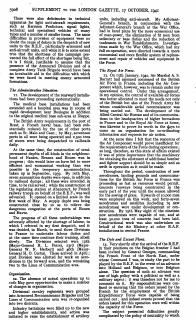
Details
5908          SUPPLEMENT TO THE LONDON GAZETTE, 17 OCTOBER, 1941

   There were also deficiencies in technical          units, including anti-aircraft. My Adjutant-
apparatus for light anti-aircraft requirements,       General's branch, in conjunction with the
such as Kenison Predictors, signal lights,            Adjutant-General's branch at the War Office,
technical and specialised vehicles of many            had in hand plans for the more economical use
types and a number of smaller items. The same         of man-power, the elimination of fit men from
difficulties in provision of equipment were no        sedentary or base duties and the reduction of
doubt the cause of delays in the despatch of new      tradesmen in War Establishments. Investiga-
units to the B.E.F., particularly armoured and        tions made by the War Office, which had my
anti-aircraft units, and while it is to some extent   full co-operation, were directed towards a more
true that the shortness of the campaign pre-          economical and more flexible system of replace-
vented the full effect of the shortages being felt,   ment and repair of vehicles and equipment in
it is I think, justifiable to assume that the         the Force.
presence of the Armoured Division and of a
complete Army Tank Brigade would have been             The Royal Air Force.
an invaluable aid in the difficulties with which          13. On I5th January, 1940, Air Marshal A. S.
we were faced in meeting enemy armoured                Barratt had assumed command of the British
formations.                                            Ah- Force in France, including the Air Com-
                                                       ponent which, however, was to remain under my
 The Administrative Situation.                         operational control. Under this arrangement,
    11. The development of the rearward installa-     in my opinion, the control of available air forces
 tions had been proceeding systematically.             was better allocated to meet the needs not only
    The medical base installations had been            of the British but also of the French Army for
 extended and a hospital area was in course of         whom considerable aerial reconnaissance was
 rapid development near Boulogne in addition           being carried out. The development of the
to the original medical base sub-area at Dieppe.       Allied Central Air Bureau and of its communica-
                                                       tions to the headquarters of higher formations
    The British Army requirements in the port of       in France and to the Royal Air Force at home,
 Brest, a French naval base, had been sub-             was likewise to prove its worth in the 4^ys to
 stantially reduced by the use of other ports          come as an organisation for co-ordinating
 such as St. Malo and Caen ; by May, seventeen        information and requests for air action.
ports in all were being operated and 2,500 tons
of stores were being despatched to railheads              At the same time I felt that the resources of
daily.                                                the Air Component would prove insufficient for
                                                      the requirements of the Force during operations ;
    At the same time, the construction of semi-        so long, therefore, as this state of affairs existed
permanent dep6ts of all kinds in the neighbour-       it was of prime importance that the machinery
hood of Nantes, Rennes and Rouen was in                for obtaining the allotment of additional bomber
progress; this would later on have led to more         and fighter support should be as simple and as
efficient and economical working than was             swift in operation as it could be made.
possible in the temporary accommodation,
taken up in September, 1939. By loth May,                 Throughout the period, construction of new
seven ammunition depdts were open, in addition        aerodromes, landing grounds and communica-
to railhead dumps ; all these were intended, in       tions for the British Air Force in France was
time, to be rail served; while the construction of    proceeding as fast as resources would permit,
the regulating station at Abancourt, by French        concrete runways being constructed in the
railway troops on behalf of the B.E.F., was well      early part of the year until the season allowed
advanced. It opened on a limited scale in the         for the sowing of grass. Upwards of 10,000 men
first week of May. A supply dep6t was being           were employed on this work, and forty-seven
constructed close by so as to relieve the             aerodromes and satellites (including 19 new
dangerous congestion at the ports of Rouen            aerodromes) were under development or con-
and Havre.                                            struction. By I5th May eight of the nineteen
                                                      new aerodromes were capable of use, and at
    The progress of all these undertakings was        least 50,000 tons of concrete had been laid.
adversely affected by the shortage of labour, to      Constructional work was also undertaken on
which I referred in my first despatch, and it         behalf of the Air Ministry at other R.A.F.
was decided, in March, to send three Divisions        installations in central France.
to France to undertake labour duties and
at the same time continue their training, albeit       The Dyle and Escaut Plans.
slowly. The Divisions selected were I2th
(Major-General R. L. Petre), 23rd (Major-                14. Very shortly after the arrival of the B.E.F.
General W. N. Herbert) and 46th (Major-               in their positions on the Belgian frontier I had
General H. O. Curtis). These arrived in April;        been invited by General Georges, commanding
23rd Division was allotted for work on aero-          the French Front of the North East, under
dromes in the forward area, and the remaining         whose Command I was, to study the part to be
two to the Lines of Communication area.               played by the B.E.F. in the event of an advance
                                                      into Holland and Belgium, or into Belgium
                                                      alone. The question of such an advance was
Organisation.                                         one of high policy with a political as well as a
   12. The absence of actual operations up to         military aspect; it was therefore not for me to
 loth May gave opportunities to make a number         comment on it. My responsibilities were con-
of changes in organisation.                           fined to ensuring that the orders issued by the
   Divisional cavalry regiments were grouped          French for the employment of the British
into Armoured Reconnaissance Brigades and the         Expeditionary Force were capable of being
Lines of Communication area was re-organised          carried out; and indeed events proved that the
into two districts.                                   orders issued for this operation were well within
   Infantry battalions were filled up to the new      the capacity of the Force.
and higher establishments, and action was                The subject presented difficulties greatly
initiated to raise the establishment of artillery     complicated by the policy of neutrality to which
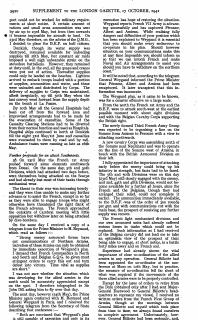
Details
5920           SUPPLEMENT TO THE LONDON GAZETTE, 17 OCTOBER, 1941

 port could not be worked for military require-             execution has hope of restoring the situation.
 ments at short notice. A certain amount of                Weygand reports French VII Army is advanc-
 rations and small arms ammunition was sent                ing successfully and has captured Peronne,
 by air up to 23rd May, but from then onwards              Albert and Amiens. While realising fully
 it became impossible for aircraft to land. On             dangers and difficulties of your position which
 23rd May therefore, on the advice of the Q.M.G.,          has been explained to Weygand it is essential
 I decided to place the B.E.F. on half rations.            that you should make every endeavour to
    Dunkirk, though its water supply was                   co-operate in his plan. Should however
 destroyed, remained available for unloading               situation on your communications make this
 supplies till 26th May, but constant air raids            at any time impossible you should inform us
 imposed a well nigh unbearable strain on the              so that we can inform French and make
 stevedore battalions. However, they remained              Naval and Air arrangements to assist you
 at duty until, in the end, all the quays and cranes       should you have to withdraw on the northern
 were put out of action. Thereafter supplies               coast."
 could only be landed on the beaches. Lighters             It will be noted that, according to the telegram
 arrived to embark troops loaded with a portion         General Weygand informed the Prime Minister
 of supplies, ammunition and water, and these           that Peronne, Albert and Amiens had- been
were unloaded and distributed by Corps. The             recaptured. It later transpired that this in-
delivery of supplies to Corps was maintained,           formation was inaccurate.
albeit irregularly, up till 30th May when the              The Weygand plan, as it came to be known,
last convoy went forward from the supply depdt          was for a counter offensive on a large scale.
on the beach at La Panne.                                  From the north the French ist Army and the
    By 20th May all the General Hospitals had           B.E.F. were to attack south-west at the earliest
been cut off from the forward area and                  possible moment with about eight divisions
improvised arrangements had to be made for              and with the Belgian Cavalry Corps supporting
the evacuation of casualties. Some of the               the British right.
Casualty Clearing Stations had to be diverted             The newly formed Third French Army Group
from their normal function and used as Hospitals.      was reported to be organising a line on the
Hospital ships continued to berth at Dunkirk            Somme from Amiens to Peronne with a view to
till the night 3ist May/ist June and casualties        attacking northwards.
were evacuated to them by road and by rail.
Ambulance trains were running as late as 26th             A new cavalry Corps was assembling south of
May.                                                   the Somme near Neufchatel and was to operate
            *                                           on the line of the Somme west of Amiens, in
Further proposals for an attack Southwards.            'touch with the British Armoured Division on
   38. On 23rd May the French ist Army                 their left.
pushed forward some elements southwards                    I fully appreciated the importance of attacking
from Douai. On the same day, 5th and 5oth               early before the enemy could bring up his
Divisions, which had attacked two days before,          infantry in strength, but facts had to be faced.
were themselves being attacked on the Scarpe            The 5th and 5oth Divisions were on this day
and had already lost most of their tanks through        (23rd May) still closely engaged with the enemy,
mechanical wear.                                        and 2nd, 44th and 48th Divisions, would not be-
                                                        come available for a further 48 hours, since the
   The threat to their rear was increasing hourly       French and the Belgians> though they had
and they were thus unable to make any further           arranged their relief, could not complete it
advance or to assist the French, except in so far       earlier. The ammunition immediately available,
as they were able to engage troops who might -          to the B.E.F. .was of the order of 300 rounds
otherwise have threatened the right flank of            per gun and with communications cut with the
the French advance. The French approached               main base, the prospect of receiving any further
the outskirts of Cambrai meeting with little           supply was remote.
opposition but withdrew later on being attacked
by dive-bombers.                                          The French light mechanised divisions and
                                                        our own armoured units had already suffered
   On the same day I received a copy of a               serious losses in tanks which could not be
telegram from the Prime Minister to M. Reynaud,        replaced. Such information as I. had received
which read as follows:—                                of the Belgian cavalry did not lead me to take
      " Strong enemy armoured forces have               an optimistic view of the prospect of their
   cut communications of Northern Armies.              being able to engage, at short notice, in a battle
   Salvation of these Armies can only be obtained      forty miles away and on French soil.
   by immediate execution of Weygand's plan.              Experience had already shown the vital
   I demand that French Commanders in North            importance of close co-ordination of the allied
   and South and Belgian G.Q.G. be given most           armies in any operation. General Billotte had
   stringent orders to carry this out and turn         been appointed the co-ordinator at the con-
   defeat into victory. Time vital as supplies         ference at Mons on I2th May, but in practice,
   are short."                                         the measure of co-ordination fell far short of
   I was not sure whether the situation which          what was required if the movements of the
was developing for the allied armies in the            three allied armies were to be properly controlled.
north could be accurately appreciated except              Except for the issue of orders to retire from
on the spot. I therefore telegraphed to Sir            the Dyle (obtained only after I had sent Major-
John Dill asking him to fly over that day.             General Eastwood to General Billotte's head-
   The next day, however (24th May), the Prime         quarters to represent my views), I received no
Minister again conferred with M. Reynaud and           written orders from the French First Group of
General Weygand in Paris, and I received the           Armies, though at the meetings between
following telegram from the Secretary of State         General Billotte and myself which took place
describing that conference :—                          from time to time, we always found ourselves
      " Both are convinced that Weygand's plan         in complete agreement. Unfortunately, how-
   is still capable of execution and only in its       ever, General Billotte had been seriously.-and.
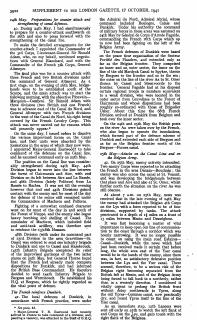
Details
5922          SUPPLEMENT TO THE LONDON GAZETTE, 17 OCTOBER, 1941

2qkh May. Preparations for counter attack and            the Admiral du Nord, Admiral Abrial, whose
    strengthening of canal defences.                     command included Boulogne, Calais and
    40. During 24th May, I had simultaneously            Dunkirk. Under his authority the command
to prepare for a counter-attack southwards on            of military forces in these areas was assumed on
the 26th and also to press forward with the              24th May by General de Corps d'Arme'e Fagalde,
strengthening of the canal line.                         commanding the French i6th Corps which up
    To make the detailed arrangements for the            to now had been fighting on the left of the
counter-attack I appointed the Commander of              Belgian Army.
the 3rd Corps, Lieutenant-General Sir Ronald                The French defences of Dunkirk were based
Adam, who, on my behalf, continued negotia-              on the peace time organisation of the Secteur
tions with General Blanchard, and with the               Fortifie des Flandres, and extended only as
Commander of the French 5th Corps, General               far as the Belgian frontier. They comprised
Altmeyer.                                                an inner and an, outer sector, the inner on the
    The final plan was for a counter attack with         line of the old Mardyck Canal to Spyker, thence
three French and two British divisions under             by Bergues to the frontier and so to the sea;
the command of General Altmeyer. As a                    the outer on the line of the river Aa to St. Omer
first stage, on the evening of 26th May, bridge-         thence by Cassel and Steenvoorde to the
heads were to be established south, of the               frontier. General Fagalde had at his disposal
Scarpe, and the main attack was to start the             certain regional troops in numbers equivalent
following morning, with the objective Plouvain—          to a weak division, who were located in the
Marquion—Cambrai. Sir Ronald Adam with                   outer sector from Grayelines to the Forest of
three divisions (two British and one French)             Clairmarais and whose dispositions had been
was to advance east of the Canal du Nord, and            roughly co-ordinated with those of Brigadier
General Altmeyer with two French divisions               Usher. About this time the 68th French
to the west of the Canal du Nord, his right being        Division arrived at Dunkirk from Belgium and
covered by the French Cavalry Corps. This                took over the inner sector.
attack was never carried out for reasons which              On the 24th and 25th May the British posts
will presently appear.*                                  on the river Aa were taken over by the French,
    On the same day, I issued orders to dissolve         who also began to operate the inundations,
the various improvised forces on the Canal               which formed part of the defence scheme of
line, and their units were absorbed by the               Dunkirk and extended each side of Bergues and
 formations in the areas of which they now were..         as far as the Belgian frontier north of the
 I appointed Major-General Eastwoodj to take             Bergues—Furnes canal.
 command of the defences on the Canal line,               2$th May—Attacks on the Canal Line and on
and he assumed command early on 25th May.                        the Belgian Army.
    The position on the Canal line was consider-              42. On 25th May, enemy activity intensified.
 ably strengthened -during 24th May. 44th                  Two enemy Corps were reported to be attacking
 Division began to move into the line between             the French in the area Denain—Bouchain ; the
the forest of Clairmarais and Aire, with 2nd               enemy was also across the canal at St. Venant,
 Division on its left between Aire and La Bassee,          and was developing the bridgeheads between
 and 4&th Division (lately Polforce) from La              that place and Aire and also at St. Omer, whilst
 Bassee to Raches. It was not till the evening             further north the situation on the river Aa was
 however that 2nd and 44th Divisions gained                still obscure.
 contact with the enemy and for most of the day               At about 7 a.m. on 25th May, news was
 the defence of the sector still remained under            received that in the late evening of 24th May
 the Commanders of Macforce and Perforce.                  the enemy had attacked the Belgian 4th Corps
    Fighting of a somewhat confused character              on the Lys with a force reported to be of four
 went on for most of the day in and south of               divisions, supported by tanks. The attack
 the Forest of Nieppe, and the enemy also began            penetrated to a 'depth of i| miles on a front of
 heavy bombing and shelling of Cassel. The                 13 miles between Menin and Desselghem.
 remainder of Macforce, which included field                  It was fast becoming a matter of vital
 and anti-tank artillery, was therefore sent               importance to keep open our line of communica-
 to reinforce the i3/i8th Hussars.                         tion to the coast through a corridor which was
     48th Division (with under its command part            hourly narrowing. It was no longer possible
 of 23rd Division in the area Gravelines—St.               to count on using the main road Estaires—
 Omer) was ordered to send one "infantry brigade         • Cassel—Dunkirk, while the news which had
 to Dunkirk and one to Cassel and Hazebrouck.              just been received made it certain that before
  I45th Infantry Brigade completed its relief              long, the whole area east of the Yser canal
 of the improvised garrisons of the two latter             would be in the hands of the enemy, since there      <•
 places on 25th May, but General Thome found               was, in fact, no satisfactory defensive position
 that the French had already made complete                 between the Lys and the Yser canal. There
 dispositions for Dunkirk, and had informed                seemed, therefore, to be a serious risk of the
 the British Base Commandant. He therefore                 Belgian right becoming separated from the
 decided to send I44th Infantry Brigade to                 British left at Menin, and of the Belgian Army
 Bergues and Wormhoudt. He established his                  being forced to fall back in a northerly, rather
  H.Q. at Bergues, which he- rightly regarded as           than in a westerly direction. I considered it
 the vital point of defence.                               vitally urgent to prolong the British front
The French reinforce Dunkirk.                              without delay northwards to Ypres, along
                                                           the old Ypres—Comines canal, now practically
  41. The local defences of Dunkirk, in                    dry, and round Ypres itself to the line of the
accordance with French practice, were under                Yser canal.
   * See pars.. 43.                                           As an immediate step, I2th Lancers were
   f Major-General T. R. Eastwood had recently             sent off early on 25th to .watch the left flank of
arrived in France to take command of a division, and,      2nd Corps on the Lys, and gain touch with the
pending a vacancy, was attached to the Staff of G.H.Q.     right flank of the Belgians.
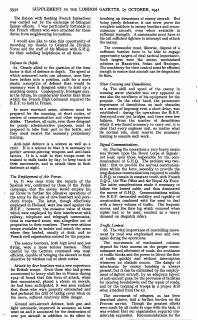
Details
5932          SUPPLEMENT TO THE LONDON GAZETTE, 17 OCTOBER, 1941

   The liaison with flanking French formations          breaking up formations of enemy aircraft. But
was carried out by the exchange of bilingual            being purely defensive, it can never prove the
liaison officers. I was particularly fortunate in      complete antidote to 'enemy bombers and recon-
the French officers who were attached for these        naissance aircraft, even when available in
duties from neighbouring formations.                    sufficient strength. A commander must have at
                                                       his call sufficient fighters to intercept and attack
   I would also like to take this opportunity of       the enemy.
recording my thanks to General de Division
Voruz and the staif of his Mission with G.H.Q.            The commander must, likewise, dispose of a
for their unfailing helpfulness at all times.           sufficient bomber force to be able to engage
                                                        opportunity targets of. vital tactical importance.
                                                        Such targets were the enemy mechanised
Defence in Depth.                                      columns at Maastricht, Sedan and Boulogne.
  62. Closely allied to the question of the time       The machinery for their control must be efficient
factor is that of defence in depth. The speed at       enough to ensure that aircraft can be despatched
which armoured units can advance, once they            in time.
have, broken into a position, calls for a more
elastic conception of defence than would be            River Crossing and .Demolitions.
necessary were it designed solely to hold up a            64. The skill and speed of the enemy in
marching enemy. Consequently, frontages may,           crossing water' obstacles was very apparent as
in-the future, be considerably shorter than those      was also the excellence of his equipment for the
which the French High Command required the             purpose. On the other hand, the paramount
B.E.F. to hold in France.                              importance of demolitions on such obstacles
   In more rearward areas, schemes must be             as a means of imposing even a short delay, was
prepared for the manning, at short notice, of          established: during the operations the B.E.F.
centres of communication and other important           destroyed over 500 bridges, and there were few
denies. Therefore, all units, even those designed      failures. From the number of demolitions
for purely administrative purposes, must be            which it was found necessary to carry out, it is
prepared to take their part in the battle, and         clear that every engineer unit, no matter what
they must receive the necessary preliminary            its normal role, must receive the necessary
training.                                              training to execute such work.
   Anti-tank defence is a science as well as a         Signal Communications.
craft. It is a science in that it is necessary to         65. During the operations a very heavy strain
perfect armour-piercing weapons and anti-tank          was thrown upon the Royal Corps of Signals:
tactics. It is a craft in that troops must be          not least upon those responsible for the com-
trained to stalk tanks by day, to keep track of        munications of G.H.Q. The problem was two-
their movements, and to attack them in their           fold : first to provide the normal communica-
harbours at night.                                     tions within the force, secondly to provide the
                                                       long-distance communications required to enable
The Employment of Air Forces.                          G.H.Q. to remain in constant touch with French
   63. It was clear from the reports of the            G.Q.G., the War Office and the Royal Air Force.
Spanish war, confirmed by those of the Polish          The latter considerations made it necessary to
campaign, that the enemy would employ his              follow the buried cable, and thus dominated
air forces to further the offensive operations of      the moves of G.H.Q. Communications within
the army by the use of dive bombers and para-          the B.E.F. demanded mobility and rapidity of
chute troops. The latter, though effectively           construction combined with the need to deal
employed in Holland, were less used against the        with a heavy volume of traffic. The frequent
B.E.F.; however, the nuisance value of those           moves, and .the time lag which occurred when
which were employed, by their interference with        cipher had to be used, resulted in a heavy
railway, telephone and telegraph communica-            demand on despatch riders.
tions in rearward zones, Was altogether out of
proportion to their numbers. There were seldom          Traffic Control.
troops available to isolate and search the areas           66. The vital importance of controlling move-
where they landed, usually at dusk, and no              ment by road was emphasised over and over
French civil organization existed for the purpose.      again during the operations.
   The enemy bombers, both high level and low              The movements of mechanised columns
flying, were a more serious menace. Their               depend for their success on the proper recon-
control by the German command was most                  naissance and allotment of roads, the avoidance
efficient, capable of bringing the aircraft to their    of traffic blocks and the power to divert the flow
objective by wireless call at short notice.             of traffic quickly and without interruption
                                                        whenever an obstacle occurs. The danger of
   Attack by dive bombers was a new experience          interference by enemy bombing is always
for British troops. Even those who had grown            present, but it can be minunised by the employ-
accustomed to heavy shell fire in France during         ment of fighter aircraft, by an adequate layout
1914-18 found that this form of attack, when            of anti-aircraft guns, by the provision of facilities
first encountered, placed a strain on morale.           for clearing breakdowns and the repair of roads,
As had been anticipated, it was soon realised           and by the training of troops in a proper drill
that those who were properly entrenched and            .when attacked from the air.
had perfected the drill of taking cover when on
the move, suffered relatively little danger.               The movement of refugees, as has been
                                                        described above, laid a further burden on the
   Ground anti-aircraft defence, both gun and           Provost service. Though the greatest efforts
light automatic, improved in accuracy as time           were made by all ranks to cope with the task, it
went on and it accounted for the destruction of         was evident that our organisation required con-
over 500 aircraft in addition to its effect in          siderable expansion. Recommendations for the
Details
5934         SUPPLEMENT TO THE LONDON GAZETTE, 17 OCTOBER, 1941

of my three Corps. Lieut.-Generals Sir Alan          Honours and Awards.
Brooke, M. G. H. Barker and Sir Ronald Adam,            73. I am submitting separately the names of
Bart. The sudden turn of events on iyth May          officers and other ranks whom I wish to recom-
threw a violent and unexpected strain on the         mend for reward or to bring to your notice for
Commander, Lines of Communication Area (the          gallant or distinguished service.
late Major-General P. de Fonblanque), and I
wish to record my sincere appreciation of his                        I have the honour to be
good and devoted work during the time that he
was serving under my command.                                                       Sir,
   Finally, I desire to express my thanks and                              Your Obedient Servant,
good wishes to all those officers in' the' French                                 GORT,
Army whose duties brought them into contact
with the British Expeditionary Force, and whose                                        General,
goodwill, understanding and personal friendship
 did so much to foster the good relations which                              Commander-in-Chief,
existed between the two armies.                                          British Expeditionary Force.


                  APPENDIX TO SECOND DESPATCH OF C.-IN-C., B.E.F.

OPERATIONS OF IST CORPS FROM 6 P.M.                   artillery fire. It was therefore evident that the
ON 3isT MAY TO MIDNIGHT SND/SED JUNE,                 force could not be evacuated completely on the
                 1940                                 night ist/2nd June. Major-General Alexander
                                                      therefore agreed on a modified plan with Admiral
   Major-General Hon. H. R. L. G. Alexander,          Abrial and General Fagalde at 8 a.m. on ist June.
on taking over command of ist Corps, handed           He arranged to hold his present line till
over command of the ist Division to Brigadier         midnight ist/2nd June; thus he would cover
M. B. Beckwith-Smith. He then proceeded to            Dunkirk and so enable the French to evacuate
Dunkirk to see Admiral Abrial, who informed           as many of their troops as possible. He would
him that he intended to hold the perimeter till       then withdraw to a bridgehead round Dunkirk
all the troops were embarked. A French Corps          with all available anti-aircraft and anti-tank
on the right was to hold the sector from Grave-       guns and such troops as had not yet embarked.
lines to Bergues (Gravelines however had not              During the ist June, heavy enemy attacks
apparently been in French hands for some days)        developed on the British sector, supported by
and a mixed French and British Corps under             bombing and artillery fire. The garrison of
command of Major-General Alexander was to             Bergues (ist Loyals) were forced to withdraw
hold a line from Bergues to Les Moeres, and           to the line of the canal north of the town, and
thence to the sea.                                     to the west, 46th Division, i26tH Infantry
    Major-General Alexander at once • told the         Brigade of 42nd Division and ist Division
Admiral and General Fagalde that in his view           were forced back north of the canal for about
this plan did not take account of the true naval       1,000 yards. 5oth Division had also to meet
and military situation which was serious and           enemy penetration from the east, but by
deteriorating rapidly. The fighting condition of       nightfall on ist June the enemy advance had
the tro'ops was now such that prolonged resist-        been checked on a line Bergues-Uxem-Ghyvelde,
 ance was out of the question and the present          thence due east to the frontier and along the
front could riot in his opinion be maintained          frontier defences to the sea.
 after.the night ist/2nd June : furthermore the
 line to be held was so close to the beach and to         Embarkation was temporarily stopped at
 Dunkirk that the enemy might soon stop all            3 a.m. on 2nd June to prevent casualties in
 further evacuation by short range artillery fire.     daylight; by that time there remained in the
 He gave the same opinion to the Secretary of          Dunkirk area about 3,000 men of various
 State and received a reply that the British force      artillery and infantry units, with seven anti-
 should be withdrawn as rapidly as possible on a       aircraft guns and twelve anti-tank guns. They
 basis of equal numbers of British and French           held the outskirts of Dunkirk throughout
 continuing to be embarked from that time            - 2nd June with little interference save heavy
 onward. This he showed to Admiral Abrial               shelling and bombing of the beaches.
 and General Fagalde informing'them that he                By midnight on 2nd/3rd June, all the remain-
 would hold the sector allotted to him till mid-        ing British troops had been embarked. Major-
 night ist/2nd June and then withdraw under             General Alexander, with the Senior Naval Officer
 cover of darkness. They agreed that in the.            (Captain W. G. Tennant, R.N.) made a tour of
 circumstances no other plan was feasible.              the beaches and harbour in a motor boat and
    The naval situation had by now grown worse,         on being satisfied that no British troops were
 and the Channel from Dunkirk was under direct          left on shore, they themselves left for England.


                                              LONDON
          PRINTED AND PUBLISHED BY HIS MAJESTY'S STATIONERY OFFICE
       To be purchased directly from H.M. STATIONERY OFFICE at the following addresses :
              York House, Kingsway, London, W.C.2; 120, George Street, Edinburgh 2;
                 39-41 King Street, Manchester 2; i, St. Andrew's Crescent, Cardiff;
                                    80, Chichester Street, Belfast;
                                      or through any bookseller.
Details
SUPPLEMENT TO THE LONDON GAZETTE, 17 JULY, 1947                                          33"
executing a series of round trips without inter-   enemy and though the fog made navigation
mission tor several days under navigation con-     extremely difficult it undoubtedly served to
ditions of extreme difficulty and in the face      shield the Armada from enemy aircraft.
of unparalleled air attack.
   The Vice Admiral accordingly represented to        91. When the count was taken later in the
the Admiralty that the continuance of the de-      day it was ascertained that 27,000 troops had
mands made by evacuation would subject a           been evacuated as a result of the night's opera-
number of officers and men to a test which,        tion and Admiral Nord agreed that the opera-
might be .beyond the limit of human endurance,     tion should be considered as completed, observ-
and requesting that fresh forces should be         ing that all ammunition at Dunkirk had been
used if evacuation had to be continued after       expended and that the numbers left behind
the coming night, with the acceptance of any       were small consisting principally of non-
consequent delay.                                  combatant troops. This decision was agreed
                                                   to by the French Admiralty at uoo, and the
   87. The evacuation plan was communicated        operation " Dynamo " terminated by Ad-
to Units taking part at 1440 and was briefly as    miralty Message 1423/4.
follows: —
Commence 2230/3, withdraw 0230/4. From                92. It was realised that in all probability
East Pder evacuation by Personnel Vessels,         there might be a number of open boats, barges,
Destroyers and Paddle Minesweepers. From           etc., drifting a'bout in the Channel with troops
West Pier, new outer port, by other Milne-         on board.       It was accordingly decided to
sweepers, Corvettes, Skoots and French vessels.    have an air reconnaissance over the Channel.
Drifters and smaller craft into the inner har-        It was reported that a Transport was lying
bour, LOCUST remaining outside entrance re-        on its side between Dunkirk and Gravelines
ceiving loads ferried out 'by small boats. Tugs    and also a barge east of the Goodwins with
available outside entrance to assist ships in      survivors on board.
berthing and in leaving.                              C. in C. Nore despatched 2 M.T.B.s to find
                                                   the transport with no avail. On the 5th the
   88. In the evening the Vice Admiral was         R.A.F. speedboat did a sweep south of a line
informed by the B.N.L.O. Marceau that it was       Goodwin/Boulogne and recovered 33 French
estimated 30,000 French remained and that          troops and two Naval ratings.       In addition
the French Admiralty agree that evacuation         French troops were picked up by patrols and
should be terminated that night if possible.       brought in to Dover, Margate and Ramsgate.
Force -used was to consist of nine Personnel       Troops also arrived in French and Belgian
Vessels with one in reserve, nine Destroyers       Trawlers totalling in ail some additional 1,100.
(maximum, number available), four Paddle              Air reconnaissance was also carried out on
Minesweepers, seven Fleet Minesweepers, nine       the morning of the 5th but nothing was re-
Drifters, LOCUST, two Corvettes, four French.      ported.
Destroyers and a -number of organised motor
boat flotillas including lifeboats from Ramsgate   REMARKS ON THE INSHORE FLO-
and Dover, together with a large number of              TILLAS       AND       NAVAL        SHORE
French and Belgian fishing vessels. The lifting         PARTIES,
capacity of this force, if used to the full, was      93. About 400 small craft, ranging from
more than 30,000 but it was certain that the       Dutch Skoots to 30 ft. Motor boats, set out at
facilities within Dunkirk could not .permit more   various times to the Flanders Coast. In addi-
than a'bout 25,000 to be embarked in the time      tion scores of pulling boats, merchant ship
available, and this number only if the French      lifeboats, Naval cutters and whalers, were sent
troops moved with the greatest rapidity at all     off in tow. Only a proportion—particularly of
points of embarkation. This point was im-          the pulling boats—succeeded in reaching the
pressed upon the French Liaison Officers and a     coast and taking active part in the evacuation.
number of French officers and ratings added        Fewer still were able to remain off the coast
to the augmented pier parties which were de-       for more than one period. Nevertheless, these
spatched to Dunkirk at 2200 in advance of the      small craft, in conjunction with the pulling
evacuation force.                                  and power boats of HjM. Ships off the coast,
                                                   were responsible for lifting more than 100,000
   89. The movements commenced according to        Allied troops direct off a stretch of open beach
plan. The weather conditions at Dunkirk,           in shoal waters between 1600/27/5 ano^
although favourable as regards tide were ad-       0400/2/6.     Further, a large number of the
verse with a north easterly wind tending to        •power boats operated within Dunkirk Harfbour
blow Personnel Vessels and Destroyers off the      on the last three nights, working principally in
vital East Pier making berthing difficult. The     the inner harbour, which was continually
MANXMAN, the seventh Personnel Ship due            under artillery fire, ferrying a further large
to sail failed to sail, and her place was taken    uncounted number out to the comparative
by the ROYAL SOVEREIGN.                            safety of ships lying off.
Tuesday, qkh June.                                    94. Throughout the period all these craft
   90. At midnight when the earlier vessels had    of the inshore flotillas were subjected at one
commenced the return voyage fog was reported       time or another to intense attack from the air,
in mid-channel and off the Thanet coast and        both by bombing and machine gun, and a
a number of ships had to anchor before enter-      large proportion also to sporadic bombard-
ing harbour. The EXPRESS and SHIKARI               ment by German artillery. Under this fire
were the last ships to leave Dunkirk at 0318       no case occurred of boats ceasing work as long
and 0340 and carried approximately 1,000           as troops w'ere in sight on shore, and move-
troops and the British pier parties. Except        ments of boats westward away from the fire
for an air attack on SHIKARI this final pass-      zone only occurred as dictated by the military
age was made without interruption by the           situation ashore.
Details
3306            SUPPLEMENT TO THE LONDON GAZETTE, 17 JULY, 1947
Friday, ^ist May.                                        final evacuation plan during the night of
  48. The Admiralty informed the Vice Admiral            31/5-1/6. Accordingly, instructions were
that the policy of H.M. Government was that              issued for the special tows to leave Ramsgate
both British and French troops be given an               at 1300/31 for Dunkirk via Route X, and the
equal opportunity of being evacuated in British          Commander-dn-Chief, Nore and Flag Officer in
ships and boats.                                         Charge, Harwich, were requested to provide
                                                         all available M.T.B.s to escort this convoy
   49. Personnel ships had been sailed the pre-          for as much of the outward passage as possible,
vious evening and throughout the night of the            which was timed to commence from Ramsgate
30th/3ist to provide for a continuous flow into          at 1300/31. Speed of advance—5 knots. A
Dunkirk harbour.        But at 0320 the S.N.O.           party of Naval officers had been assembled at
reported that once again the majority of these           Dover to embark in these tows and had been
personnel ships had failed to enter the harbour          given detailed instructions on the plan. Two
during the dark hours. MALCOLM, however,                 M.A/S. boats and two M.T.B.s in the Dover
left Dunkirk with 1,200 troops at 0300, during           Command were ordered to accompany the boat
heavy shelling, on relief by IVANHOE.                    convoy and subsequently embark the Com-
S.N.O. Dunkirk, however, continued to call for           mander-an-Chief, B.E.F. and Staff off the
more ships. 'No more destroyers were avail-              beaches.
able and there were no means of accelerating
the arrival of the vessels despatched there.1 By           53. Shortly after sunrise an on-shore wind
0700 the Vice Admiral had no news of the fate            arose and boat work became difficult, many
of the personnel ships that had sailed the pre-          whalers capsizing and the prospects of com-
vious evening and during the night. None of              pleting the evacuation to plan began to be less
these ships had reached the U.K. to unload,              favourable. The following extract from the
and it appeared probable that these ships                report of Captain Howson, S.N.O. on the
may thave concentrated in the narrow                     beaches illustrates conditions at Bray at this
waters close to Dunkirk, inviting a repetition           time:
of the heavy air attacks with consequent                       " At 0400 there was a very considerable
damage and loss to transports which had                    number of destroyers, paddlers, trawlers,
occurred on the two previous occasions when                skoots, etc., off Bray, and embarkation was
personnel vessels, together with other ships,              proceeding satisfactorily, but a lop had
had been concentrated in large numbers in the              already started. There were about 10 motor
approaches to Dunkirk.                                     yachts which had arrived from England.
   At this time there were no less than nine               These > craft drew 6-7 feet and were
personnel vessels and three hospital carriers              unable to get close in to any of the beaches.
known to be on the round trip U.K.—Dunkirk                 During the forenoon, considerable towing
and back and one other personnel vessel had                of empty craft towards the beach was carried
been ordered to sail during the night, but her             out, and only about two boats were allowed
whereabouts was unknown. In addition, three                to get adrift and ultimately ground. With
other personnel vessels were under orders to               the falling tide, however, a number of boats
sail between 0900 and 1030. Pending the                    were seen to ground and remain ashore until
return of the ships en passage, and while the              the tide rose in the afternoon. These in-
coal-burners were being rebunkered, the further             cluded an A.L.C.* motor boat and a life-
sailing of personnel vessels was in suspense.              boat. Other power boats broke down. Never-
   Note :—Owing to the casualties to personnel vessels     theless, the embarkation, much hindered by
           at this stage, coal burning cross channel       the lop, proceeded satisfactorily. ; As further
           steamers had to be used for some of the          destroyers and sloops arrived, they were
           trips and short endurance necessitated
           coaling between trips which could not be        directed to lower their motor boats and
            done in the vicinity of Dover, thus            whalers as this had not already been done;
           preventing a quick turn round.                  these boats were quite invaluable. About
   50. During the night a considerable amount              noon, the lop began to subside and with
of enemy mdnelaying activity by air was re-                the rising tide conditions for embarkation
ported. Shelling was heavy during the evening              very greatly improved, more boats were
and night, and operations were greatly ham-                sent in and more boats floated off and matters
pered. Nevertheless, with the cessation of                 were proceeding very well, when the gun at
shelling at about 0300, very good progress was             La Panne started to shell the beaches and
made and by full dawn the beaches were very                foreshore with great accuracy. A certain
nearly clear of troops. At 0530 attacks on                 number of light craft were sunk. The A.L.C.
Dunkirk Harbour and the beach from Dunkirk                 broke down and was towed away by a
to Bray developed more strength and the 'bom-              steamer. MOSQUITO, destroyers and sloops
bardment of Dunkirk continued. Neverthe-                   proceeded westward clear of the firing."
less, the S.N.O. reported that the embarkation              54. Rear-Admiral Wake-Walker was able to
there was proceeding satisfactorily but stressed         make a survey of the general conditions of the
the need for more ships and constant fighter             beaches, and at 1130 the Vice-Admiral received
protection. At this time French troops began
to appear at Dunkirk Pier and on the'beaches,            a signal from him stating that the majority of
and were embarked with the British troops.               the pulling boats were broached to and without
                                                         crews, conditions on the beaches .being very bad
   51. At 0600 VIMY sighted submarine off the            owing to a freshening shore wind, only small
N.W. Goodwins and commenced to hunt.                     numbers being embarked. Under present condi-
   52. The arrivals at the home ports indicated          tions any large-scale embarkation from beach
that in spite of the frequent requests for more          impracticable. Motor boats could not get close
ships and more boats received from the various           in. He considered only hope of embarking any
authorities on the French coast, the rate of             number was at Dunkirk, and further stated he
evacuation was steadily increasing and would               * Admiralty footnote: A.L.C. = Assault Landing
permit, all being well, of implementing the              Craft.
Source: The National Archives, Kew, ADM 116 4649. Contains public sector information licensed under the Open Government Licence v3.0.

Details
119411 198min
1022
ter No.B23/D/321/41 of 2nd April, 1941. Page 2.
ility and resource. His good judgment and common
nse were invaluable in keeping me in touch with the
tuation and obtaining the close co-operation of
rench Naval Forces.
During the enemy's advance into Belgium and France
his officer showed officer-like qualities of the
ighest degree, working almost day and night without
stop for three critical weeks prior to the artillery evacuation,
during a which time he was continually under
fire and subject to repeated enemy air attack. During
the his services were of inestimable value, the pier his
actual evacuation of the British Expeditionary and
Force coolness and cheerful leadership on all with
whom and sent he came back in to Dover by Amiral Abrial on 1st June. "
and beaches contact. He was finally
courage, were a constant inspiration to wounded
I am, Sir,
Your obedient Servant,
S.
Savey
VICE ADMIRAL.

Details
COPY TRANSLATION.
D. GESELLE.
Belgian Telegraphist,
G.1. Mess.
R.N. Barracks.
Devonport.
19th May 1942.
Dear Madam,
TRANSLATION.
Th. Everaert.
address and I sun sending
Dutch Naval Base.
ps
Milford Haven.
a to you.
a
Belge
I
10th May 1942.
not
know,
1
the took
c, bu!
To the Editor of the "MARINE"
it at
Newlyn, I am writing you on the subject of Mr. Georges
the
Ragaert.
board the same ship, young and as I am his best friend, I
As this man has always sailed with should me on
pres
very much like to know how he has obtained the D.S.C.
lish
ths;
L.
regarding the for a long compensation while I am now now in I have for the loss Royal been of Nethorlands a effects, I was working with
in
come
Ragaert. Netherlands the Z.50, Belgian owner: The Government flag, latter Prosper I should has but, Everaert, often be seeing grateful advised where that to me the you to 2.50 apply if was you to under could the
We
:hre
give me helpful advice.
en
any for more obtain further details Ragaert about which and myself,
or If you wish to let you have them, relevant as papers
I about the boat, I can nearly on account
are, of managed his as you to doubtless bring away enbolled know, in as will engineer.
ent
having I been thank you pupil in advance this that of saying you that
re
give I am me very good pleased advice; with I the take journal
113
Your obedient Servant,
(signed) T. Everaert.
LYDIESUZANNE
4
on

Details
D. GESELLE.
COPY TRANSLATION.
Belgian Telegraphist.
G.1. Mess.
R.N. Barracks.
Devonport.
19th May 1942.
Dear Madam,
address and I am sending you this letter, which will perhaps
It is quite by chance that I have learned your
be a surprise to you.
I am a telegraphist in the Royal Navy, Section Belge
I do not know, Madam, if you are conversant with
the events which took place during the dark days of Dunkirk, but
I would like to have some details on the suject of the
decoration bestowed on G. Ragaert.
I myself have nothing against this young man, but at
Newlyn, Penzance and Brixham, there are nunerous Belgians who
remember the fishing-boat 81.
It is a scandal that the Belgian Press and its
journalists should only learn the truth through the foreign pres
I was, with two other Belgians, on board the English
aircraft carriers "Furious" and "Illustrious" for seven months;
I I was in America for four months on board the latter vessel.
the to papers, but I have and now, when I come
have had splendid opportunities of having my story appear in
England Independant
were soldiers at Dunkirk, 600 soldiers at Havre. We
With This I see is the just what 81, such always I civilians would "Madeleine a story refused like in and Camille", you them, the 50 to "Belgique know, we Madam: saved 350 -
hours the last to leave Le were waiting for thr
were for a rear-guard of Havre French , soldiers, where we of which only 50 men
able to be rescued.
London; Germans for At For half the an entrance hour. to the port to we run were round bombed the by offices the
3
G. Ragaert myself, has I his have no one
Ostende; I was father. Royale de Ibis at
Navy I at have I the been age a pupil of at 191. sea of the since Oeuvre I was 14 years old, my and affairs, entent
you and be that have no relatives here would I look do that not after want my letter to import will
in advance,
I remain,
P.N.L.O.
(signed) Désiré Geselle.
27
Source: The National Archives, Kew, ADM 199 2429. Contains public sector information licensed under the Open Government Licence v3.0.

Details
| ADVANCE (M.O.W.T.) (Prev. owner - C. P. Dick) | MB | 1931 | 10 " | ARP AP | 3.9.39 20.2.40 | 19.2.40 | ||
| ADVANCE (M.O.W.T.) (Prev. | SPB | R(T98B) | 50 DW | FS | 16.3.40 | 7.1.44 | £15.10.0 |

Details
| DINGHY (off ADVANCE) (M.O.W.T.) (Prev. owner W. B. Dick) | PUR | Misc.N. Misc.N. |
Source: The National Archives, Kew, ADM 199 788 A. Contains public sector information licensed under the Open Government Licence v3.0.

Details
220
SECRET
1740/28 May
MLSSAGE
IN.
219
FROM: N.O. 1/c Barrow. DATE: 28.5.40
RECD: 1835
NAVAL CYPHER (c) (by T/P)
ADDRESSED: Admiralty.
X
Your 1137 28th May 12 Belgian Trawlers
sailed from Fleetwood for Dartmouth a.m. today
Tuesday pricr to receipt of signal.
1740/28
(Advance copy sent Ops, U.W.R. 9 O.I.C.)
1st Lord
1st S.L.
+ All Belgian ships to be detained
V.C.N.S.
A.C.N.S. (T)
but not treated as enemies.
A.C.N.S. (F)
A.C.N.S. (H)
Parl.Sec.
Nav.Sec.
C.S.O. to 1st S.L.
Ops. (4)
O.D. (3)
O.I.C. (2)
D.S.D.9.
D.N.I. (4)
M. (6)
D. of P. (2)
F.N.L.O.
I.P. (3)
D.T.D. (3)
D.T.D. Basement
A.C.R.
A.G.R.M.
D.S.V.P.
Care. Stephenson
File X
1736
1734
ADDITIONAL 1937 CIRCULATION BY PA
PAS(S)

Details
3
258
SECRET
MESSAGE
N.
IN
0530A/23rd August
From H.M.S. GURKHA
Date. 23.8.41.
Recd.0627
Naval Cypher (A) by W/T)
Addressed:- F.O.C. North Atlantic, repeated Admiralty
C.in C. Western Approaches, N.O.I.C. Liverpool.
IMMEDIATE
H.M.S. ZINNIA sunk. Some survivors.
0530A/23
Advance Copy 1st Lord
O.I.C.
A.C.N.S.(H)
D. of P.
N.A. 1st S.L.
D.P.D.
Ops.
1st Lord
O.D.
1st S.L.
2nd. S.L.
I.P.(3)
3rd. S.L.
W.D.
4th S.L.
D.P.D.
v.c.n.s.
Salvage Dept.
A.C.N.S. (H)
D.T.M.
A.C.N.S. (F)
D.D.T.M.
A.C.N.S. (T) (2)
D.M.S.
Parl. Sec.
D.M.S. Base
Nav. Sec.
P. Bath
N.A. 1st S.L.
D. of P. (3)
Ops. (4)
O.D. (5)
D.N.I. (4)
C.W. (2)
M.(3)
N.
O.I.C. (3)
M36
D.A/S.W.
Hydrog.
D.T.D(2)
D.S.D.(2)
Miss

Details
1
258
SECRET
MESSAGE
N.
IN
0530A/23rd August
From H.M.S. GURKHA
Date.23.8.41.
Recd.0627
Naval Cypher (A) by W/T)
Addressed:- F.O.C. North Atlantic, repeated Admiralty
C.in C. Western Approaches, N.O.I.C. Liverpool.
IMMEDIATE
H.M.S. ZINNIA sunk. Some survivors.
0530A/23
Advance Copy 1st Lord
O.I.C.
A.C.N.S.(H)
D. of P.
N.A. 1st S.L.
D.P.D.
Ops.
1st Lord
O.D.
1st S.L.
2nd. S.L.
I.P.(3)
3rd. S.L.
W.D.
4th S.L.
D.P.D.
v.c.n.s.
Salvage Dept.
A.C.N.S. (H)
D.T.M.
A.C.N.S. (F) F
D.D.T.M.
A.C.N.S. (T) (2)
D.M.S.
Parl. Sec.
D.M.S. Base
Nav. Sec.
P. Bath
N.A. 1st S.L.
D. of P. (3)
Ops. (4)
O.D. (5)
D.N.I.(4)
C.W. 2)
N. (3)
N.
O.I.C. (3)
M36
D.A/S.W.
Hydrog.
D.T.D(2)
D.S.D.(2)
Miss

Details
314
290
I have since tropps been to informed drifter that Letitia and Renown, laden,
Renown pieces.
of tow was a blown to and were themselves towed returning to Ramsgate. fully
TOTAL number of of tropps Cockle transported by Bawley boats was 600.
Description
a Bawley - 40' long, 12' beam, 2'6" over draft, Diesel engines
(All the following times are approimate)
Arriving at Ramsgate (1.6.40.) I decided that Bawley boats were not fit for further
service, and so ordered them to porceed to Southend. Obtained permission to
commandeer any craft available in Ramsgate harbour and to return to Dunkirk when
ready.
1400. Commandeered tug Contess but crew deliberately put tug aground and made every
possible obstruction to impede the sailing of same.
1700. Although tug Contess was afloat, engineer refused to put the ship: to sea, as
he claimed his filters would be blocked by sand. Crew of Tug Fossa, with Skipper,
volunteered to come instead, Commandeered tug Fossa and Motor boat Therune, which
I manned with one Petty Officer, and two Sea Scouts. (Unfortunately I lost track of
their names and addresses after I was sunk)
0000. Arrived at Dunkirk and decided that harbour was too congested with larger
craft to justify taking tug Fossa inside harbour. Proceeded with Motor-boats with
intention of filling up same and transferring soldiers to tug Fossa, whose instruc-
tions were to lay off Dunkirk until contacted. Coming alongside the jetty, overheard
Naval Officer on Mole cry "Isn't there anyone here who can deal with these Frenchmen?"
2.6.40. 0035. Offered my services as Liaison Officer. Left Therune in charge of Petty
Officer with orders to continue loading tug Fossa until at least 300 men had been
embarked, and then to return laden to Ramsgate if they could not find me.
Understand Fossa later went aground, but may have been re-floated.
0030 Mrs 0310. Due to fair knowledge of the French language Iwas able to render
a embarkation of troops on the jetty. The speed of the embarkation was greatly and slowed the
certain amount of assistance to Commander Cluston, Officer in Charge of the
due to the lack of understanding between the French Officers and men, and
up French believed that certain ships had been reserved for them,
English. The were on no account to be broken. As a result, serious could congestion not
was found round one contacting the various officers in charge of the regiments, and in getting was,
that their units gangway, while other ships at the end of the Pier I get
however, the men aboard. able to By assist to a certain extent in clearing up the point,
0310. the French Understanding troops on that the move. the destroyer Winchelsea was the last ship to be leaving
Dunkirk I returned to Dover with her.
0800. Reported to H.M.S. Lynx and was ordered and submitted to contact chart Commander with
Goodenugh (on 2.6.40) at Castle. Reported to Commander Dunkirk, Goodenugh 31.5.40 and 1.6.40, with
marked
with
rough details of state of of wrecks, affairs troops at on dunes, and from times Admiral of bombardments Ramsey to etc,
approximate as positions nights. Obtained permission assisting in
return noted to during Dunkirk these as Liaison two Officer with the object of again the
embarkation of French troops. RAF Motor boats with RAF complement, Dunkirk plus
1500. signalmen As an and advance two French party Officers, in two 3 Naval Officers, returned to under
Commander 1855. Attacked Cluston's by 4 command. enemy aircraft, bambed as a and result finally of the sunk, bombing. foundering Enemy immediately. aircraft to
No seemed casualties, to be using however, delayed were action sustained bombs with an effect on side ship similar
that of charge on a submarine.
My right a leg depth slightly in damaged water by by explosion. enemy aircraft (do not boat think to porceed any casualties to Dunkirk were
by and enemy not to bombs pick and up machine survivors, gun as fire he if the remaining RAF boat attempted to us up.
1900. sustained) Machine Commander gunned Cluston shouted feared to remaining that we RAF would be detroyed in the pick water

Details
4438
Ten minutes more and the first convoy is ready for the
sea - manned, victualled and fuelled - equipped in fact with all
but arms. Only later, when the full peril of their task was
realised and returning troops had filled the depots with sand-
fouled small arms, were weapons available for the crews'
protection. The first convoys sailed gaily into the inferno
of Dunkirk beaches without so much as a pistol between them.
Still the boats arrived and still the officers and men
flowed into the port; "T.124's" now for the most part. Sturdy
fishermen, lightermen and merchant seamen. Now, too, came in
increasing numbers the civilian volunteers who played so fine a
part in the operation.
In the very first flotilla to leave was one black motor
launch, the "Advance", manned entirely by three bearded civilian
yachtsmen. This boat and its crew stayed with the writer in
convoy through the whole of the first journey across, and after
the first murderous machine gun attack from the air three
cheerful bearded grinning faces appeared above the fore cabin
roof and three pairs of hands were clasped and shaken overhead
as a signal that allwas well; only the "Jolly Roger" was
lacking to complete that picture.
These men wore no uniform, were born on no ship's books
but took the graver risks which attend civilians engaged in
military operations as undisturbed as they would take a choppy
sea on a week-end cruise.
The journey across, perhaps, afforded the individual his
best opportunity of assessing the magnitude of the operation
in which he was playing his part. Beautiful yachting weather
(half the small craft could never have made the crossing
otherwise), hardly a chop on the water; thewhole vista bathed
in summer sunshine; and, across the expanse of sea, an endless
stream of laden ships.
From horizon ahead to horizon
astern, spanning the whole scene from coast to coast, unloading
their human freight and hastily returning for more; an endless
- 3 -
Source: The National Archives, Kew, ADM 199 788 B. Contains public sector information licensed under the Open Government Licence v3.0.

Details
214
BEN MY CREE.
Transported 408 troops in 8 trips. Should with have
completed of the TYNWALD and the MALINES. On failing written to
4. The master was evidently in league
the masters during the night 1/2nd June, in reply to & not he
enquiry sail, George Woods, Master, replied in Dunkirk
sail from the S.T.O., Folkestone, whether writing or -
would "I beg to state that after our experience at
yesterday, my answer is 'No'."
1850/2 BEN MY CREE came alongside Folkestone. the
Naval As the ship was berthed the crew were and on
guards At were placed on the gangways and demonstrating abreast
and the being run out, they attempted to do so with come on
ship. shouting that they were going to leave the ship their
kits. and advance up the Drow. The crew thereupon relief returned
prow Leading Stoker Booth ordered his men to
guard board at once, where they remained until the
on arrived. The Captain and crew left the ship, the
Chief and the W/T Operator. Otherwise the ship was manned
crew Officer stayed as Captain, together with 3 greasers with
BEN new MY CREE was in collision and did not complete the trip.
the crew. Unfortunately on sailing, at 1905/2,
LADY OF MAN.
Carried out 4 trips and transported 2902 troops.
the ship was ordered back from Dunkirk before entering that
One trip was abortive through no fault of the Master, as
harbour. The last 2 trips were carried out with a Naval
officer and 10 Naval ratings on board as an insurance,
but there is no suggestion that the LADY OF MAN did not
attempt to play her part.
MANX MAN.
Transported 233 troops in 3 voyages. Should
have completed 5.
On her fourth trip, due 2115/2, MANX MAN refused
to sail from Folkestone. New crew put on board, the
engineers remaining. She started a trip but failed to
make Dunkirk. On return, the original Captain rejoined
with some of the original crew. She should then have
sailed at 2010/3, but the Captain reported 3 engineers
short at the last minute. It was not considered necessary
to wait for the engineers and the Master and crew
disembarked and the new crew provided. Before use could
be made of her, however, the evacuation terminated.
Source: The National Archives, Kew, ADM 199 790. Contains public sector information licensed under the Open Government Licence v3.0.

Details
170
. 175
(3)
Motor boat towing vhaler and too essy pontecns. lines provious
day plar had boon constructed by driving art Lorries at obb tido
in line and securing plants on top, considerably oxpediting loading
of bonto, though embaritation ruto was closed considerably by Lock of
control at shoro and of plar to novo troops along and by natural
reluctance of troops to venture along pier without being relieved of
part of their heavy equipment. Somo difficulty experienced in loading
too of 4 boato without smaching up ageinst plane in swall, and in hendling
pontome in for in provailing conditions which tended to reduce emborketion
rate. Bonto available quito inadequato, largo open notor beach borto
required, together with vencol. enchored or our whord of pier
to give a 100 if necessary with oil slide provided. During enbortation
Sutton collected coldiers from overtumed pontoon. Allowed to bronch in
swell. Three believed dramed mainly the to lack of foresight of shore
authorities in allowing troops to emback with full equipment and overcoats
in detoriorating weather conditions. 120 tecago omberked montly 3,S,,
ReAdy RAIS.C. with a for infortaynen ml guards, moralo very good but very
critical of Lock of R.M.P. support and Solgium treathory bohind lines.
Country code to be filled with adoo,
night poultions during retreat soon
to be signatted by flamlight to plened, banbed within half on hour
of being ontablished. Surgelning apood of advance of Commo against
positions being propared and against (ive boolding also
Important factors.
1137. Walghed enchor and discharged tedogo alonguide lydi, 1SA8
and DOB Ancreasing alightly, rather low cloud.
1190. Proceedod North Goodsin 60, Voccal to and the for nomb
readeavous. tydd and Room procession to Mergabo to Mocharge treaps.
1530. Anchored où North Goodidn St. Voncol.
1055. Weighod and proceeded to Dunkiris in company with Riger.
Passed great number of mall creft, 00 will 00 Controyors and paddlors.
2115. Pessod Dunitize Herbour docume 1 cable. Heavy genfire from
boach about 2 milos word of Herboury apparently enemy chelling tom.
Pires in Dunident more expensive.
2147. Anchored off bonch between La Pomo end No algn
2235. Boat from shore reported troops further to content, only
or bonto an expected.
boat available nun aground. Moved 1 allo customerd.
Security 194 June 0200: No troops yet contrated, to bonto except
Subton's available. Several minolaying aircraft overhood, observed
parechuto minos deconding about 3 cables should and 1 cable astern.
Mines reported dropped all over folrway.
0190. Commenced loading broops with our oun notor bont and wholer
Troops ship's Refe and infentryment Including guards, 3. Yorks., after
and lifeboat found off booth. Lator contated by motor yacht. and
mohine montly detechment. No. RedePe before or One dram.
Opened gun occapional aircraft at drum. whilet lovel
bombing fire on at about 9000 foot followed by mechino gunding
in omborizing boing halped over the aldo. This heavy gun
attack wounded from postecns alongaide, 000 commity mechino receiving wounds attack
undoubtodly but would ted Lowis gun and Bron toxido manned Bron
the back whilet have boon prossed home country the
Bin ships defence 4.0. for the largo chip's lifebook breings 1940
for concernte Dotachment of low flying.
M.M.S. "SUTTON"

Details
179
- 183
(3)
Motor boat towing whaler and two army pontoons. Since previous
day pier had been constructed by driving out lorries at ehb tide
in of line and securing planks on top, considerably expediting loading
boats, though embarkation rate was slowed considerably by lack of
control at shore end of pier to move troops along and by natural
reluctance of troops to venture along pier without beding relieved of
part tow of their heavy equipment. Some difficulty experienced in loading
pontoons in tow in prevailing conditions which tended to reduce embarkation
of 4 boats without smashing up against pier in swell, and in handling
rate. Boats available quite inadequate, large open motor beach boats
required, together with vessel anchored hocadside or sunk athead of pier
Sutton collected soldiers from overturned pontoon. Allowed to broach in
to give a lee if necessary with oil &td provided. During embarkation
awell. Three believed drowned mainly due to lack of foresight of shore
authorities in allowing troops to embark with full equipment and overcoats
in deteriorating weather conditions. 120 troops embarked mostly R.B.,
R.A., R.A.S.C. with a few infantrymen and guards, morale very good but very
critical of lack of R.A.F. support and Belgium treachery behind lines.
Country said to be filled with spies, night positions during retreat seen
to be scignalled by flashlight to planes, bombed within half an hour
of being established. Surprising speed of advance of Germans against
positions being prepared and defencelessness against dive bombing also
important factors.
1137. Weighed anchor and discharged troops alongside Lydd. Widd
and sea increasing slightly, rather low cloud.
1150. Proceeded North Goodwin Lt. Vessel to await time for next
rendezvous. Lydd and Ross proceeded to Margate to discharge troops.
1538. Anchored at North Goodwin Lt. Vessel.
1855. Weighed and proceeded to Dunkirk in company with Niger.
Passed great number of small craft, as well as destroyers and paddlers.
2115. Passed Dunkirk Harbour distant 1 cable. Heavy gunfire from
beach about 2 miles west of Harbour, apparently enemy shalling town.
Fires in Dunkirk more expensive.
2147. Anchored off beach between La Panne and Dunkirk. No sdgn
of boats as expected.
2235. Boat from shore reported troops further to eastward, only
boat available run aground. Moved 1 mile eastward.
Saturday 1st June 0100: No troops yet contacted, No boats except
Sutton's available. Several minelaying aircraft overhead, observed
parachute mines decending about 3 cables ahead and 1 cable astern.
Mines reported dropped all over fairway.
0130. Commenced loading broops with our own motor boat and whaler
and ship's lifeboat found off beach. Later assisted by motor yacht.
Troops mostly R.A. and infantrymen including guards, 3. Yorks., and
machine gun detachment. No. R.A.F. assistance before or after dawn.
Opened fire on occasional reconnaisance aircraft at dawn. One level
bombing attack at about 5000 feet followed by machine gunning whilst
in the back whilst being helped over the side. This machine gun attack
embarking wounded from pontoons alongaide, one casualty receiving wounds
undoubtedly would have been pressed home causing very heavy casualties
but for concentrated Lewis gun and Bren gun fire from troops, who manned
ships M.G. armament. Detachment of Guards also offered to provide Bren
gun defence for the large ship's lifeboat against occasional low flying.

Details
-188
102
(3)
Motor boat towing whaler and two army pontoons. Since previous
day pier had been constructed by driving out lorries at ebb tide
in line and securing planks on top, considerably expediting
loading of boats, though embarkation rate was slowed considerably
by lack of control at shore end of pier to move troops along
and by natural reluctance of troops to venture along pier
without being relieved of part of their heavy equipment. Some
difficulty experienced in loading tow of 4 boats without
smashing up against pier in swell, and in handling pontoons
in tow in prevailing conditions which tended to reduce embarkation
rate. Boats available quite inadequate, large open motor beach boats
required, together with vessel anchored broadside or sunk at
head of pier to give a lee if necessary with oil slick provided.
During embarkation, Sutton collected soldiers from overturned
pontoon. allowed to broach in swell. Three believed drowned
mainly due to lack of foresight of shore authorities in
allowing troops to embark with full equipment and overcoats in
deteriorating weather conditions. I20 troops embarked mostly
R.E. , R.A. R.A.S.C. with a few infantrymen and guards, morale
very good but very critical of lack of R.A.F support and Belgium
treachery behind lines. Country said to be filled with spies,
night positions during retreat seen to be signalled by flashlight
to planes, bombed within half an hour of being established.
Surprising speed of advance of Germans against positions being
prepared and defencelessness against dive bombing also important
factors.
II37. Weighed anchor and discharged troops alonside Lydd. Wind
and sea increasing slightly, rather low cloud.
II50. Proceeded North Goodwin Lt Vessel to await time for next
rendezv ous. Lydd and Ross proceeded to Margate to discharge
troops.
1538. Anchored at North Goodwin Lt Vessel.
I855. Weighed and proceeded to Dunkirk in company with Niger.
Passed great number of small craft, as well as destroyers and
paddlers.
2115. Passed Dunkirk Harbour distantI I cable. Heavy gunfire from
beach about 2 miles west of harbour, apparently enemy shelling
town. Fires in Dunkirk more extensive.
2147. Anchored off beach between La Panne and Dunkirk. No sign
of boats as expected.
2235. Boat from shore reported troops further to eastward, only
Saturday Iss Junable roo. Saturday Isavailable.com No troops yet contacted. No boats except
aground. Moved 1 mile eastward.
Sutton's available. Several minelaying aircraft overhead, observed
parashute mines descending about 3 cables ahead and I cable
astern. Mines reported dropped all over fairway.
0130. Commenced loading troops with own motor boat and whaler
and ship's lifeboat found off beach. Later assisted by motoryacht.
Troops mostly R.A. and infantrymen including guards, E. Yorks.
and machine gun detachment. No R.A.F assistance before or after
dawn. Opened fire on occasional reconnaisance aircraft at dawn.
One level bombing attack at about 5000 feet followed by machine
gunning whilst embarking wounded from pontoons alongside, one
casualty receiving wounds in back whilst being helped over the
side. This machine gun attack undoubtably would have been pressed
gun and causing Bren fire from troops, who manned ships L.G. armament.
home very heavy casualties but for concentrated Lewis
Detachment of gun Guards also offered to provide Bren gun defence
for the large ship's lifeboat against occasional low flyiing

Details
203
(3)
Motor boat towing whaler and two army pontoons. Since previous
day pier had been constructed by driving out lorries at abb tido
in line and securing planks on top, considerably expediting loading
of boats, though embarkation rate was slowed considerablyby lack of
control at shore end of pior to move troops along and by natural
reluctance of troops to venture along pier without being relieved
of part of their heavy equipment. Some defficulty experienced
in loading tow of 4 boats without smashing up against pier in swell
and in handling pontoons in tow in provailing conditions which tended
to reduce embarkation rate. Boats available quite inadequate, large
open motor beach boats required, together with vessel anchordd broadside
or sunk at Hoad of pior to give a lee if necessary with oil slick provided.
During embarkation, Sutton collected soldiers from overturned pontoon.
Allowed to broach in swell. Three believed drowned mainly due to lack
of foresight of shore authorities in allowing troops to embark with full
equipment and overcoats in deteriorating weather conditions. 120 trags
embarked mostly R.E., R.A., R.A.S.C. with a for infantrymen and guards,
morale very good but very critical of lack of R.A.F. support and Bolgium
treachery behind lines. Country said to be filled with updes, night
positions during retreat seen to be signalled by flashlight to planos,
bombed within half nn hour of being established. Surprising speed of
advance of Germans against positions being propared and defencelossness against
dive bombing also important factors.
1137. Weighed anchor and discharged troops alongside Lydd. Wind
and sea increasing alightly, rather Low cloud.
1150. Proceeded North Goodwin Lt. Vessel to await time for next
reddezvous. Lydd and Ross proceeded to Margate to discharge troops.
1538. Anchored at North Goodwin Lt. Vessel.
1855. Weighed and proceeded to Dunkirk in company ml. th Higer.
Passed great number of small craft, as well as destroyers and paddlors.
2115. Passed Dunkirk Harbour distant 1 cable. Heavy gunfire from
beach about 2 miles west of Harbour, apparently enemy shelling tom.
Fires in Dunkirk more extensive.
2147. Anchored off beach between La Fanne and Dunkirk. No sign
of boats as expected.
2235. Boat from shore reported troopa further to eastward, only
boat available run aground. Moved 1 mile eastward.
Saturday 1st June 0100. No troops yet contacted. No boats except
Sutton's available. Several minelaying airoraft overhead, observed
parachute mines descending about 3 cables ahead and 1 cable astern. lines
0130. Commenced loading troops with own notor boats and whalar
reported dropped all over fairway.
Troops mostly R.A. and infantrymen including guards, X Yorks., and machine
and ship's lifeboat found off beach. Lator assisted by motor yacht.
gun detachmont. No R.A.F. assistance before or after. dawn. Opened
fire occasional reconnaisence aircraft at dawn. One level bombing
wounded from pontoons alongaide, one casualty receiving attack wounds in
attack on of about 5000 feet followed by machine gunning whilst embarking back
whilst helped over the side. This machine gun but undoubtedly for
would being been pressed home causing very heavy casualties manned
L.G. concentrated Detachment of Guards also offered to provide low gun
have Lowis gun and Bron gun fire from troops, who Bron ships
defence armsment. for the large ship's lifeboat against occasional flying
COMMANDING OFFICER
19 JUN 1940
H.M.S. "SUTTON"
to

Details
73
Dynam.
16
-
72
H.M.S. HILDA,
To: Vice Admiral, Dover.
Dover.
From: Captain R. Pim, R.N.V.R.
Report of events in connection with final
evacuation of troops from the beaches of
La Panne Bains and Bray-Dunnes.
Period covered: 30th May - 2nd June.
bject.
Evacuation of military personnel at La Panne Bains and
Bray-Dunnes.
rders
To take as many small motor boats, lifeboats, etc. as possible
eceived.
to the above-mentioned beaches and effect the evacuation of
all troops found there. The operation was not to include
Dunkirk beach, where evacuation arrangements had already been
organised.
Action
Transport 1. Department, Dover, for the requisitioning of motor
Arrangements were made by Captain G. Fraser, D.S.O., Sea
taken.
boats and lifeboats at Dover, Deal and Walmer. These were
inspected and arrangements made for their being manned and
provisioned on the afternoon of 30th May. The preparation of
these matters of detail in advance by Captain Fraser wore-base
ficient boats to send early the next morning, and subsequently
entirely responsible for my being able to get together suf-
for providing something in the way of food for the very large
number I had on board.
31st
2. I sailed from Deal with 8 boats in tow for Dunkirk early
May.
on the 31st, and Captain Fraser undertook to despatch the
remaining boats to Dunkirk as soon as they became available.
I took 50 gallons of petrol in 2-gallon tins on deck for re-
fuelling, the majority of these tins subsequently being
civilians at Deal desired to accompany the party, and five
jettisoned during the dive bombing east of Dunkirk. Several in
fact did manage to get to Dunkirk and were of the greatest
possible use.
Naval 3. or Port Official that I was to proceed to La Panne that
On arrival off Dunkirk I was informed by the Senior Bains French
Dunkirk beach was properly organised. An M.L. came alongside
and Bray-Dunnes beaches forthwith, and he confirmed
and took four of my boats in tow to La Panne Bains.
motor and lifeboats were sent away at 40 p.m. with to
4. work The the beaches, which at this time were being shelled
shrapnel.
5. these I as found reinforcements. I also requisitioned lifeboats
four additional boats at anchor and four acquired
from a tug and three from a drifter.
6./

Details
2.
corted Lieut. by J.C. "Stathelliot" Clark,R.N.V.R. - Went over in "Rapid 1" 369
/ from and ferried troops, who were
French, the beaches on Friday, May 31.
turday at about 0400 he was towing the "Skipjacks On
scued sailors from the wreck of a sunken destroyer.
aler with 3 Sub Lieut. Ruck in charge, when they
a was following her when she was hit by a bomb. he
transferred the ratings and troops to the "Mosquito"
lped rescue the survivors including Sub Lieut. Flint,
o had been wounded and finally left at 1330 being
wed part of the way to Margate by the "Anje
b Lieut. T.R. Rumbold, R.N.V.R. - in the motor barge
iking" from Burnham on Crouch he went to le Panne on
e 30th and ferried all the forenoon. He returned to
msgate and sailed again at noon on the 1st for Bray,
riving just after dark. He burnt out his clutches and
ached the "Viking" but managed to kedge off and was
wed to Dover.
b Lieut. P. Snow, R.N. - In the "Reda" he reached the
aches on Wednesday, May 29th and ferried B.E.F. till
30. He went again on the Friday and ferried Frenchmen.
Sunday, June 2nd, he went over in the "Advance" to
nkirk, when he sighted the "Biboli" on the beach.
b Lieut. R.A. Forbes - Reached the beaches on Friday
y 31st in "Mary Spearing II" after rrying he
turned to Ramsgate. He sighted the "Gavine"ashore.
t. W.G.M. Christian, R.N.V.R. - was in "Mary Spearing I"
t she was beached although she was sighted later being
wed by a tug. He sighted "Margerita" floating but
serted.
ipper G.W. Halladay, R.N.R. - Went over to Dunkirk
1 Sunday June 2nd, in "Meander".
1b Lieut. R.H. Wallace, R.N.V.R. - Towed over to the
eaches in an "Orient" line motor life boat on Sunday
ine 2nd. The engine failed and the boat was beached and
bandoned. He saw hardly any soldiers. He started
alling in a pulling life boat but was taken in tow by
rawler "Alcmaria", to which he now transferred. The
OW parted during the night and life boat was left
rifting.
ab Lieut. J.K. Blackmore, R.N.V.R. - In the "Lurlyne",
hich had a bad engine and so he never got over.
ab Lieut. C.E.S. Beale - In K.A. Dover's barge which
as finally left in Dunkirk.
r. S. beaches Burns at 0130 on Monday June 3rd. He picked
(From Southend) - Tokk over "Kayell" arriving
n the of the "Block Arrow" which was ashore. and fishing He
erried P the crew French troops to a French destroyer
mack. "Kayell" in now beached at Ramsgate.
ub Lieut. over by "Oranje Vreeswijk" with They boats were
T.H. Rodgers, R.N.V.R. - In "Gay Crusader" other
e was towed "Silvery Breeze" and "Silver Foam". reached beaches
ombed ut was and towed tow back was in company with O.I.C. and
neluding cut off. He never "Pioneer"
Barl"

Details
FLAG OFFICER IN CHARGE
17JUN1940
*
HARWIOH
H.M.S. "Watchful"
547
Great Yarmouth.
8th June, 1940.
Sir,
I have the honour to submit the report of proceedings of the
"M" Drifters attached to Yarmouth Base (H.M.S. "Watchful") whilst
employed on Operation "Dynamo".
30.5.40. 2345.
Flotilla sailed Yarmouth for Ramsgate,
good
569
the
533
From :- Sub.Lieut. F.N.Dann R.N.V.R.
Date :- June 5th 1940
To
:- Naval Officer in Charge, Ramsgate.
Ld
*
May 27th Sent from H.M.S. King Alfred to H.M.S. Wildfire.
May 28th
1100
Ordered to fuel and provision about 20 motor yachts
in harbour basin and other yachts continuously
1930
Left arriving. Sheerness for Dover in M.Y. Viewfinder, leading
a convoy of six yachts all towing whalers. Other
convoys followed astern.
lled
May 29th
0130
Arrived Dover. Moored alongside destroyer and
&
requested 0.0.W. to signal shore for orders.
n
The following civilian volunteers refused further
on
0400
duty and were sent ashore :-
out
T.Lewis, John Bye, - Bye, J.Palmer
all
a total of six yachts and refuelled six them
a to
0600
Left Collected Dover in Viewfinder leading a column of motor
yachts viz.
Viewfinder
(myself) Three civilian volunteers)
Advance
S.L. Minchin R.N.)
Mann,
Hanora
(S.L. Bonham)
red
Bobeli Elizabeth Green (S.L. Snow)
Joined by One Reda other which fell in with us and re-completed
which turned back.
0700
the column arrived of six. in convoy off Gravelines. None hit. Repeatedly
1400
All dive six machine gunned Panne from Beach the air. and ferried whalers
1500
1830
Viewfinder All full aboard Put Took two off arrived off of in troops whaler dragged off to La THE with ships aground was two at all in by anchor. ratings whaler excited soldiers to with Belgian abtain from No us soldiers room Viewfinder and help. soldiers. my left for
1900
Hanora's whateremasing and crew my loaded
Hanora who took whalers off my
to H.M.S. Lydd
Source: The National Archives, Kew, ADM 199 792. Contains public sector information licensed under the Open Government Licence v3.0.

Details
(1952) Wt. 20906/9711 40M 8/39 S.E.R. Ltd. Gp. 671
107
Register No.
Minute Sheet No. 105
Page 6 is included in the ww.ord copies distributed.
Submitted, in the- first instance, whether any action
should be. taken with the Air Ministry as pupaned
m D.T.S.D.
Capits of the upot have not
been 25ml trAin Ministry or was office.
Prosine,
HW 7th
15-7-40
Had a combined staff been told to investigate the problem
of evacuating 300,000 men from a harbour and beaches under the
shadow of hostile shore based aircraft and in close contact
with the enemy's troops, it is probable that their appreciation
would have been very pessimistic. It is even possible that
by all known rules the operation could have been summed up as
impossible.
2. DYNAMO was carried out by impromptu measures, executed
with the greatest courage.
3. The lessons to be learned and it is hoped, applied to
future combined operations, can only be extracted by the most
carful analysis.
4. The portions of the Report which in any way reflect on
R.A.F. co-operation or on the conduct of troops have been
marginally lined in blue. There are some stronger criticisms
of the conduct of troops - particularly of the Pioneer Corps -
in V.A. Dover's letter of 6th July, B.14/0/1028/40, advance
copies of which have been circulated under M. Branch minute
M. 013316/40 of 14th July, but which has not yet come before
the Board.
5. Propose that the document complete be analysed by a
Committee of 3 Officers of the rank or equivalent rank of
Captain, R.N. One officer from
& Savie
A.C.N.S. (H).
22.7.40.

Details
139
CONFIDENTIAL.
Page 18.
137
Operation "DYNAMO". Narrative of Events.
31/5
Friday, 31st May (Continued).
Goodwins and commenced to hunt.
55. The arrivals at the home ports indicated that in
spite of the frequent requests for more ships and more boats
received from the various authorities on the French coast, the
rate of evacuation was steadily increasing and would permit,
all being well, of implementing the final evacuation plan
during the night 31/5 - 1/6, Accordingly, instructions were
issued for the special tows to leave Ramsgate at 1300/31 for
Dunkirk via Route X, and Commander-in-Chief, Nore, and Flag
Officer-in-Charge, Harwich, were requested to provide all
available M.T.B.'s to escort this convoy for as much of the
outward passage as possible, which was timed to commence from
Ramsgate at 1300/31. Speed of advance - 5 knots. A party
of Naval officers had been assembled at Dover to embark in
these tows and had been given detailed instructions on the
plan. Two M.A./S boats and 2 M.T.B,'s in the Dover Command
were ordered to accompany the boat convoy and subsequently
embark the Commander-in-Chief, B.E.F. and Staff off the
beaches.
31MAY
56. Shortly after sunrise an on-shore wind arose and
boat work became difficult, many whalers capsizing, and the
prospects of completing the evacuation to plan began to be
less favourable. The following extract from the report of
Captain Howson, S.N.O., on the beaches illustrates conditions
at Bray at this time:
"At 0400 there was a very considerable number of
destroyers, paddlers, trawlers, skoots, etc, off Bray,
and embarkation was proceeding satisfactorily, but a lop
had already started. There were about 10 motor yachts
which had arrived from England, These craft drew 6-7
feet and were unable to get close in to any of the
beaches. During the forenoon, considerable towing of
empty craft towards the beach was carried out, and only
about 2 boats were allowed to get adrift and ultimately
ground. With the falling tide, however, a number of
boats were seen to ground and romain ashore until the
tide rose in the afternoon. These included an A.L.C.,
New
motor boat and a lifeboat. Other power boats broke
down. Nevertheless, the embarkation, much hindered by
the lop, proceeded satisfactorily. As further destroy-
ers and sloops arrived, they were directed to lower their
motor boats and whalers as this had not already been done,
these boats were quite invaluable. About noon, the lop
began to subside and with the rising tide conditions for
embarkation very greatly improved, more boats were sent
in and more boats floated off and matters were proceeding
very well, when the gun at La Panne started to shell the
beaches and foreshore with great accuracy. A certain
number of light craft were sunk. The A.L.C. broke down
and was towed away by a steamer, MOSQUITO, destroyers
and sloops proceeded westward clear of the firing.
57/

Details
CONFIDENTIAL.
153
Page 32.
151
152
4/6
150
its
CONFIDENTIAL.
Page 31
it of
Operation "DYNAMO" - Narrative of Events.
he
3/6
at
S
ed 33
h
Monday, 3rd June (continued).
d
93.
In the evening the Vice Admiral was informed by the
B.N.L.O. Marceau that it was estimated 30,000 French remained
and that the French Admiralty agree that evacuation should be
terminated that night if possible. Force used was to consist
of 9 Personnel Vessels with one in reserve, 9 Destroyers
(maximum number available), 4 Paddle Minesweepers, 7 Fleet
Minesweepers, 9 Drifters, LOCUST, 2 Corvettes, 4 French
Destroyers and a number of organised motor boat flotillas
including lifeboats from Ramsgate and Dover, together with a
large number of French and Belgian fishing vessels. The
lifting capacity of this force, if used to the full, was more
than 30,000, but it was certain that the facilities within
Dunkirk could not permit more than about 25,000 to be embarked
in the time available, and this number only if the French
troops moved with the greatest rapidity at all points of
embarkation. This point was impressed upon the French Liaison
Officers and a number of French officers and ratings added to
the augmented pier parties which were despatched to Dunkirk
at 2200 in advance of the evacuation force.
toots
94. The movements commenced according to plan. The
weather conditions at Dunkirk, although favourable as regards
ere
tide were adverse with a north easterly wind tending to blow
the
Personnel Vessels and Destroyers off the vital East Pier makin
berthing difficult. The MANXMAN, the seventh Personnel Ship
king
to
due to sail refused to sail, and her place was taken by the
theless,
ROYAL SOVEREIGN.
power
4/6
or
Tuesday, 4th June.
tretch
00/2/6.
95. At midnight when the earlier vessels had commenced
thin
the return voyage fog was reported in mid-channel and off the
cipally
Thanet coast and a number of ships had to anchor before
entering harbour. The EXPRESS and SHIKARI were the last ships llery the
to leave Dunkirk at 0318 and 0340 and carried approximately
1,000 troops and the British pier parties. Except for an air
attack on SHIKARI this final passage was made without inter-
e
ruption by the enemy and though the fog made navigation
r to
extremely difficult it undoubtedly served to shield the Armada
ne gun,
from enemy aircraft.
German
ceasing
96. When the count was taken later in the day it was
ements
ascertained that 27,000 troops had been evacuated as a result d as
of the night's operation and Admiral Nord agreed that the
operation should be considered as completed, observing that
all anmunition at Dunkirk had been expended and that the
olunteer
numbers left behind were small consisting principally of non-
combatant troops. This decision was agreed to by the French
1
Admiralty at 1100, and the operation Dynamo terminated by
Admiralty Message 1423/4.
97. It was realised that in all probability there might
be a number of open boats, barges, etc. tsmouth, bout in the
channel with troops on board. It was accr
scided
to
inary/
have

Details
CONFIDENTIAL.
Page 18.
Operation "DYNAMO". Narrative of Events.
Friday, 31st May (Continued).
Goodwins and commenced to hunt.
55. The arrivals at the home ports indicated that in
spite of the frequent requests for more ships and more boats
received from the various authorities on the French coast, the
rate of evacuation was steadily increasing and would permit,
all being well, of implementing the final evacuation plan
during the night 31/5 - 1/6. Accordingly, instructions were
issued for the special tows to leave Ramsgate at 1300/31 for
Dunkirk via Route X, and Commander-in-Chief, Nore, and Flag
Officer-in-Charge, Harwich, were requested to provide all
available M.T.B.'s to escort this convoy for as much of the
outward passage as possible, which was timed to commence from
Ramsgate at 1300/31. Speed of advance - 5 knots. A party
of Naval officers had been assembled at Dover to embark in
these tows and had been given detailed instructions on the
plan. Two M.A./S boats and 2 M.T.B.'s in the Dover Command
were ordered to accompany the boat convoy and subsequently
embark the Commander-in-Chief, B.E.F. and Staff off the
beaches.
56. Shortly after sunrise an on-shore wind arose and
boat work became difficult, many whalers capsizing, and the
prospects of completing the evacuation to plan began to be
less favourable. The following extract from the report of
Captain Howson, S.N.O., on the beaches illustrates conditions
at Bray at this time:
"At 0400 there was a very considerable number of
destroyers, paddlers, trawlers, skoots, etc, off Bray,
and embarkation was proceeding satisfactorily, but a lop
had already started. There were about 10 motor yachts
which had arrived from England. These craft drew 6-7
feet and were unable to get close in to any of the
beaches. During the forenoon, considerable towing of
empty craft towards the beach was carried out, and only
about 2 boats were allowed to get adrift and ultimately
ground. With the falling tide, however, a number of
boats were seen to ground and remain ashore until the
tide rose in the afternoon. These included an A.L.C.,
motor boat and a lifeboat. Other power boats broke
down. Nevertheless, the embarkation, much hindered by
the lop, proceeded satisfactorily. As further destroy-
ers and sloops arrived, they were directed to lower their
motor boats and whalers as this had not already been done,
began to subside and with the rising tide conditions for
these boats were quite invaluable. About noon, the lop
embarkation very greatly improved, more boats were sent
in and more boats floated off and matters were proceeding
very well, when the gun at La Panne started to shell the
beaches and fore hore with great accuracy. A certain
number of light craft were sunk. The A.L.C. broke down
and was towed away by a steamer. MOSQUITO, destroyers
and sloops proceeded westward clear of the firing.
57/

Details
CONFIDENTIAL.
Page 32.
CONFIDENTIAL.
Page 31
Operation "DYNAMO" - Narrative of Events.
Monday, 3rd June (continued).
93. In the evening the Vice Admiral was informed by the
B.N.L.O. Marceau that it was estimated 30,000 French remained
and that the French Admiralty agree that evacuation should be
terminated that night if possible. Force used was to consist
of 9 Personnel Vessels with one in reserve, 9 Destroyers
is
(maximum number available), 4 Paddle Minesweepers, 7 Fleet
Minesweepers, 9 Drifters, LOCUST, 2 Corvettes, 4 French
Destroyers and a number of organised motor boat flotillas
including lifeboats from Ramsgate and Dover, together with a
large number of French and Belgian fishing vessels. The
lifting capacity of this force, if used to the full, was more
than 30,000, but it was certain that the facilities within
Dunkirk could not permit more than about 25,000 to be embarked
in the time available, and this number only if the French
troops moved with the greatest rapidity at all points of
embarkation. This point was impressed upon the French Liaison
Officers and a number of French officers and ratings added to
the augmented pier parties which were despatched to Dunkirk
at 2200 in advance of the evacuation force.
94. The movements commenced according to plan. The
weather conditions at Dunkirk, although favourable as regards
tide were adverse with a north easterly wind tending to blow
S,
Personnel Vessels and Destroyers off the vital East Pier making
berthing difficult. The MANXMAN, the seventh Personnel Ship
due to sail refused to sail, and her place was taken by the
ROYAL SOVEREIGN.
Tuesday, 4th June.
95. At midnight when the earlier vessels had commenced
the return voyage fog was reported in mid-channel and off the r
Thanet coast and a number of ships had to anchor before
entering harbour. The EXPRESS and SHIKARI were the last ships
to leave Dunkirk at 0318 and 0340 and carried approximately
1,000 troops and the British pier parties. Except for an air
attack on SHIKARI this final passage was made without inter-
ruption by the enemy and though the fog made navigation
extremely difficult it undoubtedly served to shield the Armadas
from enemy aircraft.
I
96. When the count was taken later in the day it was
ascertained that 27,000 troops had been evacuated as a result
of the night's operation and Admiral Nord agreed that the
operation should be considered as completed, observing that
all anmunition at Dunkirk had been expended and that the
numbers left behind were small consisting principally of non-
combatant troops. This decision was agreed to by the French
Admiralty at 1100, and the operation Dynamo terminated by
Admiralty Message 1423/4.
97. It was realised that in all probability there might
be a number of open boats, barges, etc. drifting about in the
channel with troops on board. It was accordingly decided to
have
val

Details
7432 50M 10/38 S.E.R. Ltd. Gp. 671.
base'beservi
Register No.
Minute Sheet No.
X
Temporary Skipper Alfred Manning Lovis, R.N.R., W.S.3397,
H.M.Drifter PAXTON.
x
Captain Gordon Dyer Walter, Master, MAID OF ORLEANS.
Captain George Johnson, Master, ROYAL DAFFODIL.
Captain Thomas Aldis, Master, ROYAL SOVEREIGN.
Distinguished Service Medal
Petty Officer Thomas A. Topley, C/J.112800.
Yeoman of Signals Geoffrey Piper, C/JX.132686.
Able Seaman Alexander C. Moore, C/JX.129026.
Able Seaman James G. Owen, R.F.R., B.20977.
Able Seaman Joseph L. Turner, C/SS.X.24037.
Able Seaman Walter F. Cox, R.F.R., B.22716.
Able Seaman Gilbert Rose, C/J.X151776.
Able Seaman Francis H. McLaughlin, C/J. X146012.
Ordinary Seaman Andrew McKay H. Miller, C/JX.174079.
Ordinary Seaman William J. Edward Burrows, C/JX.154411.
Ordinary Seaman Sydney V. Genner, C/JX.150954.
A special note would be put in the Gazette making it
clear that circumstances had made it possible for these
recommendations to be made in advance of the general body
of recommendations and that they have not been in any sense
specially selected.
*
The Distinguished Service Cross may, at the discretion
of the Admiralty, be awarded to Officers of the Merchant
Navy, and the Committee think that the award of the
D.S.C. to these three Masters would be both correct
and unobjectionable.
R.Gleadowe
for HEAD OF COMMISSION AND WARRANT BRANCH
5th June, 1940.
The King has 1 been pleased to apparer
Source: The National Archives, Kew, ADM 199 795. Contains public sector information licensed under the Open Government Licence v3.0.

Details
1623/24 May,
SECRET.
MESSAGE.
IN.
From C. in C. Portsmouth. Date. 24. 5. 40.
Recd. 1625.
P/L BY T/P.
REGIRCULATION.
Addressed Admiralty repeated V.A.Dover.
t
760. Your 1703/22May. Following not
immediately available BREN BOEKELO HEBENOBEL VIRGO
ALDO NOTTINGHAM DUURSWOLD. Following coasters at
Poole have been taken instead PACIFIC SAIT ANTONIO
?
ZEUS PASCHOLL WIGA ATLANTIC AMAZONE. First ships should
be ready to sail from Portsmouth, dalla 25th May.
1623/24.
Advance copy Ops.
t
Order that four Dutch ships be sailed for
Southampton to take in military supplies.
1st S.L.
V.C.N.S.
A.C.N.S.
A.C.N.S. (A).
C.S.O. to 1st S.L.
Ops. (4).
O.D. (3).
S.V.P.
D.T.D. (3).
D.T.D. Basement.
D.P.S. (2).
N.A. 2nd S.L.
68
I.S.P.S.
M. (3).
I.P. Cdre. (3). Stephenson Room 77 X B.3.
ADDITIONAL CIRCULATION BY M.

Details
7
SECRET
MLSOAGE
1603/24 May
IN
From C. in C.Portemouth
Date 24.6.40
Reed. 1625
P/L BY I/P
Addressed Admiralty repeated V.A.Dover.
760. Your 1708/99 My following not
inmediately available BRAM BONKELO HASSWOBEL VIRGO AID
NOTTINGHAM DUURSWOLD. Following consters at Poole
have been Salten instead PACIFIC SAN ANTONIO ZEUS PASCHO
AMAZANE
WIGA ATLANTIC SAVERS. First ships should be ready to
seil from Portamouth, Acite 26th My.
1693/24
Advance Copy sent Ope.
+ Order that four Dutch shipe be sailed for Southemp ton
to take in military supplies.
lst S.L
V.C.N.S
A.C.N.S
A.C.N.S. (A)
0.8.0. to 1st 8.1
Ops.(4)
O.D.(3)
S.V.P
D.T.D. (3)
D.P.S. (2)
N.A.2nd 0.1
I.S.P.S.
Cdre M(3) Stephenson Room 77 3 8.
M36 (3)
we
68

Details
8
78) 9/39 1,300 pads MeON Twes, Your 1703 2018 May E-APPRIDA ready for
CONFIDENTIAL
tomorrow
MESSAGE.
00/100
for
Dover.
OUT
To C.in C. Nore. 527
DATE
24.5.40.
C.in C. Portsmouth 918.
Repeated V.A. Dover 125.
P/L by T/P. of Dutch Corstors to be reported
From Admiralty.
Advance good Doe and Trade,
Operation Dynamo. Dutch Coasters taken over are to be
commissioned as tenders to the appropriate barracks.
Name of ship date of commissioning and the names of the
Officers detailed should be reported as soon as possible.
2019/24.
for D.O.D.(H)
V.C.N.Smitrollor.
C.S.O. to 1st's. Proller
Ops. (4)asistant Controller. (39th)
I.P.(3) 0.0. to 10t 8.4
D.S.D.S.(4)
C.W.(2)D.(3)
N.A.2.S.L.P.(8)
D.P.S.
P.D.G., Bazagent,
D.N.L.O.
sl

Details
SECRET.
MESSAGE 1928/24th May
IN.
From: N.O.i/c Southampton.
Date 24.5.40
Read. 2030
Naval Cypher C (10) by A.T.X.
Addressed: Admiralty, repeated C. in .Portsmouth.
*
Your 1703 22nd May KAAPFALGA ready for
service tomorrow Saturday sailing for Dover.
1988/34
*
Names of Dutch Coasters to be reported
when ready for service.
Advance copy Ops and Trade.
Controller.
Deputy Assistant Controller. (Bath.)
Controller.
V.C.N.S.
A.C.N.S.
A.C.N.S. (A)
C.S.O. to 1st S.L.
Ops. (4)
O.D. (3)
S.V.P. (2)
D.T.D. (3)
D.T.D. Basement.
I.S.P.S.
Hydrog.
M. (15)
Cire. Stephenson.
Room 77 O.B. III
I.P. (3)
File X.
M36 18

Details
\
3,000
Prite
reason
mane
MESSAGE.
SECRET.
From C.in 0. Nore.
RECEIVED:-
DATE
26.5.40
TIME
P/L By I/P.
1938
Addressed V.A. Dover Reptd. Cdre. 1/c Sheerness.
Admiralty F.O.1/c London
275. My 1254/25. Pollowing ships for operation
DYNAMO now ready for service at Sheerness.
existise Up
(a) Loaded ORANOE
(b) Unloaded PATRIA JUILAND DELTA HONSDROO ANTJE
twolfor od:
TWENTE TILLY BRONDARIS AMAIR.
Naval
das to
Following at Sheerness* with engine defects LIMA
Following expected to be ready by noon to-marrow Honday W to
I.H To
Nam 5
10
relosss
(a) Loaded BART
(b) Unloaded VREDE HILDA CARIBIA RETURN DOCUMES SAME of
to
Teb10
BORNRIFF
To
ae\osse
All ships are bing held at four hours notice as they
To
тебт0
become ready for service.
1736/26
Advance copy sent Ope. U.V.R.
1st S.L.
2nd S.L.
Controller.
Dep. Controller.
T/P for Asst. Contri.)
4th S.L.
D.of Y.
BATH
V.C.N.S.
Sub War Red.
A.C.N.S.
11.36
A.C.N.S.(A) (A)
0.8.0.10 1st B.L.
ADDITIONAL MARKING BY 5
0ps.(4).
O.D.(3).
w.o.(15).
Care. S.V.P. Stephenson Dr. 55 B.B. A.M. (Cdr.Shirlay Robbinson)
D.P.S.(2),
N.A.2 S.L.
I.S.P.S.
D.of S.T.
Hydrog,
I.P.(3).
M.(15).
of V.

Details
28
SECRET
MESSAGE
1933/14 June.
IN.
From C. in C. Portsmouth
Date. 14.6.40.
Reod. 1946.
P/L BY T/P.
Addressed Add ralty. Repested. C. in 0. liore R.N.S. Portsmouth.
VERBON. EXCELLENT. N.O.I.G. Newhaven R.N.O. Poole.
F.O.I.C. Portland.
275.
your 3053/13 to C. in C. Portsmouth and C.in C. Nore
only. It 19 intended to assemble the, Dutch Coasters commissioned
by E.M.S. VICTORY at Poole and those commissioned by H.M.S.
PEABROKE at Newhaven. Ae these vessele are being kept
in commission for the time being it in proposed that a RIN.R.
Lieutenant 07 Dieutenant Commander be appointed in command of each
and one R.N.R. Sub Lieutenentn 56 Watch keeper. In the dase of
Portsmouth Vessels the is a number of Officers from EXCELLENT and
VERNON MAQ are wanted book 88 soon as possible. (See Compodoro
R.H.S.S. No 595/0398 of 12th June 1940 to cartain addressees only)
Propose that these 7638818 should be fitted with & Hotchkies
gun and pyrotechnic signale and be employed an off Shore outrols
whilst waiting far thoir noxt apployment.
6
1935/14.
Advance copy sont Ops.
1st Lord.
lst Salse
V.C.H.S.
A.C.N.S. (T)
A.C.N.S. (H)
C.S.O. to lot S.L.
Ops. (4)
0.1.0.(2)
Do of P. (3)
D.P.S. (3)
D.N.I.(4)
I.S.P.S.
O.D. (3) for action.
H.(3)
I.P. (3)
D.S.D. (2)
A.C.R.
C.W.(2)
D.
D.A.S. T,P for Assistant Controller.
(~
Bath
D.(3)
J.M.S. (2)
Male
68

Details
OPERATION DYNAMO.
To Vahe
VESSEL
OWNER
REMARKS
to
ACE
E. Jarvis
To V.A. Dover.
ADA MARY
Leigh Building Co.
Returned to owner.
ADELINE
F. Perham & Mr. Forbes
A.P.S.
ADVANCE
C.P. Dick
T.98 A.P.S.
AID
Risdon Beazley
Released 1.6.40.
ALBATROSS
H.W. Copeland
Abandoned off Dunkirk
ALJANOR
J.K. Mann
No reports received from lists of
missing vessels.
ALOA-OC
Mr. Bodley
No report received from lists of
missing vessels.
ALSINA
Returned to Newhaven damaged.
ALOHA
J.E. Pearce
Re-allocated to A.P.S.
AMITY
W.H. Loose
Returned to owner.
ANNE
Mr. Woolworth
A.P.S.
ANTHONY
F. Winter
With H.M.S. Wildfire, Sheerness.
ANTOINNETTE
A.J. Albert
A.P.Saremation
AQUA BELLE
B. Taylor
Re-allocated to A.P.S.
ASHINGDON
Mr. Peters
Returned to owner.
AUNTIS GUS
S. Long
Returned to owner.
AURA
Lord Moyne
A.P.S.
ANGLER
Y SPE
Golding Bros.
ANEE (WHERRY)
ILDA
A. Liddle
Returned to owners (did not go).
Lost at Dunkirk.
ANTONY
W. Bates & Son, Ltd.
Did not go. Returned to owners.
BELLE
LOWER
BRIDLINGTON
DER
(25 vessels)
Fishing vessels
Prepared but did not go.
IDEN
EY
BOSTON
(22 vessels)
Prepared but did not go.
ANT
Fishing vessels
BALQUHAIN
Dr. P. Mitchell Watt
Returned to owner.
LICENT D
BARBILL II
J. Morris
Returned to owner.
BASILDON
Leigh Building Co.
Returned to owner.
BESSIE
W.R. Box
To V.A. Dover
OSA
BLACK ARROW
Mr. Wilkinson
BLUE BIRD
Lost at Dunkirk.
IKOI
C.P. Evinson
T.98 A.P.S.
BLUE BIRD
Mrs. G. Ragless
DRU II
ROBELI
Returned to owner.
A.R. Cox
BORNIBELL
C. Patey
T.98. No trace of return from Dunkirk.
AUR
BONNY HEATHER
A.R. Foccola
No trace of return from Dunkirk.
BOY BILLY
Re-allocated to A.P.S.
J. Adams
BOY BOB (RX330)
T.W. Adams
(6a) Re-allocated to Spl. Admy. Service.
RASOL
BOY BRUCE
C. Hayes
Did not go - for Dynamo.
BREAD WINNER
Returned to owner.
J.H.A. Bellhouse
108
BREAM
Returned to owner.
Golding Bros.
MADGE
BRITANNIA IV
Sayers Bros.
Prepared - did not go.
MING
BRITANNIC
H. &J. Budd
Returned to owners 5.6.40.
MODESTY
BRYWYN
Reported lost.
C. Priestley Mist
AH
BULL PUP
Mr. Smith
T.98. Returned to owners 19/6.
NA
Reported lost.
BURGONIA
RCH
G.W. Burgoine
BURTON
Leigh Building Co.
Re-allocated to A.P.S.
ROSE
BOU SAADA
Returned to owners.
E. Dreyfus
BARBARA
A.E. Johnson
Re-allocated to A.P.S.
Motor Boat
BHURANA
W.H. Grint
Re-allocated to A.P.S.
BOAT (16 ft.)
W. Robertson
Auxy. Patrol Service.
Motor Boat
Reported lost by owner.
2 or Torpedo
top Ferries (
SME

Details
RAS to stars
(585) WE42355 0384 1/40 2,000pads JC&SLtd Gp674/36
POSTACIAM MESSAGE (Delete as OUT
MESSAGE. T.H.I.
1445/20/June, 191.
III
M.
T.H.I. 1445/20.
DATE: 20/6/11.
4/9/20
FROM: Proolicas Livervool,
TLB: 1711.
P/L BY T/P.
signal to PROELICAS, turnpose
ADDRESSED: Admiralty London,
Please stato whother H.I.S. SALMENTER was engaged to the
E. Hereian
operations off Dunkirk last May or June,
(Advance copies sent U.S.,O.D. & O.I.C.).
k
M.
V.C.N.S.
A.C.I.S.(F).
Rebert sent 26/8/41.
H.M. 1st S.L.
Ops. (4).
O.D. (5).
E. Hewison
D.P.D.
II. (5). for notion.
M
I.P. (3).
M36 action
C.P
W.R.
11.35(3) M.09759/41.
67

Details
- 8 -
25. I had previously arranged that 90,000 rations, as well
as ammunition, should be sent up to CHERBOURG, as this was
the port on which NORMAN Force would be based. Any altera-
tions to this plan at this stage would have caused & break-
down in the supply arrangements which were very difficult
because the roads were congested and the railways working.
spasmodically.
26. During that evening I was in touch with Ma.jor-General
J.S. DREW commanding the 52nd Division. He informed me
that he had embarked one of his brigades and expected to
proceed to the United Kingdom with his second brigade.
get the other away the next day. I gave him orders to
) 27. Brigadier J.G. des R. SWAYNE, Head of No. 2 Mission,
reported to me on his way to the United Kingdom.
I also dispatched Brigadier N.M. RITCHIE, B.G.S., 2nd
Corps to the United Kingdom that night, as there was no
longer need for his services in France on account of the
reduction of the number of troops.
28. Throughout the day the Germans maintained evening their
pressure on received from General MARSHALL-CORNIALL in
the Tenth French Army. In the &
message which he was it as his opinion that the Tenth French This Army
would disintegrate gave if it were seriously attacked.
R. was R.T.R.) who called at my Headquarters front the
opinion confirmed by his G.S.O.1 (Lieutenant-Colonel about
German hours continued, and the gap between the Tenth miles
2300 Briggs, that night. On the rest of the
wide. Army German forces were in this gap it was impossible and
French advance and the Army of Paris was well over 50
air say, reconnaissance as no was much hampered by low
to What allied fighting troops were in cloud the area and
thunderstorms.
29. the previous 24 hours about 47,000 have troops been and
250 vehicles During of all kinds were reported to
embarked.
17 JUNE
30. morning I received a message from French General
was in full retreat troops to CHERBOURG. His own CHEREOURG. Headquarters
MARSHALL-CORNWALL on LAVAL and RENNES, and
Early that to the effect that the Tenth that he was Army
withdrawing his AVRANCHES and would go next explained to the
were At 1015 moving hours, to I spoke to the C.I.G.S. and
situation to him.
/ On
to
FOOTNOTE:
(
)
a
Operations).

Details
219
LETTER OF 6TH JUNE 1940 FROM THE OFFICER IN CHARGE NO.3.
PARTY R.N. BARRACKS, CHATHAM, to VICE ADMIRAL, DOVER.
II.
8. Hospital Ship "St. Julien". It was reported that the crew of this
ship were very tired and shaken and required assistance in working the ship.
A party of twenty-two hands under ub.Lieutenant Radoliffe, R.N.V.R. was sent
for this purpose, half of whom were to assist in the engine-room. The crew
were very willing and the Naval party lent practical and moral support. The
ship proceeded to Dunkirk on May 31st, where she arrived at 0850 and went
alongside the pier. She remained there until 1015 and was under heavy fire
during the whole of this time. All the Naval ratings except the Stokers on
watch were ashore bringing off stretcher cases. No casualties were sustained.
Licutenant Radeliffe was himself ashore carrying stretchers and was the
last man on board having Seen all his men had returned.
9.
FOLKESTONE. At 0500 on Sunday 2nd June, 1940, it was reported that three ships -
"Malines" S.S. "Ben-my-Chree" S.S. "Tynewald" - were giving trouble. An
armed S.S. party under Petty Officer Hollingsworth was sent over to take guard leave duties
these ships. The Patty Officer had instructions that no-one was to
the ships were sent out to anchorage. Nothing untoward occurred before
on these ships under any circumstances. Shortly after the arrival of this party 1400
when a relief party under Leading Stoker Booth took over duties.
At 1850 8.5. "Ben-my-Chree" came alongaide the jetty. Three sentries-
A.B. the remainder being posted at intervals along the ship. As the ship was leave
Clithero, 0.Smn. Tomlinson, As Cook Blackman - were placed on the ganguay, being
berthed the crew were demonstrating and shouting that they were going to their
the and on the brow. being run out they attempted to do so with the brow. Rits.
Leading The crew thereupon returned on board at once, where they remained
ship, Stoker Booth ordered his nen to come on guard and advance up until the
relief crew arrived.
to leave the 3.8. ship, but contented themselves with shouting abuse at the sentries. then
"Tynewald" came alongside at 1910. The orew did not attempt
Relief crews leave. Complete lists of their names and addresses were ordered.
for these two ships arrived at 1950, and the old crews were taken and
given allowed to to the S.T.O. Folkestone. These ships subsequently sailed as at about
9.9. "Malines", had left the harbour with no instructions
1600, and was subsequently found to have proceeded to Southempton.
rendered and sending out guards and Stoker parties with the utmost despatch, the
10. the The most invaluable service in the Transit Camp, not only by regulating
Chief Gunner's Mate of the Company - Chief Patty Officer Ward
but our own also party by keeping a complete record of all Naval ratings Parties passing etc. through
Camp. These included survivors, Lewis Gun parties, U.P.
The following ratings were also outstanding - Petty officer The Harding, whole
Petty party remained in good spirits throughout and were always cheerful cager for
11. Officer Burge, Petty Officer Willook, Leading Stoker Booth - and
any duties, that were to be performed.
12. Two of these were retained in Dover and I would like hour strongly of the
The party had proceeded to Dover in buses from Maidstone and District to
commend night to transport our various parties, so saving valuable time, also
'Bus Company. the Drivers, who were only too willing to turn out at any and
day turned or to themselves in shifting gear and stowing in the buses for transport
when necessary. A report to this effect has been sent to the Proprietors.
(Sgi)
COPIES TO
Lieutenant Commander R.N.
OFFICER IN CHARGE NO.3.
Commodore. P.S.T.O.
Commodore. R.N. Barracks, Chatham.
PARTY.
Captain (G) R.N. Barracks, Chatham.
Battalion Commander.
Company Commander.

Details
314
290
Note: I have since been informed that Letitia and Renown, returning fully laden,
ransferred their troops to a drifter and were themselves towed to Ramsgate.
snown at the end of tow was blown to pieces.
OTAL number of troops transported by Bawley boats was over 600.
Description of a Cockle Bawley - 40' long, 12' Seam, 2'5" draft, Diesel engines
6 to 50 H.P.
(All the following times are approimate)
rriving at Ramsgate (1.6.40.) I decided that Barley beats were not fit for to further
commandeer service, any craft available in Ranagate harbour and to return to when
and so ordered them to porceed to Southend. Obtained permission Dunkirk
1400. ready. Commandeered tug Contess but orew deliberately put tug aground and made every
possible tug Contess was afloat, engineer refused to put the ship with Skipper, to sea, as
obstruction to impede the sailing of same.
volunteered I manned with one Patty Cfficer, and two Sea Scouts. (Infortunately 1 of
he claimed to come instead, Commandeered tug Yeasa and Yotor lost track
1700. Although his filters would be blocked by sand. Crew of Tug Teasa, Scat Therune, which
their names and addresses after I was sunk)
0000. Arrived at taking tug Foasa inside harbour. Proceeded with Tesse, whose instruct with
Dunkirk and decided that harbour use too congested with larger
craft to justify and transferring soldiers to tug overheard
intention of filling up same witil contacted. Conting alongaide the Jetty, Prencimen?"
Naval tions were Officer to lay on Vole off Dunkirk cry "In't there anyone here who can deal with these
2.6.40. services as Linison officer. Left Therene at in Teast charge 300 nen of Tatty had
0035. Offered my to continue loading tug Teasa with could not the 1004 Seen
Officer with and orders then to return Indon to Surgate if Seen they re-floated.
embarked, Understand - Feasa Inter to fair went knowledge aground, of Sub the may French have language Cfficer I'm in able Charge to of render the
0030 certain 0310. amount Due of sasistance to Communder Cluston, of the ombartation 198 greatly slowed
embarkation a of troops on the Jetty. Satween The speed the French and - them, and and the
up due to the French lack of Selieved understanding that certain ships had As Seen a result, reserved serious for congestion
was Diglish. that found their The round units one were JANUARY'S on no account while other to be ships Streken. officers at the in charge end of of the the Her regisents, could in not getting : got use,
however, the men aboard. able to by assist contacting to & certain the various extent in clearing WE the point, and leaving
0310. the French Understanding troops on that the nove. the destroyer WincheIsea was the list ship to So
Dunkink I returned to Dover with here
to Igax and was ordered and submitted to contact chart Community with
0800. Goodenugh (on 2.6.40) Castle. Reported Reported to Commander Coodenugh 31.5.40 and 1.6.10, - etc, murked
vill
rough details at of state of affairs at Dunitik, on dures, and these Addral of Issued to the
approximate as noted during positions these Maison of two wrecks, nighta. Officer troopa Obtained with the permission object of from again assisting in
return
to
Dunkirk
as
embarkation of French troops.
complement,
plus
1500. An an advance French party officers, in two BAF 3 Naval Motor Soata Officers, with returned BAF to Dunicine under
signatmen Commander and Cluston's two 4 enemy command. aircraft, Sembed & and result finally of the sunle, boubing. foundering They imediately. aircraft to
No 1855. casualties, Attacked by however, were action sustained Sombs as with an affect on side ship sixtlar
seemed that of to depth be using charge delayed on a submarine.
My 1900. sustained) right Machine & leg slightly gunned Cluston in damaged water shouted by by explosion. enemy to aircraft resaining that NO (do BAR would not boat think be to letroyed parceed any casualties in to the to Dunkirk pick water word
by and energy not to hombs pick Commander and up machine survivors, gun AS fire he feared if the reasining PAR Boat attempted 1235 up.

Details
388
LETTER OF 6TH JUNE, 1940 FROM THE OFFICER IN CHARGE, NO.3.
PARTY: .BARRACKS, CHATHAM, to VICE ADMIRAL, DOVER.
III.
Leading Stoker Booth ordered his men to come on guard and
advance up the brow. The crew thereupon returned on board
at once, where they remained until the relief crew arrived.
S.S. "Tynewald" came alongside at 1910. The crew
did not attempt to leave the ship, but contented them-
selves.th shouting abuse at the sentries. Relief crews
for these two ships arrived at 1950, and the old crews
were then allowed to leave. Complete lists of their names
and addresses were taken and given to the .0.Folkestone.
These ships subsequently sailed as ordered.
S.S. "Malines" had left the harbour with no
instructions at about 1600, and was subsequently found to
have proceeded to Southampton.
10. The Chief Gunner's Mate of the Company - Chief
Petty Officer Ward rendered the most invaluable service in
the Transit Camp, not only by regulating our own party and
sending out guards and Stoker parties with the utmost des-
patch, but also by keeping a complete record of all Naval
ratings passing through the Camp. These included survivors,
Lewis Gun parties, Parties etc.
11. The following ratings were also outstanding -
Petty Officer Harding, Petty Officer Burge, Petty Officer
Willock, Leading Stoker Booth - The whole party remained
in good spirits throughout and were always cheerful and
eager for any duties, that were to be performed.
12. The party had proceeded to Dover in buses from
Maidstone andDistrict 'Bus Company. Two of these were
retained in Dover and I would like strongly to commend the
Drivers, who were only too willing to turn out at any
hour of the day or night to transport our various parties,
so saving valuable time, and also turned to themselves in
shifting gear and stowing in the buses for transport when
necessary. A report to this effect has been sent to the
Proprietors.
COPIES TO.
Lieutenant With Commander, R.N.
Commodore. P.S.T.O.
OFFICER IN CHARGE NO.3.
PARTY.
Commodore. R.N.Barracks.
Chatham.
Captain (G). R.N.Barracks.
Chatham.
Battalion Commander.
Company Commander.

Details
416
10.
ordered him to return to Dover, taking with him as many troops as
he could carryBe left at 0230 on the 2nd. June.
Sunday 2nd. June.
We had arranged for Commander Ellwood and myself to remain with
the S.N.O. till the end, but Commander Surteeps and Commander Gotto
refused to leave, as they. considered that there was yet work for
them to do. The work of these two Officers the former at
Naval Headquarters and the latter controlling the troop movements
on to the Eastern Arm, cannot be described by words of mine.
Suffice it to say that they were never for one moment absent
from their posts ,in the face of heavy bombardment and air attack
and that they carried out their duties with a sense of courage
and cheerfulness which must have been a fine example taxther
not only to the ratings left with them but to the troops.
On returning to the Harbour I discovered that the drifter
"LORD CAVAN" - our Depot Ship had been sunk by shellfire.
Sunday June 2nd.
As it had been decided to cease evacuation of troops by
daylight, there remained little to do during the daylight
hours today. We were prepared to make 3 naximum effort tonight
to get away the remainder of the B.S.F. There were roughly 4,300
of the rearguard troops to be embarked, which had been withdrawn,
according to plan, from the front linde positions.
The position was becoming critical. The Germans were at 1000
to have penetrated important positions surrounding whether
reported and it waas for see time questionable as to last
Dunkirk, to carry out the evacuation of this
we would be able The hours went by and it was established ships were that the
force of troops. had checked the enemy's advance. No air
French troops day, and we were subjected to very intense to move
admitted attacks and by bombardment, the enemy having been able
up his At artillery 2130 I took due up to my our position withdrawal. at the end of the Bestern Mole

Details
443
Ten minutes more and the first convoy is ready for the
sea - manned, victualled and fuelled - equipped in fact with all
but arms. Only later, when the full peril of their task was
realised and returning troops had filled the depots with sand-
fouled small arms, were weapons available for the crews'
protection. The first convoys sailed gaily into the inferno
of Dunkirk beaches without SO much as & pistol between them.
Still the boats arrived and still the officers and men
flowed into the port; "T.124's" now for the most part. Sturdy
fishermen, lightermen and merchant seamen. Now, too, came in
increasing numbers the civilian volunteers who played so fine a
part in the operation.
In the very first flotilla to leave was one black motor
launch, the "Advance", manned entirely by three bearded civilian
yachtsmen. This boat and its crew stayed with the writer in
convoy through the whole of the first journey across, and after
the first murderous machine gun attack from the air three
cheerful bearded grinning faces appeared above the fore cabin
roof and three pairs of hands were clasped and shaken overhead
as a signal that allwas well; only the "Jolly Roger" was
lacking to complete that picture.
These men wore no uniform, were born on no ship's books
but took the graver risks which attend civilians engaged in
military operations as undisturbed as they would take a choppy
sea on a week-end cruise.
The journey across, perhaps, afforded the individual his
opportunity of assessing the magnitude of the operation
best which he was playing his part. Beautiful yachting weather
in the small craft could never have made the crossing
otherwise), (half hardly a chop on the water; the whole vista bathed endless
in summer sunshine; and, across the expanse of sea, an
From horizon ahead to horizon
of laden ships.
stream spanning the whole scene from coast to coast, unloading endless
astern, their human freight and hastily returning for more; an
3
Source: The National Archives, Kew, ADM 234 360. Contains public sector information licensed under the Open Government Licence v3.0.

Details
| AIR ATTACKS | E-BOATS OR S/MS | MINES | SHORE | |
| 51 | 31 | GUNS | ||
| Destroyers | 1 | 1² | ||
| Gunboats | 5 | |||
| Minesweepers | 1 | |||
| Armed boarding vessels | ||||
| Trawlers | 65 1 | 2 | 51 | |
| Special Service vessels | 1³ | |||
| Drifters | 2 | |||
| Yachts | 1 | 1 | 1 | |
| Skoots | ||||
| Personnel vessels | 6 | 1 | 14 | |
| Hospital carriers | 1 | |||
| Seaplane tender | 1 | |||
| Tugs | 2 | |||
| Cockle Bawley boat | 1 | |||
| Total | 32 | 5 | 8 | 4 |
| AIR ATTACKS | E-BOATS OR S/MS | MINES | SHORE GUNS | |
| Destroyers | 8 | 16 | ||
| Sloops | 1 | |||
| Minesweepers | 2 | |||
| Trawlers | 1 | |||
| Personnel vessels | 2 | 2 | ||
| Hospital carriers | 2 | 1 | ||
| Total | 15 | 1 | 1 | 3 |

Details
RESTRICTED
CHAPTER I
PRELIMINARY EVENTS
10TH-18TH MAY 1940 (See Plan 1)
10TH MAY
Germany Invades Holland and Belgium
On the 10th May, following the invasion of Holland and Belgium, the Franco-
British forces under General Georges, commanding the French Front of the
North East, crossed the Belgian frontier and began their advance to the River
Dyle,¹ according to plan.
11TH MAY
Allies reach River Dyle
During the afternoon and evening of the 11th May the leading infantry
brigades reached the Dyle.
The news from the Belgian Army, of which King Leopold had assumed
command on the outbreak of war, was not good. At Maastricht the Belgians
had been unable to demolish important bridges over the Albert Canal and the
river Meuse, and the enemy had begun to move across them; whilst the
Belgian anti-tank obstacle eastward had been reconnoitred by the French
Cavalry Corps and found to be not only badly sited but unfinished.²
12TH MAY
German thrust on French 9th Army Front
The Allied advance to the Dyle was successfully completed by the 12th May.
The B.E.F. was in position between Wavre and Louvain, with the French 7th
Army (General Giraud) on its left and the French 1st Army (General Blanchard)
on its right. On the right of the French 1st Army was the French 9th Army
(General Corap) of the French Southern Command. Disquieting news was,
however, received from the south, where a German thrust with at least two
armoured divisions¹ was reported as developing on the front of the French
9th Army.
This thrust eventually proved to be the beginning of the German break-
through and their sweep westward, which cut off the Allied northern forces
from the main French forces in the south, led to the capture of Boulogne and
Calais, and culminated in the evacuation of Dunkirk.
General Billotte was in command of the French First Group of Armies,
which included the French 1st Army (with the French Cavalry Corps), and
the French 7th Army. Between these two armies lay the Belgian Army
(under the independent command of their King), and the B.E.F., which,
though under the command of General Georges, was not under that of General
Billotte. On this day, however, it was agreed to co-ordinate the action of the
British, French and Belgian forces, and General Billotte was appointed to
perform this task.³
I Lord Gort's Second Despatch, para. 18.
2 Lord Gort's Second Despatch, para. 19.
3 Lord Gort's Second Despatch para. 22.
1

Details
WEDNESDAY, 29TH MAY
CHAP. VI
M/B Sceneshifter swamped and lost
The M/B Silver Moon, from Ramsgate, arrived off the beaches at 0800 and
ferried troops to ships at anchor. Without charts or compass she returned to
Ramsgate that night. The M/B Sceneshifter, on arrival, was rushed by French
troops, swamped, and became a total loss.
M/B Viewfinder dragged aground and lost
The six motor yachts, Advance, Bobeli, Elizabeth Green, Hanora, Reda and
Viewfinder sailed from Dover for La Panne beach and were machine-gunned
from the air off Gravelines. They arrived off La Panne beach at about
1500/29, and at once began towing whalers full of troops to off-lying ships.
At 1830, the Viewfinder was dragged aground by Belgian soldiers and became
a total loss.
M/B's Hanora and Bobeli abandoned
At 1900, the Hanora fouled her propeller and was abandoned; her crew
transferred to the Elizabeth Green and thence to the minesweeper Lydd. At
1900 also, the dr. Sabre requisitioned the Advance and embarked in her a W/T
transmitter and 2 operators for transportation to G.H.Q. at La Panne. The
Reda, having ferried troops, sailed for Ramsgate at 2200 with 21 troops on
board. The Bobeli having received some damage while alongside a destroyer
which suddenly went full ahead on account of an air attack, subsequently
fouled her screw and rudder; she made fast. to the minesweeper Albury, but
was abandoned when the Albury departed and became stranded on the beach.
The Elizabeth Green and Advance sailed in company that night for Ramsgate.
M/B Glitter II brings drinking water
The Glitter II arrived off Bray beach at 1600 on the 29th May, loaded with
tins of fresh water. She then ferried troops. Next day she lost her rudder and
was towed to Dover by a drifter.
M/B Queen of England sunk
A number of other small motor craft left Southend, Sheerness or Dover for
the beaches on the 29th May, but did not arrive until 30th May. Among them
was the Shamrock, and in company with her were the Princess Maud, Canvey
Queen and Queen of England. On the way over on the night of the 29th/30th
May the Queen of England was rammed amidships by the skoot Tilly and sank
immediately ; her crew were picked up by the Shamrock and transferred to
the Tilly1. The remaining three motor boats were all abandoned and lost next
day after ferrying troops to various destroyers, among them the Anthony;
the Canvey Queen and Shamrock fouled their propellers, and the Princess Maud
went aground.
The Mirasol², alongside Dunkirk mole, was damaged by a near miss. She
was taken in tow by a trawler, but later sank.
Other M/B's that sailed for the beaches on 29th May
The Triton and Silver Queen, with 6 motor launches in company, sailed for
La Panne at 2200. Three of the motor launches broke down on the way over
I Shamrock's report, unconfirmed. The name of the vessel is in doubt; the matter is
not referred to in Tilly's report.
2 Commonly, but erroneously referred to in reports as the " Marasole."
53

Details
THE EVACUATION FROM DUNKIRK
CHAP. VIII
several wrecks close inshore. vessels one to and
boats, motor launches and yachts About aground mile and, out in most cases, abandoned, most cases, abandoned,
numerous boats were destroyers running and between other the shore waiting and these ships. the but scarcely
quiet any except for occasional shelling and intermittent
between 0800 and 1315 Lt. Col. Hutchins about 250 ferried about 450
pulsive off Malo, and thereafter, about 1800 troops to the off Bray.
the
The Swallow sailed for Ramsgate at with 30 troops on board.
beaches were very bad owing to a freshening in on-shore wind; that the majority small
of pulling boats were no crews that
At 1035 Rear-Admiral broached-to Wake-Walker and informed had V.A. Dover that the majority that the majority that the majon smity
numbers were being embarked even daylight; that motor boats could
get close in, and that under present conditions any large scale embarkation not
a ship to form a lee and SO improve conditions¹.
of embarking any number was at Dunkirk, that he would attempt to beach
from the beaches was quite impracticable. but He considered that the only hope
Sailing of personnel vessels suspended
Simultaneously with this bad news came a signal from S.N.O., Dunkirk, to
the effect that Dunkirk was being continuously and heavily bombarded; that
the enemy artillery were gradually finding the range of the loading berths
and that only ships necessary for the flow of troops should enter². This signal
personnel vessels to Dunkirk until the number of those en route had been
confirmed the V.A. Dover in a decision he had made to suspend the sailing of
reduced. There were at this time no less than 9 personnel vessels and 3 hospital
carriers known to be on the round trip U.K.-Dunkirk and back, and one other
personnel vessel had been ordered to sail during the night but her whereabouts
was unknown. In addition, 3 other personnel vessels were under orders to
sail between 0900 and 1030.
Military plan changed
B.E.F. beach on the 30th May, was to lift the B.E.F. rearguard of 4,000, R.N.
The plan, arranged between V.A. Dover and representatives of the C.-in-C.,
been parties, on the night of 31st May/Ist June; and naval plus had
been made³. The minesweepers had received their orders4 arrangements instructions had
all available X; and C.-in-C. Nore, and F.O.I.C. Harwich, were to
Route issued for the special tows to leave Ramsgate at 1300/31 for Dunkirk via
as possible. M.T.B.'s to escort this convoy for as much of requested the outward provide
at Dover Speed of advance 6 knots⁵. A party of Naval officers assembled passage
At 1000 to embark in these tows were given detailed instructions
evacuation. the Hebe arrived off La Panne beach carrying the plans on the for plan. this
Military In the afternoon of the 31st May, however, Dover
covering plan had been changed, as it was was informed that the
withdrawn embarkation. Instead, the finally to withdraw to
the beaches position for to be held by 4,000 troops no who longer were possible for the original
was to be westward from the La Panne easternmost Division was to boats be
I used to lift this force from the beaches. area, and At the the special same time flight the of troops
Appendix Q.6.
2 Appendix Q.7.
5 Appendix Q.1.
4 3 Appendices Q.1, G.29.
Appendix G.29.
70

Details
CHAPTER x
THE NIGHT OF 1ST - 2ND JUNE AND
FROM DAYLIGHT TO DUSK ON 2ND
Situation ashore on evening of 1st (Plan 3)
During the Ist June heavy enemy attacks developed the
of the line, and our forces had to give some THE a a
the enemy advance had been checked on a
thence due east of the frontier and along the frontier sea.
was to withdraw through this line which the French would continue to hold.
French troops were holding a line in rear of ours, and the British rearguard
Two divisions of French Territorial troops reduced in strength, in addition
to part of the British 1st Corps and rearguard of 4,000 men, still remained to
be evacuated on the evening of the 1st. The War Office, aware that they were
not in a position to judge the local situation, did not set a period to the evacua-
tion but ordered Major-General Alexander to hold on as long as possible in order
that the maximum number of French and British might be embarked. It
left to the General, in close co-operation with Admiral Abrial, to decide was the
moment when evacuation must come to an end.¹
Plan for the night 1st-2nd June (See Plan 4)
Early in the afternoon of the 1st June the only remaining Route x came under
the fire of German guns, and it was judged impossible to carry out any further
evacuation by day. There was hope both at Dover and at the War Office that
it would be possible to complete the evacuation of the B.E.F. during the dark
hours of the night 1st/2nd June, by using both sides of Dunkirk harbour, pier
and eastern beach. The War Office asked General Weygand to urge Admiral
Abrial to co-operate in completing the evacuation of the French this night.
Evacuation was to be confined to the period between 2100 and 0330. It
was estimated that British vessels could lift about 17,000 men, probably in the
proportion 50 per cent British and 50 per cent French, during these hours, as
follows :-(Appendix R8) :-(a) From the beach between Dunkirk and 11 miles
to the eastward between 2100/1 and 0300/2, 9,000 men. (b) At the East Pier
between 2100/1 and 0330/12, 7,000 men. This time might be extended.
(c) On the east side inside the harbour, between 2200/1 and 0300/2, 1,000 men.
It was intended to withdraw all naval personnel this night3.
All minesweepers, both fleet and paddle, and skoots and all small craft
except certain flotillas specially organised, were to lift from the beach stretching
eastward 100 1½ miles from Dunkirk, and it was hoped to employ here also about
French small beach fishing craft and drifters. Personnel ships up to 7 in
2 I The Report of Captain W. Tennant, S.N.O. Dunkirk, Record Office Case 5458 Vol. 3, p.357.
written 0330 or from by hand, and the time has been altered by the exceptionally) either typed from 0300 to read
originator's copy of this signal is (rather instead of being
was intended 0330 to read 0300, though it is not possible typewriter, to with which figure
Admiral to be sent. The time was received at the say certainty at 0330, and Rear
S.N.O. Wake-Walker in his Report, M.017978/41 p.32 Admiralty 0330 intended.
giving details of the plan until 0430/2.
Dunkirk reported, however (Appendix R.24) says that he did was not receive the message
96

Details
THE FINAL NIGHT, 3RD-4TH JUNE
CHAP. XII
advance of the evacuation force. Captain de Revoir, the French Naval Attaché,
also crossed over to assist.
There were still many British wounded in Dunkirk, and Admiral Nord was
asked to make special arranagements to evacuate as many as possible in return
for the effort the British were making on behalf of the French Army.
Air Protection
Coastal Command were to provide protection for shipping between Dover
and Dunkirk during the period from 1930 on the 3rd until dark.
Fighter Command was to maintain a continuous patrol by one Blenheim
over the Dunkirk area during the dark hours. Fighter protection over the
Dunkirk area and shipping in the Channel was arranged for first light, the
intention being that Fighter Command should patrol from 0345 to 0600 on
June 4th, and Coastal Command from 0600 to 0800. The execution of the
first part of this programme was hindered, and that of the second part pro-
hibited by fog which, however, no doubt supplied an even more thorough form
of protection for the ships.
From 0430 to 0615 four Spitfires squadrons were on the line, but encountered
no enemy aircraft. Fog rendered their landing in England difficult on their
return. Hurricane squadrons continued the patrol, reaching the Dunkirk
area about 0530 again no enemy aircraft were encountered, and again great
difficulty was experienced in landing, one squadron losing 4 aircraft. With
this unfortunate anti-climax, the fighter patrols over Dunkirk came to an end.
The scene at Dunkirk 2200, 3rd June
Movements from England of the 50 or so ships and numerous small craft
for the night's evacuation commenced according to plan. Rear-Admiral
Wake-Walker, who had come over to Dover earlier in the day for consultation,
returned to Dunkirk, arriving at 2200 in M.T.B. 102 " to find the harbour
swarming with French fishing craft and vessels of all sorts. They were yelling
and crowding alongside the East Pier which was already thick with French
troops. At one time it looked as if they would get in the way of the transports
and destroyers which were on their way, but I managed to get them to go on
up the inner harbour and out of the way in time."¹
"The congestion", said Lieutenant J. N. Wise, R.N.V.R., one of the officers
of the skoot Pascholl which arrived at Dunkirk at 2300, was chaotic, ships
going astern into others coming ahead. French destroyers shrieking on their
sirens, small craft nipping here and there, rendering the exit most dangerous."
The numerous wrecks in the harbour and its approaches increased the
difficulty and danger of entering. In addition to old wrecks marked on the
charts there were now a dozen or more new ones, 3 to the west, and 9 to the
east, half of them in the fairway; and more wrecks lay in the harbour. One
lay alongside the East Pier ; there was a wrecked trawler off the end of the
piling on the west side of the Channel leading up harbour and blockships in
the Channel, though luckily the tide was high.
Off the Thanet Coast and in mid-Channel there was thick fog (the Royal
Sovereign, 40 minutes out from Margate, reported visibility nil), though the
ships were spared this added difficulty at Dunkirk where a fresh easterly wind
was blowing and there was a choppy sea at the entrance.
M.017978/41 Report of R. A. Wake-Walker, p.37.
115

Details
LIST OF BRITISH SHIPS
APPENDIX A
TROOPS
TRANSPORTED
LIFE BOATS (contd.)
49
Louise Stephens
-
Lucy Lavers
(S/Lt. T. W. Betts, R.N.V.R.)
—
Mary Scott
Michael Stephens
52
(S/Lt. M. J. R. Yeatman, R.N.V.R.)
17
Prudential (H. P. C. Knight, Coxswain)
Rosa Wood & Phyllis Lunn
-
The Viscountess Wakefield
-
Thomas Kirk Wright
-
(L/Sea. H. Huntington)
Total
323
MOTOR BOATS, LAUNCHES AND VESSELS.
Total 202, of which 78 were lost.
-
Advance
(C. P. Dick, Owner, Skipper)
85
Adventuress
-
Albatross1
-
Aljanor'
-
Aloha-Oe1
-
Ambleve' 2
(S/Lt. R.E. Blows, R.N.V.R.)
-
23
Andova
(L/Sea. H. Cook, Coxswain) (S/Lt. E. T. Garside, R.N.V.R.)
Anglev II
Not known
-
Anne
-
Aura'
(S/Lt. M. A. Chodzko, R.N.V.R.)
Balquhain
54
(S/Lt. B. D. O. MacIntyre, R.N.)
Bat
116
(J. T. Butchers, Capt.)
Bee
15
(W. C. Trowbridge, Capt.)
Belfast
61
Black Arrow¹
-
Blackpool
250
Bluebird
-
(S/Lt. G. B. Eyre, R.N.V.R.)
Bobeli
—
(S/Lt. W.G. H. Bonham, R.N.)
Bonnibell'
I
(Sto. 1st Cl. G. H. Rose)
Bonny Heather
420
(Lieut. C. W. Read, D.S.C., R.N.R.)
Britannia
-
(S/Lt. S.D. Ward, R.N.V.R.)
Brittanic
65
Bullpup
not known
Cairngorm
not known
Canvey Queen
-
Chamois
-
(A. E. Brown, Capt.) (L. Church, Engr.)
Chantecler
30
(S/Lt. T. K. Edge-Partington, R.N.)
Commodore
(S/Lt. Thompson, R.N.R.)
I Lost.
2 Ex-Belgian canal boat.
147

Details
THE EVACUATION FROM DUNKIRK
APPENDIX G
22. REAR-ADMIRAL, DOVER to ADMIRALTY for 1ST SEA LORD
destroyers and sloops. Until more on a a strongly
Your 1019. Beaches crowded. Hardly small any ships are here for loading. Request
of
opinion essential to concentrate
1107/30
23. ADMIRALTY to F.O. DOVER STRAITS (R) V.A. Dover
taken to send as many as possible.
Understand pulling boats are weak link please confirm. Every step is being
1141/30
24. ADMIRAL TAYLOR, SHEERNESS to D.S.V.P. (R) D. of S.T.
no more be sent.
Thames river steamers have no condensers and cannot run on sea water. Request
1150/30
25. ADMIRALTY to VICE-ADMIRAL, DOVER, N.O.I.C. RAMSGATE
War Office have placed seven 30-knot motor launches at your disposal and are
sending them to Ramsgate today Thursday. Naval crews are being sent to man
them.
Names of launches : Marlborough, Wolfe, Grouse, Kestrel, Vulture, Swallow,
Pidgeon.
1336/30
and later
26.
Add to list of fast military launches Haig.
1882/30
27. C.-in-C. PORTSMOUTH to ADMIRALTY, N.O.I.C. Ramsgate, VICE-ADMIRAL, Dover.
Small craft due Ramsgate approx. as follows:
1900/30 Power boat R.F.A. 115 (?)
2100/30 Fast motor boat, Admiral's barge and Examination Serv. Vessel
Llanthony.
0100/31 F.A.A. Tender Ocean Rover and hopper Foremost 102.
0880/31 Car Ferry Fishbourne (previously reported but delayed.)
1000/31 One self-propelled lighter.
1300/31 One self-propelled lighter and steam pinnace.
1852/30
28. F.O.I.C. LONDON to C.-in-C. NORE, VICE-ADMIRAL, DOVER, N.O.I.C. RAMSGATE,
N.O.I.C. SOUTHEND, ADMIRALTY.
23 merchant ships motor-lifeboats and 46 rowing ditto in tow of six tugs leaving
Tilbury from now till complete, manned by volunteers and naval ratings
On arrival Southend they will be route-ed immediately to Ramsgate where first
tow should arrive about 0600 Friday [31st May].
1900/30
Friday, 31st May
29. VICE-ADMIRAL, DOVER to C.-in.-C. NORE, F.O.I.C. HARWICH, Admiralty, R.A. Dover,
N.O.I.C. Ramsgate.
Boat convoy for last flight of B.E.F. departs Ramsgate 1300 Friday 31st for
Dunkirk via Route X. Anticipate time of return to Dover and Sheerness 1000
Saturday 1st June. Request all available M.T.B.'s may escort this convoy for as
much of the outward passage as possible and for the whole of the return passage.
Anticipated speed of advance outward bound six knots.
0459/31
30. VICE-ADMIRAL, DOVER to M.A/S.B.'s 06, 07, M.T.B.'s 68, 102 (R) R.A. Dover
M.A/S.B.'s are to rendezvous off Ramsgate at 1200 Friday 31st May with boat
convoy about to Dunkirk, and escort on outward passage also on return passage, sailing
0300, Sat. 1st June for Dover.
Off Dunkirk beaches, M.A./S.B.'s and available M.T.B.'s are to embark, under
the direction of R.A. Dover, the C.-in.C., B.E.F., and Staff.
M.T.B.'s report when ready to sail.
0736/31
168

Details
THE EVACUATION FROM DUNKIRK
APPENDIX Z
APPENDIX Z
SIGNALS RE OPERATION C.K.
THE BLOCKING OF DUNKIRK INNER HARBOUR
Sunday, 2nd June
1. S.N.O. DUNKIRK to VICE-ADMIRAL, DOVER
night. He will signal if their placing to postponed.
Admiral Nord requests that blockships is will be arrive at entrance at 0300 tomorrow
0405/2
2. ADMIRALTY to VICE-ADMIRAL, DOVER, REAR-ADMIRAL, DOVER STRAITS, S.N.O.
DUNKIRK
My 1600/31st May, not to S.N.O. Dunkirk. Operation is to be carried
forces sailing from the Downs about 1900 today Sunday. E.T.A. Dunkirk roads out,
0200 3rd June.
Final order to block is to be given by Captain Dangerfield who will enter Dunkirk
ahead of forces and consult with Admiral Nord as necessary.
Owing to the tide, blockships cannot enter Dunkirk harbour after 0300 on night
2nd/3rd June.
1300/2
3. ADMIRALTY to S.N.O. DUNKIRK (R) V.A. Dover, R.A. Dover Straits
French now state that following has been received from Admiral Nord.
"Evacuation will not be completed during the night of 2nd/3rd. Blocking of
Dunkirk must not take place for the moment".
We hope, however, to complete evacuation tonight and blockships are being
sent. Captain Dangerfield has orders to proceed to Dunkirk in advance of block-
ships and get in touch with Admiral Nord and arrange time of blocking with him.
1552/2
[Here see Appendix Y.15].
Monday, 3rd June
4. Vivacious to ADMIRALTY (R) VICE-ADMIRAL, DOVER
Operation C.K. completed. Two blockships¹ sunk between breakwater, but
regret obstruction of channel not achieved.
T.O.R. 0445/3
I The two blockships were the Westcove and Edvard Nissen. The third block-
ship, the Holland, was lost en route.
5. ADMIRALTY to VICE-ADMIRAL, DOVER, REAR-ADMIRAL, DOVER STRAITS
My 1300/2 [Appx. Z.2]. Operation is to be repeated tonight June 3rd, forces
sailing from the downs about 2000 today Monday. E.T.A. Dunkirk roads 1158/3 0130/4.
RESTRICTED
194

Details
INDEX
References are to pages.
A.5, (Belgian), 107n. 29.
Abrial, Abel Admiral, 12, 51, 61, 68, 85, 96, 105-7, 113, 115, 116, 120.
Tasman, 20,
Abukir, Adam, Lt. sunk, Gen. 28. Sir R., 18 (organises Dunkirk bridgehead), 26, 35.
Advance, 53.
Adventuress, 60n.
Aegir, 91.
Aidie, 71n, 95 (sunk).
Ahola, 71n.
Air, (see Royal Air Force) : cover for evacuation ships, 5; co-operation with B.E.F., 7;
co-operation with Navy, 123 ; German ordered to concentrate attacks on shipping, 83.
Aircraft, Naval operating under Coastal Command, XIII.
Albury, 28n, 44, 53-4, 86, 97, 107n, 109, 114n, 116, 119.
A.L.C.3, 52.
A.L.C.5, 47, 52 (rushed by French troops).
A.L.C.4, 51, damaged.
A.L.C.8, 52, 75n.
A.L.C.15, 47, 51, 75n.
A.L.C.16, 45 (sunk), 52.
A.L.C.17, 45, 52 (breaks down).
A.L.C.18, 52 (damaged).
Alcmaria, 71n.
Aldis, Capt. T., 108.
Alexander, Maj.-Gen. Hon. H.R.L.G., 66 (assumes command), 68, 84, 85, 96 (to decide
when evacuation must end), 98, 103, 105, 108 (embarks),
Alice, 20, 29, 30 (abandoned).
Alphacca, 101.
Amazone, 29n.
Ambleve, 60.
A.M.C.3, 71n, 75n.
Amiral du Nord, see Abrial, Adm.
Amulree, 71n, 74 (sunk).
Anderson, Lieut. C. C., 67.
Andora, 71n.
Angèle Marie, 62n, 73n.
Angler II, 32n, 47n.
Ankh, 71n, 74 damaged.
Anna Marguerite, 73n.
Anna Marie, 73.
Anthony, 20n, 23, 24n, 27, 30, 42, 47n, 53, 54n, 55, 64 (damaged), 80.
Archangel, 19, 28.
Argyllshive, sunk, 85.
Arley, 13n, 39, 44.
Aronia, 71n.
Arras, 62, 69.
Arras, lost, 6.
Aura, lost, 100.
Autocarrier, 114n, 118.
Balloons, 75, 84.
Balquhain, 72n.
Barbara Jean, 71n, 95 (sunk).
Barker, Lt.-Gen. M. G. H., 2.
Base Party, British Naval, embarks, 102.
Basilisk, 61, 86, 90-91 (sunk).
Bat, 63.
Bathelemy General, 120.
Beach parties, 21, 49, 65, 70, 77, 79-83.
Beaches embarkation begins, 17, 22 allotted to troops, 18; organised, 23, 31n, 75n
all ships diverted to, 23, 24 ; first supplies reach, 26; weather affects embarkation,
difficulties, 57, 81 ; crowded with troops, 58; difficulties of control, 58 ; marked by
36, 48, 69-70; development of evacuation from, 54, 60; changing situation causes
lights, 58-9; no ships off, 59-60; strewn with motor transport, 69; 30,000 troops
195
Source: The National Archives, Kew, CAB 103 191. Contains public sector information licensed under the Open Government Licence v3.0.

Details
OF
SHIPPID
die
LIST A.
OPERATION DYNAMO.
VESSEL
OWNER
REMARKS
CE
E. Jarvis
To V.A. Dover.
ADA MARY
Leigh Building Co.
Returned to owner.
ADELINE
F. Perham & Mr. Forbes
A.P.S.
ADVANCE
C.P. Dick
T.98 A.P.S.
AID
Risdon Beazley
Released 1.6.40.
ALBATROSS
H.W. Copeland
Abandoned off Dunkirk
ALJANOR
J.K. Mann
No reports received from lists of
missing vessels.
ALOA-OC
Mr. Bodley
No report received from lists of
missing vessels.
ALSINA
Returned to Newhaven damaged.
ALOHA
J.E. Pearce
Re-allocated to A.P.S.
AMITY
W.H. Loose
Returned to owner.
ANNE
Mr. Woolworth
A.P.S.
ANTHONY
F. Winter
With H.M.S. Wildfire, Sheerness.
ANTOINNETTE
A.J. Albert
A.P.S.
AQUA BELLE
B. Taylor
Re-allocated to A.P.S.
ASHINGDON
Mr. Peters
Returned to owner.
AUNTIE GUS
S. Long
Returned to owner.
AURA
Lord Moyne
A.P.S.
ANGLER
Golding Bros.
Returned to owners (did not go).
ANEE (WHERRY)
A. Liddle
Lost at Dunkirk.
ANTONY
W. Bates & Son, Ltd.
Did not go. Returned to owners.
BRIDLINGTON
(15 vessels)
Prepared but did not go.
Fishing vessels
BOSTON
(22 vessels)
Prepared but did not go.
Fishing vessels
BALQUHAIN
Dr. P. Mitchell Watt
Returned to owner.
BARBILL II
J. Morris
Returned to owner.
BASILDON
Leigh Building Co.
Returned to owner.
BESSIE
W.R. Box
To V.A. Dover
BLACK ARROW
Mr. Wilkinson
Lost at Dunkirk.
BLUE BIRD
C.P. Evinson
T.98 A.P.S.
BLUE BIRD
Mrs. G. Ragless
Returned to owner.
ROBELI
A.R. Cox
T.98. No trace of return from Dunkirk.
BONNIBELL
C. Patey
No trace of return from Dunkirk.
BONNY HEATHER
A.R. Foccola
Re-allocated to A.P.S.
BOY BILLY
J. Adams
(6a) Re-allocated to Spl. Admy. Service.
BOY BOB (RX330)
T.W. Adams
Did not go - for Dynamo.
BOY BRUCE
C. Hayes
Returned to owner.
BREAD WINNER
J.H.A. Bellhouse
Returned to owner.
BREAM
Golding Bros.
Prepared - did not go.
BRITANNIA IV
Sayers Bros.
Returned to owners 5.6.40.
BRITANNIC
H. & J. Budd
Reported lost.
BRYWYN
C. Priestley Mist
T.98. Returned to owners 19/6.
BULL PUP
Mr. Smith
Reported lost.
BURGONIA
G.W. Burgoine
Re-allocated to A.P.S.
BURTON
Leigh Building Co.
Returned to owners.
BOU SAADA
E. Dreyfus
Re-allocated to A.P.S.
BARBARA
A.E. Johnson
Re-allocated to A.P.S.
BHURANA
W.H. Grint
Auxy. Patrol Service.
BOAT (16 ft.)
W. Robertson
Reported lost by owner.

Details
3A,
4A
THE WAR OFFICE CASUALTY BRANCH,
BLUE COAT SCHOOL,
CHURCH ROAD,
WAVERTREE,
LIVERPOOL, 15.
10ᵗʰ. January, 1941.
Dear Moore,
branch, quarter. but I shall be very grateful if you will place it in the your
I am afraid the following enquiry has no connexion with
and I I have been transferred from Sea Transport to R. Casualties right
been making out a case for a formal presumption of death of men who of
find that one of the problems facing my new branch is that
in missing since the evacuation of the British Expeditionary Force, have
June, 1940.
sunk before they reached the United Kingdom, but, in the absence were
As you know, a large number embarked in ships which
rence)
to any reports on the circumstances of these sinkings, we find it of
ve
to assess the French the coast. possibility of survivors having been picked up and difficult conveyed
e
Would it be possible to give us a list of the
en
were were employed in the evacuation of the British Expeditionary ships Force which and
and
or boats distance from shore, and (if at sea) whether other sinking,
approximate sunk after embarking troops, with the date and time of
little probably the outstanding case in point, and if it is likely 1940, to is a
"Lancastria", which left St. Nazaire on the 17th June, resouss?
were in their vicinity and may have effected ships The
if time to collect details of all such cases it would be helpful take
we could have the "Lancastria" particulars in advance.
Yours Sincerely.
Ha, Dawkens
A.L. Moore, Esq.,
Sea Transport Division,
B:
Ministry of Shipping,
Berkeley Square House,
Berkeley Square,
London, W.1.
Typing Sectem
Source: The National Archives, Kew, MT 40 36. Contains public sector information licensed under the Open Government Licence v3.0.

Details
Reference
OPERATION DYNAMO
VESSEL
OWNER
REMARKS
ACE
E.Jarvis
To V.A.Dover
ADA MARY
Leigh Building Co
Returned to owner
ADELINE
F.Parham &
A.P.S.
Mr.Forbes
ADVANCE
C.P.Dick
T.98 A.P.S.
AID
Risdon Beazley
Released 1.6.40.
ALBATROSS
H.W.Copeland
Abandoned off Dunkirk
ALJANOR
J.K.Mann
No reports received from lists of
missing vessels.
ALOA-OC
Mr.Bodley
No report received from lists of
missing vessels.
ALOHA
J.E.PEARCE
Re-allocated to A.P.S.
AMITY
W.H.Loose
Returned to owner.
ANNE
Mr.Woelworth
A.P.S.
ANTHONY
F.Winter
With H.M.S. Wildfire Sheerness
0
ANTO INNETTE
A.J.Albert
A.P.S.
AQUA BELLE
B.Taylor
Re-allocated to A.P.S.
ASHINGDON
Mr.Peters
Returned to owners
AUNTIE GUS
S.Long
Returned to owner
AURA
Lord Moyne
A.P.S.
ANGLER
Golding Bros.
ANEE (WHERRY)
Returned to owner (did not go.)
A.Liddle
Lost at Dunkirk
ANTONY
W. Bates & Son Ltd.
Did not go. Returned to owner.
N
N
N
BRIDLINGTON
(15 vessels)
Prepared but did not go
Fishing vessels
BOSTON
NA
(22 vessels)
NH
Fishing vessels)
Prepared but did not go.
BAIQUHAIN
Dr.P.Mitchell
MI
Returned to owners.
Watt
BARBILL II
J.Morris
BASILDON
Returned to owners.
Leigh Building Co
Returned to owner.
BESSIE
W.R.Cox
BLACK ARROW
To V.A.Dover
OFF
Mr.Wilkinson
Lost at Dunkirk
OME
BLUE BIRD
Evinson
T.98 A.P.S.
ORA
BLUE BIRD
Mrs.G.Ragless
OREI
ROBELI
Returned to Owner.
A.R.Cox
T.98. No trace of return from
OSPF
Dunkirk.
BONN IBELL
C.Patey
OUL
BONNY HEATHER
A.R.Foccola
No trace of return from Dunkirk
BOY BILLY
Re-allocated to A.P.S.
J.Adams
(6a) Re-allocated to Spl.Admy.
OUR
OUR 2
BOY BOB (RX330)
T.W.Adams
service.
BOY BRUCE
C.Hayes
Did not go - for Dynamo
BREAD WINNER
Returned to owner
ONA II
A.Bellhouse
BREAM
Returned to owner
Golding Bros.
OUR J
BRITTANIA IV
Sayers Broe.
Prepared did not go.
OUR B
BRITTANIC
H.& J. Budd
Returned to owners 5.6.40
BRYWYN
Reported lost
C.Priestley Mist
BULL PUP
Mr. Smith
T.98 Returned to owners 19/6
BURGONIA
Reported lost
PROSP
Burgoine
BURTON
Re-allocated to A.P.S.
Leigh Building Oo.
BOU SAADA
Returned to owner.
PROVI
E.Dreyfus
BARBARA
A.E.Johnson
Re-allocated to A.P.S.
PROGRE
BHURANA
W.H.Grint
Re-allocated to A.P.S.
PROVID
BOAT (16 it)
AUXY. PATROL SERVICE
PALMES
W.Robertson
BLUEFIRD II
Reported Lost by owner.
PAUL M BOOTH
DNG
BLUE BOAT JACKET. (18'6" Rowbont)
A,CHAMPS
DAMAGED AT RICHBOROUGH,
R.SADD.
Lost or missing (Noic Ramogate)

Details
TM 6213
Schedule af Small Crafe- utilized
A
OPERATION DYNAMO
VESSEL
OWNER
REMARKS
ACE
E.Jarvis
To V.A.Dover
ADA MARY
Leigh Building Co.
Returned to owner
ADELINE
F.Parham &
A.P.S.
Mr.Forbes
ADVANCE
C.P.Dick
T.98 A.P.S.
AID
Risdon Beazley
Released 1.6.40.
ALBATROSS
H.W.Copeland
Abandoned off Dunkirk
ALJANOR
J.K.Mann
No reports received from lists of
missing vessels.
ALOA-OC
Mr.Bodley
No report received from lists of
missing vessels.
ALOHA
J.E.PEARCE
Re-allocated to A.P.S.
AMITY
W.H.Loose
Returned to owner.
ANNE
Mr.Woelworth
A.P.S.
ANTHONY
F.Winter
With H.M.S. Wildfire Sheerness
ANTO INNETTE
A.J.Albert
A.P.S.
AQUA BELLE
B.Taylor
Re-allocated to A.P.S.
ASHINGDON
Mr.Peters
Returned to owners
AUNTIE GUS
S.Long
Returned to owner
AURA
Lord Moyne
A.P.S.
D
ANGLER
Golding Bros.
DI
Returned to owner (did not go.)
ANEE (WHERRY)
A.Liddle
Lost at Dunkirk
DO
ANTONY
W.Bates & Son Ltd.
Did not go. Returned to owner.
BRIDLINGTON
(15 vessels)
FE
Prepared but did not go
FR
Fishing vessels
BOSTON
(22 vessels)
Prepared but did not go.
Fishing vessels)
BAIQUHAIN
Dr.P.Mitchell
Returned to owners.
Watt
BARBILL II
J.Morris
Returned to owners.
BASILDON
GOP
Leigh Building Co.
Returned to owner.
BESSIE
W.R.Cox
To V.A.Dover
BLACK ARROW
Mr.Wilkinson
Lost at Dunkirk
BLUE BIRD
C.P.Evinson
T.98 A.P.S.
BLUE BIRD
Mrs.G.Ragless
Returned to owner.
ROBELI
A.R.Cox
T.98. No trace of return from
Dunkirk.
BONNIBELL
HEB
C.Patey
No trace of return from Dunkirk
HON
BONNY HEATHER
A.R.Foccola
Re-allocated to A.P.S.
HOR
BOY BILLY
J.Adams
(6a) Re-allocated to Spl.Admy.
service.
BOY BOB (RX330)
T.W.Adams
Did not go - for Dynamo
BOY BRUCE
C.Hayes
Returned to owner
BREAD WINNER
J.H.A.Bellhouse
Returned to owner
BREAM
Golding Bros.
Prepared did not go.
JAVA
BRITTANIA IV
Sayers Bros.
Returned to owners 5.6.40
JUTL
BRITTANIC
H.& J.Budd
Reported lost
BRYWYN
C.Priestley Mist
T.98 Returned to owners 19/6
BULL PUP
Mr.Smith
Reported lost
BURGONIA
G.W.Burgoine
Re-allocated to A.P.S.
BURTON
Leigh Building Co.
Returned to owner.
BOU SAADA
E.Dreyfus
Re-allocated to A.P.S.
KAAFA
BARBARA
A.E.Johnson
Re-allocated to A.P.S.
BHURANA
W.H.Grint
AUXY. PATROL SERVICE.
BOAT (16 ft)
W.Robertson
Reported Lost by owner.

Details
MINISTRY OF
Shill
To
OFFICE OF SHIPPING D'SEAMEN
Towar HILI MESSAGE.
PPING
IN
SECKET.
GREAT Office STATE AMS
160
0830/4 Ju RECEIVED :-
28th June, 19 40.
IN
(ALD)
From N.O.I/C Ramsgate
DATE 4.7.40.
E
Jines)
RECEIVED
S
TIME DATE 0928
of
15/6/40.
P/L BY SECRET T/P
TIME
Dear Moore,
1310.
Thanks for your list of vessels
engaged in the svacuation of troops from
Dunkirk.
Addressed ill D.S.V.P. "Admiralty repeated Dover
with applications for C.in C.Portsmouth N.O.i/c Newhaven N.O.i/c Southampton
under T.124 and other agreements in all sorts
of craft engaged in the Motor Boats FOLKESTONE BELLE FORTUNA and TARPON
all
Visat gladit you would sendailed 0640 calling Newhaven en route
compided.
cock
being net
0830/4
the
Tours sincerely,
of
SETLARK
on
owners.
Advance copy sent Ops U.W.R.
C.S.O to ets.L.
Ops (4)
M.O.S.I.
O.D.8.
D.O.S.T. C.O.R.T.
O.D.(3)
Mr. Dorrell
M (2)
Mr. H. Edwards
A.h.Moore,Esq.
Ministry of Shippingails O.I.C.(2)
Mr.Meredith
S.T.N.6B
Berksley
P
Perksley D.S.D.9.
Extra.
D.P.S.
I.P.(3)
I.S.P.S.
D.D.O.D.(M)
Copy.
D of S.T.
S.V.P.
IH
THE Date: 1842
(Signed) В.П. RAMSAY.
VICE ADMIRAL.
100
P 8VR.
M.
ed
n
11/

Details
WASSERE 189 1/40 3000 pads MeO N T5913.
MINISTRY OF SHIPPING.
MESSAGE. 1259/15th June.
OUN
No. 272.
DATE
RECEIVED
From Y.A. Dover.
Sheerness
DATE 15/6/40.
Pass to D. of S.T.
SENT
TIME 1310.
Addressed
ADMIRALTY. For D. of S.T. N.O.I.C. Southend.
Dover 15th June. Departure Tug CRESTED COCK with
SKYLARK (L0243) in tow at 1230 for Southend. Expected time
of arrival 1900. Request owners take delivery of SKYLARK on
arrival. CRESTED COCK will then proceed to Gravesend.
Departure Tug SUN XI for Gravesend at 1226.
Sea
= 1259/15 2142/13
Advance copy sent OPS C.C.R.T.
Ops (4).
M. of S.I.
B. O.D.S.
D. of S.T. S.T.
D. D.D.P.(3).
Mr D.H. Edwards.
O.I.C. (2).
Mr Avida Moore.
D.S.D.9.
C.C.R.T.
S.T.N.4B.
D.. of S.T.
S.T.N.6B.
P.
Extra Copy.
RECD. 1913/15. 6. 40.JT.
W.L.H.
-
(Signed) B.H. RAMSAY.
1842.
VICE ADMIRAL.
192
P
PVR.
ed
n

Details
UNITED
MINISTRY OF SHIPPING.
&
is
234.
21
or
MESSAGE.
1045/1st June.
IN
MESSAGE.
OUT
RECEIVED
From
F.O.I.C.
London.
DATE
DATE
2.6.40
TIME
1104
611.
Pass to D. of S.T. SENT
Addressed
V.A. Dover, Repeated Admiralty, N.O.I.C. Ramsgate,
C. in C. Nore, Commodore Sheerness, N.C.S.O. Thames,
N.C.S. London.
Reference Admiralty signal 2321/1 All
Dutch coasters, yachts, motor boats, life boats, returning
to the Thames should close Tilbury landing stage for orders.
1045/1
Advance copy sent to Ops.
M.
of
S.lass
D. of S.T.
V.C.N.S. A.C.N.S. (H) have because Mr. Weston (6064)
C.S.O. to lst S.L.
Mr. F. V. Cross
Ops. (4)
Mr. D.H. Edwards
O.D. (3)
Mr. A.L. Moore
O.I.C. (2) to Mr. Du Boisson
I.P. (3)
S.T.N.4
D.S.D.9
S.T.N.6a
(A92409) W1 38636/439 2500 Pade 1/10 M.P.L.S.
D. of S.T.
S.T.N.6b
I.S.P.S.
Extra
D.S.V.P.
Any
JCH
RECD. 2145/2.6.40
branen) sex nouse, Lower Regent Street, S.W.E. &
similar
message is being sent to local Registrars.
1850/1.
#
Re requisitioning of motor Boats under Emergency Stature.
p Additional small craft from all ports available for
operation Dynamo.
2nd S.L.
D.O.S.T.
4th S.L.
Mr.D.H. Rdwards.
A.C.N.S. (H)
Mr.Justice.
0.D.(3)
Mr.A.L.Moore.
D.of S.T. (S.T.N.2)
S.T.N.6B. Riggs)
D.P.S.(2)
S.T.N.2.
P.M.
Mr.DuBoisson.
N.
Mr. Bellamy.
c.w.(2)
Mr. B. Sanderson.
Extra.
N.L.
R.G.S.S.
D.N.A. (3) Bath.
Sub War Registry.
BSL.

Details
169) WISS686/480 1/40 3000 pads MeO N T5918.
MINISTRY OF SHIPPING.
D
MESSAGE.
IN
IN
CONFIDENTIAL.
91.
RECEIVED
RECEIVED
From V.A., Dover.
DATE
1. 6. 40.
DATE
TIME 0546.
Time 2393.
Addressed N.O. 1/0., Ramsgate.
(Admiralty (pass to D. of S.T.),
repeated:-
(
(c. in 0., Nore.
F.O. i/c., London's +2330/31. Three tugs,
thirty power boats and forty life-boats are to be
sailed for each immediately east of Dunkirk as soon
as possible. Naval crews are to be sent in lifeboats.
Extra tonnage is to be provided by you. Acknowle ge.
2330/31
+Called for from War Registry.
0452/1.
Advance copy sent Ops.
U.W.R.
0.1.0.(2)
1st Lord.
D.S.D.9.
1st S.L.
N.O.S.1.
M. (3)
V.C.N.S.
D.O.S.T.
A.C.N.S. (T)
I.P. (3)
Mr. Justice.
D.T.D.(2)
A.C.N.S. (H)
Mr. D.H. Edwards.
D.of S.T.
C.S.O. to 1st S.L.
Mr. Bellamy.
I.S.P.S.
Ops. (4)
S.T.N.4A.
Adml. Bellairs.
O.D.(3).
S.T.N.4B.
S.T.B.6A. Extra copy.
S.T.N.6B.
EJ/-- RECD. 0932/1. 6. 40.
AT/INT.1(4)

Details
E
WISS686/439 1/40 3000 pads MoO N T5913.
1900.
MINISTRY OF SHIPPING.
of
MESSAGE.
IN
0430/31.
Poole.
No. 181.
RECEIVED
From
London-
N.O.I.C. RAMSGATE
RECEIVED
DATE
Pass to D. of S.T.
31. 5. 40.
TIME
0543.
Addressed
D.S.V.P. ADMIRALTY F.O. MARISTON V.I. DOVER C. IN C.
18 Poole has to NORE Dover N.O. shall IVC. be RANSGAGE paid NOTA (Five pounds) 'each,
and reasonable expenses for the trip.
In compensated at the scale of equivalent Naval Ratings.
the event of accident during this they will be
8 small vessels left for Ramagate 0430/31.
= 0430/31.
Advance copy Ops.
V.C.N.S.
A.C.N.S. (T)
A.C.N.S. (N)
0.0.0. to 1st 8.6.
D.O.S.T. N.O.S.T.
Ops. (4)
Mr. Edwards
O.D. (3)
Mr. R.N.B.
O.I.O. (2)
Mr. Du Boisson
D.S.B.9.
S.T.N.4A.
M. (3)
Copies
0.7.N.4B
D.T.D. (2)
S.T.N.6A
D. of S.T.
1. (Skylarks)
S.T.N.6B
TRANSPORT POOLE. OFFICE OF
I. Admiral Bellairs.doliers)
P.
1. 1. (Fishing Boats)
Extra copy
2. S.N.O. File Toole.
1. Mr.Harvey.
1. Mr Davis.
RECD. 21045/31. 5. 40. HS.
RB.
levts.
D.B.V.P.
(2)
(T)
A
.s.(H)
t.
(3)
2nd S.L.

Details
No. 275.
1138/29th May.
SECRET.
MESSAGE.
IN.
From:- N.C.S.O. Thames.
Date:- 29/5/40.
Pass to D. of S.T.
Time:- 1320.
Addressed:- N.O.I.C. Ramsagte. C. in Co Nore. Admiralty.
V.A. Dover. N.C.S.O. London Ministry of
Shipping.
Southend 29th May departure Motor Boats
CANEY QUEEN, QUEEN OF ENGLAND MDDK (SHAMROCK/MDDK)
MJFV (WOLSEY) PRINCESS MAUDE for Beach east of
Dunkirk.
= 1138/29 ++++
Advance copy sent OPS. U.W.R. and O.I.C.
1st Lord.
M.O.S.I.
1st S.L.
D.O.S.T.
V.C.N.S.
Mr Dorrell.
A.C.N.S. (T).
Mr D.H. Edwards.
A.C.N.S. (H).
Mr Du Boisson.
C.S.O. to 1st S.L.
Mr J.D. Walker.
Ops (4)
Mr Aikens,
O.D. (3).
S.T.N.6 B.
O.I.C. (2).
S.T.N.2.
D.S.D.9.
S.T.A.5.
M. (3).
AT/INT.I.(4).
E.P. (3).
P.
D.T.D. (2).
Extra Copy.
D. of S.T.
I.S.P.S.
File X.
++++++
RCD. 1906/29. 5. 40. GT.
W.L.H.
|

Details
| 1st Lord. | PERSONAL |
| 18% S.D. | PERSONAL |
| V.G.N.B. | PERSONAL |
| A.C.N.S. (H) | PERSONAL |
| A.C.N.B. (T) | PERSONAL |
| D.O.D. (R) | PERSONAL |
| Duty Capt. | PERSONAL |
| I.P. | PERSONAL |

Details
5,000 pads JC&SLfd 51-6896
MESSAGE.
2227/27/May.
IN
RECEIVED:-
m N.C.S.O. Themes.
DATE
27.5.40.
TIME 0031.
P/L by Secret T/P.
d C. in C. Here, Repeated V.A. Dover, Admiralty,
Ministry or Shipping, N.O.I.C. Ramsgate.
Reference Your 1433/27.
Fellowing creft requisitioned today and expected
to sail 0630 temorrow under charge of Lieut. C.M.
Wright R.N.V.R. in Tug FOSSA for South Downs. Each
mon has 3 days previsions.
SOUTHEND BRITANNIA
Lieut. G.L. Norton R.N.V.R.
NEW PRINCESOF, WALES
PRINCESOP WALES.
NEMO IV
SILVER POAM
SKYLARK
SEA FOAM.
SKYEARK II
Nominal list of ratings
DUCHESS 0 YORK
Borne and details of
GRACE DARLING IV
craft will be sent
BREADNOUGHT II
by letter
BREADHOUGHT III
PRINCESS MAUD.
(3)
(2)
2227/27.
Advance copy sent D.C.
1st Lord.
PERSONAL
18% S.L.
PERSONAL
V.C.H.S.
PERSONAL
A.C.N.S. (H)
PERSONAL
A.C.N.B. (T) PERSONAL
D.O.D. (H)
PERSONAL
Duty Capt.
PERSONAL
I.P.
PERSONAL
Dafs T Penovak 29/V

Details
1
TO DOVER LETTER OF 6 ans. 19to
ENCLOSURE No
- 2 -
VI Yachts and Small Craft. (Continued).
Pioneer.
Chelsea.
Two Rivers.
Charlotte.
Unique.
Diana Mary. - DOVER
Eothen.
Cuisisana.
Ramagete 18/6
Princess Lily.
/
The King.
Count Dracula.
Royal Thames.
Gayfly.
Formosa.
Sallyforth.
Margherita.
Kayell.
Maldon Annie.
Anthony.
Canvey Queen.
Imshi.
Miss Ming.
Sinbad II.
Princess Maud.
Curlew.
Empress.
Skylark.
Faversham.
Bream.
Queen Boadicea.
Pike.
Queen Boadicea. II.
Windsor Castle.
Vera.
Omega.
Daphne.
Tinker.
Kingwood.
Black Arrow.
Hurlingham.
Thetis.
The Viscount.
Aljanor.
His Majesty.
Silvery Breeze.
The Marchioness.
Rummy II.
Mutt.
Thark. ih,Dovier 18/6
Jeff.
Thurne.
Beverley.
Fleetwing.
St. Patrick.
Miss Modesty.
Skylark. (whech of may ?)
Gay Venture.
Spinaway.
Westerly.
Mary Rose.
Sylvia.
Advance.
Lorna Doone.
Hanora.
Hazard.
Maid of Honour.
Tigris I.
Cordelia.
Iote.
View Finder.
Shamrock.
Karina.
Queen of England.
Triton.
Wolsey.
Stonehaven.
X
Sceneshifter.
1 name unknown (Thames Conservancy).
1 Seaschool Yacht (Shipping Federation, Cmdr. Cavill).
VII Power Driven Lifeboats.
26 out of 27 have not been returned. It is
understood that 3 are still at Ramsgate.
VIII Ordinary Lifeboats.
34 out of 87 have not been returned.
Source: The National Archives, Kew, MT 40 36 Pt 2. Contains public sector information licensed under the Open Government Licence v3.0.

Details
YORK
AGE
text
e-row
NOS
ASSOTE
1898
OFFICE
&
the
GREAT
AGIS
in gaire
- 3 -
SLB
were
Y
Before the boats left I arranged with Commander A.L. Sanders Naval Officer in
70 Lowestoft for an advance of £200 to me so that some cash payments could be
to these fishermen suddenly taken out of their daily earnings. The money ha
accounted for in detail on the appropriate naval account form and the
in view
maistry of Shipping has been advised of the advances. I am informed tonight that
ne Sea Transport Department is sending out a circular letter to all concerned so
that they can make claims for their services.
Wilth the loss of only one boat and a few small damages the operation can be
considered to have been a great success so far as boats were concerned which came
from north of Lowestoft. This is attributéd to the ceaseless work put in by
Mr. Graham, Mr. Jay and Mr. Macmillan; work involving all night attendance at the
office on May 31/June 1st as it was originally intended the little ships should
sail at dawn June 1st. The fishermen's only regret is that they were not called on
earlier so their long experience of working boats to an inch on flat beaches could
have been better utilised. I would like official thanks to be sent to Major Hannam
of the Salvation Army Hostel, who on my appeal at once found beds and fed some thirty
fishermen making them most comfortable.
The
a
ced
as
am
onl
Dey
(805) 00 Hormoes
exp

Details
ADVANCE
sent
ath
Fountain Court,
kingham Palace Road,
1.1.
5 - DEC 1940
th. November, 1940.
RECEIVED 28 NOV 1940 16
Berkeley Square,
S.W.1.
Your reference:-
T.0.9144/STN.6B.
Dear Sir,
As I explained in my letter to
you under your reference as above, due to cir-
cumstances beyond my control there would be
some delay in furnishing you with a rough log
in respect of the motor yacht 'Advance' and
the part played with her at Dunkirk.
The necessary particulars have
d
now come to hand and I have much pleasure in
red
enclosing them herewith.
Trusting that the enclosed will
be of assistance to you,
I am,
as
Yours faithfully, anick
C.P.Dick.
On
medical attention.
спеу transferreu
cue
r
a that day's day, rest. so they Daylight returned prevented to England, them and reaching Dunkirk
but were unable to Following remove this they again went were to allowed Dunkirk
to and England. bombing, there were none any on troops the beach, as, owing so they to shelling returned

Details
ADVANCE
Letter
25, Fountain Cairt,
Buckingham Palace Road,
S.W.1.
27th. November, 1940.
RECEIVED 28 NOV 1940 18
Director of Sea Transport,
Ministry of Shipping,
Berkeley Square House,
Berkeley Square,
S.W.1.
Your reference:-
T.O.9144/STN.6B.
Dear Sir,
As I explained in my letter to
you under your reference as above, due to cir-
cumstances beyond my control there would be
some delay in furnishing you with a rough log
in respect of the motor yacht 'Advance' and
the part played with her at Dunkirk.
The necessary particulars have
now come to hand and I have much pleasure in
enclosing them herewith.
Trusting that the enclosed will
be of assistance to you,
I am,
You rs faithfully, Mick
C.P.Dick.
medical men, attention. whom they transferreu
on
loue
r
and but a that day's were day, rest. unable so Daylight to rourned remove again reaching and were allowed Dunkirk
to England. bombing, there were none any on troops the beach, as, owing went so they to to shelling Dunkirk returned

Details
LOG
of
Motor Boat
"Advance"
on a Voyage From Teddington,
To Ramsgate.
Via Sheerness,
Dover,
and Dunkirk.
Departed 27th May 1940.
Arrived 30th May 1940.
M/B. "Advance"
Builder
Vosper.
Designer
Fred Cooper.
40ft. X llft. 6in.
Engine
Thorneycroft RB/6. (petrol) 140 h.p.
The
in their pockets was
on
120 men, whom they transferred **** to a richer
loue
medical attention.
or
that day, so they returned to England, and were allowed
Daylight prevented them reaching Dunkirk
but a day's rest. Following this they again went to Dunkirk
and were unable to remove any troops as, owing to shelling
to England.
bombing, there were none on the beach, so they returned

Details
THE
"ADVANCE"
Preliminary.
27 May. 1630 hrs. Informed by telephone that the Admiralty had
taken over "Advance" and that we were to go at once to
Teddington to remove any private gear remaining on board Did so.
1830 hrs. At Teddington we were told that about ten other
boats had also been taken over and that there was a shortage of
crews.
Asked if we would be able to take the boat down to
Sheerness the following morning, starting not later than 0730 hrs.
we agreed. After a ranging for fuel, oil and battery attention,
we returned to London for the night, by road.
28 May. 0700 hrs. Arrived at Teddington, bringing with us a sandwich
lunch, as no china, cutlery or cooking utensils had been left on
board.
0730 hrs. Weather fine, but with slight tendency to drizzle.
Wind slight.
Slipped and proceeded. Nothing of note until 1130 hrs.
Hailed by R.E.S. launch off Woolwich Pier, and given a pass to
enter Sheerness Dockyard, also instructions to do so via the
Swatchway.
1330 hrs. Arrived Sheerness and made fast the inner basin, as
instructed, among a large assortment of other small craft. Went
ashore to report arrival.
1350 hrs. Left Dockyard and went to Lord Nelson Hotel for
refreshment and to enquire about transport back to London.
NOTE:
At this time, we had no idea what the boats were wanted for and
had not even heard of the Belgian defection. In the Lord Nelson
we got into conversation with an officer, and told him of the boat
we had just brought down, and that we were anxious to serve in some
capacity, if possible together, and in the boat with which we were
familiar.
He suggested that we might try his own section (Boom Defence)
and that while on the spot we should go and see the officer
concerned, to whom he would introduce us.
We did so, and were told that while he could make no use of our
services, he knew who could. We telephoned Admiral Taylor, to
whom we were taken.
After some questioning, we were signed on (H.M.S. Wildfire) as
The
in their pockets was
on
120 men, whom they transferred **** to a
cue
medical attention.
or
Daylight prevented them reaching Dunkirk
that day, so they returned to England, and were allowed
a day's rest. Following this they again went to Dunkirk
but were unable to remove any troops as, owing to shelling
and bombing, there were none on the beach, so they returned
to England.

Details
"ADVANCE"
Preliminary.
2.
follows:- C.P. Dick, Charge Hand; E.H. Piercy, Engineer-Deckhand;
K.C. McGuffie, Cook-Deckhand.
We drew Provisions, (But nothing with which to cook, eat, or
even open them: see above), Water, Steel Helmets, Oilskins, Sea-
boots and Petrol.
We also took advantage of a slight pause to clean out the filters
and carburettors, as the boat had been standing at Teddington for
nearly three months.
28 May. 1600 hrs. Fuel, Stores etc. on board. Picked up a whaler,
and left Sheerness with orders to stand off until a convoy was made
up and then proceed to Dover.
00/
1630 hrs. Eight other boats (with whalers) formed up and
proceeded. 'Advance' number two in line. 'Advance', so far as
could be seen, the only boat with no Naval Officers or ratings
on board.
Nothing of note, other than the difficulty of keeping station
owing to widely varying powers and speeds of different boats, bad
towing of empty and unsteered whalers, behind launches in some cases
little larger than their tows, and the unfamiliarity of most other
crews with their craft.
2230 hrs. N.Foreland abeam. Cloudy dark night, but good
visibility. Leader showing stern light, but otherwise all blacked
out.
1259 hrs. Between Ramsgate and Deal. Leader's stern light
failed. After this had some difficulty in following; some other
boats failed to do so.
(Note) 'Advance' had own charts, but no compass.
29 May. 0300 hrs. Leader, 'Advance' and River passenger launch arrived
in Dover Outer Harbour, and made fast alongside a Destroyer moored
to buoys. After making fast we were rammed by Leader, apparently
owing to defective astern clutches. (Later found two frames cracked
on port side.)
0330 hrs. Instructed to move into Submarine Basin, where we
refueled, and rested (a little). And those who had the wherewithall
breakfasted.
0600 hrs. An Officer came along the jetty, and at last told
us what we were wanted to do. - That it would be dangerous but was
very important, and that we should have ample support from the
R.A.F. - We were also given the opportunity of going ashore,
in their pockets was
The
medical 120 men, attention. whom they transferred to a richer
on
cue
or
a that day's day, rest. so they Daylight returned prevented to England, them reaching and Dunkirk
and but were bombing, unable to Following remove any this troops they again went were to allowed Dunkirk
to England. there were none on the beach, as, owing so they to shelling returned

Details
3.
"ADVANCE"
Preliminary.
and leaving the boats to be taken over by Naval or other crews.
The (Trades Union ?) crew of the passenger launch 'Queen Boadicea'
took advantage of this offer (apparently being more concerned with
their 'dues' than with their duty).
NOTE:
The remaining boats which had left Sheerness with us, and had
dropped out during the night, arrived at intervals during the
morning; except one which had been sunk in collision; her crew,
however, had been picked up and were redistributed.
0645 hrs. Fine clear morning, no wind. Slipped and proceeded
29/5
in company with other boats, again following Leader as No. Two.
Led Convoy for a short time, while Leader was investigating a
straggler with carburettor trouble.
9
Nothing else of note, so we were able to get a little sleep on
turns, and dry clothing in the sun.
0900 hrs. Found old hacksaw blade in a locker and so were able
to open tin of beef, and make sandwiches.
"ADVANCE"
DUNKIRK.
29 May. 1130 hrs. Realised that cloud-bank observed ahead was actually
smoke from burning town.
1200 hrs. Fairly close in, turned East, parallel with Coast
line.
1230 hrs. Approaching Dunkirk. Two enemy aircraft believed to
be J.U.87's dived on convoy and machine gunned it. No casualties
or important damage noticed, but 'Advance' signal mast carried away.
(Apparently by under-carriage of second machine).
NOTE:
A good deal of wreckage about, also sunken ships and crashed
aeroplanes. A lot of firing going on. Passed a moored hulk, flying
French flag and mounting several AA-guns, firing a good deal at no
very apparent target.
Saw aeroplane (unidentified) dive into sea and explode, some
distance out.
Saw what appeared to be several fires on the beach. (Was later
told that they were exhausts of torpedoes from a British Destroyer,
set on fire during the morning.)
in their pockets was
The
medical 120 men, whom they transferred **** to a
on
attention.
lcue
or
a that day's day, so they Daylight returned prevented to England, them reaching Dunkirk
but were rest. Following this they again and were allowed
to and England. bombing, unable there to were remove none any on troops the beach, as, owing went so they to to shelling Dunkirk returned

Details
"ADVANCE"
DUNK IRK.
4.
1300 hrs. Approached a large merchant ship (on fire) with a
Destroyer alongside, for more detailed instructions. Told to get
as many men as possible from the beach to the waiting ships.
Proceeded to do so.
Took 'Advance' as close in as seemed safe, Piercy and McGuffie
away in whaler. Whaler broached to and swamped on reaching beach;
as two men only, not enough to handle her in slight surf caused by
other ships wash and bombs.
The troops at this time rather disorganised, not only units, but
nationalities being mixed. Saw a French Officer, on a horse, making
great efforts to obtain order, (later "The Frenchman on the Horse"
seemed to become almost a landmark).
10
Eventually Piercy and McGuffie, assisted by a French Interpreter
Officer (Capt. de Gailis) succeeded in getting whaler partially
emptied of water, loaded and under way. Taken in tow by Dick in
'Advance'.
Proceeded alongside Destroyer, and troops embarked therein.
Returned to beach for more. Shortly after we left this
Destroyer appeared to be hit by one or more bombs.
Troops in rather better order by now, so got second boat-load off
without much trouble.
On third trip managed to get 'Advance' close enough in for men to
wade or swim out, in addition to those picked up by whaler. (Some
Naval Ratings in this party). On the way out, the whaler fouled
some submerged obstruction, was holed, overturned and sank. Picked
up all but three men, who were rescued by a motor pontoon.
Took our men out to a drifter. (Two Ratings remaining with us).
On the way back to the beach, picked up another whaler, empty and
abandoned, but apparently intact. Piercy and two ratings took it in,
filled up, and returned. Took it in tow and went alongside a
Destroyer to unload.
While we were there, and troops were climbing up nettings hung
over her side, aircraft dived from behind clouds, and the Destroyer
suddenly went ahead, presumably on orders, carrying away our lines
and also the whalers tow rope. Three or four men were seen to fall
over-board, some being crushed between the Destroyer's side and
'Advance' port quarter.
After getting 'Advance' under control again we could only see one
Cio
VIID
120 in their pockets was
The
medical men, attention. whom they transferred to a French
on
cue
J
a that day's day, so they Daylight returned prevented to England, them reaching Dunkirk
but were rest. unable to Following this they again and went were to allowed
to England. there were none on the beach, as, owing so they to shelling returned
and bombing, remove any troops Dunkirk

Details
"ADVANCE"
DUNKIRK.
5.
man floating, so went to pick him up; McGuffie remaining in whaler
in charge of her and the remaining troops. Piercy and a gun-layer
who had remained with us, (name unknown) had some difficulty in
getting this man on board, as he was wearing full equipment and
a great-coat; so Dick left the wheel temporarily to help. The man
turned out to be a middle-aged infantry Captain, and appeared to
have a broken thigh. He fainted after we got him on board.
Went alongside an escort vessel and got the man on to a stretcher
and on board her, assisted by two ratings who remained with us
afterwards.
McGuffie had also got the whaler alongside this vessel, and had
unloaded his men, so took him in tow, and returned to the beach to
fill up again. Did not take 'Advance' close in, as we had touched
several times, previously, and were worried about possible damage
to propeller, etc.
As we got clear again great aerial activity began, so decided
that it would be safer to keep clear of all ships for the time
being. Stood out.
A bomb fell close to our starboard side, shaking us considerably;
when we had got to our feet again,we saw that, though there were no
casualties, the whaler's seams had opened up, owing to the con-
cussion, and she was sinking rapidly. Stopped and took the men out
of her and abandoned.
Without the tow, we could make better speed away from the bombed
area, and were able to investigate the damage to 'Advance'.
She appeared to have been considerably strained, and was making
a certain amount of water but the only hole found was about six
or eight inches above the water-line.
After things had quietened a little, returned and got out men
into a transport.
After this we made no attempt to use a boat of our own, but
picked up anything we could find near the beach, whalers, pontoons,
rafts, shore boats, and even bathing floats and canoes; taking
the men from them to the nearest ship of any sort that we could
find. (Including a heavily laden motor boat (broken down) from
one of H.M. Ships.)
After several trips of this sort, we realised that we had drifted
rather far to the East, i.e. into Belgium, so we picked up several
pontoons with a view to towing them further West, to where they
SHOTO
120 in their pockets was
The
medical men, attention. whom they transferred express to a French Trawler
on
due
that day's day, rest. so they Daylight returned prevented to England, them reaching and Dunkirk
but a were unable to Following remove this they again went were to allowed Dunkirk
to and England. bombing, there were none any on troops the beach, as, owing so they to shelling returned

Details
BEE
BAT
"ADVANCE"
DUNKIRK.
6.
appeared to be more needed.
While we were doing this, we were hailed by a Destroyer and
came alongside. We were instructed to take on board a portable
radio transmitting set, and two operators and to land them at a
certain place. (Signal Station at La Panne, not marked on our
chart, but readily visible on land).
Embarked signalman and equipment.
Cast off pontoons etc. so that they would, as far as possible,
drift onto beach near troops and so be of further use.
Picked up another whaler, and while doing so, passed close to a
transport using her remaining boat to evacuate troops from a crowded
paddle steamer recently bombed; aground and with her after part on
fire.
Went as close to beach as possible, transferred signalmen and
radio to whaler, and slipped them near "The Frenchman on the Horse".
Their plan was to get a volunteer party of soldiers to carry their
gear, and to leave the boat to be used by troops.
By this time (late afternoon), we had no electrical circuits and
no instruments (other than engine oil pressure, and water temperature)
still working, so we stood off and dipped the fuel tanks by hand. -
Found that there was only a small reserve over what we should need
to make the English coast again (about 40 galls.) Still making
water through strained chines - Neither hand nor power bilge -
pumps working (probably owing to leaks in suction lines)- Decided it
was advisable to return to England soon, without passengers.
29 May. 2045 hrs. Found one of the boats which had started with us
from Dover, still afloat and functioning. We had seen several others
beached or abandoned at various times, including the original Leader.
Reported to Lieutenant Garside, R.N.V.R. in command, as the
only available officer.
It appeared that he was in much the same state as ourselves,
except that he had a compass. Neither of us had charts which
showed minefields, etc., nor had we any other aids to navigation.
Agreed that be should endeavour to make Ramsgate, towing a
whaler which he still had; 'Advance' to follow, keeping as much
reserve fuel as possible in cans, in case we had to abandon during
the night.
One of Leader's crew found an empty tin so we came alongside
cue
cloths TO
The
in their pockets was explouing.
n
medical 120 men, whom they transferred to a French Trawier 102
ue
attention.
that day, so they returned to England, and were allowed
Daylight prevented them reaching Dunkirk
and were unable to remove any troops as, owing to Dunkirk
but a day's rest. Following this they again went to
to England. bombing, there were none on the beach, so they sholling returned

Details
BEE
"ADVANCE"
DUNKIRK.
7.
and collected it and managed to boil water and make some tea,
one can full of which we passed back.
NOTE:
'Advance' had a built in pressure stove which had not been
removed at Teddington, and luckily there was a little paraffin
left in it. This was the first hot drink we ('Advance') had had
for over thirty six hours.
Nothing else of note, but fires on French coast were visible
for some time after dark as we went away. Judging from flashes
and tracer seen there was a good deal of air raiding.
2230 hrs. Piercy and McGuffie below to try and rest. Dick
and gunlayer remaining on bridge. Following Leader at 4 - - 5
knots: no lights.
30 May. 0001 hrs. Dick handed over to gunlayer and went below to
rouse McGuffie, who went up to take over. Dick resting.
NOTE: McGuffie unable to see sufficiently in dark, so gunlayer at
wheel, McGuffie standing by controls etc.
0400 hrs. Patches of mist. Land sighted to port. Dick
and Piercy called.
Went alongside Leader to consult. Gunlayer thought he had
recognised Deal, but Lt. Garside said he had not expected to
make the English coast for about another hour, he was very doubtful
about his compass and was afraid it might be some part of the
French coast. (Presumably Occupied).
Decided to carry on cautiously keeping land to port.
0430 hrs. Mist thickening. Sighted large motor boat to
starboard. Gunlayer thought he made out German Ensign but no-one
else could be sure. She avoided us and disappeared in the mist.
0445 hrs. High land visible ahead and on both sides. Decided
to anchor and wait for full daylight, and possible lifting of fog.
0445 hrs. Leader attempted to drop anchor but found only about
4 ft. of water so stood out a little and re-anchored in about
8 ft. 'Advance' made fast alongside.
McGuffie and gunlayer managed to start stove again, and make
tea and cocoa.
us
cue
cloths TO
The
in their pockets was exploding.
n
medical 120 men, whom they transferred to a French Trawler 102
ue
attention.
that day, so they returned to England, and were Dunkirk
Daylight prevented them reaching
and were unable to remove any troops as, owing to Dunkirk
but a day's rest. Following this they again went to allowed
to England. bombing, there were none on the beach, so they shelling returned

Details
BEE
BAT
LIETTER SENTH
CHAMOIS
ns
HOUND
"ADVANCE"
DUNKIRK.
8.
0530 hrs. Mist clearing. Recognised end of Undercliff Parade
at Ramsgate. 'Advance' cast off, Leader weighed anchor and we
proceeded into harbour; making fast, as instructed, alongside a
dredger. Went ashore.
0600 hrs. Found a Lt. -Commander R.N. and reported to him. He
told us to go and get some food and rest. Did so. We ('Advance')
making our own arrangements.
We were later informed that 'Advance' had had to be beached to
save her from sinking alongside.
14
DS
C. P. DICK.
I have given times where possible but they must be regarded as
very approximate, as no log was kept on the spot.
I have used the word "Leader" throughout to indicate the boat
carrying the S.N.O. of our party (at the time) as, with the
exception of Lt. Garside, I do not know the names of either the
Officers or boats concerned.
light prevented
returned to England,
ollowing this they agal
DS remove any troops as
3 were none on the bea
is
DUNKIRK.
n
Recognised end
many of these were
0530 hrs.
ockets was exploding. They managed to rescue
off, Leader wei
at Ramsgate.
hom they transferred to a French Trawler for
ng fast, as insi
Recognt proceeded int
tention.
Leat dredger. Went ashore.
fast,
as
Daylight prevented them reaching Dunkirk
hrs. Found
Found y, so they returned to England, and were allowed
go and
and ges rest. Following this they again went to Dunkirk
ander R.N. and re
ised end
were unable to remove any troops as, owing to shelling
and
rest.
Did
clearing bombing, there were none on the beach, so they returned
00 England.
HO
'Advance' had had
ible
thro ICK.
(at

Details
The MOTOR BOAT and
42
YACHTING
The M
Dunkirk Cruise
"Sea Roamer's" Work in the Evacuation
By J. E. W. Wheatley
TIN-HAC lifebelt, and harnessed into a Mae West pneu-
the inflation tube of which hung out
comically in front, I stood on the after trunking of
43-ft. cruiser "Sea Roamer," leaned on the wheelhouse my
roof and contemplated the dull red glow on the horizon
astic Lieut. R.N.V.R.
that was Dunkirk. Beside me stood a young and enthusi-
It was 10.30 and we had an urgent appointment
could the B.E.F. make at midnight. With less than 12 miles to with
it easily. There was no moon but the go we
sky was ablaze with stars. From astern came a summer
extra-large lighted for identification. stars, moving through the sky-British group planes, of
A destroyer loomed past at about 30 knots, her
knocked more. We bucked and dived in the wash followed
wave by several shooting out like twin fountains. She was bow
from up and took some water down the forward they
snug way, Lewis which the cover had been torn to hatch-
along. It gun emplacement. But Sea Roamer make plugged a
That was no new thing for her to be in the
Dunkirk's pall broken tafrail. behind-
round afternoon, in a South Coast harbour, the Navy.
gone on this that none but 18-knot craft would be order had
claim for Sunday night show, so, for the first time, I allowed
-high speed. Sea Roamer a virtue that she does not possess had to
between Leaving them and And and and and and and a And and and and and and a sheet of w f
over matter Even
The author (centre) with two of the French soldiers rescued
by Sea Roamer.
phone every fow We a the be like
still in
flame, derricks stretching for miles, against which the
lised on the mole and inner harbours stood cranes and
silhouette. Above the flames and rolling to out the in trel
reservoirs. The green light on the end of the mole, prob-
ward hung a black pall of smoke from the burning west oil
as ably supplied by a portable gas bottle, was still gleaming,
more. were had probably ranged properly the the desultory she but targets during them the a t
Channel. were several buoys in the roadstead and the Dunkirk
Roamer's starshells and from
As we turned eastward and came the mouth of
the harbour a destroyer was just gliding across in to take off her
load of French troops lined up on the Suddenly her
observing to the Germans in a were few rounds. on no
Bren guns spouted streams of coloured quay. tracer bullets into
invisible to us, followed suit and in a minute or so the sky
the sky. A second later all the ships in the vicinity,
B.E.F. decided Two gave and to up a search head half hope miles popped the of wre find
was pierced with a shower of golden rain like firework
night hear at Henley, In the noise and darkness I could neither
nor see the enemy plane, but better trained than
she dropped her bombs.
through the wheelhouse and rattled our doors told when
mine had found her and the whoof of hot air that eyes pushed
THE Anglais against her Anglais against ha A voice
A grim view through the wheelhouse window.
Four Naval ratings, in charge of the Lieut., fixed up
the tions wrecks that encumbered the roadstead. way Our instruc-
In the light of the flames we picked our between
her machine gun, stowed the ammunition and rations and
impede east bigger ships, and to go to the beach the we north-
were to keep out of the harbour, where might
hitched a suitable boat astern. Soon, with relief, we slipped
out of the harbour beyond recall.
plan and locate and take off troops there. Following to this
before.sen They by the the last enem of ag
After the destroyers had passed I am afraid we looked
the beach we passed the mole, turned in as close as possible to
crossed-eyed at the official route instructions for deeper-
tide and crawled eastward towards La Panne. The
draught craft and shaped a course of our own, directly
was able was high, and Sea Roamer," drawing only 4 ft.,
THE next. said:
THE days ha
across the shallows and the west end of the Breedt Bank,
starshell to get within 50 yards of the A German
So we left the fleet of French fishermen, Dutch schuits,
scene. hung for minutes in the sky, lighting shore. up the whole
trawlers and other vessels to follow the deeper channels.
To the north-east we could hear the crump, crump, of
megaphone, Any more for the Mudlark?" yelled through the
heavy gun fire and hoped it was the Navy shelling the
There Any more for Blighty?" we
ing up on us.
German advance, The sight of Dunkirk, as we approached,
was truly unforgettable. The whole place was a wall of
above recognized the Casino and the beach at all. road
I was no sign of life upon the
the beach. As I looked an incendiary Kursaal on shell the burst
opere being
about the fathom mega- light,

Details
DUNKIRK CLAIMS
WINDSORA
her
EM
61. OR INSERTION IN REGISTERED PAPERS
H.O.
GERBERA
LETTER SENT
I
WINDSONG
144/STN6B.
(S)
TELEPHONE: BRIGHTON N° 5711/2.
-5DEC1940
POST ROOM
5th December
1940.
6
ance Company Limited
Sir,
15
District Branch,
198
I have to acknowledge receipt of
ORTH STREET,
your letter dated 27th November, 1940,
enclosing report on the Dunkirk
Operations, insofar as your Motor Boat
"ADVANCE" took part in these operations
Brighton!1.
1st
October,
1940.
and to thank you for the most
interesting information which you have
been good enough to supply. It is
anticipated that this report will be
- Small Craft - Yacht -
of value in compiling the final report ONG".
which will be drawn up on these
operations.
favour of the 16th instant, I now have
ou desire for your records of the part
I am, Sir,
f the B.E.F. from Dunkirk.
Your obedient Servant,
rden of 29, Hill Road, Littlehampton,
tlehampton.
The following is a
(Sgd.) A. P. MEREDITH.
for Director of Sea Transport.
ider its own power on May 30th, arriving
tside until the following morning, when
gave orders to proceed to east of
C. P.Dick Esq.,
ions.
Late that afternoon instructions
nte
25, Fountain Court,
sin.
Early on the morning of June 1st
Buckingham Palace Road,
D adjoining Basin where, with five other
S.W.1.
ar" a trawler, to Dunkirk.
W e made
we
rders had already been given by the Captain
We were on the point of making for the
beach when we were heavily raided by dive bombers, one large salvo just missing
our trawler.
We were ordered to cut adrift and make back, it was every man for
himself.
Two or three times we were lifted or shot up with the detonations, in
fact, it was marvellous how the boat stuck it.
There were several small and
two large transports put down quite close to us. Every moment we thought it
would be our turn for the machine guns which the Huns were using on small craft.
of
Meanwhile, there was wreckage all around us. One of the craft alongside was in
trouble with its engines, and we gave them a hand getting their engines going,
after which we proceeded on our course back to Dover.
Eventually we got
by
across the Goodwins when darkness set in.
We made the "Downs" and moored to a
as
tug until daybreak, finally reaching the east harbour of Dover about 7 a.m. on
June 2nd, where we reported our return.
After a while a naval crew took over
the yacht and we then made our way back to Littlehampton where we reported.
ther
P.T.O.
after taking on Petrol at Gravesend.
About 10.30 a.m. we arrived at Southend Pier and
29/5
were asked to take the vessel to Dunkirk as there were
not sufficient Naval Ratings available. Provisions for
three days and more petrol were taken aboard, and we were
-1-

Details
| Nemo IV | File No. | Advance on a/c | Date |

Details
| SKYLARK III | T.M.3898/40 | Await inform for (Advance made valuer £250 to be) |

Details
DUNKIRK CLAIMS COMMITTEE.
MEETING HELD AT 11 a.m. ON FRIDAY, 14TH
AT THE MINISTRY OF SHIPPING (ROOM 508
Present :
Mr. Moore.
11
Simmons
"
Riddell
It Chamberlin
"
Wand.
Mr. Moore took the Chair in the absence OZ
who was unable to attend.
1. Minutes of Meeting held on 7th February W
2. Matters arising were discussed :-
(a) "Madame Sans Gene: Agreed to negotiat
and £1,700.
(b) "Southern Queen":
Agreed to settleme
this vessel plus
and hire at appro
(c) "Ferry Nymph" :
Offer of £15 for h
(a) "Nemo IV" :
Agreed to endorse
since last meetin
(e) Belgian Trawler
"Jacomina"
Decided that this
the Committee.
3. Report of Payments for period ending 13th
amounting to £1,416. 11. 8. was presented and
4. The following cases were discussed :-
(a) "Grace Darling IV" Agreed to increase
£735 plus interes
(b) "Kate" :
Agreed to offer £32
(c) "Maldon Annie" :
Agreed to settle at
interest.
(d) "Moss Rose" :
Agreed to offer £37
(e) "New Prince of
Wales" :
Agreed to defer fin
formula of values
passenger boats is
the meantime offer
advance of £2,000
(f) "Skylark II & III": Agreed to negotiate
settlement for the
between £900 and £

Details
| "QUEEN OF ENGLAND" | M/V | Bowmaker Ltd. A. & W.C. Crouch | TM 3716/40 " | 545.14. 8 129. 5. 4 } | Advance of £700 already made | ||
| "EMPRESS" | M/V | Bowmaker Ltd. A & W.C. Crouch | " " | 188. 8. - } 955. 7. 11 | Advance of £300 made (£1. 4. 1. deducted for Survey Fees) |

Details
DUNKIRK CLAIMS COMMITTEE
Payments made since presentation of Report on 21st July 1941.
Repairs and
Total Loss
Vessel.
Type
Claimant
Paper No.
Hire and
Replacements
Remarks.
Expenses
£. s. d.
£. S. d.
£ S. d.
"LARK"
S/Barge
Dover Harbour Board
O. 9315/40.
8. 5.
"BARBARA JEAN"
T.O.9296/40.
18. 7.
"ROYALTY"
T.O.9298/40.
13. 4.
14.
"PANDORA"
Punt
A. Read
T.M. 5152/41.
30.
"KATHLEEN"
17' Boat
C. Morris
4918/41.
266.
-.
"FOLKESTONE
M/V
Spraggs Bros.
9201/40.
110.
BELLE"
(c/o Adams)
99. 17. -.
"BLUEBIRD"
M.L.
Mrs. G. Ragless
T.M. 4136/40
20. -.
"OLIVE MAY"
M/Barge
Samuel West Ltd.,
T.0.8532/40
30.
"LADY ROSEBERY"
AS/barge
=
T.0.9306/40
20. -.
"GLENWAY"
100. -.
65.
"RIVER TOY"
M/B.
C.H.Elkington
T.M. 2766/41
"ALPHEUS"
M/Barge
S. Instone & Co.,
T.0,9104/40
90. -: i,
"SHERFIELD"
J.J.Prior (Transport)
Limited
T.0.9423/40
66. -.
Dover Harbour Board
"
9. 1.
"SHAWFORD"
Prior (Trans) Ltd.
11
30. -. i,
"CAROLINE"
Row Boat
H.E. Parker
5206/41
28. -.
"SHRIMP"
Skiff
"
"
3. 17. -.
"FERROCRETE"
M/Barge
Assoc.Portland Cement
Manufacturers Ltd.,
T.0.7976/40
50.
ex "HIGHLAND
28'
Royal Mail Lines
T.M.6352/40
PRINCESS"
Lifeboat
Limited
236. 5. ".
"NEW PRINCE OF
Southend Motor Nav:
Balance of "Total Loss"
WALES"
P.M.B.
Company Limited
T.M. 3887/40
: ! 120.
: : 1236.
Compensation.
"SHAMROCK"
P.M.B.
A. Barrell c/o
T.M.3898/40
! : 415.
Balance of "Total Loss"
W.G. & S. Beecroft
Compensation
"BONITA"
M/V
S.W. Newton c/o
T.M.2779/41
30. --
50. -.
Wannop & Falconer
ex "GLOUCESTER
13
Union Castle Mail
T.M.9092/40
96. 7. -.
Lifeboat No.12
CASTLE"
Lifeboats
S.S. Co. Ltd.,
315. 8. 4.
7 Lifeboats
234. 14. -.
Fitting out 6 Lifeboats which
replaced missing ones.
"SKYLARK III"
M/V
Mrs. M. Corsan
T. 0.9203/40
487. i.
"QUEEN OF
M/V
Bowmaker Ltd.,
T.M.3716/40
700.
i
Advance on account
ENGLAND"
"EMPRESS"
M/V
=
"
"
300.
!
Advance on account
"KNOWLES"
Aux.
London & Rochester
T.O.7764/40.
8. 6.11.
S/Barge
Trading Co.Ltd.,
"THYRA"
Aux
London & Rochester
S/Barge
Trading Co. Ltd.,
"
14. 9. 3.
"PUDGE"
Aux.
London & Rochester
S/Barge
Trading Co. Ltd.,
21. 8. 6.
London & Rochester
Trading Co. Ltd.,
75. -- -:
Dover Harbour Board
10. 11.
"CABBY"
London & Rochester
Trading Co. Ltd.,
"SCONE"
14. 3,
London & Rochester
Trading Co. Ltd.,
"SEINE"
M/Barge
38.10. 8,
London & Rochester
T.O.8949/40.
66. 8. 1.
Trading Cox Ltd.,
C/f
£ 893.18. -
£1,145. 3. 4.
£3,432. 5. -
Source: The National Archives, Kew, MT 40 66. Contains public sector information licensed under the Open Government Licence v3.0.

Details
(2)
132
hloaded as quickly as possible for the enemy was close, saying they
would hold them if they got the stuff to do it with. All our men
em
turned to, and did their utmost to this end, the R.E's being more
WEB
This
for
Total
or less played out, having we understood been at it for three days
to
700
without a break. Our task was considerably hampered by recurring
we
50
bombing attacks from the air, and later from shell fire from the
BY
The
direction of the town, which we were told was from howitzers towed
into the town by the advance tanks, and it was evident they were
very close as men we had landed contacted the enemy within half an
to on deck S.B. our
hour of being put ashore. About 10 p.m. we had discharged part of
were received to proceed to low
our cargo, when Major Attway, who I may add was carrying out
the to
admirable work along with his S.T.O. colleagues, told me that things
batteries,
looked very black, and left it to me to leave when I considered it n
to to
necessary, but at the same time ordering me to stay and take off as
the
many men as possible. All preparations were made for a hasty departure,
30 on the I decided it
but I gave my word that I would not leave till he ordered me to
bank to the line of do
so. Meantime the last train load of wounded arrived, apparently after
we we to
a very and rough passage, having been bombed heavily, and I am told
French with of us. The the
driver had to be forced to keep the train moving at the
of a revolver. first point
we to take the wounded, this I agreed to, By this
were asked on a few of the
As the hospital ship which was expected did not arrive,
were being heavily shelled, all making over our lying in this time we
precarious or 30 the position a
the one. Attempts were made to discharge more cargo during
night the or rather May early morning, as Officers from the front
pleading for ammunition, and this was done till we started were
the wounded. At to load
about 2 a.m. we felt an extra heavy blow to the ship,
der
single
The great majority of the buoys were unlit,
TWIN
a bi.,
Daigo
were rowing off in their boat towards us. I picked them up, also boat
and crew of barge "DUCHESS" that had anchored in the Roads, and then the
next wave of bombers were overhead.
(Continued)
Source: The National Archives, Kew, Unclassified 1. Contains public sector information licensed under the Open Government Licence v3.0.

Details
73
Dynam.
16
-
72
H.M.S. HILDA,
To: Vice Admiral, Dover.
Dover.
From: Captain R. Pim, R.N.V.R.
Report of events in connection with final
evacuation of troops from the beaches of
La Panne Bains and Bray-Dunnes.
Period covered: 30th May - 2nd June.
bject.
Evacuation of military personnel at La Panne Bains and
Bray-Dunnes.
rders
To take as many small motor boats, lifeboats, etc. as possible
eceived.
to the above-mentioned beaches and effect the evacuation of
all troops found there. The operation was not to include
Dunkirk beach, where evacuation arrangements had already been
organised.
Action
Transport 1. Department, Dover, for the requisitioning of motor
Arrangements were made by Captain G. Fraser, D.S.O., Sea
taken.
boats and lifeboats at Dover, Deal and Walmer. These were
inspected and arrangements made for their being manned and
provisioned on the afternoon of 30th May. The preparation of
these matters of detail in advance by Captain Fraser wore-base
ficient boats to send early the next morning, and subsequently
entirely responsible for my being able to get together suf-
for providing something in the way of food for the very large
number I had on board.
31st
2. I sailed from Deal with 8 boats in tow for Dunkirk early
May.
on the 31st, and Captain Fraser undertook to despatch the
remaining boats to Dunkirk as soon as they became available.
I took 50 gallons of petrol in 2-gallon tins on deck for re-
fuelling, the majority of these tins subsequently being
civilians at Deal desired to accompany the party, and five
jettisoned during the dive bombing east of Dunkirk. Several in
fact did manage to get to Dunkirk and were of the greatest
possible use.
Naval 3. or Port Official that I was to proceed to La Panne that
On arrival off Dunkirk I was informed by the Senior Bains French
Dunkirk beach was properly organised. An M.L. came alongside
and Bray-Dunnes beaches forthwith, and he confirmed
and took four of my boats in tow to La Panne Bains.
motor and lifeboats were sent away at 40 p.m. with to
4. work The the beaches, which at this time were being shelled
shrapnel.
5. these I as found reinforcements. I also requisitioned lifeboats
four additional boats at anchor and four acquired
from a tug and three from a drifter.
6./

Details
2.
0 Lieut. J.O. Clark, - Went over in "Rapid I" 369
corted by "Stathelliot" and ferried troops, who were
/ French, from the beaches on Friday, May 31. On
turday at about 0400 he was towing the "Skipjacks
ler with Sub Lieut. Ruck in charge, when they
scued 3 sailors from the wreck of a sunken destroyer.
transferre the ratings and troops to the "Mosquito"
a was following her when she was hit by a bomb. he
lped rescue the survivors including Sub Lieut. Flint,
o had been wounded and finally left at 1330 being
wed part of the way to Margate by the "Anje"
b Lieut. T.R. Rumbold, R.N.V.R. - in the motor barge
iking" from Burnham on Crouch he went to le Panne on
e 30th and ferried all the forenoon. He returned to
msgate and sailed again at noon on the 1st for Bray,
riving just after dark. He burnt out his clutches and
ached the "Viking" but managed to kedge off and was
wed to Dover.
b Lieut. P. Snow, R.N. - In the "Reda" he reached the
aches on Wednesday, May 29th and ferried B.E.F. till
30. He went again on the Friday and ferried Frenchmen.
Sunday, June 2nd, he went over in the "Advance" to
nkirk, when he sighted the "Biboli" on the beach.
b Lieut. R.A. Forbes - Reached the beaches on Friday
y 31st in "Mary Spearing II" after rying he
turned to Ramsgate. He sighted the "Gavine 'ashore.
t. W.G.M. Christian, R.N.V.R. - was in "Mary Spearing I"
t she was beached although she was sighted later being
wed by a tug. He sighted "Margerita" floating but
serted.
ipper G.W. Halladay, R.N.R. - Went over to Dunkirk
1
Sunday June 2nd, in "Meander".
ab in an "Orient" line motor life boat on Sunday
Lieut. R.H. Wallace, R.N.V.R. - Towed over to the
ne He saw hardly any soldiers. He started
eaches 2nd. The engine failed and the boat was beached and
bandoned. in a pulling life boat but was taken in tow The by
alling "Alcmaria", to which he now transferred. left
OW rawler parted during the night and life boat was
rifting.
ib Lieut. J.K. Blackmore, R.N.V.R. - In the over. "Lurlyne",
hich had a bad engine and so he never got
ab Lieut. C.E.S. Beale - In K.A. Dover's barge which
as finally left in Dunkirk.
(From Southend) - Tokk over "Kayell" He picked arriving
n the beaches of the "Block Arrow" which was and fishing He
r. S. Burns at 0130 on Monday June 3rd. ashore.
P the crew French troops to a French destroyer
erried mack. "Kayell" in now beached at Ramsgate.
ub Lieut. T.H. over by "Oranje Vreeswijk" Foam". with They boats were
Rodgers, R.N.V.R. - In "Gay Crusader" other
e was towed 'Silvery Breeze" and "Silver reached beaches
ut ombed was and towed tow back was in company with O.I.C. and
neluding cut off. He never "Pioneer"
Barl"

Details
FLAG OFFICER IN CHARGE
17JUN1940
*
HARWIOH
H.M.S. "Watchful"
547
Great Yarmouth.
8th June, 1940.
Sir,
I have the honour to submit the report of proceedings of the
"M" Drifters attached to Yarmouth Base (H.M.S. "Watchful") whilst
employed on Operation "Dynamo".
30.5.40. 2345.
Flotilla sailed Yarmouth for Ramagate,
good
569
the
From :- Sub.Lieut. F.N.Dann R.N.V.R.
533
Date :- June 5th 1940
To
:- Naval Officer in Charge, Ramsgate.
Ld
May 27th Sent from H.M.S. King Alfred to H.M.S. Wildfire.
*
May 28th
1100
Ordered to fuel and provision about 20 motor yachts
in harbour basin and other yachts continuously
arriving.
1930
Left Sheerness for Dover in M.Y. Viewfinder, leading
a convoy of six yachts all towing whalers. Other
convoys followed astern.
May 29th
lled
0130
Arrived Dover. Moored alongside destroyer and
&
requested 0.0.W. to signal shore for orders.
n
0400
The following civilian volunteers refused further
on
duty and were sent ashore :-
out
T.Lewis, John Bye, - Bye, J.Palmer
all
Collected a total of six yachts and refuelled them
8 e
0600
Left Dover in Viewfinder leading a column of six motor
yachts viz.
Viewfinder (myself)
Advance
Three civilian volunteers)
Hanora
(S.L. Minchin R.N.)
Mann,
Bobeli Elizabeth Green (S.L. Snow)
(S.L. Bonham)
red
Joined by Reda which fell in with us and re-completed
One other which turned back.
0700
the six arrived in convoy off Gravelines. hit. Repeatedly
column of six.
1400
All dive arrived off La Panne Beach and ferried whalers
All machine gunned from the air. None
1500
1830
full of troops dragged to ships aground at by anchor. excited Belgian abtain help. soldiers.
Viewfinder in whaler with two ratings to with us and
Put off load of soldiers in whaler Put soldiers left
Took two ratings off aboard Lydd to and await contacted my return. Hanora Contacted (S.L.Minchin) my
aboard H.M.Sloop was abandoned.
1900
Hanora Pouled and took off all soldiers etc. from No room Viewfinder for my
whaler remaining two Elizabeth charts Green who took off
Hanora's personal also gear. officer Hailed and crew and towed my loaded whalers
to H.M.S. Lydd
Operation Dynamo Map — Movement Logs
Movements recorded for Advance during the evacuation period, as plotted on the Operation Dynamo map.
No reviewed movement log is currently published for this vessel.
Log in to suggest an evidence-backed edit or a new movement log.